


Judges 9:57
Bible text: King James Version (1769 Blayney text) · Public domain
Bible text: Berean Standard Bible · Public domain
Bible text: American Standard Version (1901) · Public domain
Bible text: World English Bible, Messianic edition · Public domain
Bible text: Geneva Bible (1599) · Public domain
Bible text: Young's Literal Translation · Public domain
- וְאֵתve·'Etand <obj.>H853Conj-w ¦ DirObjMParticle Object Indicatorוְandאֵת<obj.>
- כָּלkolallH3605N-mscNoun Singular Masculine Construct
- רָעַתra·'At[the] evil ofH7451N-fscNoun Singular Feminine Construct
- אַנְשֵׁי'an·Shei[the] men ofH582N-mpcNoun Plural Masculine Construct
- שְׁכֶםshe·KhemShechemH7927N-properNoun Proper Location
- הֵשִׁיבhe·Shivhe repaidH7725V-Hiphil-Perf-3msVerb Hiphil Perfect 3rd Singular Masculine
- אֱלֹהִים'E·lo·HimGodH430N-mpNoun Plural Masculine Absolute
- בְּרֹאשָׁםbe·ro·Shamon their headH7218Prep-b ¦ N-msc ¦ 3mpNoun Singular Masculine Constructבְּonרֹאשָׁheadםtheir
- וַתָּבֹאva·ta·Vo'and it cameH935Conj-w ¦ V-Qal-ConsecImperf-3fsVerb Qal Consecutive Imperfect 3rd Singular Feminineוַandתָּבֹאit came
- אֲלֵיהֶם'a·lei·Hemto themH413Prep ¦ 3mpPreposition Definiteאֲלֵיtoהֶםthem
- קִלֲלַתki·la·Lat[the] curse ofH7045N-fscNoun Singular Feminine Construct
- יוֹתָםyo·TamJothamH3147N-proper-mNoun Proper Masculine
- בֶּןben[the] son ofH1121N-mscNoun Singular Masculine Construct
- יְרֻבָּעַלye·ru·Ba·'alJerub-BaalH3378N-proper-mNoun Proper Masculine
English is a literal word-by-word gloss of the Hebrew, not the KJV's wording. Why?
This is the original text the KJV's translators worked from — each Hebrew word with its own literal English meaning in this verse, prepared by scholars at Tyndale House, Cambridge. The KJV translates whole sentences, not word by word, so its wording differs: one Hebrew word can become several English words, and the KJV may choose “the LORD” where the gloss reads “Yahweh”. Both are faithful — they answer different questions. For the KJV's own rendering, switch to the KJV text.
Details
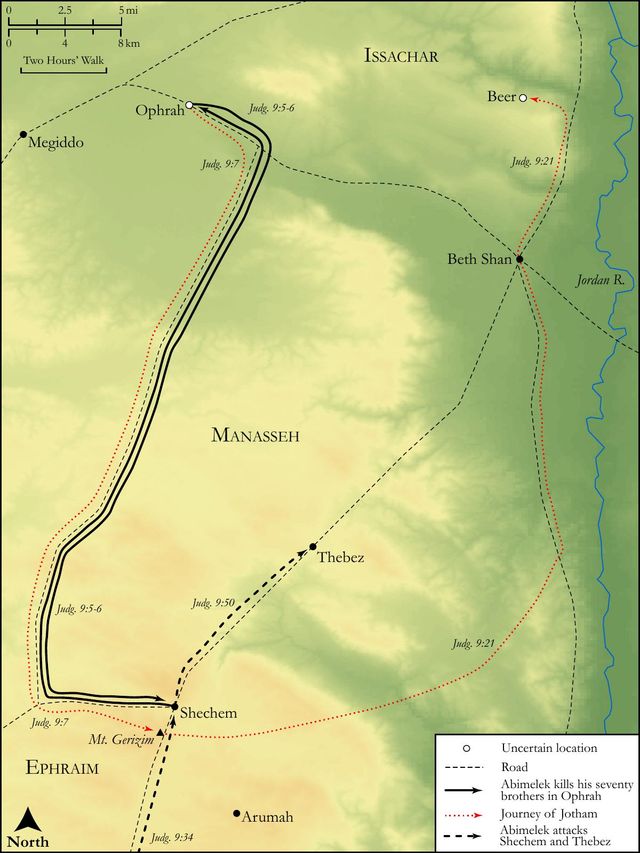
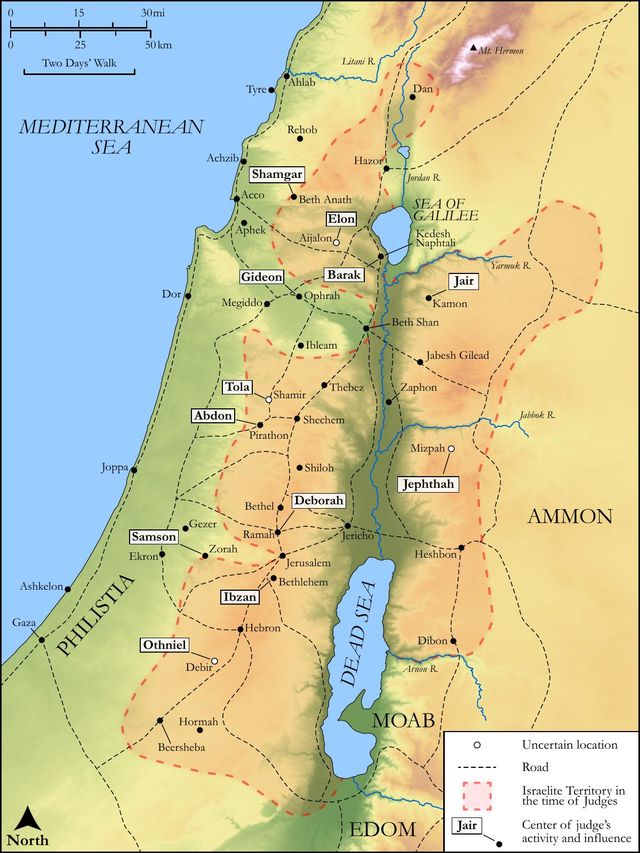
See on the biblical-era maps
Study this verse
Public-domain commentary
Matthew Henry
From his Commentary on the Whole Bible. Henry comments on passages, not single verses — this entry covers Judges 9:50–57. His two-level outline is real structure in the source text, so it is rendered as structure.
We have seen the ruin of the Shechemites completed by the hand of Abimelech; and now it comes to his turn to be reckoned with who was their leader in villany. Thebez was a small city, probably not far from Shechem, dependent upon it, and in confederacy with it. Now,
I.Abimelech attempted the destruction of this city (Jdg 9:50), drove all the inhabitants of the town into the castle, or citadel, Jdg 9:51.
When he had them there he did not doubt but he should do the same execution here that he had lately done at the strong-hold of the temple of Baal-berith, not considering that the tower of an idol-temple lay more exposed to divine vengeance than any other tower. He attempted to set fire to this tower, at least to burn down the door, and so force an entrance, Jdg 9:52. Those who have escaped and succeeded well in one desperate attempt are apt to think the like attempt another time not desperate. This instance was long after quoted to show how dangerous it is to come near the call of a besieged city, Sa2 11:20, etc. But God infatuates those whom he will ruin.
II.In the attempt he was himself destroyed, having his brains knocked out with a piece of a millstone, Jdg 9:57.
No doubt this man was a murderer, whom, though he had escaped the dangers of the war with Shechem, yet vengeance suffered not to live, Act 28:4. Evil pursues sinners, and sometimes overtakes them when they are not only secure, but triumphant. Thebez, we may suppose, was a weak inconsiderable place, compared with Shechem. Abimelech, having conquered the greater, makes no doubt of being master of the less without any difficulty, especially when he had taken the city, and had only the tower to deal with; yet he lays his bones by that, and there is all his honour buried. Thus are the mighty things of the world often confounded by the weakest and those things that are most made light of. See here what rebukes those are justly put under many times by the divine providence that are unreasonable in their demands of satisfaction for injuries received. Abimelech had some reason to chastise the Shechemites, and he had done it with a witness; but when he will carry his revenges further, and nothing will serve but that Thebez also must be sacrificed to his rage, he is not only disappointed there, but destroyed; for verily there is a God that judges in the earth. Three circumstances are worthy of observation in the death of Abimelech: - 1. That he was slain with a stone, as he had slain his brethren all upon one stone. 2. That he had his skull broken. Vengeance aimed at that guilty head which had worn the usurped crown. 3. That the stone was cast upon him by a woman, Jdg 9:53. He saw the stone come; it was therefore strange he did not avoid it, but, no doubt, this made it so much the greater mortification to him to see from what hand it came. Sisera died by a woman's hand and knew it not; but Abimelech not only fell by the hand of a woman but knew it, and, when he found himself ready to breathe his last, nothing troubled him so much as this, that it should be said, A woman slew him. See, (1.) His foolish pride, in laying so much to heart this little circumstance of his disgrace. Here was no care taken about his precious soul, no concern what would become of that, no prayer to God for his mercy; but very solicitous he is to patch up his shattered credit, when there is no patching his shattered skull. "O let it never be said that such a mighty man as Abimelech was killed by a woman!" The man was dying, but his pride was alive and strong, and the same vain-glorious humour that had governed him all along appears now at last. Qualis vita, finis ita - As was his life, such was his death. As God punished his cruelty by the manner of his death, so he punished his pride by the instrument of it. (2.) His foolish project to avoid this disgrace; nothing could be more ridiculous; his own servant must run him through, not to rid him the sooner out of his pain, but that men say not, A woman slew him. Could he think that this would conceal what the woman had done, and not rather proclaim it the more? Nay, it added to the infamy of his death, for hereby he became a self-murderer. Better have it said, A woman slew him, than that it should be said, His servant slew him by his own order; yet now both will be said of him to his everlasting reproach. And it is observable that this very thing which Abimelech was in such care to conceal appears to have been more particularly remembered by posterity than most passages of his history; for Joab speaks of it as that which he expected David would reproach him with, for coming so nigh the wall, Sa2 11:21. The ignominy we seek to avoid by sin we do but perpetuate the remembrance of.
III.The issue of all is that Abimelech being slain,
1.Israel's peace was restored, and an end was put to this civil war; for those that followed him departed every man to his place, Jdg 9:55.
2.God's justice was glorified (Jdg 9:56, Jdg 9:57): Thus God punished the wickedness of Abimelech, and of the men of Shechem, and fulfilled Jotham's curse, for it was not a curse causeless. Thus he preserved the honour of his government, and gave warning to all ages to expect blood for blood. The Lord is known by the judgments which he executes, when the wicked is snared in the work of his own hands. Though wickedness may prosper awhile, it will not prosper always.
Continue studying Judges 9:57 across the web’s major study libraries — every link below opens this exact verse, chapter, or book on the destination site.
Read & Compare
 BibleGatewayThis verse in more than 200 translations and 70 languages.
 Bible.comThe YouVersion reader — hundreds of translations, reading plans, and highlights.
 ESV.orgCrossway's official English Standard Version reader.
 NET BibleThe NET translation with 60,000+ translators' notes on every rendering decision.
 STEP BibleTyndale House's free study tool — original text, vocabulary, and scholarly resources.
 BibliaLogos Bible Software's free web reader.
 USCCBThe New American Bible (Revised Edition) with the U.S. bishops' study notes.
Commentaries
 BibleHub CommentariesDozens of classic commentaries on this verse, gathered on one page.
 StudyLightMore than 100 commentary sets — the largest collection on the web.
 BibleRefPlain-English commentary on what this verse means, verse by verse.
 Enduring WordDavid Guzik's free commentary on this chapter, widely used by Bible teachers.
 Bible Study ToolsVerse commentary alongside Greek and Hebrew study aids.
Original Language & Research
- BibleHub InterlinearThe verse word by word — original language, transliteration, and English.
- BibleHub LexiconEvery word's original-language definition and Strong's entry.
 Blue Letter BibleDeep-study tools — Strong's numbers, concordance, and word studies.
 SefariaThe Hebrew text with Rashi and centuries of Jewish commentary.
Sermons, Hymns & Audio


TrulyRandomVerse is not affiliated with these sites and doesn’t control their content. They’re linked because they’re genuinely useful.
Summary
Judges 9:57 serves as the definitive theological conclusion to the tumultuous narrative of Abimelech and the men of Shechem, powerfully affirming the unwavering principle of divine retribution and the precise fulfillment of prophetic utterance. It declares with solemn authority that God Himself orchestrated the consequences of their collective wickedness, ensuring that the judgment fell directly upon their heads, thereby validating the potent curse pronounced by Jotham, the sole surviving son of Jerubbaal (Gideon), against those who had conspired in the murder of his seventy brothers and sought to establish an illegitimate monarchy through bloodshed.
Context
ShowHideLiterary Context
This verse provides the climactic and conclusive statement for the entire narrative of Abimelech's reign, which dominates Judges 9. The chapter initiates with Abimelech's ruthless ambition, leading him to conspire with the men of Shechem to murder his seventy half-brothers, a treacherous act that secures his kingship over Shechem (Judges 9:1-6). The immediate literary predecessor to this verse is Jotham's powerful "Parable of the Trees" and subsequent curse, delivered from Mount Gerizim, which foretells mutual destruction between Abimelech and Shechem (Judges 9:7-20). The intervening narrative details the three years of Abimelech's oppressive rule, God's active intervention in sending a spirit of discord between Abimelech and the Shechemites (Judges 9:22-23), and the escalating conflict that culminates in the destruction of Shechem and Abimelech's ignominious death at Thebez (Judges 9:24-56). Judges 9:57 acts as the divine commentary on these events, explicitly stating that the chaos and violence were not random but were divinely orchestrated acts of justice, bringing the narrative to a definitive theological close.
Historical & Cultural Context
The period of the Judges, characterized by the refrain "everyone did what was right in his own eyes," was marked by profound political fragmentation, moral decline, and cyclical apostasy. Abimelech's attempt to establish a monarchy in Shechem, a historically significant Canaanite city that had been incorporated into Israelite territory, represents a premature and illegitimate grab for power, starkly contrasting with God's later, divinely appointed kingship. Shechem itself held deep covenantal significance, having been the site of covenant renewal under Joshua (Joshua 24:1-28). The "evil" committed by the men of Shechem refers to their complicity in the brutal murder of Gideon's sons and their subsequent betrayal of Abimelech, actions that violated Israel's norms of loyalty, hospitality, and justice. The concept of a "curse" was a potent force in Israel, believed to carry inherent power and consequences, often with divine backing, as vividly demonstrated by Jotham's prophetic utterance. This verse underscores the belief that divine judgment was an active force in the historical outworking of human actions.
Key Themes
ShowHideJudges 9:57 powerfully underscores several foundational themes within the book of Judges and broader biblical theology. Foremost is the theme of Divine Justice and Retribution, where God is depicted not as a passive observer but as actively intervening in human affairs to bring precise judgment upon wickedness. The emphatic phrase "did God render upon their heads" emphasizes that the consequences for sin are not merely natural outcomes but are divinely administered, aligning with the biblical principle that God is not mocked and that individuals and communities will ultimately reap what they sow, as articulated in Galatians 6:7. Another crucial theme is the Fulfillment of Prophecy. Jotham's curse, delivered years earlier, is shown to be a divinely inspired word that comes to pass with precise accuracy, demonstrating God's sovereignty over human events and the reliability of His pronouncements. Finally, the verse highlights the Consequences of Unrighteous Alliances and Sin. The alliance between Abimelech and the men of Shechem, founded on treachery, violence, and self-interest, ultimately leads to their mutual destruction, illustrating how evil, when unchecked, inevitably consumes those who practice it, a truth echoed throughout the wisdom literature, such as in Proverbs 26:27.
Exposition and Analysis
ShowHideKey Word Analysis
ShowHideThis term (H7451) is rich in meaning, encompassing not only moral wickedness and depravity (such as the heinous murder of Gideon's sons and the subsequent treachery of the Shechemites) but also the calamity, disaster, or harm that results from such actions. In this context, "all the evil" refers both to the heinous deeds committed by the men of Shechem and the destructive consequences that ultimately befell them. It signifies a comprehensive judgment for their collective depravity, where their actions returned upon them as affliction and distress.
Literally meaning "to turn back," "return," or "repay" (H7725), this verb emphasizes the principle of lex talionis – that the consequences of one's actions return directly to the perpetrator. It highlights God's active and deliberate role as the dispenser of justice, ensuring that the recompense perfectly matches the offense. It implies a precise and intentional act of divine accountability, where God brings back upon them the very destruction they initiated.
This refers specifically to Jotham's prophetic imprecation (H7045) found in Judges 9:20, where he declared, "Let fire come out from Abimelech and devour the men of Shechem and Beth Millo; and let fire come out from the men of Shechem and Beth Millo and devour Abimelech." The fulfillment of this curse underscores its divine origin and the undeniable reliability of prophetic utterance, demonstrating that God's word, spoken through His servant, carries inherent power and consequence.
Verse Breakdown
ShowHide"And all the evil of the men of Shechem"
This opening clause precisely identifies the recipients of divine retribution and the nature of their offense. The "evil" refers to their willing and active participation in Abimelech's conspiracy, providing him with money from the temple of Baal-berith to hire thugs for the brutal murder of Gideon's seventy sons (Judges 9:4-5), and subsequently making him king. It also encompasses their later treachery and rebellion against Abimelech, which ultimately led to their downfall. Their culpability is explicitly and comprehensively stated, leaving no doubt as to the justice of their fate.
"did God render upon their heads"
This is a powerful and unequivocal declaration of divine agency. It signifies that God Himself was the active force behind the unfolding events, ensuring that the consequences of their wickedness were brought directly upon them. The idiom "upon their heads" emphasizes the personal, direct, and inescapable nature of the retribution, indicating that they were fully accountable for their actions and would bear the full weight of the resulting judgment. This is not merely a natural consequence of human folly but a divinely orchestrated act of precise justice, demonstrating God's active governance over human history.
"and upon them came the curse of Jotham the son of Jerubbaal."
This concluding clause highlights the precise and undeniable fulfillment of prophecy. Jotham, the youngest son of Gideon (also known as Jerubbaal, as in Judges 6:32), had pronounced a potent curse years earlier in the chapter (Judges 9:7-20). This statement confirms that the mutual destruction of Abimelech and Shechem was the direct and undeniable outcome of that prophetic word. It serves as a powerful testament to God's sovereignty over human history and the absolute reliability of His spoken word through His chosen servants, even when delivered in a moment of despair and warning.
Literary Devices
ShowHideJudges 9:57 masterfully employs several potent literary devices to convey its profound message. Poetic Justice is strikingly evident, as the very violence and treachery that Abimelech and the men of Shechem initiated ultimately consumed them; their end perfectly mirrored their unrighteous means. Irony is also present: those who sought to establish power through bloodshed and an unholy alliance found their partnership dissolving into mutual destruction, a self-inflicted wound. The explicit mention of God's direct action ("did God render") functions as a form of Divine Intervention or Theophany, emphasizing that these events were not random occurrences but were part of God's active governance, judgment, and righteous administration of justice. Finally, the verse serves as a powerful instance of Fulfillment of Prophecy, validating Jotham's earlier curse and reinforcing the pervasive biblical theme of God's sovereign control over the unfolding narrative of human history.
Theological and Thematic Connections
ShowHideJudges 9:57 stands as a profound theological statement on God's active and unwavering justice in the world. It asserts that God is not a passive observer of human wickedness but an ultimate arbiter who ensures that evil deeds eventually return upon the heads of their perpetrators. This consistent principle of divine retribution, often referred to as the law of sowing and reaping, is a pervasive thread throughout scripture, affirming that while justice may be delayed, it is never ultimately denied. The verse powerfully reinforces the absolute reliability of God's word, demonstrating that prophetic pronouncements, even those spoken in despair or warning, carry divine authority and will inevitably come to pass. It serves as a stark reminder that choices have profound consequences, and complicity in evil, whether through direct action, financial support, or silent assent, incurs divine accountability. This narrative segment illustrates that God's moral order cannot be violated with impunity, and He will ensure that righteousness ultimately prevails.
Reflection and Application
ShowHideJudges 9:57 offers timeless lessons for contemporary life, reminding us of the enduring principles of divine justice and personal accountability. In a world where evil often seems to triumph and perpetrators escape immediate consequence, this verse assures us that God is a righteous judge who sees all actions, both overt and concealed. It challenges us to examine our own alliances, ambitions, and choices, urging us to avoid complicity in wrongdoing or the pursuit of power and gain through unrighteous means, for the "evil" we sow will inevitably be "rendered upon our heads" in some form, whether in this life or the next. The narrative encourages us to trust implicitly in God's ultimate sovereignty and justice, even when circumstances appear chaotic or unfair, knowing that He will bring about His purposes in His perfect timing. It calls us to live with integrity, recognizing that true flourishing and lasting peace come from aligning with God's righteous standards, not from manipulating circumstances or engaging in treachery. This passage serves as a powerful call to repentance and a reminder of the gravity of our moral choices before a holy God.
Questions for Reflection
ShowHideFAQ
ShowHideWhy is God explicitly mentioned as the agent of retribution here, rather than simply attributing it to natural consequences?
ShowHideThe explicit mention of "God did render upon their heads" is crucial because it elevates the events from mere historical happenstance or the natural consequences of human folly to a direct, intentional act of divine justice. While the discord between Abimelech and Shechem might appear to be a natural outcome of their unholy alliance, the text in Judges 9:23 explicitly states that "God sent an evil spirit between Abimelech and the men of Shechem." This demonstrates God's active sovereignty over human affairs, even using human sin and conflict to achieve His righteous purposes. It underscores the profound theological message that God is not a passive observer but an active participant in history, ensuring that justice is ultimately served and His word, whether in promise or judgment, is perfectly fulfilled.
What was Jotham's curse and why was its fulfillment so significant?
ShowHideJotham's curse, delivered as part of his poignant "Parable of the Trees" from Mount Gerizim (Judges 9:7-15), was a prophetic warning that "fire would come out from Abimelech and devour the men of Shechem and Beth Millo, and fire come out from the men of Shechem and Beth Millo and devour Abimelech" (Judges 9:20). Its fulfillment is profoundly significant because it validates Jotham as a true prophet of God and unequivocally confirms the reliability of divine pronouncements. The mutual destruction of Abimelech and Shechem, through internal conflict and external warfare, was not random but the precise working out of God's judgment as foretold. It serves as a powerful testament to God's meticulous control over human events and His unwavering commitment to upholding justice, even when delivered through a human voice in a moment of despair.
Christ-Centered Fulfillment
ShowHideWhile Judges 9:57 vividly portrays God's unyielding justice in rendering evil upon the heads of the wicked, its ultimate fulfillment and deepest theological meaning are found in the person and redemptive work of Jesus Christ. The curse that came upon Abimelech and Shechem for their sin foreshadows the universal truth that the wages of sin is death (Romans 6:23) and that all humanity stands under a divine curse due to rebellion against God's holy law (Galatians 3:10). Yet, in Christ, God's perfect justice and boundless mercy perfectly converge. Instead of rendering the full weight of humanity's evil upon our own heads, God, in His infinite love, "made him who knew no sin to be sin for us, so that in him we might become the righteousness of God" (2 Corinthians 5:21). Jesus, the true and righteous King, unlike the illegitimate and violent Abimelech, willingly bore the curse and the "evil" of humanity's sin on the cross, becoming a curse for us to redeem us from the curse of the law (Galatians 3:13). He is the ultimate Lamb of God who takes away the sin of the world (John 1:29), absorbing the divine wrath that was justly due to us. Thus, Judges 9:57, with its stark image of retribution, points forward to the cross, where God's justice was fully satisfied, and a path to reconciliation, forgiveness, and eternal life was opened for all who believe in the one who took our curse upon Himself.