


Genesis 24:18
Bible text: King James Version (1769 Blayney text) · Public domain
Bible text: Berean Standard Bible · Public domain
Bible text: American Standard Version (1901) · Public domain
Bible text: World English Bible, Messianic edition · Public domain
Bible text: Geneva Bible (1599) · Public domain
Bible text: Young's Literal Translation · Public domain
- וַתֹּאמֶרva·To·merand she saidH559Conj-w ¦ V-Qal-ConsecImperf-3fsVerb Qal Consecutive Imperfect 3rd Singular Feminineוַandתֹּאמֶרshe said
- שְׁתֵהshe·TehdrinkH8354V-Qal-Imp-2msVerb Qal Imperative 2nd Singular Masculine
- אֲדֹנִי'a·do·Nimy O lordH113N-msc ¦ 1csNoun Singular Masculine ConstructאֲדֹנִO lordיmy
- וַתְּמַהֵרva·te·ma·Herand she hurriedH4116Conj-w ¦ V-Piel-ConsecImperf-3fsVerb Piel Consecutive Imperfect 3rd Singular Feminineוַandתְּמַהֵרshe hurried
- וַתֹּרֶדva·To·redand she put downH3381Conj-w ¦ V-Hiphil-ConsecImperf-3fsVerb Hiphil Consecutive Imperfect 3rd Singular Feminineוַandתֹּרֶדshe put down
- כַּדָּהּka·Dahher jarH3537N-fsc ¦ 3fsNoun Singular Feminine Constructכַּדָּjarהּher
- עַל'alonH5921PrepPreposition
- יָדָהּya·Dahher handH3027N-csc ¦ 3fsNoun Singular common gender Constructיָדָhandהּher
- וַתַּשְׁקֵהוּva·tash·Ke·huand she gave a drink himH8248Conj-w ¦ V-Hiphil-ConsecImperf-3fs ¦ 3msVerb Hiphil Consecutive Imperfect 3rd Singular Feminineוַandתַּשְׁקֵshe gave a drinkהוּhim
English is a literal word-by-word gloss of the Hebrew, not the KJV's wording. Why?
This is the original text the KJV's translators worked from — each Hebrew word with its own literal English meaning in this verse, prepared by scholars at Tyndale House, Cambridge. The KJV translates whole sentences, not word by word, so its wording differs: one Hebrew word can become several English words, and the KJV may choose “the LORD” where the gloss reads “Yahweh”. Both are faithful — they answer different questions. For the KJV's own rendering, switch to the KJV text.
Details
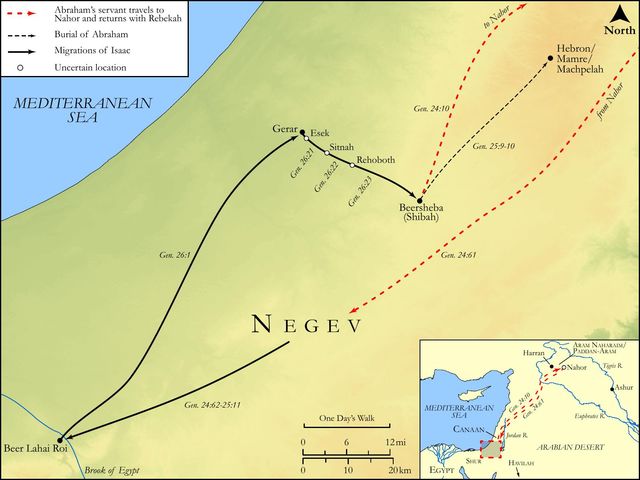
See on the biblical-era maps


Study this verse
Public-domain commentary
Matthew Henry
From his Commentary on the Whole Bible. Henry comments on passages, not single verses — this entry covers Genesis 24:10–28. His four-level outline is real structure in the source text, so it is rendered as structure.
Abraham's servant now begins to make a figure in this story; and, though he is not named, yet much is here recorded to his honour, and for an example to all servants, who shall be honoured if, by faithfully serving God and their masters, they adorn the doctrine of Christ (compare Pro 27:18 with Tit 2:10); for there is no respect of persons with God, Col 3:24, Col 3:25. A good servant that makes conscience of the duty of his place, and does it in the fear of God, though he make not a figure in the world nor have praise of men, yet shall be owned and accepted of God and have praise of him. Observe here,
I.How faithful Abraham's servant approved himself to his master.
Having received his charge, he with all expedition set out on his journey, with an equipage suitable to the object of his negotiation (Gen 24:10), and he had all the goods of his master, that is, a schedule or particular account of them, in his hand, to show to those with whom he was to treat; for, from first to last, he consulted his master's honour. Isaac being a type of Christ, some make this fetching of a wife for him to signify the espousing of the church by the agency of his servants the ministers. The church is the bride, the Lamb's wife, Rev 21:9. Christ is the bridegroom, and ministers are the friends of the bridegroom (Joh 3:29), whose work it is to persuade souls to consent to him, Co2 11:2. The spouse of Christ must not be of the Canaanites, but of his own kindred, born again from above. Ministers, like Abraham's servant, must lay out themselves with the utmost wisdom and care to serve their master's interest herein.
II.How devoutly he acknowledged God in this affair, like one of that happy household which Abraham had commanded to keep the way of the Lord, etc., Gen 18:19. He arrived early in the evening (after many days' journeying) at the place of his destination, and reposed himself by a well of water, to consider how he might manage his business for the best. And,
1.He acknowledges God by a particular prayer (Gen 24:12-14), wherein,
(1.)He petitions for prosperity and good success in this affair: Send me good speed, this day. Note, We have leave to be particular in recommending our affairs to the conduct and care of the divine Providence. Those that would have good speed must pray for it. This day, in this affair; thus we must, in all our ways, acknowledge God, Pro 3:6. And, if we thus look up to God in every undertaking which we are in care about, we shall have the comfort of having done our duty, whatever the issue be.
(2.)He pleads God's covenant with his master Abraham: O God of my master Abraham, show kindness to him. Note, As the children of good parents, so the servants of good masters, have peculiar encouragement in the prayers they offer to God for prosperity and success.
(3.)He proposes a sign (Gen 24:14), not by it to limit God, nor with a design to proceed no further if he were not gratified in it; but it is a prayer,
[1.]That God would provide a good wife for his young master, and this was a good prayer. He knew that a prudent wife is from the Lord (Pro 19:14), and therefore that for this he will be enquired of. He desires that his master's wife might be humble and industrious woman, bred up to care and labour, and willing to put her hand to any work that was to be done; and that she might be of a courteous disposition, and charitable to strangers. When he came to seek a wife for his master, he did not go to the playhouse or the park, and pray that he might meet one there, but to the well of water, expecting to find one there well employed.
[2.]That he would please to make his way, in this matter, plain and clear before him, by the concurrence of minute circumstances in his favour. Note, First, It is the comfort, as well as the belief, of a good man, that God's providence extends itself to the smallest occurrences and admirably serves its own purposes by them. Our times are in God's hand; not only events themselves, but the times of them. Secondly, It is our wisdom, in all our affairs, to follow Providence, and folly to force it. Thirdly, It is very desirable, and that which we may lawfully pray for, while in the general we set God's will before us as our rule, that he will, by hints of providence, direct us in the way of our duty, and give us indications what his mind it. Thus he guides his people with his eye (Psa 32:8), and leads them in a plain path, Psa 27:11.
2.God owns him by a particular providence. He decreed the thing, and it was established to him, Job 22:28. According to his faith, so was it unto him. The answer to this prayer was,
(1.)Speedy - before he had made an end of speaking (Gen 24:15), as it is written (Isa 65:24), While they are yet speaking, I will hear. Though we are backward to pray, God is forward to hear prayer.
(2.)Satisfactory: the first that came to draw water was, and did, in every thing, according to his own heart.
[1.]She was so well qualified that in all respects she answered the characters he wished for in the woman that was to be his master's wife, handsome and healthful, humble and industrious, very courteous and obliging to a stranger, and having all the marks of a good disposition. When she came to the well (Gen 24:16), she went down and filled her pitcher, and came up to go home with it. She did not stand to gaze upon the strange man and his camels, but minded her business, and would not have been diverted from it but by an opportunity of doing good. She did not curiously nor confidently enter into discourse with him, but modestly answered him, with all the decorum that became her sex. What a degenerate age do we live in, in which appear all the instances of pride, luxury, and laziness, the reverse of Rebekah's character, whose daughters few are! Those instances of goodness which were then in honour are now in contempt.
[2.]Providence so ordered it that she did that which exactly answered to his sign, and was wonderfully the counterpart of his proposal: she not only gave him drink, but, which was more than could have been expected, she offered her services to give his camels drink, which was the very sign he proposed. Note, First, God, in his providence, does sometimes wonderfully own the prayer of faith, and gratify the innocent desires of his praying people, even in little things, that he may show the extent of his care, and may encourage them at all times to seek to him and trust in him; yet we must take heed of being over-bold in prescribing to God, lest the event should weaken our faith rather than strengthen it. Secondly, It is good to take all opportunities of showing a humble, courteous, charitable, disposition, because, some time or other, it may turn more to our honour and benefit than we think of; some hereby have entertained angels, and Rebekah hereby, quite beyond her expectation at this time, was brought into the line of Christ and the covenant. Thirdly, There may be a great deal of obliging kindness in that which costs but little: our Saviour has promised a reward for a cup of cold water, Mat 10:42. Fourthly, The concurrence of providences and their minute circumstances, for the furtherance of our success in any business, ought to be particularly observed, with wonder and thankfulness, to the glory of God: The man wondered, Gen 24:21. We have been wanting to ourselves, both in duty and in comfort, by neglecting to observe Providence.
[3.]Upon enquiry he found, to his great satisfaction, that she was a near relation to his master, and that the family she was of was considerable, and able to give him entertainment, Gen 24:23-25. Note, Providence sometimes wonderfully directs those that by faith and prayer seek direction from heaven in the choice of suitable yoke-fellows: happy marriages those are likely to be that are made in the fear of God; and these, we are sure, are made in heaven.
3.He acknowledges God in a particular thanksgiving. He first paid his respects to Rebekah, in gratitude for her civility (Gen 24:22), obliging her with such ornaments and attire as a maid, especially a bride, cannot forget (Jer 2:32), which yet, we should think, ill suited the pitcher of water; but the ear-rings and bracelets she sometimes wore did not make her think herself above the labours of a virtuous woman (Pro 31:13), who works willingly with her hands; nor the services of a child, who, while under age, differs nothing from a servant, Gal 4:1. Having done this, he turns his wonder (Gen 24:21) into worshipping: Blessed be the Lord God of my master Abraham, Gen 24:26, Gen 24:27. Observe here,
(1.)He had prayed for good speed (Gen 24:12), and now that he had sped well he gives thanks. Note, What we win by prayer we must wear with praise; for mercies in answer to prayer lay us under particular obligations.
(2.)He had as yet but a comfortable prospect of mercy, and was not certain what the issue might prove; yet he gives thanks. Note, When God's favours are coming towards us we must meet them with our praises.
(3.)He blesses God for success when he was negotiating for his master. Note, We should be thankful for our friend's mercies as for our own.
(4.)He gives thanks that, being in the way, at a loss what course to steer, the Lord had led him. Note, In doubtful cases, it is very comfortable to see God leading us, as he led Israel in the wilderness by the pillar of cloud and fire.
(5.)He thinks himself very happy, and owns God in it, that he was led to the house of his master's brethren, those of them that had come out of Ur of the Chaldees, though they had not come to Canaan, but remained in Haran. They were not idolaters, but worshippers of the true God, and inclinable to the religion of Abraham's family. Note, God is to be acknowledged in providing suitable yoke-fellows, especially such as are agreeable in religion.
(6.)He acknowledges that God, herein, had not left his master destitute of his mercy and truth. God had promised to build up Abraham's family, yet it seemed destitute of the benefit of that promise; but now Providence is working towards the accomplishing of it. Note,
[1.]God's faithful ones, how destitute soever they may be of worldly comforts, shall never be left destitute of God's mercy and truth; for God's mercy is an inexhaustible fountain, and his truth an inviolable foundation.
[2.]It adds much to the comfort of any blessing to see in it the continuance of God's mercy and truth.
Continue studying Genesis 24:18 across the web’s major study libraries — every link below opens this exact verse, chapter, or book on the destination site.
Read & Compare
 BibleGatewayThis verse in more than 200 translations and 70 languages.
 Bible.comThe YouVersion reader — hundreds of translations, reading plans, and highlights.
 ESV.orgCrossway's official English Standard Version reader.
 NET BibleThe NET translation with 60,000+ translators' notes on every rendering decision.
 STEP BibleTyndale House's free study tool — original text, vocabulary, and scholarly resources.
 BibliaLogos Bible Software's free web reader.
 USCCBThe New American Bible (Revised Edition) with the U.S. bishops' study notes.
Commentaries
 BibleHub CommentariesDozens of classic commentaries on this verse, gathered on one page.
 StudyLightMore than 100 commentary sets — the largest collection on the web.
 BibleRefPlain-English commentary on what this verse means, verse by verse.
 Enduring WordDavid Guzik's free commentary on this chapter, widely used by Bible teachers.
 Bible Study ToolsVerse commentary alongside Greek and Hebrew study aids.
Original Language & Research
- BibleHub InterlinearThe verse word by word — original language, transliteration, and English.
- BibleHub LexiconEvery word's original-language definition and Strong's entry.
 Blue Letter BibleDeep-study tools — Strong's numbers, concordance, and word studies.
 SefariaThe Hebrew text with Rashi and centuries of Jewish commentary.
Sermons, Hymns & Audio


TrulyRandomVerse is not affiliated with these sites and doesn’t control their content. They’re linked because they’re genuinely useful.
Summary
Genesis 24:18 records Rebekah's immediate, respectful, and generous response to Abraham's servant, offering him water with promptness and humility. This pivotal moment serves as the initial, crucial fulfillment of the specific sign the servant had prayed for, revealing Rebekah's character as divinely suited for the role of Isaac's wife and confirming God's providential guidance in the unfolding of His covenant plan.
Context
ShowHideLiterary Context
Genesis 24 is a narrative masterpiece, dedicated entirely to the search for a wife for Isaac, Abraham's son of promise. The chapter opens with Abraham, old and full of days, entrusting his most trusted servant with the solemn task of finding a bride for Isaac from his own kindred in Mesopotamia, explicitly forbidding a Canaanite wife (Genesis/24-1-4). The servant's journey and his arrival at the well outside the city of Nahor set the stage for a divinely orchestrated encounter. Prior to Rebekah's appearance, the servant articulates a very specific prayer, asking God for a clear sign: the chosen woman would not only offer him water but also generously water his camels (Genesis/24-12-14). Genesis 24:18 immediately follows the servant's request for water from Rebekah in Genesis 24:17, marking the first step in the miraculous fulfillment of his prayer and the unfolding of God's providential plan.
Historical & Cultural Context
In the lands of the patriarchs, water was a precious commodity, and wells were vital social hubs, often serving as meeting places for communities and travelers. Hospitality was not merely a courtesy but a sacred duty, especially towards strangers and weary travelers. Offering water to a guest was a fundamental act of kindness and respect. The act of drawing water was typically a woman's chore, often performed in the cooler parts of the day. For a woman to offer water to a stranger, and especially to volunteer to water his animals (as Rebekah does subsequently), demonstrated exceptional generosity, strength, and a diligent work ethic. The address "my lord" (Hebrew: ʼâdôwn) was a common honorific used by a subordinate or a respectful individual when addressing a person of higher status or a stranger, signifying deference and politeness. Rebekah's immediate and unprompted offer goes beyond mere social custom, highlighting a character of remarkable virtue.
Key Themes
ShowHideThis chapter, and Genesis 24:18, deeply interweaves several significant themes. Divine Providence and Guidance is paramount, as God actively orchestrates the events to ensure the continuation of the covenant line through Isaac. The servant's prayer and its immediate, precise answer underscore God's faithfulness in guiding His people, as seen throughout the patriarchal narratives (e.g., Genesis 12:1-3). The theme of Hospitality and Generosity is vividly portrayed through Rebekah's actions, presenting it as a virtue that aligns with God's purposes. Her character, marked by promptness and willingness to serve, becomes a Sign of Divine Favor, demonstrating how God uses the inherent qualities of individuals to accomplish His will. Furthermore, the search for a suitable bride for Isaac contributes to the overarching theme of Covenant Continuity and Fulfillment, ensuring the lineage through which God's promises would ultimately be realized, culminating in the Messiah.
Exposition and Analysis
ShowHideKey Word Analysis
ShowHideThis word (H113) signifies a sovereign, controller, master, or owner. Rebekah's use of "my lord" is a respectful address to a stranger, acknowledging his apparent status as a traveler of means, and demonstrating her humble and deferential posture. It sets the tone for her immediate and willing service.
The verb (H4116) means "to be liquid or flow easily," and by implication, "to hurry" or "to be prompt." It conveys more than mere physical speed; it speaks to Rebekah's eager, willing, and unhesitating spirit. Her haste indicates an innate generosity and readiness to serve, demonstrating a character that goes above and beyond a perfunctory response.
This primitive root (H3381) means "to descend" or "to go downwards," and causatively, "to bring down" or "let down." It describes the physical action of lowering her pitcher. This detail emphasizes her active and personal involvement in the act of service, making it easy for the servant to drink. It underscores her diligence and humility in providing refreshment.
Verse Breakdown
ShowHide"And she said, Drink, my lord"
Rebekah's immediate verbal response is one of respect and invitation. Her address, "my lord," indicates a polite and humble deference to the stranger, a common courtesy of that day, yet delivered with a remarkable promptness that signals her willingness to serve. This is the first, crucial part of her response.
"and she hasted"
This phrase highlights Rebekah's promptness and eagerness. It's not a reluctant or delayed action, but a swift, willing movement, demonstrating her innate generosity and readiness to fulfill the request. Her speed underscores her genuine desire to provide hospitality.
"and let down her pitcher upon her hand"
This detail describes Rebekah's physical action. She actively lowered the pitcher, making it accessible for the servant to drink. This gesture signifies her personal involvement and humility, going beyond merely pointing to the water or offering the pitcher from a distance. It's a hands-on, diligent act of service.
"and gave him drink"
This final clause confirms the completion of the act of providing refreshment. It is the culmination of her verbal assent, her swift movement, and her physical effort, demonstrating her complete and effective fulfillment of the servant's initial request. This act directly fulfills the first part of the servant's prayed-for sign.
Literary Devices
ShowHideThe passage employs Action-Oriented Narrative to vividly portray Rebekah's character through her deeds rather than extensive description. The sequence of "said," "hasted," "let down," and "gave him drink" creates a dynamic and immediate impression of her responsiveness. The use of Detailing ("upon her hand," "her pitcher") grounds the scene in concrete actions, making Rebekah's service tangible and personal. Furthermore, the passage functions as a Sign or Test, as Rebekah's actions precisely match the specific criteria Abraham's servant had prayed for, thereby confirming divine guidance and demonstrating her suitability for Isaac. This immediate and complete fulfillment of the sign serves as a powerful Foreshadowing of her character and her future role in the covenant lineage.
Theological and Thematic Connections
ShowHideGenesis 24:18 is a profound illustration of divine providence working through human virtue. Rebekah's immediate and generous response to the servant's simple request for water is not merely a polite gesture but a divinely orchestrated moment that confirms her as the chosen bride for Isaac. Her character, marked by promptness, humility, and extraordinary hospitality, perfectly aligns with the specific sign the servant had prayed for, demonstrating God's active involvement in guiding the lives of His people and His faithfulness to His covenant promises. This passage underscores that God often works through the willing hearts and righteous actions of individuals to accomplish His grand purposes, revealing that even seemingly ordinary acts of kindness can be integral to His unfolding plan.
Reflection and Application
ShowHideRebekah's example in Genesis 24:18 provides a powerful model for contemporary believers. Her "hasted" response teaches us the profound value of prompt and willing service. In a world often characterized by hesitation or reluctance, Rebekah's immediate action, driven by genuine generosity, challenges us to cultivate a heart that is quick to perceive and meet the needs of others. This isn't about frantic activity, but about a spirit of readiness and cheerful giving. Her humility in serving a stranger, even lowering her pitcher for him, reminds us that true service often involves humbling ourselves and actively engaging in the needs of those around us, without seeking recognition or reward. This narrative encourages us to trust that God can use our seemingly small, ordinary acts of kindness, when offered with a willing heart, as integral parts of His grand, unfolding divine plan, demonstrating how our obedience and virtuous character can align with His greater purposes.
Questions for Reflection
ShowHideFAQ
ShowHideWhy is Rebekah's response in this verse so significant?
ShowHideRebekah's response is profoundly significant because it is the initial, precise fulfillment of the specific sign Abraham's servant had prayed for to identify Isaac's future wife (Genesis 24:14). Her immediate verbal assent ("Drink, my lord") and swift, diligent action ("she hasted, and let down her pitcher") demonstrate a character of exceptional hospitality, humility, and willingness to serve, which perfectly matched the servant's divinely inspired request. This moment confirms God's providential hand in the selection of Isaac's bride, ensuring the continuation of the covenant line.
What does the KJV phrase "she hasted" imply about Rebekah's character?
ShowHideThe phrase "she hasted" translates the Hebrew verb mâhar (H4116), which means to be quick, to hurry, or to be eager. It implies more than just physical speed; it conveys Rebekah's prompt, willing, and enthusiastic spirit. This highlights her innate generosity and readiness to serve without hesitation, rather than a reluctant or delayed response. It suggests a proactive and benevolent disposition, a key quality for the woman chosen to be part of God's covenant plan.
Does this passage suggest that God still guides people in finding a spouse today?
ShowHideWhile this specific narrative involves a unique and direct divine intervention for a foundational covenant figure, the underlying principle of God's providential guidance in all areas of life, including significant decisions like marriage, remains true. Believers can pray for wisdom, discernment, and God's leading in their relationships, trusting that He works through various means—such as wise counsel, personal character development, and circumstances—to direct their paths according to His will (Proverbs 3:5-6). This passage encourages us to seek God's will and be open to His leading in our lives.
Christ-Centered Fulfillment
ShowHideRebekah's spontaneous and generous provision of water in Genesis 24:18 offers a beautiful foreshadowing of Christ, the ultimate provider of life-sustaining spiritual refreshment. Just as Rebekah offered physical water to a weary traveler, Jesus Christ offers "living water" to all who are spiritually thirsty, promising that "whoever drinks the water I give them will never thirst" (John 4:10-14). Her willingness to serve a stranger, without hesitation or expectation of reward, mirrors Christ's own self-sacrificial service, who "did not come to be served, but to serve, and to give his life as a ransom for many" (Mark 10:45). Furthermore, the divine orchestration of a bride for Isaac, the son of promise, prefigures the divine plan for Christ, the true Son of Promise, to have a bride—the Church. Just as Rebekah was chosen and prepared, so too is the Church, chosen by God before the foundation of the world (Ephesians 1:4), and being prepared by the Holy Spirit to be presented as a pure and spotless bride to Christ (Ephesians 5:25-27). Thus, Rebekah's humble act of service points forward to the boundless grace and ultimate provision found in Jesus Christ.