


1 Samuel 20:29
Bible text: King James Version (1769 Blayney text) · Public domain
Bible text: King James Version with Strong's numbers · Public domain
Bible text: Berean Standard Bible · Public domain
Bible text: American Standard Version (1901) · Public domain
Bible text: World English Bible, Messianic edition · Public domain
Bible text: Geneva Bible (1599) · Public domain
Bible text: Young's Literal Translation · Public domain
- וַיֹּאמֶרvai·Yo·merand he saidH559Conj-w ¦ V-Qal-ConsecImperf-3msVerb Qal Consecutive Imperfect 3rd Singular Masculineוַandיֹּאמֶרhe said
- שַׁלְּחֵנִיsha·le·Che·nilet go meH7971V-Piel-Imp-2ms ¦ 1csVerb Piel Imperative 2nd Singular Masculineשַׁלְּחֵlet goנִיme
- נָאna'pleaseH4994PrtParticle Interjection
- כִּיkiforH3588PrtParticle Conditional
- זֶבַחze·Vacha sacrifice ofH2077N-mscNoun Singular Masculine Construct
- מִשְׁפָּחָהmish·pa·Chah[the] clanH4940N-fsNoun Singular Feminine Absolute
- לָנוּLa·nu[belongs] to <the> usPrep-l ¦ 1cpSuffix Personal 1st Plural common genderלָ[belongs] to <the>נוּus
- בָּעִירba·'Irin the cityH5892Prep-b ¦ N-fsNoun Singular Feminine Absoluteבָּin theעִירcity
- וְהוּאve·Hu'and heH1931Conj-w ¦ Pro-3msPronoun Personal 3rd Singular Masculineוְandהוּאhe
- צִוָּהtzi·vahhe has commandedH6680V-Piel-Perf-3msVerb Piel Perfect 3rd Singular Masculine
- לִיlito <the> mePrep-l ¦ 1csSuffix Personal 1st Singular common genderלִto <the>יme
- אָחִי'a·Chimy brotherH251N-msc ¦ 1csNoun Singular Masculine Constructאָחִbrotherיmy
- וְעַתָּהve·'a·Tahand thereforeH6258Conj-w ¦ AdvAdverbוְandעַתָּהtherefore
- אִם'imifH518PrtParticle Conditional
- מָצָאתִיma·Tza·tiI have foundH4672V-Qal-Perf-1csVerb Qal Perfect 1st Singular common gender
- חֵןchenfavorH2580N-msNoun Singular Masculine Absolute
- בְּעֵינֶיךָbe·'ei·Nei·khain your viewH5869Prep-b ¦ N-fdc ¦ 2msNoun Dual Feminine Constructבְּinעֵינֶיviewךָyour
- אִמָּלְטָה'i·Mal·tahlet me slip awayH4422V-Niphal-Imperf-1csVerb Niphal Imperfect 1st Singular common gender
- נָּאna'pleaseH4994PrtParticle Interjection
- וְאֶרְאֶהve·'er·'Ehso I may seeH7200Conj-w ¦ V-Qal-ConjImperf-1csVerb Qal Conjunction+Imperfect 1st Singular common genderוְsoאֶרְאֶהI may see
- אֶת'et<obj.>H853DirObjMParticle Object Indicator
- אֶחָי'e·Chaimy brothersH251N-mpc ¦ 1csNoun Plural Masculine Constructאֶחָbrothersיmy
- עַל'althere-H5921PrepPreposition
- כֵּןken-foreH3651AdvAdverb
- לֹאlo'notH3808NegParticle Negative
- בָאVa'he has comeH935V-Qal-Perf-3msVerb Qal Perfect 3rd Singular Masculine
- אֶל'eltoH413PrepPreposition
- שֻׁלְחַןshul·Chan[the] table ofH7979N-mscNoun Singular Masculine Construct
- הַמֶּלֶךְha·Me·lekhthe kingH4428Art ¦ N-msNoun Singular Masculine Absoluteהַtheמֶּלֶךְking
English is a literal word-by-word gloss of the Hebrew, not the KJV's wording. Why?
This is the original text the KJV's translators worked from — each Hebrew word with its own literal English meaning in this verse, prepared by scholars at Tyndale House, Cambridge. The KJV translates whole sentences, not word by word, so its wording differs: one Hebrew word can become several English words, and the KJV may choose “the LORD” where the gloss reads “Yahweh”. Both are faithful — they answer different questions. For the KJV's own rendering, switch to the KJV text.
Details
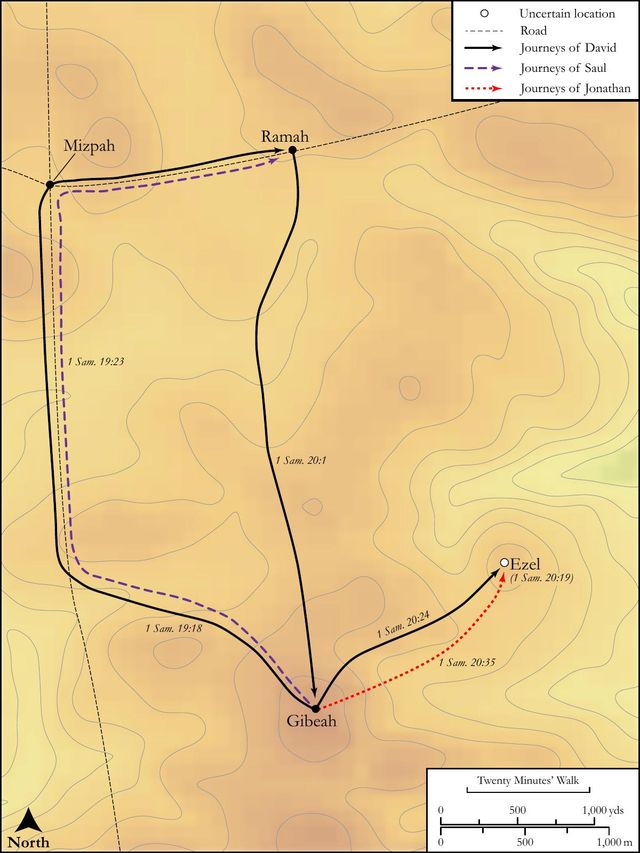
See on the biblical-era map
Study this verse
Public-domain commentary
Matthew Henry
From his Commentary on the Whole Bible. Henry comments on passages, not single verses — this entry covers 1 Samuel 20:24–34. His two-level outline is real structure in the source text, so it is rendered as structure.
Jonathan is here effectually convinced of that which he was so loth to believe, that his father had an implacable enmity to David, and would certainly be the death of him if it were in his power; and he had like to have paid very dearly himself for the conviction.
I.David is missed from the feast on the first day, but nothing is said of him.
The king sat upon his seat, to feast upon the peace-offerings as at other times (Sa1 20:25), and yet had his heart as full of envy and malice against David as it could hold. He should first have been reconciled to him, and then have come and offered his gift; but, instead of that, he hoped, at this feast, to drink the blood of David. What an abomination was that sacrifice which was brought with such a wicked mind as this! Pro 21:27. When the king came to take his seat Jonathan arose, in reverence to him both as a father and as his sovereign; every one knew his place, but David's was empty. It did not use to be so. None more content than he in attending holy duties; nor had he been absent now but that he must have come at the peril of his life; self-preservation obliged him to withdraw. In imminent peril present opportunities may be waived, nay, we ought not to throw ourselves into the mouth of danger. Christ himself absconded often, till he knew that his hour had come. But that day Saul took no notice that he missed David, but said within himself, "Surely he is not clean, Sa1 20:26. Some ceremonial pollution has befallen him, which forbids him to eat of the holy things till he has washed his clothes, and bathed his flesh in water, and been unclean until the evening." Saul knew what conscience David made of the law, and that he would rather keep away from the holy feast than come in his uncleanness. Blessed be God, no uncleanness is now a restraint upon us, but what we may by faith and repentance be washed from in the fountain opened, Psa 26:6.
II.He is enquired for the second day, Sa1 20:27.
Saul asked Jonathan, who he knew was his confidant, Wherefore cometh not the son of Jesse to meat? He was his own son by marriage, but he calls him in disdain, the son of Jesse. He asks for him as if he were not pleased that he should be absent from a religious feast; and so it should be example to masters of families to see to it that those under their charge be not absent from the worship of God, either in public or in the family. It is a bad thing for us, except in case of necessity, to omit an opportunity of statedly attending on God in solemn ordinances. Thomas lost a sight of Christ by being once absent from a meeting of the disciples. But that which displeased Saul was that hereby he missed the opportunity he expected of doing David a mischief.
III.Jonathan makes his excuse, Sa1 20:28, Sa1 20:29.
1.That he was absent upon a good occasion, keeping the feast in another place, though not here, sent for by his elder brother, who was now more respectful to him than he had been (Sa1 17:28), and that he had gone to pay his respects to his relations, for the keeping up of brotherly love; and no master would deny a servant liberty to do that in due time. He pleads,
2.That he did not go without leave humbly asked and obtained from Jonathan, who, as his superior officer, was proper to be applied to for it. Thus he represents David as not wanting in any instance of respect and duty to the government.
IV.Saul hereupon breaks out into a most extravagant passion, and rages like a lion disappointed of his prey.
David was out of his reach, but he falls upon Jonathan for his sake (Sa1 20:30, Sa1 20:31), gives him base language, not fit for a gentleman, a prince, to give to any man, especially his own son, heir apparent to his crown, a son that served him, the greatest stay and ornament of his family, before a great deal of company, at a feast, when all should be in good humour, at a sacred feast, by which all irregular passions should be mortified and subdued; yet he does in effect call him,
1.A bastard: Thou son of the perverse rebellious woman; that is, according to the foolish filthy language of men's brutish passion now a day, "Thou son of a whore." He tells him he was born to the confusion of his mother, that is, he had given the world cause to suspect that he was not the legitimate son of Saul, because he loved him whom Saul hated and supported him who would be the destruction of their family.
2.A traitor: Thou son of a perverse rebellion (so the word is), that is, "thou perverse rebel." At other times he reckoned no counsellor or commander that he had more trusty and well-beloved than Jonathan; yet now in this passion he represents him as dangerous to his crown and life.
3.A fool: Thou hast chosen the son of Jesse for thy friend to thy own confusion, for while he lives thou shalt never be established. Jonathan indeed did wisely and well for himself and family to secure an interest in David, whom Heaven had destined to the throne, yet, for this, he is branded as most impolitic. It is good taking God's people for our people and going with those that have him with them. It will prove to our advantage at last, however for the present it may be thought a disparagement, and a prejudice to our secular interest. It is probable Saul knew that David was anointed to the kingdom by the same hand that anointed him, and then not Jonathan, but himself, was the fool, to think to defeat the counsels of God. Yet nothing will serve him but David must die, and Jonathan must fetch him to execution. See how ill Saul's passion looks, and let it warn us against the indulgence of any thing like it in ourselves. Anger is madness, and he that hates his brother is a murderer.
V.Jonathan is sorely grieved and put into disorder by his father's barbarous passion, and the more because he had hoped better things, Sa1 20:2. He was troubled for his father, that he should be such a brute, troubled for his friend, whom he knew to be a friend of God, that he should be so basely abused; he was grieved for David (Sa1 20:34), and troubled for himself too, because his father had done him shame, and, though most unjustly, yet he must submit to it. One would pity Jonathan to see how he was put,
1.Into the peril of sin. Much ado that wise and good man had to keep his temper, upon such a provocation as this. His father's reflections upon himself made no return to; it becomes inferiors to bear with meekness and silence the contempts put upon them in wrath and passion. When thou art the anvil lie thou still. But his dooming David to die he could not bear: to that he replied with some heat (Sa1 20:32), Wherefore shall he be slain? What has he done? Generous spirits can much more easily bear to be abused themselves than to hear their friends abused.
2.Into the peril of death. Saul was now so outrageous that he threw his javelin at Jonathan, Sa1 20:33. He seemed to be in great care (Sa1 20:31) than Jonathan should be established in his kingdom, and yet now he himself aims at his life. What fools, what savage beasts and worse does anger make men! How necessary it is to put a hook in its nose and a bridle in its jaws! Jonathan was fully satisfied that evil was determined against David, which put him out of frame exceedingly: he rose from table, thinking it high time when his life was struck at, and would eat no meat, for they were not to eat of the holy things in their mourning. All the guests, we may suppose, were discomposed, and the mirth of the feast was spoiled. He that is cruel troubles his own flesh, Pro 11:17.
Continue studying 1 Samuel 20:29 across the web’s major study libraries — every link below opens this exact verse, chapter, or book on the destination site.
Read & Compare
 BibleGatewayThis verse in more than 200 translations and 70 languages.
 Bible.comThe YouVersion reader — hundreds of translations, reading plans, and highlights.
 ESV.orgCrossway's official English Standard Version reader.
 NET BibleThe NET translation with 60,000+ translators' notes on every rendering decision.
 STEP BibleTyndale House's free study tool — original text, vocabulary, and scholarly resources.
 BibliaLogos Bible Software's free web reader.
 USCCBThe New American Bible (Revised Edition) with the U.S. bishops' study notes.
Commentaries
 BibleHub CommentariesDozens of classic commentaries on this verse, gathered on one page.
 StudyLightMore than 100 commentary sets — the largest collection on the web.
 BibleRefPlain-English commentary on what this verse means, verse by verse.
 Enduring WordDavid Guzik's free commentary on this chapter, widely used by Bible teachers.
 Bible Study ToolsVerse commentary alongside Greek and Hebrew study aids.
Original Language & Research
- BibleHub InterlinearThe verse word by word — original language, transliteration, and English.
- BibleHub LexiconEvery word's original-language definition and Strong's entry.
 Blue Letter BibleDeep-study tools — Strong's numbers, concordance, and word studies.
 SefariaThe Hebrew text with Rashi and centuries of Jewish commentary.
Sermons, Hymns & Audio


TrulyRandomVerse is not affiliated with these sites and doesn’t control their content. They’re linked because they’re genuinely useful.
Summary
1 Samuel 20:29 captures Jonathan's strategic explanation to King Saul for David's absence from the new moon feast. This pivotal verse serves as the pre-arranged alibi—a supposed urgent family sacrifice in Bethlehem, commanded by David's brother—designed to test Saul's true intentions toward David. It masterfully highlights the intricate interplay of loyalty, deception, and escalating danger that defines David's relationship with Saul, setting the stage for Saul's violent outburst and the confirmation of his murderous designs against God's anointed.
Context
ShowHideLiterary Context
This verse is deeply embedded within the dramatic narrative of David and Jonathan's profound covenant friendship and their desperate attempt to discern the extent of King Saul's murderous intent toward David. Following Saul's repeated, unprovoked attempts on David's life and David's subsequent flight, Jonathan devises a perilous plan outlined in 1 Samuel 20:5-8. David is to conceal himself while Jonathan observes Saul's reaction to his conspicuous absence from the royal new moon feast. Jonathan's words in 1 Samuel 20:29 represent the precise execution of this plan, meticulously crafted to provoke a clear and undeniable response from Saul. The immediate subsequent verses, 1 Samuel 20:30-34, vividly portray Saul's furious and violent reaction, confirming the very danger David sought to escape. This tense exchange marks the climax of their test, irrevocably leading to David's permanent flight from Saul's court.
Historical & Cultural Context
The "new moon feast" (Hebrew: rosh chodesh) was a significant religious and social occasion in ancient Israel, observed at the beginning of each lunar month (Numbers 28:11-15). It was a time for communal worship, special sacrifices, and often a royal banquet, making David's absence from such a prominent gathering highly noticeable and requiring a compelling explanation. The "family sacrifice" (Hebrew: zevach mishpachah) refers to a private, annual communal offering and meal held by a specific family or clan, typically in their hometown (in David's case, Bethlehem). Such an obligation was considered legitimate and binding within Israelite society, providing a culturally plausible and religiously sanctioned reason for David's temporary departure from courtly duties. The detail about David's "brother" commanding his presence further emphasizes the familial authority and obligation, lending additional credibility to the fabricated excuse in a society where family ties and patriarchal authority were paramount.
Key Themes
ShowHideThe passage powerfully underscores the theme of unwavering loyalty and sacrificial friendship. Jonathan, despite being King Saul's son and heir apparent, prioritizes his covenant with David over his filial duty to his increasingly erratic and malevolent father, even risking his own life (as dramatically shown in 1 Samuel 20:33). Another prominent theme is the desperate use of deception for protection. In a life-or-death situation, Jonathan employs a strategic untruth to shield David from Saul's escalating paranoia and murderous intent. This highlights the moral complexities faced by individuals under tyrannical rule, where conventional ethics may be challenged by the dire need to preserve innocent life. Finally, the verse, through Saul's explosive reaction to it, serves to reveal Saul's true, unredeemable character. His inability to tolerate David's popularity and God's favor, coupled with his violent outbursts, confirms his rejection by God and his unsuitability for kingship, contrasting sharply with David's anointing as the future king (1 Samuel 16:1-13).
Exposition and Analysis
ShowHideKey Word Analysis
ShowHideThis term refers to a slaughter, specifically the flesh of an animal, and by implication, a sacrifice (the victim or the act). In this context, it denotes a communal peace offering, often followed by a shared meal, which was a significant religious and social event binding families and clans together. The mention of a "family sacrifice" (זֶבַח מִשְׁפָּחָה, zevach mishpachah) suggests an annual, traditional gathering unique to David's clan in Bethlehem. By using this specific type of offering, Jonathan presents an excuse that is not only religiously legitimate but also deeply rooted in familial obligation, making David's absence appear both necessary and respectful of cultural norms.
This primitive root means "to constitute, enjoin; appoint, (for-) bid, (give a) charge, (give in, send with) command(-er, -ment), send a messenger, put, (set) in order." When Jonathan states that David's "brother, he hath commanded me [to be there]," it implies a strong, authoritative directive. This is not a mere invitation but an instruction that carries significant weight and obligation within the family structure. It elevates the importance of David's supposed presence at the sacrifice, making it difficult for Saul to dismiss without appearing to disrespect sacred familial duties. This detail adds a layer of credibility and urgency to the fabricated excuse.
This word signifies graciousness, kindness, or goodwill, and can also refer to beauty or pleasantness. The phrase "if I have found favour in thine eyes" (אִם־מָצָאתִי חֵן בְּעֵינֶיךָ, im-matzati chên b'eyneykha) is a common deferential request in biblical Hebrew, meaning "if I have found grace/goodwill in your sight." Jonathan uses this polite, submissive language to couch David's request for permission to leave. It is an appeal to Saul's benevolence, attempting to elicit a positive response by framing the request as a humble plea for the king's gracious allowance rather than a demand. This polite phrasing ironically precedes Saul's explosive display of disfavor.
Verse Breakdown
ShowHide"And he said, Let me go, I pray thee; for our family hath a sacrifice in the city;"
Jonathan initiates the deception by presenting David's supposed request for leave. The "city" refers to Bethlehem, David's ancestral home, where his family resided. The "sacrifice" is the annual family ritual, a plausible and culturally significant reason for absence. This opening clause establishes the premise of David's legitimate, unavoidable obligation.
"and my brother, he hath commanded me [to be there]:"
This clause significantly strengthens the excuse by introducing a layer of familial authority. The "brother" (likely a senior family member or clan head, not necessarily a literal sibling of David) has "commanded" David's presence, implying a non-negotiable obligation. This detail is meticulously designed to make the excuse more compelling and less easily dismissed by the king, emphasizing the binding nature of the familial duty.
"and now, if I have found favour in thine eyes, let me get away, I pray thee, and see my brethren."
This is the formal request for permission, carefully framed in deferential language. David (through Jonathan) seeks Saul's "favour" or grace to be allowed to depart. The phrase "see my brethren" reinforces the familial nature of the obligation, emphasizing the desire to be with his kin for this important, traditional event, thereby making the request seem personal and sincere.
"Therefore he cometh not unto the king's table."
This concluding statement directly addresses David's absence from the royal feast, providing the pre-arranged explanation. It explicitly links David's non-attendance to the "family sacrifice," making the excuse clear, concise, and seemingly unassailable. This is the crucial information Jonathan delivers to observe Saul's reaction and confirm his murderous intentions.
Literary Devices
ShowHideThe passage employs several potent literary devices that amplify its dramatic impact. Irony is prominently featured, as Jonathan delivers a meticulously crafted lie—a "truthful" lie, given David's actual absence and the underlying danger—in a desperate attempt to uncover the truth of Saul's murderous intentions. The polite, deferential language used by Jonathan ("if I have found favour in thine eyes") stands in stark contrast to the violent, ungracious response it immediately elicits from Saul, highlighting the king's deep-seated rage and irrationality. Furthermore, the very act of presenting this excuse serves as a powerful form of foreshadowing, as Saul's subsequent furious outburst (described in 1 Samuel 20:30-34) confirms David's gravest fears and necessitates his permanent flight, thus propelling the narrative toward its tragic resolution of Saul's downfall and David's eventual rise. The dialogue itself is a masterfully constructed device, designed to be plausible and to elicit a definitive reaction, serving as the dramatic pivot point of the chapter.
Theological and Thematic Connections
ShowHideThis verse, though seemingly a simple explanation, is rich with profound theological implications. It showcases the extraordinary depth of covenantal friendship, reflecting a bond that transcends familial and political loyalties, echoing the divine faithfulness that undergirds God's covenants with His people. Jonathan's willingness to risk everything for David, even deceiving his own father, raises complex ethical questions about truth-telling in the face of tyranny and mortal danger. While the Bible generally upholds truthfulness, this narrative illustrates the desperate measures taken by those seeking to protect innocent life from an unrighteous authority. Ultimately, the passage subtly points to God's providential hand, orchestrating events even through imperfect human actions, to protect His anointed one and fulfill His sovereign plan for the kingdom of Israel, demonstrating that His purposes will prevail despite human opposition.
Reflection and Application
ShowHide1 Samuel 20:29 invites us to reflect deeply on the nature of true friendship and the agonizing choices individuals sometimes face when confronted with injustice and oppression. Jonathan's unwavering loyalty to David, even at immense personal cost and risk to his own life, serves as a powerful and enduring example of self-sacrificing love and commitment. In our own lives, we are called to cultivate friendships that are marked by faithfulness, unwavering support, and a courageous willingness to stand with others, especially in times of profound trial and adversity. This passage also prompts us to consider the profound complexities of navigating relationships with those in authority who may be consumed by jealousy, malice, or irrationality. While deception is not generally condoned by biblical principles, the extreme circumstances faced by David and Jonathan highlight the desperate measures sometimes taken to preserve innocent life when all righteous avenues are closed. It encourages us to pray for divine wisdom and discernment when confronting ethical dilemmas, trusting that God's sovereign providence can work through even the most challenging and morally ambiguous situations to achieve His ultimate purposes. Ultimately, it reminds us that genuine love and loyalty, even in the face of grave danger, are virtues that profoundly reflect God's own faithful and compassionate character.
Questions for Reflection
ShowHideFAQ
ShowHideWas it right for Jonathan to lie to his father, King Saul, in this situation?
ShowHideThis question presents a complex ethical dilemma that has been debated by theologians for centuries. While the Bible consistently upholds truthfulness as a divine virtue and a cornerstone of righteous living (e.g., Exodus 20:16 and Proverbs 12:22), this passage illustrates a situation of extreme duress where a lie is employed to protect an innocent life from an unrighteous, murderous authority. Jonathan's primary motivation was not self-gain, malice, or personal convenience, but the preservation of David, God's anointed, from Saul's irrational and homicidal rage. Some theological perspectives argue for a "hierarchy of ethics," suggesting that in dire circumstances, protecting innocent life takes moral precedence over strict adherence to truth-telling. Others maintain that a lie is always a sin, but acknowledge that God can still work through imperfect human actions and even bring about His purposes despite them. Regardless of one's specific ethical framework, the narrative clearly portrays Jonathan as a hero whose actions, though ethically fraught, are driven by a deep love and covenant loyalty that God ultimately honors and uses within His sovereign plan.
What was the significance of the "new moon feast" and the "family sacrifice" in ancient Israel?
ShowHideThe "new moon feast" (ראשׁ חֹדֶשׁ, rosh chodesh) was a significant monthly religious observance in ancient Israel, marked by special sacrifices, the blowing of trumpets (Numbers 10:10), and often a communal meal. It was a time for national and familial gathering, and for the royal court, it was a prominent occasion where the king and his key officials would be present. David's absence from such a visible event would be immediately noticed and require a compelling explanation. The "family sacrifice" (זֶבַח מִשְׁפָּחָה, zevach mishpachah) was a private, annual communal offering and feast held by a specific family or clan, typically in their hometown. These events were deeply ingrained in Israelite culture, representing both religious devotion and strong familial bonds and obligations. Jonathan's use of this specific excuse was strategically chosen because it was a legitimate, compelling, and culturally respected reason for David to be absent from his duties at court, making the fabricated story believable and difficult for Saul to dismiss without appearing to disrespect sacred traditions.
Christ-Centered Fulfillment
ShowHide1 Samuel 20:29, while detailing a moment of human deception and desperate loyalty, ultimately points forward to the greater King and the ultimate act of self-sacrificial friendship. Jonathan's unwavering commitment to David, the anointed king-in-waiting who was unjustly pursued, powerfully foreshadows the perfect loyalty of Christ to His Father's will and His unparalleled, self-giving love for His people. Just as David was persecuted and sought refuge from a jealous king, Jesus, the true Son of David, was a man of sorrows, acquainted with grief, rejected by His own people, and relentlessly pursued by those in power (Isaiah 53:3). Jonathan's willingness to risk his very life for David's safety finds its ultimate and perfect fulfillment in Jesus, who, though utterly innocent, voluntarily laid down His life for His friends (John 15:13) and for His enemies (Romans 5:8). The "sacrifice" mentioned in the verse, a temporary, earthly offering for a specific family, pales in comparison to the once-for-all, perfect sacrifice of Christ on the cross, which truly takes away the sin of the world and establishes a new and eternal covenant of peace (Hebrews 9:26 and Hebrews 10:10). Thus, Jonathan's loyalty, David's persecution, and the very concept of a life-saving "excuse" all echo the grand divine narrative of redemption, where Christ's perfect obedience and ultimate sacrifice provide the only true and eternal "way out" from the judgment we deserve, securing everlasting favor and reconciliation with God for all who believe in Him.