


1 Samuel 20:28
Bible text: King James Version (1769 Blayney text) · Public domain
Bible text: Berean Standard Bible · Public domain
Bible text: American Standard Version (1901) · Public domain
Bible text: World English Bible, Messianic edition · Public domain
Bible text: Geneva Bible (1599) · Public domain
Bible text: Young's Literal Translation · Public domain
- וַיַּעַןvai·Ya·'anand he answeredH6030Conj-w ¦ V-Qal-ConsecImperf-3msVerb Qal Consecutive Imperfect 3rd Singular Masculineוַandיַּעַןhe answered
- יְהוֹנָתָןye·ho·na·TanJonathanH3083N-proper-mNoun Proper Masculine
- אֶת'et<obj.>H853DirObjMParticle Object Indicator
- שָׁאוּלsha·'UlSaulH7586N-proper-mNoun Proper Masculine
- נִשְׁאֹלnish·'Olcertainly <to ask>H7592V-Niphal-InfAbsVerb Niphal Infinitive Absolute
- נִשְׁאַלnish·'Alhe asked for himselfH7592V-Niphal-Perf-3msVerb Niphal Perfect 3rd Singular Masculine
- דָּוִדda·VidDavidH1732N-proper-mNoun Proper Masculine
- מֵעִמָּדִיme·'i·ma·Difrom with meH5978Prep-m ¦ Prep ¦ 1csPrepositionמֵfromעִמָּדִwithיme
- עַד'adtoH5704PrepPreposition
- בֵּיתbeitBeth-H1035N-properNoun Proper Location
- לָחֶםLa·chem-lehemH1035N-properNoun Proper Location
English is a literal word-by-word gloss of the Hebrew, not the KJV's wording. Why?
This is the original text the KJV's translators worked from — each Hebrew word with its own literal English meaning in this verse, prepared by scholars at Tyndale House, Cambridge. The KJV translates whole sentences, not word by word, so its wording differs: one Hebrew word can become several English words, and the KJV may choose “the LORD” where the gloss reads “Yahweh”. Both are faithful — they answer different questions. For the KJV's own rendering, switch to the KJV text.
Details
See on the biblical-era map
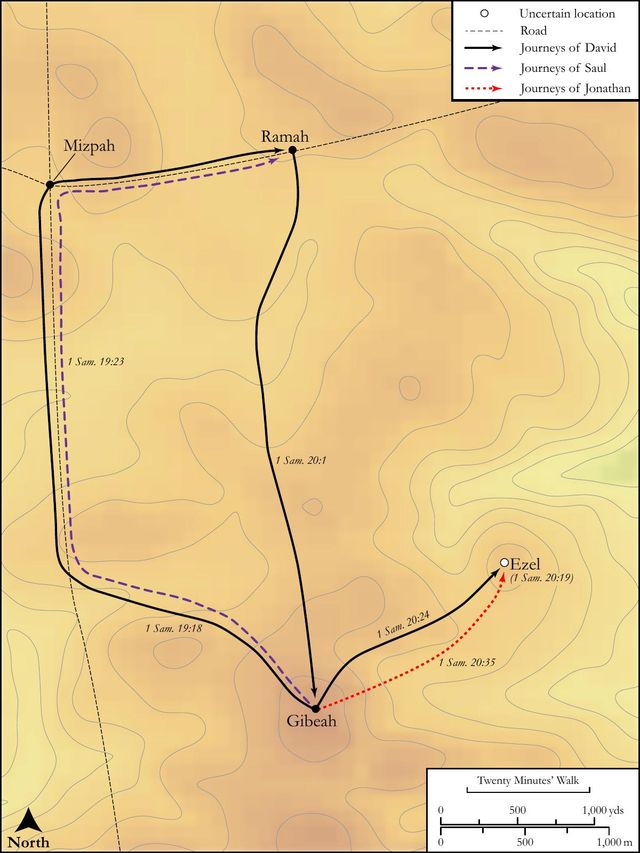
Study this verse
Public-domain commentary
Matthew Henry
From his Commentary on the Whole Bible. Henry comments on passages, not single verses — this entry covers 1 Samuel 20:24–34. His two-level outline is real structure in the source text, so it is rendered as structure.
Jonathan is here effectually convinced of that which he was so loth to believe, that his father had an implacable enmity to David, and would certainly be the death of him if it were in his power; and he had like to have paid very dearly himself for the conviction.
I.David is missed from the feast on the first day, but nothing is said of him.
The king sat upon his seat, to feast upon the peace-offerings as at other times (Sa1 20:25), and yet had his heart as full of envy and malice against David as it could hold. He should first have been reconciled to him, and then have come and offered his gift; but, instead of that, he hoped, at this feast, to drink the blood of David. What an abomination was that sacrifice which was brought with such a wicked mind as this! Pro 21:27. When the king came to take his seat Jonathan arose, in reverence to him both as a father and as his sovereign; every one knew his place, but David's was empty. It did not use to be so. None more content than he in attending holy duties; nor had he been absent now but that he must have come at the peril of his life; self-preservation obliged him to withdraw. In imminent peril present opportunities may be waived, nay, we ought not to throw ourselves into the mouth of danger. Christ himself absconded often, till he knew that his hour had come. But that day Saul took no notice that he missed David, but said within himself, "Surely he is not clean, Sa1 20:26. Some ceremonial pollution has befallen him, which forbids him to eat of the holy things till he has washed his clothes, and bathed his flesh in water, and been unclean until the evening." Saul knew what conscience David made of the law, and that he would rather keep away from the holy feast than come in his uncleanness. Blessed be God, no uncleanness is now a restraint upon us, but what we may by faith and repentance be washed from in the fountain opened, Psa 26:6.
II.He is enquired for the second day, Sa1 20:27.
Saul asked Jonathan, who he knew was his confidant, Wherefore cometh not the son of Jesse to meat? He was his own son by marriage, but he calls him in disdain, the son of Jesse. He asks for him as if he were not pleased that he should be absent from a religious feast; and so it should be example to masters of families to see to it that those under their charge be not absent from the worship of God, either in public or in the family. It is a bad thing for us, except in case of necessity, to omit an opportunity of statedly attending on God in solemn ordinances. Thomas lost a sight of Christ by being once absent from a meeting of the disciples. But that which displeased Saul was that hereby he missed the opportunity he expected of doing David a mischief.
III.Jonathan makes his excuse, Sa1 20:28, Sa1 20:29.
1.That he was absent upon a good occasion, keeping the feast in another place, though not here, sent for by his elder brother, who was now more respectful to him than he had been (Sa1 17:28), and that he had gone to pay his respects to his relations, for the keeping up of brotherly love; and no master would deny a servant liberty to do that in due time. He pleads,
2.That he did not go without leave humbly asked and obtained from Jonathan, who, as his superior officer, was proper to be applied to for it. Thus he represents David as not wanting in any instance of respect and duty to the government.
IV.Saul hereupon breaks out into a most extravagant passion, and rages like a lion disappointed of his prey.
David was out of his reach, but he falls upon Jonathan for his sake (Sa1 20:30, Sa1 20:31), gives him base language, not fit for a gentleman, a prince, to give to any man, especially his own son, heir apparent to his crown, a son that served him, the greatest stay and ornament of his family, before a great deal of company, at a feast, when all should be in good humour, at a sacred feast, by which all irregular passions should be mortified and subdued; yet he does in effect call him,
1.A bastard: Thou son of the perverse rebellious woman; that is, according to the foolish filthy language of men's brutish passion now a day, "Thou son of a whore." He tells him he was born to the confusion of his mother, that is, he had given the world cause to suspect that he was not the legitimate son of Saul, because he loved him whom Saul hated and supported him who would be the destruction of their family.
2.A traitor: Thou son of a perverse rebellion (so the word is), that is, "thou perverse rebel." At other times he reckoned no counsellor or commander that he had more trusty and well-beloved than Jonathan; yet now in this passion he represents him as dangerous to his crown and life.
3.A fool: Thou hast chosen the son of Jesse for thy friend to thy own confusion, for while he lives thou shalt never be established. Jonathan indeed did wisely and well for himself and family to secure an interest in David, whom Heaven had destined to the throne, yet, for this, he is branded as most impolitic. It is good taking God's people for our people and going with those that have him with them. It will prove to our advantage at last, however for the present it may be thought a disparagement, and a prejudice to our secular interest. It is probable Saul knew that David was anointed to the kingdom by the same hand that anointed him, and then not Jonathan, but himself, was the fool, to think to defeat the counsels of God. Yet nothing will serve him but David must die, and Jonathan must fetch him to execution. See how ill Saul's passion looks, and let it warn us against the indulgence of any thing like it in ourselves. Anger is madness, and he that hates his brother is a murderer.
V.Jonathan is sorely grieved and put into disorder by his father's barbarous passion, and the more because he had hoped better things, Sa1 20:2. He was troubled for his father, that he should be such a brute, troubled for his friend, whom he knew to be a friend of God, that he should be so basely abused; he was grieved for David (Sa1 20:34), and troubled for himself too, because his father had done him shame, and, though most unjustly, yet he must submit to it. One would pity Jonathan to see how he was put,
1.Into the peril of sin. Much ado that wise and good man had to keep his temper, upon such a provocation as this. His father's reflections upon himself made no return to; it becomes inferiors to bear with meekness and silence the contempts put upon them in wrath and passion. When thou art the anvil lie thou still. But his dooming David to die he could not bear: to that he replied with some heat (Sa1 20:32), Wherefore shall he be slain? What has he done? Generous spirits can much more easily bear to be abused themselves than to hear their friends abused.
2.Into the peril of death. Saul was now so outrageous that he threw his javelin at Jonathan, Sa1 20:33. He seemed to be in great care (Sa1 20:31) than Jonathan should be established in his kingdom, and yet now he himself aims at his life. What fools, what savage beasts and worse does anger make men! How necessary it is to put a hook in its nose and a bridle in its jaws! Jonathan was fully satisfied that evil was determined against David, which put him out of frame exceedingly: he rose from table, thinking it high time when his life was struck at, and would eat no meat, for they were not to eat of the holy things in their mourning. All the guests, we may suppose, were discomposed, and the mirth of the feast was spoiled. He that is cruel troubles his own flesh, Pro 11:17.
Historical interpretation
Historical reception
1 surviving comment on this verse from the historical church.
And Jonathan answered Saul: He earnestly requested me that he might go to Bethlehem, etc. It indeed seems strange according to the letter, why he should think and inquire about David in this manner, or Jonathan should respond, when the very obvious cause of royal jealousy had occurred, by which David should rightly seek his own safety, or even life: unless perhaps Saul ought to be supposed to have done or said many things under the frequent invasion of the demon, which, like those possessed, he was neither able to premeditate beforehand nor to remember afterward: and among these, also, the matter regarding David is believed to have occurred rather in the spirit of one enraged than one listening. Even Scripture seems to support this view, which, with David absent from Saul’s table, says that Saul did not reconsider the previously inflicted injury, but only thought that he might be unclean, either due to nocturnal sleep, or intercourse, or some touch of a funeral or something defiled, by which he would be kept from the company of the pure according to the edict of the law. Moreover, it supports what is written at the beginning of this entire reading: And the evil spirit from the Lord came upon Saul (1 Samuel 19). However, whatever may be the case, the mystical sense is clear. For the dove-like simplicity of the chosen ones of Christ answered the ruling Synagogue that persecutes: Jesus Christ, whom you ask about, my God and Lord, earnestly requested me, that, by sending teachers for this very purpose and in every direction, I might bring Him into the heart of the New Testament of those rejoicing in grace, where there is no blood of victims, no Mosaic manna, but according to the order of Melchizedek, the living bread which came down from heaven is celebrated in a mystery. Hence the assembly of such people is most rightly called by the sacred name of Bethlehem, that is, house of bread. Let me go, he says, to such people, believing in the mystery of the same baptism, and also the companionship of your catholic peace. And what is first and last becomes fitting, the guardianship of the word by which they are catechized and perpetually confirmed is to be entrusted to them; for the solemn sacrifice is the very life of the converted in the city of our God, on his holy mountain (Ps. 47). The unity of my chosen ones, who are my brothers and coheirs by grace, beseeches me with frequent prayers that I may always deign to multiply their number with a new generation of believers. Now if you love me with all your heart, also allow me to make others future brothers of mine by visiting through you for this cause. Nor did he longer care to seek the typical table of the law with its own; nor in the Scripture, which you do not understand by reading carnally, do you find him who is to be sought spiritually.
Continue studying 1 Samuel 20:28 across the web’s major study libraries — every link below opens this exact verse, chapter, or book on the destination site.
Read & Compare
 BibleGatewayThis verse in more than 200 translations and 70 languages.
 Bible.comThe YouVersion reader — hundreds of translations, reading plans, and highlights.
 ESV.orgCrossway's official English Standard Version reader.
 NET BibleThe NET translation with 60,000+ translators' notes on every rendering decision.
 STEP BibleTyndale House's free study tool — original text, vocabulary, and scholarly resources.
 BibliaLogos Bible Software's free web reader.
 USCCBThe New American Bible (Revised Edition) with the U.S. bishops' study notes.
Commentaries
 BibleHub CommentariesDozens of classic commentaries on this verse, gathered on one page.
 StudyLightMore than 100 commentary sets — the largest collection on the web.
 BibleRefPlain-English commentary on what this verse means, verse by verse.
 Enduring WordDavid Guzik's free commentary on this chapter, widely used by Bible teachers.
 Bible Study ToolsVerse commentary alongside Greek and Hebrew study aids.
Original Language & Research
- BibleHub InterlinearThe verse word by word — original language, transliteration, and English.
- BibleHub LexiconEvery word's original-language definition and Strong's entry.
 Blue Letter BibleDeep-study tools — Strong's numbers, concordance, and word studies.
 SefariaThe Hebrew text with Rashi and centuries of Jewish commentary.
Sermons, Hymns & Audio


TrulyRandomVerse is not affiliated with these sites and doesn’t control their content. They’re linked because they’re genuinely useful.
Summary
1 Samuel 20:28 records Jonathan's strategic deception of King Saul, his father, by fabricating an excuse for David's absence from the new moon feast. This pivotal moment underscores Jonathan's profound loyalty and self-sacrificial friendship with David, as he endeavors to protect David from Saul's escalating and murderous jealousy, highlighting the perilous circumstances surrounding David's life.
Context
ShowHideLiterary Context
This verse is situated at a critical juncture in the narrative of Saul's decline and David's rise, specifically within the account of Jonathan's unwavering loyalty to David despite his father's escalating paranoia. Following Saul's repeated, violent attempts on David's life (e.g., Saul's javelin throws), David has fled, and Jonathan has reaffirmed his covenant with David, promising to ascertain Saul's intentions and warn his friend. The new moon feast, a significant royal and religious gathering, serves as the perfect test for Saul's disposition towards David. Jonathan's fabricated explanation here sets the stage for Saul's furious outburst against his own son in the immediately subsequent verses, revealing the depth of Saul's irrational hatred and confirming the wisdom of Jonathan's protective lie (as seen in Saul's rage against Jonathan).
Historical & Cultural Context
The new moon festival (Rosh Chodesh) was a significant monthly observance in ancient Israel, marked by special sacrifices and communal meals, particularly for prominent figures within the royal court, as detailed in Numbers 28:11-15. David's absence would therefore be conspicuous and demand an explanation. The cultural context also emphasizes the strong expectation of filial loyalty to a king and father. Jonathan's decision to deceive Saul, his own father and king, represents a profound act of defiance rooted in a higher loyalty—to David, God's anointed, and to the sacred covenant they shared. Bethlehem, David's hometown, was a plausible destination for a family gathering or a local sacrifice, making Jonathan's fabricated story culturally believable and difficult for Saul to immediately disprove without further inquiry.
Key Themes
ShowHideThis passage powerfully illuminates several core themes within the book of 1 Samuel. Firstly, it showcases Jonathan's exemplary loyalty and self-sacrificial friendship, a bond that transcends political ambition, familial duty, and personal danger. His actions here are a profound demonstration of his covenant with David, a loyalty that ultimately cost him dearly but cemented his legacy as a noble figure (further emphasized in Jonathan's enduring covenant with David). Secondly, it vividly portrays Saul's escalating paranoia and tyrannical rule, revealing the extent to which his jealousy and rejection by God had consumed him, making him a danger not only to David but also to his own family and the stability of the kingdom. Thirdly, the narrative underscores God's providential protection of David. Despite being hunted and in constant peril, David is consistently preserved and guided by divine intervention, often through human agents like Jonathan, foreshadowing his eventual, divinely ordained ascension to the throne of Israel.
Exposition and Analysis
ShowHideKey Word Analysis
ShowHideFrom the Hebrew meaning "Jehovah-given," this name carries significant weight in the narrative. Jonathan, as the rightful heir to Saul's throne, acts against his own self-interest and familial obligation to protect David, the one chosen by God to succeed his father. His name, signifying divine giving, paradoxically highlights his role in preserving God's true gift to Israel—David's future kingship—even as it means sacrificing his own claim.
This primitive root means "to heed, pay attention," and by implication, "to respond" or "to begin to speak." In this context, Jonathan's "answer" to Saul is not merely a verbal reply but a deliberate, calculated response to a dangerous situation. It signifies his conscious decision to intervene and protect David, acting as a shield against Saul's inquiry, demonstrating his attentiveness to David's plight and his readiness to act decisively.
This root means "to inquire," "to request," or "to demand." The KJV's "earnestly asked" reflects a Hebrew grammatical construction (infinitive absolute) that intensifies the verb, emphasizing the urgency or persistence of the (fabricated) request. Jonathan's use of this strong phrasing aims to convince Saul that David's need to go to Bethlehem was not casual but compelling and unavoidable, thereby lending credibility to his deceptive explanation.
Meaning "house of bread," Bethlehem is David's hometown and holds profound significance. Jonathan's choice of Bethlehem as the destination for David's feigned absence is strategic, providing a plausible and culturally understandable reason (e.g., a family sacrifice or gathering). The name itself, "house of bread," subtly foreshadows its future importance as the birthplace of the true "Bread of Life," Jesus Christ, who would also emerge from David's lineage.
Verse Breakdown
ShowHide"And Jonathan answered Saul,"
This clause establishes the direct confrontation between Jonathan and his volatile father. It highlights Jonathan's courage in stepping forward to address Saul's inquiry about David's absence, knowing the potential danger to himself. This is not a casual remark but a deliberate and prepared response aimed at protecting his friend.
"David earnestly asked [leave] of me"
This is the core of Jonathan's fabricated excuse. By asserting that David personally and urgently sought permission from him, Jonathan takes responsibility for David's absence. The intensification of "asked" (from the Hebrew shâʼal) conveys a sense of pressing necessity, making the feigned request seem legitimate and deflecting Saul's immediate suspicion from David's true whereabouts or the real reason for his flight.
"[to go] to Bethlehem:"
Specifying Bethlehem, David's ancestral home, provides a culturally plausible and religiously acceptable reason for David's absence. It suggests a family obligation or participation in a local sacrifice, making the excuse difficult for Saul to immediately refute without further investigation, thereby buying David crucial time to escape Saul's reach.
Literary Devices
ShowHideThe verse is rich with significant literary devices. Irony is profoundly present, as Jonathan, the king's son and rightful heir, lies to his own father to protect David, the one destined to replace him. This act of deception, while ethically complex, is presented within the narrative as a righteous and necessary one, serving a higher purpose of protecting God's anointed and upholding a sacred covenant. There is also a strong element of foreshadowing, as Jonathan's courageous and self-sacrificial act here hints at the severe consequences he will face from Saul in the subsequent verses, ultimately leading to Saul's attempt on Jonathan's life. Furthermore, the narrative employs contrast to highlight the stark difference between Jonathan's selfless loyalty and Saul's consuming, paranoid self-interest. This juxtaposition underscores the moral decay of Saul's kingship against the backdrop of Jonathan's noble character, emphasizing the tragic trajectory of Saul's reign.
Theological and Thematic Connections
ShowHideThis brief verse is pregnant with theological implications, speaking to the profound nature of covenantal loyalty and friendship, even when faced with immense personal danger and conflicting duties. Jonathan's actions, though involving deception, are presented within the broader biblical narrative as an act of righteousness, prioritizing the life of God's anointed king and the sacred bond he shared with David over blind obedience to a tyrannical and unrighteous ruler. It implicitly raises critical questions about the limits of human authority and the moral imperative to protect the vulnerable and uphold justice. Theologically, it powerfully underscores God's providential care for David, using human agents like Jonathan to preserve him for his divine calling, even amidst the machinations of a jealous and increasingly unhinged king.
Reflection and Application
ShowHide1 Samuel 20:28 challenges us to deeply consider the nature and cost of true loyalty, especially when it conflicts with other duties or societal expectations. Jonathan's willingness to risk his own life and standing to protect David, even by means of a lie, forces us to grapple with complex ethical dilemmas where a higher moral good might necessitate difficult choices. It prompts us to examine our own friendships: are we willing to stand by those we love, particularly when they are vulnerable, persecuted, or in dire need, even if it means personal discomfort, sacrifice, or facing opposition? The narrative also serves as a stark reminder of the destructive power of jealousy and unchecked anger, vividly portrayed in Saul, and the importance of discerning when to distance ourselves from toxic relationships or situations that threaten our well-being or the well-being of others. Ultimately, this passage encourages us to cultivate relationships built on genuine covenantal love and integrity, reflecting God's own unwavering faithfulness to His promises and His people.
Questions for Reflection
ShowHideFAQ
ShowHideWhy did Jonathan lie to his father, King Saul, in this verse?
ShowHideJonathan lied to his father, King Saul, in 1 Samuel 20:28 to protect David from Saul's murderous intentions. Saul had become consumed by jealousy and paranoia, repeatedly attempting to kill David. Jonathan, fully aware of his father's volatile state and David's extreme peril, had made a solemn covenant with David to protect him and warn him of danger (as detailed in 1 Samuel 20:12-17). David's conspicuous absence from the new moon feast would undoubtedly provoke Saul's wrath and reveal David's location. Jonathan's fabricated story about David earnestly asking leave to go to Bethlehem was a desperate but necessary measure to deflect Saul's suspicion, buy David crucial time to escape, and ultimately save his life. Jonathan understood that telling the truth would have directly endangered David, and given Saul's irrationality and violent outbursts (as seen in Saul's rage against Jonathan where Saul attempts to kill Jonathan for defending David), a direct confrontation or truthful explanation would have been futile and dangerous for both David and Jonathan himself.
Christ-Centered Fulfillment
ShowHideJonathan's self-sacrificial loyalty in 1 Samuel 20:28, where he risks his own life and standing to protect David, powerfully foreshadows the ultimate act of friendship and love demonstrated by Jesus Christ. Just as Jonathan interceded for David and even bore the wrath of his own father for David's sake, Christ, the true Son, willingly bore the wrath of God the Father on our behalf (as described in Romans 5:8). Jonathan's lie, while morally complex within the narrative, was an act of love to preserve the life of God's anointed king; Christ, however, is the very embodiment of truth (as stated in John 14:6), whose perfect obedience and sinless sacrifice truly delivers us from the tyranny of sin and the ultimate death it brings. Jonathan's bond with David, described as "love as his own soul" (1 Samuel 18:1), pales in comparison to the divine love of Christ, who laid down His life for His friends (as Jesus Himself declared in John 15:13). Furthermore, David, as the hunted and unjustly persecuted future king, serves as a profound type of Christ, who was also rejected by His own people and pursued by earthly powers, yet ultimately preserved by God's providence to establish His eternal kingdom (as seen in Acts 2:23-24).