


1 Samuel 20:27
Bible text: King James Version (1769 Blayney text) · Public domain
Bible text: King James Version with Strong's numbers · Public domain
Bible text: Berean Standard Bible · Public domain
Bible text: American Standard Version (1901) · Public domain
Bible text: World English Bible, Messianic edition · Public domain
Bible text: Geneva Bible (1599) · Public domain
Bible text: Young's Literal Translation · Public domain
- וַיְהִיvay·Hiand it wasH1961Conj-w ¦ V-Qal-ConsecImperf-3msVerb Qal Consecutive Imperfect 3rd Singular Masculineוַandיְהִיit was
- מִמָּחֳרַתmi·mo·cho·Ratfrom [the] next day ofH4283Prep-m ¦ N-fscNoun Singular Feminine Constructמִfromמָּחֳרַת[the] next day of
- הַחֹדֶשׁha·Cho·deshthe new moonH2320Art ¦ N-msNoun Singular Masculine Absoluteהַtheחֹדֶשׁnew moon
- הַשֵּׁנִיha·she·Ni<the> secondH8145Art ¦ Adj-msAdjective Numerical Position Singular Masculine Absoluteהַ<the>שֵּׁנִיsecond
- וַיִּפָּקֵדvai·yi·pa·Kedand it was emptyH6485Conj-w ¦ V-Niphal-ConsecImperf-3msVerb Niphal Consecutive Imperfect 3rd Singular Masculineוַandיִּפָּקֵדit was empty
- מְקוֹםme·Kom[the] place ofH4725N-mscNoun Singular Masculine Construct
- דָּוִדda·VidDavidH1732N-proper-mNoun Proper Masculine
- וַיֹּאמֶרvai·Yo·merand he saidH559Conj-w ¦ V-Qal-ConsecImperf-3msVerb Qal Consecutive Imperfect 3rd Singular Masculineוַandיֹּאמֶרhe said
- שָׁאוּלsha·'UlSaulH7586N-proper-mNoun Proper Masculine
- אֶל'eltoH413PrepPreposition
- יְהוֹנָתָןye·ho·na·TanJonathanH3083N-proper-mNoun Proper Masculine
- בְּנוֹbe·Nohis sonH1121N-msc ¦ 3msNoun Singular Masculine Constructבְּנsonוֹhis
- מַדּוּעַma·Du·a'why?H4069InterrogParticle Interrogative
- לֹאlo'notH3808NegParticle Negative
- בָאva'has he comeH935V-Qal-Perf-3msVerb Qal Perfect 3rd Singular Masculine
- בֶןven[the] son ofH1121N-mscNoun Singular Masculine Construct
- יִשַׁיyi·ShaiJesseH3448N-proper-mNoun Proper Masculine
- גַּםgambothH1571AdvAdverb
- תְּמוֹלte·MolyesterdayH8543N-msNoun Singular Masculine Absolute
- גַּםgamas well asH1571AdvAdverb
- הַיּוֹםhai·Yomthis dayH3117Art ¦ N-msNoun Singular Masculine Absoluteהַthisיּוֹםday
- אֶל'eltoH413PrepPreposition
- הַלָּחֶםha·La·chemthe foodH3899Art ¦ N-msNoun Singular Masculine Absoluteהַtheלָּחֶםfood
English is a literal word-by-word gloss of the Hebrew, not the KJV's wording. Why?
This is the original text the KJV's translators worked from — each Hebrew word with its own literal English meaning in this verse, prepared by scholars at Tyndale House, Cambridge. The KJV translates whole sentences, not word by word, so its wording differs: one Hebrew word can become several English words, and the KJV may choose “the LORD” where the gloss reads “Yahweh”. Both are faithful — they answer different questions. For the KJV's own rendering, switch to the KJV text.
Details
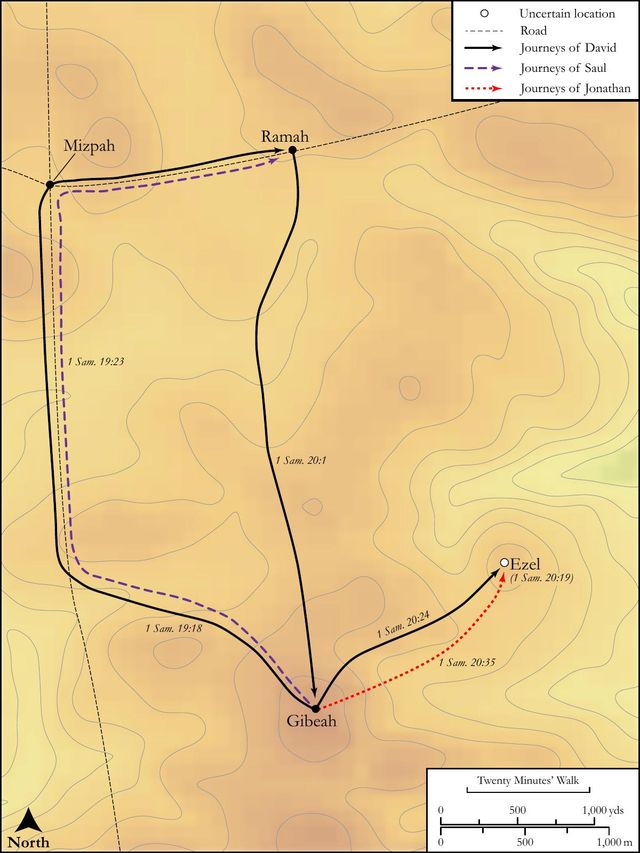
See on the biblical-era map
Study this verse
Public-domain commentary
Matthew Henry
From his Commentary on the Whole Bible. Henry comments on passages, not single verses — this entry covers 1 Samuel 20:24–34. His two-level outline is real structure in the source text, so it is rendered as structure.
Jonathan is here effectually convinced of that which he was so loth to believe, that his father had an implacable enmity to David, and would certainly be the death of him if it were in his power; and he had like to have paid very dearly himself for the conviction.
I.David is missed from the feast on the first day, but nothing is said of him.
The king sat upon his seat, to feast upon the peace-offerings as at other times (Sa1 20:25), and yet had his heart as full of envy and malice against David as it could hold. He should first have been reconciled to him, and then have come and offered his gift; but, instead of that, he hoped, at this feast, to drink the blood of David. What an abomination was that sacrifice which was brought with such a wicked mind as this! Pro 21:27. When the king came to take his seat Jonathan arose, in reverence to him both as a father and as his sovereign; every one knew his place, but David's was empty. It did not use to be so. None more content than he in attending holy duties; nor had he been absent now but that he must have come at the peril of his life; self-preservation obliged him to withdraw. In imminent peril present opportunities may be waived, nay, we ought not to throw ourselves into the mouth of danger. Christ himself absconded often, till he knew that his hour had come. But that day Saul took no notice that he missed David, but said within himself, "Surely he is not clean, Sa1 20:26. Some ceremonial pollution has befallen him, which forbids him to eat of the holy things till he has washed his clothes, and bathed his flesh in water, and been unclean until the evening." Saul knew what conscience David made of the law, and that he would rather keep away from the holy feast than come in his uncleanness. Blessed be God, no uncleanness is now a restraint upon us, but what we may by faith and repentance be washed from in the fountain opened, Psa 26:6.
II.He is enquired for the second day, Sa1 20:27.
Saul asked Jonathan, who he knew was his confidant, Wherefore cometh not the son of Jesse to meat? He was his own son by marriage, but he calls him in disdain, the son of Jesse. He asks for him as if he were not pleased that he should be absent from a religious feast; and so it should be example to masters of families to see to it that those under their charge be not absent from the worship of God, either in public or in the family. It is a bad thing for us, except in case of necessity, to omit an opportunity of statedly attending on God in solemn ordinances. Thomas lost a sight of Christ by being once absent from a meeting of the disciples. But that which displeased Saul was that hereby he missed the opportunity he expected of doing David a mischief.
III.Jonathan makes his excuse, Sa1 20:28, Sa1 20:29.
1.That he was absent upon a good occasion, keeping the feast in another place, though not here, sent for by his elder brother, who was now more respectful to him than he had been (Sa1 17:28), and that he had gone to pay his respects to his relations, for the keeping up of brotherly love; and no master would deny a servant liberty to do that in due time. He pleads,
2.That he did not go without leave humbly asked and obtained from Jonathan, who, as his superior officer, was proper to be applied to for it. Thus he represents David as not wanting in any instance of respect and duty to the government.
IV.Saul hereupon breaks out into a most extravagant passion, and rages like a lion disappointed of his prey.
David was out of his reach, but he falls upon Jonathan for his sake (Sa1 20:30, Sa1 20:31), gives him base language, not fit for a gentleman, a prince, to give to any man, especially his own son, heir apparent to his crown, a son that served him, the greatest stay and ornament of his family, before a great deal of company, at a feast, when all should be in good humour, at a sacred feast, by which all irregular passions should be mortified and subdued; yet he does in effect call him,
1.A bastard: Thou son of the perverse rebellious woman; that is, according to the foolish filthy language of men's brutish passion now a day, "Thou son of a whore." He tells him he was born to the confusion of his mother, that is, he had given the world cause to suspect that he was not the legitimate son of Saul, because he loved him whom Saul hated and supported him who would be the destruction of their family.
2.A traitor: Thou son of a perverse rebellion (so the word is), that is, "thou perverse rebel." At other times he reckoned no counsellor or commander that he had more trusty and well-beloved than Jonathan; yet now in this passion he represents him as dangerous to his crown and life.
3.A fool: Thou hast chosen the son of Jesse for thy friend to thy own confusion, for while he lives thou shalt never be established. Jonathan indeed did wisely and well for himself and family to secure an interest in David, whom Heaven had destined to the throne, yet, for this, he is branded as most impolitic. It is good taking God's people for our people and going with those that have him with them. It will prove to our advantage at last, however for the present it may be thought a disparagement, and a prejudice to our secular interest. It is probable Saul knew that David was anointed to the kingdom by the same hand that anointed him, and then not Jonathan, but himself, was the fool, to think to defeat the counsels of God. Yet nothing will serve him but David must die, and Jonathan must fetch him to execution. See how ill Saul's passion looks, and let it warn us against the indulgence of any thing like it in ourselves. Anger is madness, and he that hates his brother is a murderer.
V.Jonathan is sorely grieved and put into disorder by his father's barbarous passion, and the more because he had hoped better things, Sa1 20:2. He was troubled for his father, that he should be such a brute, troubled for his friend, whom he knew to be a friend of God, that he should be so basely abused; he was grieved for David (Sa1 20:34), and troubled for himself too, because his father had done him shame, and, though most unjustly, yet he must submit to it. One would pity Jonathan to see how he was put,
1.Into the peril of sin. Much ado that wise and good man had to keep his temper, upon such a provocation as this. His father's reflections upon himself made no return to; it becomes inferiors to bear with meekness and silence the contempts put upon them in wrath and passion. When thou art the anvil lie thou still. But his dooming David to die he could not bear: to that he replied with some heat (Sa1 20:32), Wherefore shall he be slain? What has he done? Generous spirits can much more easily bear to be abused themselves than to hear their friends abused.
2.Into the peril of death. Saul was now so outrageous that he threw his javelin at Jonathan, Sa1 20:33. He seemed to be in great care (Sa1 20:31) than Jonathan should be established in his kingdom, and yet now he himself aims at his life. What fools, what savage beasts and worse does anger make men! How necessary it is to put a hook in its nose and a bridle in its jaws! Jonathan was fully satisfied that evil was determined against David, which put him out of frame exceedingly: he rose from table, thinking it high time when his life was struck at, and would eat no meat, for they were not to eat of the holy things in their mourning. All the guests, we may suppose, were discomposed, and the mirth of the feast was spoiled. He that is cruel troubles his own flesh, Pro 11:17.
Historical interpretation
Three Centuries of Reception
2 surviving comments on this verse. Each one is dated, so this reads as a timeline rather than a list.
Select a marker to jump to its quote. Markers stagger vertically where authors wrote within a few decades of each other.
As for Saul, he hated and abhorred David so much after the countless good services which he had done, after his brilliant triumphs, and the salvation which he had wrought in the matter of Goliath, that Saul could not bear to mention him by his own name but called him after his father. For once when a festival was at hand, and Saul, having devised some treachery against him and contrived a cruel plot, did not see him arrive—“where,” said he, “is the son of Jesse?” He called him by his father’s name because he thought to damage the distinguished position of that righteous man by a reference to his low birth—a miserable and despicable thought. For certainly, even if he had some accusation to bring against the father this could in no way injure David. For each man is answerable for his own deeds, and by these he can be praised and accused. But, as it was, not having any evil deed to mention, Saul brought forward his low birth, expecting by this means to throw his glory into the shade, which in fact was the height of folly. For what kind of offence is it to be the child of insignificant and humble parents? Saul, however, did not understand true wisdom in these things.
And when the second day after the Kalends dawned, etc. When in the hearts of the faithful the radiance of new grace happily grew after the silence of listening to the word until the time arrived to act on what was taught, nevertheless, the brazenness of the unfaithful celebrated empty sustenance without Christ and the rites of the flesh blindly performed sacred rituals. Traitorous parents of those chosen for Christ sought from their children, of whom it is said: “By whom do your sons expel them?” (Luke 11:19). Why did the Christians not flock to the carnal works of the law, I mean circumcision, sacrifices, and various solemnities, to hear or perform them along with the others? Why could Jesus himself, whom they believed incarnate from the root of Jesse, dead, and resurrected, as Christ God, not be found anywhere in prophetic reading?
Continue studying 1 Samuel 20:27 across the web’s major study libraries — every link below opens this exact verse, chapter, or book on the destination site.
Read & Compare
 BibleGatewayThis verse in more than 200 translations and 70 languages.
 Bible.comThe YouVersion reader — hundreds of translations, reading plans, and highlights.
 ESV.orgCrossway's official English Standard Version reader.
 NET BibleThe NET translation with 60,000+ translators' notes on every rendering decision.
 STEP BibleTyndale House's free study tool — original text, vocabulary, and scholarly resources.
 BibliaLogos Bible Software's free web reader.
 USCCBThe New American Bible (Revised Edition) with the U.S. bishops' study notes.
Commentaries
 BibleHub CommentariesDozens of classic commentaries on this verse, gathered on one page.
 StudyLightMore than 100 commentary sets — the largest collection on the web.
 BibleRefPlain-English commentary on what this verse means, verse by verse.
 Enduring WordDavid Guzik's free commentary on this chapter, widely used by Bible teachers.
 Bible Study ToolsVerse commentary alongside Greek and Hebrew study aids.
Original Language & Research
- BibleHub InterlinearThe verse word by word — original language, transliteration, and English.
- BibleHub LexiconEvery word's original-language definition and Strong's entry.
 Blue Letter BibleDeep-study tools — Strong's numbers, concordance, and word studies.
 SefariaThe Hebrew text with Rashi and centuries of Jewish commentary.
Sermons, Hymns & Audio


TrulyRandomVerse is not affiliated with these sites and doesn’t control their content. They’re linked because they’re genuinely useful.
Summary
1 Samuel 20:27 captures a pivotal and highly charged moment in the escalating conflict between King Saul and David, revealing the king's deepening paranoia and murderous intent. David's calculated and conspicuous absence from the royal New Moon feast for a second consecutive day removes any lingering doubt for Saul, confirming his suspicions of betrayal and igniting a furious, public confrontation with his loyal son, Jonathan. This scene irrevocably seals David's fate as a fugitive and underscores the irreconcilable chasm that has opened between the reigning monarch and God's anointed successor.
Context
ShowHideLiterary Context
This verse is strategically placed within a dramatic narrative arc in 1 Samuel that chronicles the tragic unraveling of King Saul's reign and the providential rise of David. Chapters 18 and 19 establish Saul's intense, irrational jealousy and his repeated, violent attempts on David's life, forcing David to flee the court. Chapter 20 then details the poignant and unbreakable covenant between David and Jonathan, Saul's son, as they devise a perilous plan to ascertain the true depth of Saul's murderous intentions. Jonathan's initial, fabricated excuse for David's absence on the first day of the New Moon feast (as seen in 1 Samuel 20:6) temporarily deflects Saul's immediate wrath. However, David's continued absence on the second day, as explicitly noted in this verse, exposes the deception and directly precipitates Saul's violent outburst against Jonathan in the verses that immediately follow (1 Samuel 20:30-34). This moment is the definitive turning point, confirming that David can no longer safely remain in Saul's presence and must embark on a life as a fugitive.
Historical & Cultural Context
The "New Moon" (Hebrew: Rosh Chodesh) was a significant monthly religious and social festival in ancient Israel, marked by special sacrifices, blowing of trumpets, and communal feasting (Numbers 28:11-15). It was customary for prominent figures, especially those closely connected to the royal family or holding high office, to attend these gatherings at the king's table. David, as the king's son-in-law, a celebrated national hero, and a high-ranking military commander, would have been not only expected but almost obligated to be present. His absence, particularly on the second day, would have been exceptionally conspicuous, culturally disrespectful, and interpreted as a deliberate affront to the king and the established social order. The setting of a communal meal, traditionally a symbol of fellowship, peace, and unity, is tragically subverted here, becoming a public stage for the revelation of deep-seated animosity, suspicion, and the fracturing of royal relationships, starkly contrasting with the expected harmony.
Key Themes
ShowHideThis verse powerfully contributes to several overarching themes woven throughout the book of 1 Samuel. Firstly, it underscores Saul's escalating hostility and paranoia, revealing his obsessive determination to eliminate David, whom he perceives as an existential threat to his throne. His loaded question about David's absence is not born of concern but of deeply rooted suspicion and anger, reflecting the spiritual decline and torment that has plagued him since the Spirit of the Lord departed from him (1 Samuel 16:14). Secondly, it highlights David's prudence and reliance on divine guidance, as his strategic absence, meticulously orchestrated with Jonathan, demonstrates his wisdom in discerning imminent danger and his implicit trust in God's protective hand. This aligns with the broader narrative of God actively preserving His chosen king through various means. Thirdly, the verse implicitly sets the stage for Jonathan's unwavering loyalty and covenant faithfulness to David, emphasizing a profound friendship that transcends familial obligations and political pressures, a theme beautifully articulated in their solemn covenant vows earlier in the chapter (1 Samuel 20:16-17). Finally, it subtly points to divine providence, as David's successful evasion of Saul's trap is ultimately part of God's sovereign plan to protect His anointed future king and ensure the fulfillment of His promises, despite human treachery and opposition.
Exposition and Analysis
ShowHideKey Word Analysis
ShowHideWhile the KJV translates this as "empty," the Hebrew verb pâqad (H6485) carries a much broader semantic range, including "to visit," "to inspect," "to muster," "to miss," "to appoint," or "to be absent/lacking." In this context, "David's place was empty" means more than mere physical absence; it implies that his non-attendance was noted, observed, and significant. It suggests a deliberate, conspicuous vacancy that could not be overlooked, drawing immediate attention to his non-attendance and prompting Saul's pointed inquiry. It conveys the idea of a position that should have been filled but was found to be missing, carrying an implication of accountability or a breach of expectation.
The word bên (H1121) primarily means "son," but in its widest sense, it refers to a literal or figurative relationship, including a descendant, a member of a group, or one characterized by a certain quality. In the phrase "son of Jesse," it is used to identify David by his paternal lineage, emphasizing his humble origins. Saul's deliberate choice to use this term, rather than David's name or his titles (e.g., "commander," "son-in-law"), is a profound act of public degradation. It is a contemptuous expression of disdain, a refusal to acknowledge David's achievements, status, or God-given anointing, aiming to strip him of honor in the eyes of the court.
In archaic English, "meat" (H3899, lechem) simply refers to "food" or "bread," and by extension, a meal or provisions. It does not exclusively mean animal flesh as in modern English. In this verse, "to meat" means "to eat" or "to dine," specifically referring to partaking in the royal feast. The phrase underscores the social and ceremonial importance of the communal meal from which David was conspicuously absent, highlighting the breach of custom and the king's expectation of his presence.
Verse Breakdown
ShowHide"And it came to pass on the morrow, [which was] the second [day] of the month,"
This opening clause precisely establishes the timing of the event, emphasizing its continuation. "The morrow" indicates the day after David's initial absence was noted and Jonathan offered his excuse. The "second day of the month" clarifies that the New Moon festival, a two-day observance, was still underway. This detail builds suspense and highlights David's sustained, deliberate non-attendance, making his absence undeniable and signaling a deeper issue than a mere temporary commitment.
"that David's place was empty:"
This is the central observation and the immediate catalyst for Saul's reaction. David's designated seat at the royal table, which he was expected to occupy as a prominent member of the court, remained conspicuously vacant. This was not an accidental oversight but a clear, strategic withdrawal, confirming Saul's suspicions and signaling that Jonathan's previous day's excuse was a fabrication. The emptiness of the seat speaks volumes, signifying David's calculated avoidance and the unfolding of the plan between him and Jonathan.
"and Saul said unto Jonathan his son,"
This identifies the speaker and the immediate target of his inquiry. Saul's direct address to Jonathan underscores the king's suspicion that Jonathan is either complicit in David's absence or knows the true reason for it. This direct confrontation sets the stage for the dramatic and emotionally charged exchange that immediately follows, highlighting the king's escalating anger and his willingness to challenge his own son publicly.
"Wherefore cometh not the son of Jesse to meat, neither yesterday, nor to day?"
This is Saul's loaded question, revealing his simmering anger, deep suspicion, and profound contempt. His use of "the son of Jesse" is a deliberate and demeaning insult, stripping David of his titles and reducing him to his humble origins, a clear sign of Saul's jealousy and hatred. The question itself is rhetorical, not genuinely seeking information, but rather expressing Saul's indignation and challenging Jonathan's loyalty. The emphasis on "neither yesterday, nor to day" highlights the sustained and undeniable nature of David's absence, making it inexcusable in Saul's eyes and confirming his belief in David's defiance or conspiracy.
Literary Devices
ShowHideThe verse employs several potent Literary Devices to heighten the drama and convey its profound meaning. Foreshadowing is prominent, as Saul's pointed question and the conspicuous absence of David clearly presage the violent outburst that immediately follows, confirming the king's murderous intent and the irreversible break between him and David. The scene is imbued with Dramatic Irony, as the audience is fully privy to the secret pact and detailed plan between David and Jonathan (1 Samuel 20:1-23), understanding the true, life-saving reason for David's absence, while Saul remains tragically ignorant of the full extent of their loyalty and only perceives betrayal. Saul's deliberate use of "the son of Jesse" is a powerful example of a Derogatory Epithet or Insult, serving as a means of Characterization, revealing the depth of his contempt, jealousy, and the extent of his psychological and spiritual deterioration. The stark contrast between the expected communal harmony and festive atmosphere of a royal feast and the underlying tension, suspicion, and impending violence creates a palpable sense of Pathos and highlights the tragic unraveling of Saul's reign and the destruction of familial bonds.
Theological and Thematic Connections
ShowHideThis pivotal moment in 1 Samuel 20:27 profoundly illustrates the clash between human treachery and divine protection. Saul's escalating rage and his contemptuous reference to David as "the son of Jesse" reveal the depth of his spiritual decline and his futile attempts to thwart God's sovereign plan. Yet, David's strategic absence, orchestrated through Jonathan's unwavering loyalty and discernment, serves as a powerful testament to God's faithfulness in preserving His anointed one, even amidst intense persecution and life-threatening danger. It underscores the biblical principle that while human wickedness may plot destruction, the Lord's purposes will ultimately prevail, safeguarding those He has chosen for His service. This narrative reminds believers that discernment, reliance on God's guidance, and the cultivation of faithful friendships can be crucial instruments of God's providence in times of severe trial and opposition.
Reflection and Application
ShowHide1 Samuel 20:27 serves as a potent reminder of the critical importance of spiritual discernment and the courage to act upon it, even when it means deviating from social expectations or enduring misunderstanding and false accusation. David's decision to absent himself, guided by Jonathan's intelligence and their shared trust in God's plan, illustrates the profound wisdom of avoiding unnecessary confrontation when danger is clear and present. In our own lives, this might translate to setting healthy boundaries, discerning when to withdraw from toxic relationships or environments, or understanding when to speak and when to remain silent in the face of hostility or manipulation. Furthermore, the unwavering loyalty of Jonathan, who risked his own life and royal standing for David, challenges us to cultivate and cherish friendships rooted in integrity, covenant faithfulness, and sacrificial commitment—friendships that reflect God's own steadfast love. Ultimately, this passage encourages us to place our deepest trust in God's sovereign protection, knowing that He can use various means—including the discernment of His servants and the unwavering loyalty of true friends—to preserve us through trials and fulfill His divine purposes in our lives, even when circumstances seem dire.
Questions for Reflection
ShowHideFAQ
ShowHideWhat was the significance of David's absence on the "second day of the month"?
ShowHideThe "month" refers to the New Moon festival, a significant religious and social celebration in ancient Israel, typically observed over two days. David's absence on the first day was explained by Jonathan as a visit to Bethlehem for a family sacrifice (1 Samuel 20:6). However, his continued absence on the second day made it impossible to maintain the deception. It signaled to Saul that David's non-attendance was deliberate and not merely a temporary commitment, confirming Saul's suspicions of a deeper conspiracy or defiance, and ultimately provoking his full wrath. This prolonged absence transformed a potential oversight into a undeniable act of perceived rebellion in Saul's eyes.
Why did Saul refer to David as "the son of Jesse" instead of by his name or title?
ShowHideSaul's use of "the son of Jesse" was a deliberate and deeply insulting derogatory epithet, laden with contempt. By refusing to use David's name or acknowledge his well-deserved status as a national hero, the king's son-in-law, or a high-ranking military commander, Saul was attempting to strip David of his honor, reduce him to his humble, common origins, and publicly express his profound disdain. It was a verbal act of dehumanization, reflecting the depth of Saul's jealousy and his refusal to recognize David's God-given prominence and anointing, which he perceived as an illegitimate threat to his own throne (1 Samuel 18:8-9).
What does this verse reveal about Saul's character?
ShowHideThis verse is highly revealing of Saul's character in his spiritual decline. His question, filled with suspicion, anger, and contempt, demonstrates his escalating paranoia, his deep-seated jealousy of David, and his increasing instability. He is no longer concerned with justice, rational inquiry, or the welfare of his kingdom, but is consumed by a personal vendetta against David. His immediate assumption of David's guilt and his public display of anger, even before hearing an explanation, show a king who has lost his capacity for rational judgment and is driven by uncontrolled malice, foreshadowing his violent outburst against Jonathan in the verses that follow (1 Samuel 20:30). His character is marked by an inability to accept God's sovereign choice and a descent into tyranny.
Christ-Centered Fulfillment
ShowHideThe dramatic tension in 1 Samuel 20:27, where David, God's anointed but persecuted king, is forced to absent himself from the royal table due to the murderous intent of the reigning monarch, powerfully foreshadows the experience of Jesus Christ. Like David, Jesus was God's chosen King, the true Son of David, yet He was rejected and persecuted by the very religious and political leaders of His own people (John 1:11). The intense hostility Saul harbored against David finds its ultimate, most heinous expression in the unjust hatred directed at Christ, who continually faced plots against His life (John 7:1, John 8:59). Just as David's life was providentially preserved through divine intervention and the unwavering loyalty of Jonathan, so too was Christ's life protected until His appointed time, and He was sustained by the Father's will and the devotion of His true disciples. Ultimately, David's strategic withdrawal from Saul's table points to Christ, the true Lamb of God who takes away the sin of the world, who willingly "absented" Himself from the glory of heaven to come to earth, not to avoid a feast, but to become the ultimate sacrifice for humanity. His "absence" from the world through death was a temporary one, leading to His glorious resurrection and ascension, where He now sits at the right hand of God, awaiting the day when all His enemies will be made a footstool for His feet (Hebrews 10:12-13). The empty seat at Saul's table for David prefigures the empty tomb of Christ, signifying not defeat, but ultimate victory, the triumph over death, and the establishment of an eternal kingdom where the true King reigns forevermore.