


1 Samuel 22:9
Bible text: King James Version (1769 Blayney text) · Public domain
Bible text: King James Version with Strong's numbers · Public domain
Bible text: Berean Standard Bible · Public domain
Bible text: American Standard Version (1901) · Public domain
Bible text: World English Bible, Messianic edition · Public domain
Bible text: Geneva Bible (1599) · Public domain
Bible text: Young's Literal Translation · Public domain
- וַיַּעַןvai·Ya·'anand he answeredH6030Conj-w ¦ V-Qal-ConsecImperf-3msVerb Qal Consecutive Imperfect 3rd Singular Masculineוַandיַּעַןhe answered
- דֹּאֵגdo·'EgDoegH1673N-proper-mNoun Proper Masculine
- הָאֲדֹמִיha·'a·do·Mithe EdomiteH130Art ¦ N-msNoun Gentilic Singular Masculine AbsoluteהָtheאֲדֹמִיEdomite
- וְהוּאve·Hu'and heH1931Conj-w ¦ Pro-3msPronoun Personal 3rd Singular Masculineוְandהוּאhe
- נִצָּבni·Tzav[was] standingH5324V-Niphal-Prtcpl-msVerb Niphal Participle Singular Masculine Absolute
- עַל'alwithH5921PrepPreposition
- עַבְדֵי'av·dei[the] servants ofH5650N-mpcNoun Plural Masculine Construct
- שָׁאוּלsha·'UlSaulH7586N-proper-mNoun Proper Masculine
- וַיֹּאמַרvai·yo·Marand he saidH559Conj-w ¦ V-Qal-ConsecImperf-3msVerb Qal Consecutive Imperfect 3rd Singular Masculineוַandיֹּאמַרhe said
- רָאִיתִיra·'I·tiI sawH7200V-Qal-Perf-1csVerb Qal Perfect 1st Singular common gender
- אֶת'et<obj.>H853DirObjMParticle Object Indicator
- בֶּןben[the] son ofH1121N-mscNoun Singular Masculine Construct
- יִשַׁיyi·ShaiJesseH3448N-proper-mNoun Proper Masculine
- בָּאba'comingH935V-Qal-Prtcpl-msVerb Qal Participle Singular Masculine Absolute
- נֹבֶהNoehNob towardsH5011N-proper ¦ SfxNoun Proper LocationנֹבֶNobהtowards
- אֶל'eltoH413PrepPreposition
- אֲחִימֶלֶךְ'a·chi·Me·lekhAhimelechH288N-proper-mNoun Proper Masculine
- בֶּןben[the] son ofH1121N-mscNoun Singular Masculine Construct
- אֲחִטוּב'a·chi·TuvAhitubH285N-proper-mNoun Proper Masculine
English is a literal word-by-word gloss of the Hebrew, not the KJV's wording. Why?
This is the original text the KJV's translators worked from — each Hebrew word with its own literal English meaning in this verse, prepared by scholars at Tyndale House, Cambridge. The KJV translates whole sentences, not word by word, so its wording differs: one Hebrew word can become several English words, and the KJV may choose “the LORD” where the gloss reads “Yahweh”. Both are faithful — they answer different questions. For the KJV's own rendering, switch to the KJV text.
Details
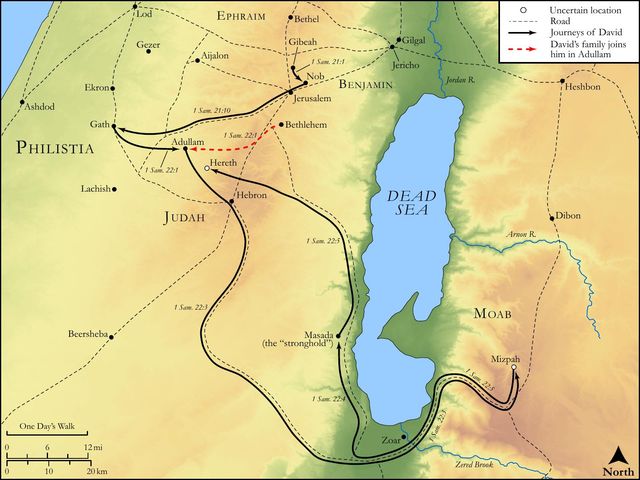
See on the biblical-era map
Study this verse
Public-domain commentary
Matthew Henry
From his Commentary on the Whole Bible. Henry comments on passages, not single verses — this entry covers 1 Samuel 22:6–19. His four-level outline is real structure in the source text, so it is rendered as structure.
We have seen the progress of David's troubles; now here we have the progress of Saul's wickedness. He seems to have laid aside the thoughts of all other business and to have devoted himself wholly to the pursuit of David. He heard at length, by the common fame of the country, that David was discovered (that is, that he appeared publicly and enlisted men into his service); and hereupon he called all his servants about him, and sat down under a tree, or grove, in the high place at Gibeah, with his spear in his hand for a sceptre, intimating the force by which he designed to rule, and the present temper of his spirit, or its distemper rather, which was to kill all that stood in his way. In this bloody court of inquisition,
I.Saul seeks for information against David and Jonathan, Sa1 22:7, Sa1 22:8.
Two things he was willing to suspect and desirous to see proved, that he might wreak his malice upon two of the best and most excellent men he had about him: - 1. That his servant David did lie in wait for him and seek his life, which was utterly false. He really sought David's life, and therefore pretended that David sought his life, though he could not charge him with any overt act that gave the least shadow of suspicion. 2. That his son Jonathan stirred him up to do so, and was confederate with him in compassing and imagining the death of the king. This also was notoriously false. A league of friendship there was between David and Jonathan, but no conspiracy in any evil thing; none of the articles of their covenant carried any mischief to Saul. If Jonathan had agreed, after the death of Saul, to resign to David, in compliance with the revealed will of God, what harm would that do to Saul? Yet thus the best friends to their prince and country have often been odiously represented as enemies to both; even Christ himself was so. Saul took it for granted that Jonathan and David were in a plot against him, his crown and dignity, and was displeased with his servants that they did not give him information of it, supposing that they could not but know it; whereas really there was no such thing. See the nature of a jealous malice, and its pitiful arts to extort discoveries of things that are not. He looked upon all about him as his enemies because they did not say just as he said; and told them, (1.) That they were very unwise, and acted against the interest both of their tribe (for they were Benjamites, and David, if he were advanced, would bring the honour into Judah which was now in Benjamin) and of their families; for David would never be able to give them such rewards as he had for them, of fields and vineyards, and such preferments, to be colonels and captains. (2.) That they were unfaithful: You have conspired against me. What a continual agitation and torment are those in that give way to a spirit of jealousy! If a ruler hearken to lies, all his servants are wicked (Pro 29:12), that is, they seem to be so in his eyes. (3.) That they were very unkind. He thought to work upon their good nature with that word: There is none of you that is so much as sorry for me, or solicitous for me, as some read it. By these reasonings he stirred them up to act vigorously, as the instruments of his malice, that they might take away his suspicions of them.
II.Though he could not learn any thing from his servants against David or Jonathan, yet he got information from Doeg against Ahimelech the priest.
1.An indictment is brought against Ahimelech by Doeg, and he himself is evidence against him, Sa1 22:9, Sa1 22:10. Perhaps Doeg, as bad as he was, would not have given this information if Saul had not extorted it, for had he been very forward to it he would have done it sooner: but now he thinks they must be all deemed traitors if none of them be accusers, and therefore tells Saul what kindness Ahimelech had shown to David, which he himself happened to be an eye-witness of. He had enquired of God for him (which the priest used not to do but for public persons and about public affairs) and he had furnished him with bread and a sword. All this was true; but it was not the whole truth. He ought to have told Saul further that David had made Ahimelech believe he was then going upon the king's business; so that what service he did to David, however it proved, was designed in honour to Saul, and this would have cleared Ahimelech, whom Saul had in his power, and would have thrown all the blame upon David, who was out of his reach.
2.Ahimelech is seized, or summoned rather to appear before the king, and upon this indictment he is arraigned. The king sent for him and all the priests who then attended the sanctuary, whom he supposed to be aiding and abetting; and they, not being conscious of any guilt, and therefore not apprehensive of any danger, came all of them to the king (Sa1 22:11), and none of them attempted to make an escape, or to flee to David for shelter, as they would have done now that he had set up his standard if they had been as much in his interests as Saul suspected they were. Saul arraigns Ahimelech himself with the utmost disdain and indignation (Sa1 22:12): Hear now, thou son of Ahitub; not so much as calling him by his name, much less giving him his title of distinction. By this it appears that he had cast off the fear of God, that he showed no respect at all to his priests, but took a pleasure in affronting them and insulting them. Ahimelech holds up his hand at the bar in those words: "Here I am, my lord, ready to hear my charge, knowing I have done no wrong." He does not object to the jurisdiction of Saul's court, nor insist upon an exemption as a priest, no, not though he is a high priest, to which office that of the judge, or chief magistrate, had not long since been annexed; but Saul having now the sovereignty vested in him, in things pertaining to the king, even the high priest sets himself on a level with common Israelites. Let every soul be subject (even clergymen) to the higher powers.
3.His indictment is read to him (Sa1 22:13), that he, as a false traitor, had joined himself with the son of Jesse in a plot to depose and murder the king. "His design" (says Saul) "was to rise up against me, and thou didst assist him with victuals and arms." See what bad constructions the most innocent actions are liable to, how unsafe those are that live under a tyrannical government, and what reason we have to be thankful for the happy constitution and administration of the government we are under.
4.To this indictment he pleads, Not guilty, Sa1 22:14, Sa1 22:15. He owns the fact, but denies that he did it traitorously or maliciously, or with any design against the king. He pleads that he was so far from knowing of any quarrel between Saul and David that he really took David to have been then as much in favour at court as ever he had been. Observe, He does not plead that David had told him an untruth, and with that had imposed upon him, though really it was so, because he would not proclaim the weakness of so good a man, no, not for his own vindication, especially to Saul, who sought all occasions against him; but he insists upon the settled reputation David had as the most faithful of all the servants of Saul, the honour the king had put upon him in marrying his daughter to him, the use the king had often made of him, and the trust he had reposed on him: "He goes at thy bidding, and is honourable in thy house, and therefore any one would think it a meritorious piece of service to the crown to show him respect, so far from apprehending it to be a crime." He pleads that he had been wont to enquire of God for him when he was sent by Saul upon any expedition, and did it now as innocently as ever he had done it. He protests his abhorrence of the thought of being in a plot against the king: "Be it far from me. I mind my own business, and meddle not with state matters." He begs the king's favour: "Let him not impute any crime to us;" and concludes with a declaration of his innocency: Thy servant knew nothing of all this. Could any man plead with more evidences of sincerity? Had he been tried by a jury of honest Israelites, he would certainly have been acquitted, for who can find any fault in him? But,
5.Saul himself gives judgment against him (Sa1 22:16): Thou shalt surely die, Ahimelech, as a rebel, thou and all thy father's house. What could be more unjust? I saw under the sun the place of judgment, that wickedness was there, Ecc 3:16.
(1.)It was unjust that Saul should himself, himself alone, give judgment in his own cause, without any appeal to judge or prophet, to his privy council, or to a council of war.
(2.)That so fair a plea should be overruled and rejected without any reason given, or any attempt to disprove the allegations of it, but purely with a high hand.
(3.)That sentence should be passed so hastily and with so much precipitation, the judge taking no time himself to consider of it, nor allowing the prisoner any time to move in arrest of judgment.
(4.)That the sentence should be passed not only on Ahimelech, himself, who was the only person accused by Doeg, but on all his father's house, against whom nothing was alleged: must the children be put to death for the fathers?
(5.)That the sentence should be pronounced in passion, not for the support of justice, but for the gratification of his brutish rage.
6.He issues out a warrant (a verbal warrant only) for the immediate execution of this bloody sentence.
(1.)He ordered his footmen to be the executioners of this sentence, but they refused, Sa1 22:17. Hereby he intended to put a further disgrace upon the priests; they may not die by the hands of the men of war (as Kg1 2:29) or his usual ministers of justice, but his footmen must triumph over them, and wash their hands in their blood.
[1.]Never was the command of a prince more barbarously given: Turn and slay the priests of the Lord. This is spoken with such an air of impiety as can scarcely be paralleled. Had he seemed to forget their sacred office or relation to God, and taken no notice of that, he would thereby have intimated some regret that men of that character should fall under his displeasure; but to call them the priests of the Lord, when he ordered his footmen to cut their throats, looked as if, upon that very account, he hated them. God having rejected him, and ordered another to be anointed in his room, he seems well pleased with this opportunity of being revenged on the priests of the Lord, since God himself was out of his reach. What wickedness will not the evil spirit hurry men to, when he gets the dominion! He alleged, in his order that which was utterly false and unproved to him, that they knew when David fled; whereas they knew nothing of the matter. But malice and murder are commonly supported with lies.
[2.]Never was the command of a prince more honourably disobeyed. The footmen had more sense and grace than their master. Though they might expect to be turned out of their places, if not punished and put to death for their refusal, yet, come on them what would, they would not offer to fall upon the priests of the Lord, such a reverence had they for their office, and such a conviction of their innocence.
(2.)He ordered Doeg (the accuser) to be the executioner, and he obeyed. One would have thought that the footmen's refusal would awaken Saul's conscience, and that he would not insist upon the doing of a thing so barbarous as that his footmen startled at the thought of it. But his mind was blinded and his heart hardened, and, if they will not do it, the hands of the witness shall be upon the victims, Deu 17:7. The most bloody tyrants have found out instruments of their cruelty as barbarous as themselves. Doeg is no sooner commanded to fall upon the priests than he does it willingly enough, and, meeting with no resistance, slays with his own hand (for aught that appears) on that same day eighty-five priests that were of the age of ministration, between twenty and fifty, for they wore a linen ephod (Sa1 22:18), and perhaps appeared at this time before Saul in their habits, and were slain in them. This (one would think) was enough to satiate the most blood-thirsty; but the horseleech of persecution still cries, "Give, give." Doeg, by Saul's order no doubt, having murdered the priests, went to their city Nob, and put all to the sword there (Sa1 22:19), men, women, and children, and the cattle too. Barbarous cruelty, and such as one cannot think of without horror! Strange that ever it should enter into the heart of man to be so impious, so inhuman! We may see in this,
[1.]The desperate wickedness of Saul when the Spirit of the Lord had departed from him. Nothing so vile but those may be hurried to it who have provoked God to give them up to their hearts' lusts. He that was so compassionate as to spare Agag and the cattle of the Amalekites, in disobedience to the command of God, could now, with unrelenting bowels, see the priests of the Lord murdered, and nothing spared of all that belonged to them. For that sin God left him to this.
[2.]The accomplishment of the threatenings long since pronounced against the house of Eli; for Ahimelech and his family were descendants from him. Though Saul was unrighteous in doing this, yet God was righteous in permitting it. Now God performed against Eli that at which the ears of those that heard it must needs tingle, as he had told him that he would judge his house for ever Sa1 3:11-13. No word of God shall fall to the ground.
[3.]This may be considered as a great judgment upon Israel, and the just punishment of their desiring a king before the time God intended them one. How deplorable was the state of religion at this time in Israel! Though the ark had long been in obscurity, yet it was some comfort to them that they had the altar, and priests to serve at it; but now to see their priests weltering in their own blood, and the heirs of the priesthood too, and the city of the priests made a desolation, so that the altar of God must needs be neglected for want of attendants, and this by the unjust and cruel order of their own king to satisfy his brutish rage - this could not but go to the heart of all pious Israelites, and make them wish a thousand times they had been satisfied with the government of Samuel and his sons. The worst enemies of their nation could not have done them a greater mischief.
Historical interpretation
Three Centuries of Reception
2 surviving comments on this verse. Each one is dated, so this reads as a timeline rather than a list.
Select a marker to jump to its quote. Markers stagger vertically where authors wrote within a few decades of each other.
I am taught through these words that whenever understanding guides my life like it did the life of the great David, that this carries me through to the end of the victory. And then I grieve especially for Doeg, the tyrant of my salvation, whenever I am in the house of the priest and when the attendant of the mules plots against me secretly because he no longer has the power to come to grips with me face to face, by informing the one who thirsts for my blood that I am staying with the priest.It’s obvious what the mules represent, which this Edomite has charge over. He tends that sterile nature which has no room for God’s blessing that sets fruitfulness in the creature in the beginning by saying “increase and multiply.” Multiplication in evil, like the continuation of the species of mules, is not of God. As the animal is always begun anew, this sterile nature of the creature is produced by trickery and is achieved underhandedly by means of the nature itself.
But the goal intended by the Word is obvious in what has been said. For if everything that the Lord made was very good, and the mule is not part of what was made in creation, it is obvious that “mule” has been used by the story to indicate evil. Its existence does not come from God, and it lacks the ability to propagate in order to make its characteristic nature endure. As the mule is unable to maintain its nature by itself, so evil lacks the ability to remain forever or preserve itself. Like with mules, another evil comes into being when it is created by another, when what is noble and splendid in our nature, and perhaps also haughty, sinks to the desire for a union which is ass-like and irrational.
That foreigner Doeg, then, who became the messenger to Saul against David, the herdsman of the sterile herd of mules, is the wicked angel who draws the human soul to evil through the various passions of sin. Whenever he sees that the soul is in the house of the true priest, being unable to strike it with the kicks of the mules, he informs the ruler of wickedness, “the spirit which is at work in the sons of disobedience.”
But Doech the Edomite, replying, etc. Doech, as we said above, means agitated or anxious; Edomite, bloodthirsty; Nobe, barking; Ahimelech, my brother's kingdom; Ahitub, my brother is good in interpretation. Therefore, he will respond to the persecuting Jews who are agitated for shedding innocent blood, being an associate of a gathering of the wicked; who, while others openly attack the faith, he usually plots inwardly to seek out and betray more diligently the meetings of the followers of Christ during the time of persecution, which he rightly suggests as the first among Saul's servants; because the more perverse and insensitive one is toward the good, the greater place they hold among the wicked. Without any doubt, the false brothers, who are within, burden the Church more than open enemies who attack it from outside. The time of the last conspiracy against Christ will respond, I say, like it is written about Judas: And night to night shows knowledge (Ps. 18). What is sober, just, and pious, he will wickedly betray, saying he has seen the faith of the Lord Jesus in the doctrine of those who, against the wickedness of the impious, bark like the sharpest and most watchful dog, and following the example of good brothers who have gone before, they also await the possession of the eternal kingdom. But they also supplicate the Father for the kingdom of Christ, and always refresh Him with spiritual bread in their members; and rescuing everyone they can from the hands of the devil, they will rather advise, command, and help them to strive for the peace of their rescuer.
Continue studying 1 Samuel 22:9 across the web’s major study libraries — every link below opens this exact verse, chapter, or book on the destination site.
Read & Compare
 BibleGatewayThis verse in more than 200 translations and 70 languages.
 Bible.comThe YouVersion reader — hundreds of translations, reading plans, and highlights.
 ESV.orgCrossway's official English Standard Version reader.
 NET BibleThe NET translation with 60,000+ translators' notes on every rendering decision.
 STEP BibleTyndale House's free study tool — original text, vocabulary, and scholarly resources.
 BibliaLogos Bible Software's free web reader.
 USCCBThe New American Bible (Revised Edition) with the U.S. bishops' study notes.
Commentaries
 BibleHub CommentariesDozens of classic commentaries on this verse, gathered on one page.
 StudyLightMore than 100 commentary sets — the largest collection on the web.
 BibleRefPlain-English commentary on what this verse means, verse by verse.
 Enduring WordDavid Guzik's free commentary on this chapter, widely used by Bible teachers.
 Bible Study ToolsVerse commentary alongside Greek and Hebrew study aids.
Original Language & Research
- BibleHub InterlinearThe verse word by word — original language, transliteration, and English.
- BibleHub LexiconEvery word's original-language definition and Strong's entry.
 Blue Letter BibleDeep-study tools — Strong's numbers, concordance, and word studies.
 SefariaThe Hebrew text with Rashi and centuries of Jewish commentary.
Sermons, Hymns & Audio


TrulyRandomVerse is not affiliated with these sites and doesn’t control their content. They’re linked because they’re genuinely useful.
Summary
1 Samuel 22:9 records the chilling and pivotal moment when Doeg the Edomite, a high-ranking official in King Saul's court, maliciously volunteers information about David's recent visit to Ahimelech the high priest in Nob. This seemingly factual report, delivered with sinister intent and a calculated omission of context, serves as the direct catalyst for Saul's subsequent brutal and sacrilegious massacre of the priests of Nob, starkly revealing the destructive power of betrayal, the depths of Saul's unchecked paranoia, and the tragic vulnerability of the innocent caught in the crossfire of political and spiritual conflict.
Context
ShowHideLiterary Context
This verse is strategically placed within a rapidly intensifying narrative of King Saul's descent into paranoia and his relentless pursuit of David, whom he perceives as a rival to his throne. Immediately preceding Doeg's intervention, Saul bitterly complains to his loyal servants, accusing them of disloyalty and lamenting that none have informed him of David's whereabouts or any supposed conspiracy against him (1 Samuel 22:7-8). Saul's emotional outburst creates a volatile atmosphere, effectively issuing an open invitation for someone to betray David in exchange for royal favor. Doeg's response in 1 Samuel 22:9 is a direct and eager answer to Saul's desperate plea, setting in motion the horrific events that follow, culminating in Saul's command for the slaughter of the priests of Nob—a command only Doeg is willing to carry out (1 Samuel 22:18-19). The narrative thread connecting David's desperate visit to Nob in 1 Samuel 21 with Saul's vengeful actions in 1 Samuel 22 is tragically forged by Doeg's malicious testimony.
Historical & Cultural Context
The events unfold during the nascent period of the Israelite monarchy, a time characterized by the precarious balance between the divinely appointed king (Saul) and the divinely chosen successor (David). King Saul, having been rejected by God due to his disobedience, is increasingly unstable, prone to violent fits of rage, and consumed by a deep-seated paranoia, viewing anyone who might aid David as an enemy. Nob was a significant priestly city, likely serving as the location of the tabernacle and a repository for sacred items like the showbread and Goliath's sword, making Ahimelech a high-ranking and respected religious figure. Doeg is specifically identified as an "Edomite," a descendant of Esau, whose people, the Edomites, frequently had a contentious and often hostile relationship with Israel (e.g., Numbers 20:14-21). His position as "set over the servants of Saul" (likely chief herdsman or a trusted royal official) indicates his close proximity to the king and his access to sensitive information. In a culture where loyalty to the monarch was paramount and divine favor was often perceived through political and military success, Saul's desperate search for information against David created an exceedingly dangerous environment for anyone perceived as disloyal, regardless of their actual intent.
Key Themes
ShowHideThis verse powerfully contributes to several profound themes within 1 Samuel and the broader biblical narrative. It vividly illustrates the destructive nature of Saul's paranoia and spiritual decline, demonstrating how his fear, jealousy, and disobedience lead him to commit heinous acts against God's anointed and His consecrated priests, starkly contrasting with David's developing character as a man after God's own heart. The incident highlights the pervasive theme of betrayal and the abuse of power, as Doeg, an outsider, leverages a factual observation for purely malicious purposes, revealing the dangers of unchecked authority and the willingness of individuals to exploit situations for personal gain and advancement. Furthermore, it poignantly foreshadows the suffering of the innocent caught in the crossfire of divine and human conflict, as Ahimelech and the priests of Nob become unwitting victims, a tragic theme that resonates throughout biblical history, from the persecution of prophets to the ultimate sacrifice of the Lamb of God, who takes away the sin of the world. The incident also subtly reinforces the theme of divine sovereignty, as even through such profound human sin and tragedy, God's overarching plan for David's eventual kingship continues to unfold, albeit through immense suffering and injustice.
Exposition and Analysis
ShowHideKey Word Analysis
ShowHideThe name "Doeg" (H1673) is derived from a root meaning "anxious" or "fearful," which, while not directly defining his character, could subtly hint at a restless or opportunistic disposition. More significantly, his identification as "the Edomite" immediately marks him as an outsider, a non-Israelite, holding a position of considerable authority in Saul's court. This foreign identity, often carrying negative connotations in biblical narratives, suggests a potential lack of inherent loyalty to Israel's God or its sacred institutions. Doeg's eagerness to betray the high priest and his subsequent willingness to carry out the massacre of the priests underscore his character as a ruthless opportunist, driven by a desire to gain favor with Saul rather than by principles of justice or truth. He is famously denounced by David in the superscription of Psalm 52, where his deceitful tongue and destructive nature are condemned.
This ethnonym (H130) identifies Doeg as a descendant of Esau, Jacob's brother, and thus from the nation of Edom. The Edomites were a neighboring people to Israel, frequently engaged in conflict and marked by a history of animosity (e.g., 2 Kings 8:20-22). Doeg's foreign background is crucial here; it emphasizes his lack of reverence for the Israelite priesthood and sacred institutions. It highlights the profound irony and tragedy that an Edomite, a traditional adversary, is the one who steps forward to carry out Saul's horrific command to slaughter God's priests after Saul's own Israelite guards refuse (1 Samuel 22:17). This detail deepens the sense of moral decay and the perversion of justice within Saul's kingdom.
While the literal meaning of "Nob" (H5011) is "fruit," its significance in this context is its identity as a city of priests, located near Jerusalem. It functioned as a sanctuary and was likely the primary location for the tabernacle and priestly service after the destruction of Shiloh. As such, Nob was a sacred place, a center of divine presence and worship. David's visit there was for legitimate provisions and counsel from the high priest Ahimelech (1 Samuel 21:1-6). Doeg's report, though factually true about David's presence, weaponizes this sacred space, transforming it into a scene of perceived conspiracy in Saul's paranoid mind, leading directly to its desecration and the slaughter of its inhabitants.
Verse Breakdown
ShowHide"Then answered Doeg the Edomite"
This opening phrase immediately introduces the speaker and highlights his ethnic identity. Doeg is not a passive observer but an active, willing participant, stepping forward to respond to Saul's desperate and accusatory plea. His "answering" is not a reluctant duty but a proactive, self-serving act, distinguishing him from the other servants who remained silent or later refused Saul's murderous command. The mention of his Edomite origin immediately casts him as an outsider, setting a tone of potential malevolence.
"which was set over the servants of Saul"
This descriptive clause establishes Doeg's significant position of authority and his close proximity to the king. He was not a casual bystander but a high-ranking official, perhaps the chief of Saul's herdsmen or a trusted royal administrator, indicating that his presence was legitimate and his testimony would carry considerable weight. This status makes his betrayal even more egregious, as he exploits his privileged access and the trust placed in him for his own gain, at the expense of innocent lives.
"and said, I saw the son of Jesse coming to Nob, to Ahimelech the son of Ahitub"
Doeg's statement is factually accurate, recounting David's visit to the priestly city of Nob and his interaction with the high priest Ahimelech. However, the profound malice of his report lies in what he omits and the intent behind his words. He deliberately leaves out the crucial context of David's desperate flight, his hunger, and Ahimelech's innocent provision of aid based on David's fabricated story of a secret mission for the king (1 Samuel 21:2). By simply stating the bare facts without the mitigating circumstances, Doeg paints a picture of conspiracy and complicity, skillfully fueling Saul's already raging paranoia. Referring to David as "the son of Jesse" is a common, somewhat humble identifier, emphasizing his lineage rather than any royal claim, yet it is enough to trigger Saul's deep-seated jealousy and fear of David's rising popularity.
Literary Devices
ShowHideThe verse employs several potent literary devices that amplify its dramatic and tragic impact. Foreshadowing is prominently featured, as Doeg's seemingly straightforward report immediately signals impending doom for Ahimelech and the entire priestly community at Nob, setting the stage for the horrific massacre that follows. The deliberate mention of "Doeg the Edomite" also serves as a powerful form of Characterization, immediately painting him as an outsider and implicitly suggesting a lack of inherent loyalty or a moral compass aligned with Israelite values, a trait that is chillingly borne out by his subsequent actions. There is also a profound Irony in the fact that an Edomite, a traditional enemy of Israel, is the one who eagerly steps forward to condemn the high priest, while Saul's own Israelite guards later refuse to lay hands on the priests (1 Samuel 22:17). This stark contrast highlights the moral inversion and spiritual decay within Saul's kingdom, where an outsider proves more willing to commit atrocity than the king's own loyal subjects.
Theological and Thematic Connections
ShowHide1 Samuel 22:9 stands as a stark and sobering illustration of the destructive power of a deceitful tongue and the tragic consequences of unchecked, paranoid authority. Theologically, it underscores the profound vulnerability of God's servants and institutions when confronted by human sin and political machinations. Ahimelech, acting in good faith and according to his priestly duty of hospitality and provision, becomes an unwitting victim, revealing that even those dedicated to God's service are not immune to suffering caused by the wickedness and malice of others. This incident highlights the profound moral and spiritual decay in Saul's reign, where truth is twisted, innocence is condemned, and even sacred spaces are brutally violated. It stands as a somber reminder of the ongoing spiritual battle between good and evil, where malicious words can have devastating, tangible effects, leading to bloodshed, the perversion of justice, and the suffering of the righteous.
Reflection and Application
ShowHideThe chilling account of Doeg's betrayal in 1 Samuel 22:9 offers profound and enduring lessons for contemporary believers. It compels us to deeply consider the immense power of our words, recognizing that even factually accurate statements can be weaponized and become instruments of destruction when delivered with malicious intent, a lack of crucial context, or a desire for personal gain. We are therefore called to cultivate a spirit of discernment, guarding diligently against the temptation to spread gossip, engage in slander, or contribute to a culture of suspicion, accusation, and division within our communities. Furthermore, this passage serves as a powerful warning against the insidious dangers of unchecked authority and the corrupting influence of paranoia, urging those in leadership—whether in the church, home, or public sphere—to seek wisdom, verify information with integrity, and prioritize justice, truth, and compassion over personal vendettas or insecure ambitions. For the innocent who suffer unjustly, this narrative offers a poignant and empathetic reminder that even in the darkest moments of human treachery, God sees and knows, and ultimately, His divine justice and sovereign plan will prevail, even if not immediately apparent.
Questions for Reflection
ShowHideFAQ
ShowHideWhat was Doeg's motivation for betraying Ahimelech?
ShowHideDoeg's primary motivation appears to be gaining favor and advancement with King Saul. In 1 Samuel 22:7-8, Saul openly accuses his servants of disloyalty and laments that no one informs him of David's activities. Doeg, as a high-ranking official, seizes this opportune moment to demonstrate his perceived loyalty and secure a higher position or reward by providing information that he knows will please the paranoid king. His Edomite background might also suggest a lesser allegiance to Israelite priestly institutions, making him less hesitant to betray the high priest compared to an Israelite.
Was Ahimelech truly guilty of conspiring with David?
ShowHideNo, Ahimelech was not guilty of conspiring with David. When David came to Nob, he deceived Ahimelech by claiming he was on a secret, urgent mission for King Saul and needed provisions and a weapon (1 Samuel 21:2). Ahimelech, believing David's fabricated story and acting out of his priestly duty to provide for those in need, gave David the consecrated bread and Goliath's sword. He had no knowledge of the true nature of David's flight from Saul. His actions were based on a misunderstanding and an act of hospitality, not malicious intent or disloyalty to the king, as he later earnestly explains to Saul in 1 Samuel 22:14-15.
How does this event relate to Psalm 52?
ShowHideThe superscription of Psalm 52 explicitly states that David wrote it "when Doeg the Edomite went and told Saul, 'David has gone to the house of Ahimelech.'" This psalm is David's powerful lament and imprecation against Doeg, condemning his deceitful tongue and his love for evil and destruction. It serves as David's theological reflection on the profound wickedness of Doeg's actions and a fervent prayer for divine justice against those who use their words for harm and betrayal, expressing confidence in God's ultimate vindication of the righteous.
Christ-Centered Fulfillment
ShowHideThe tragic events initiated by Doeg's malicious betrayal in 1 Samuel 22:9 find profound Christ-centered fulfillment and echo in the New Testament narrative. David, the innocent, divinely anointed king-in-waiting, is unjustly pursued and betrayed, leading to the suffering and death of others. This powerfully foreshadows Jesus Christ, the ultimate innocent one, the true King, who was likewise betrayed by one of His own inner circle, Judas Iscariot, for personal gain (Matthew 26:14-16). Just as Doeg's seemingly factual report was twisted with malicious intent to condemn the innocent Ahimelech, so too were false witnesses brought against Jesus, leading to His unjust condemnation and crucifixion (Matthew 26:59-60). The horrific massacre of the priests of Nob, an act of sacrilege against God's anointed servants, points to the ultimate sacrifice of the great High Priest, Jesus, who, though perfectly innocent, was "led like a lamb to the slaughter" (Isaiah 53:7) to atone for the sins of humanity. In both narratives, innocent suffering is a central theme, but while David's story ends with the escape of Abiathar and David's lament, Christ's suffering culminates in resurrection and the ultimate triumph over sin, death, and human treachery, demonstrating God's sovereign plan unfolding even through the darkest acts of human evil (Acts 2:23).