


1 Samuel 21:15
Bible text: King James Version (1769 Blayney text) · Public domain
Bible text: Berean Standard Bible · Public domain
Bible text: American Standard Version (1901) · Public domain
Bible text: World English Bible, Messianic edition · Public domain
Bible text: Geneva Bible (1599) · Public domain
Bible text: Young's Literal Translation · Public domain
- חֲסַרcha·Sarlacking ofH2638Adj-mscAdjective Singular Masculine Construct
- מְשֻׁגָּעִיםme·shu·ga·'ImmadmenH7696V-Pual-PassPrtcpl-mpVerb Pual Participle Passive Plural Masculine Absolute
- אָנִי'A·ni[am] I?H589Pro-1csPronoun Personal 1st Singular common gender
- כִּיkithatH3588PrtParticle Conditional
- הֲבֵאתֶםha·ve·Temyou have broughtH935V-Hiphil-Perf-2mpVerb Hiphil Perfect 2nd Plural Masculine
- אֶת'et<obj.>H853DirObjMParticle Object Indicator
- זֶהZehthis oneH2088PrtParticle Demonstrative
- לְהִשְׁתַּגֵּעַle·hish·ta·Ge·a'to behave like a madmanH7696Prep-l ¦ V-Hithpael-InfVerb Hithpael Infinitive Constructלְtoהִשְׁתַּגֵּעַbehave like a madman
- עָלָי'a·Laion meH5921Prep ¦ 1csPreposition Definiteעָלָonיme
- הֲזֶהha·Zeh¿ this oneH2088Interrog ¦ PrtParticle Demonstrativeהֲ¿זֶהthis one
- יָבוֹאya·Vo'will he comeH935V-Qal-Imperf-3msVerb Qal Imperfect 3rd Singular Masculine
- אֶל'elintoH413PrepPreposition
- בֵּיתִיbei·Timy houseH1004N-msc ¦ 1csNoun Singular Masculine Constructבֵּיתִhouseיmy
English is a literal word-by-word gloss of the Hebrew, not the KJV's wording. Why?
This is the original text the KJV's translators worked from — each Hebrew word with its own literal English meaning in this verse, prepared by scholars at Tyndale House, Cambridge. The KJV translates whole sentences, not word by word, so its wording differs: one Hebrew word can become several English words, and the KJV may choose “the LORD” where the gloss reads “Yahweh”. Both are faithful — they answer different questions. For the KJV's own rendering, switch to the KJV text.
Details
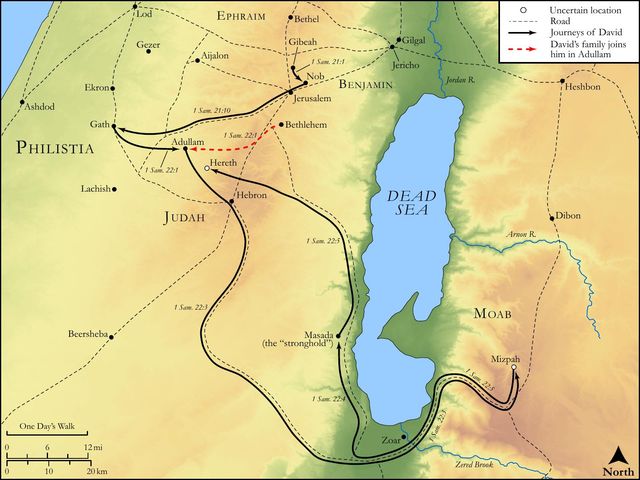
See on the biblical-era map
Study this verse
Public-domain commentary
Matthew Henry
From his Commentary on the Whole Bible. Henry comments on passages, not single verses — this entry covers 1 Samuel 21:10–15.
David, though king elect, is here an exile - designed to be master of vast treasures, yet just now begging his bread - anointed to the crown, and yet here forced to flee from his country. Thus do God's providences sometimes seem to run counter to his promises, for the trial of his people's faith, and the glorifying of his name, in the accomplishment of his counsels, notwithstanding the difficulties that lay in the way. Here is, 1. David's flight into the land of the Philistines, where he hoped to be hid, and to remain undiscovered in the court or camp of Achish king of Gath, Sa1 21:10. Israel's darling is necessitated to quit the land of Israel, and he that was the Philistine's great enemy (upon I know not what inducements) goes to seek for shelter among them. It should seem that as, though the Israelites loved him, yet the king of Israel had a personal enmity to him, which obliged him to leave his own country, so, though the Philistines hated him, yet the king of Gath had a personal kindness for him, valuing his merit, and perhaps the more for his killing Goliath of Gath, who, it may be, had been no friend to Achish. To him David now went directly, as to one he could confide in, as afterwards (Sa1 27:2, Sa1 27:3), and Achish would not have protected him but that he was afraid of disobliging his own people. God's persecuted people have often found better usage from Philistines than from Israelites, in the Gentile theatres than in the Jewish synagogues. The king of Judah imprisoned Jeremiah, and the king of Babylon set him at liberty. 2. The disgust which the servants of Achish took at his being there, and their complaint of it to Achish (Sa1 21:11): "Is not this David? Is not this he that has triumphed over the Philistines? witness that burden of the song which was so much talked of, Saul has slain his thousands, but David, this very man, his ten thousands. Nay, Is not this he that (if our intelligence from the land of Israel be true) is, or is to be, king of the land?" As such, "he must be an enemy to our country; and is it safe or honourable for us to protect or entertain such a man?" Achish perhaps had intimated to them that it would be policy to entertain David, because he was now an enemy to Saul, and he might be hereafter a friend to them. It is common for the outlaws of a nation to be sheltered by the enemies of that nation. But the servants of Achish objected to his politics, and thought it not at all fit that he should stay among them. 3. The fright which this put David into. Though he had some reason to put confidence in Achish, yet, when he perceived the servants of Achish jealous of him, he began to be afraid that Achish would be obliged to deliver him up to them, and he was sorely afraid (Sa1 21:12), and perhaps he was the more apprehensive of his own danger, when he was thus discovered, because he wore Goliath's sword, which, we may suppose, was well known in Gath, and with which he had reason to expect they would cut off his head, as he had cut off Goliath's with it. David now learned by experience what he has taught us (Psa 118:9), that it is better to trust in the Lord than to put confidence in princes. Men of high degree are a lie, and, if we make them our hope, they may prove our fear. It was at this time that David penned Psalm 55 (Michtam, a golden psalm), when the Philistines took him in Gath, where having shown before God his distresses, he resolves (Psa 55:3), "What time I am afraid I will trust in thee; and therefore (Psa 55:11) will not be afraid what man can do unto me, no, not the sons of giants." 4. The course he took to get out of their hands: He feigned himself mad, Sa1 21:13. He used the gestures and fashions of a natural fool, or one that had gone out of his wits, supposing they would be ready enough to believe that the disgrace he had fallen into, and the troubles he was now in, had driven him distracted. This dissimulation of his cannot be justified (it was a mean thing thus to disparage himself, and inconsistent with truth thus to misrepresent himself, and therefore not becoming the honour and sincerity of such a man as David); yet it may in some degree be excused, for it was not a downright lie and it was like a stratagem in war, by which he imposed upon his enemies for the preservation of his own life. What David did here in pretence and for his own safety, which made it partly excusable, drunkards do really, and only to gratify a base lust: they made fools of themselves and change their behaviour; their words and actions commonly are either as silly and ridiculous as an idiot's or as furious and outrageous as a madman's, which has often made me wonder that ever men of sense and honour should allow themselves in it. 5. His escape by this means, Sa1 21:14, Sa1 21:15. I am apt to think Achish was aware that the delirium was but counterfeit, but, being desirous to protect David (as we find afterwards he was very kind to him, even when the lord of the Philistines favoured him not, Sa1 28:1, Sa1 28:2; Sa1 29:6), he pretended to his servants that he really thought he was mad, and therefore had reason to question whether it was David or no; or, if it were, they need not fear him, what harm could he do them now that his reason had departed from him? They suspected that Achish was inclined to entertain him: "Not I," says he. "He is a madman. I'll have nothing to do with him. You need not fear that I should employ him, or give him any countenance." He humours the thing well enough when he asks, "Have I need of madmen? Shall this fool come into my house? I will show him no kindness, but then you shall do him no hurt, for, if he be a madmen, he is to be pitied." He therefore drove him away, as it is in the title of Ps. 34, which David penned upon this occasion, and an excellent psalm it is, and shows that he did not change his spirit when he changed his behaviour, but even in the greatest difficulties and hurries his heart was fixed, trusting in the Lord; and he concludes that psalm with this assurance, that none of those that trust in God shall be desolate, though they may be, as he now was, solitary and distressed, persecuted, but not forsaken.
Historical interpretation
Historical reception
1 surviving comment on this verse from the historical church.
Every kind of honour and happiness was bestowed upon you, and then was fulfilled that which is written, "My beloved ate and drank, and was enlarged and became fat, and kicked." [Deuteronomy 32:15] Hence flowed emulation and envy, strife and sedition, persecution and disorder, war and captivity. So the worthless rose up against the honoured, those of no reputation against such as were renowned, the foolish against the wise, the young against those advanced in years. For this reason righteousness and peace are now far departed from you, inasmuch as every one abandons the fear of God, and has become blind in His faith, neither walks in the ordinances of His appointment, nor acts a part becoming a Christian, but walks after his own wicked lusts, resuming the practice of an unrighteous and ungodly envy, by which death itself entered into the world. [Wisdom 2:24]
For thus it is written: "And it came to pass after certain days, that Cain brought of the fruits of the earth a sacrifice unto God; and Abel also brought of the firstlings of his sheep, and of the fat thereof. And God had respect to Abel and to his offerings, but Cain and his sacrifices He did not regard. And Cain was deeply grieved, and his countenance fell. And God said to Cain, Why are you grieved, and why is your countenance fallen? If you offer rightly, but do not divide rightly, have you not sinned? Be at peace: your offering returns to yourself, and you shall again possess it. And Cain said to Abel his brother, Let us go into the field. And it came to pass, while they were in the field, that Cain rose up against Abel his brother, and slew him." [Genesis 4:3-8] You see, brethren, how envy and jealousy led to the murder of a brother. Through envy, also, our father Jacob fled from the face of Esau his brother [Genesis 27:41-45]. Envy made Joseph be persecuted unto death, and to come into bondage. [Genesis 37:18-28] Envy compelled Moses to flee from the face of Pharaoh king of Egypt, when he heard these words from his fellow-countryman, "Who made you a judge or a ruler over us? Will you kill me, as you killed the Egyptian yesterday?" [Exodus 2:14] On account of envy, Aaron and Miriam had to make their abode without the camp. [Numbers 12:14-15] Envy brought down Dathan and Abiram alive to Hades, through the sedition which they excited against God's servant Moses. [Numbers 16:33] Through envy, David not only underwent the hatred of foreigners, but was also persecuted by Saul king of Israel. [1 Samuel 21:10-15]
Continue studying 1 Samuel 21:15 across the web’s major study libraries — every link below opens this exact verse, chapter, or book on the destination site.
Read & Compare
 BibleGatewayThis verse in more than 200 translations and 70 languages.
 Bible.comThe YouVersion reader — hundreds of translations, reading plans, and highlights.
 ESV.orgCrossway's official English Standard Version reader.
 NET BibleThe NET translation with 60,000+ translators' notes on every rendering decision.
 STEP BibleTyndale House's free study tool — original text, vocabulary, and scholarly resources.
 BibliaLogos Bible Software's free web reader.
 USCCBThe New American Bible (Revised Edition) with the U.S. bishops' study notes.
Commentaries
 BibleHub CommentariesDozens of classic commentaries on this verse, gathered on one page.
 StudyLightMore than 100 commentary sets — the largest collection on the web.
 BibleRefPlain-English commentary on what this verse means, verse by verse.
 Enduring WordDavid Guzik's free commentary on this chapter, widely used by Bible teachers.
 Bible Study ToolsVerse commentary alongside Greek and Hebrew study aids.
Original Language & Research
- BibleHub InterlinearThe verse word by word — original language, transliteration, and English.
- BibleHub LexiconEvery word's original-language definition and Strong's entry.
 Blue Letter BibleDeep-study tools — Strong's numbers, concordance, and word studies.
 SefariaThe Hebrew text with Rashi and centuries of Jewish commentary.
Sermons, Hymns & Audio


TrulyRandomVerse is not affiliated with these sites and doesn’t control their content. They’re linked because they’re genuinely useful.
Summary
1 Samuel 21:15 captures the exasperated and incredulous reaction of King Achish of Gath as he dismisses David, who has feigned madness to escape a life-threatening situation. This pivotal moment underscores David's desperate plight as a fugitive from King Saul and highlights God's providential care in preserving His anointed one through unconventional means, allowing David to continue his journey toward the throne of Israel and fulfilling His divine purpose.
Context
ShowHideLiterary Context
This verse serves as the climactic resolution to David's perilous flight from King Saul, who relentlessly sought his life. Having narrowly escaped Saul's immediate pursuit, David made the desperate and seemingly illogical decision to seek asylum in Gath, a prominent Philistine city-state and the very home of Goliath, whom David had famously slain. Upon his arrival, David was recognized by Achish's servants, who immediately reminded their king of David's formidable reputation as Israel's celebrated warrior, known for the song, "Saul has slain his thousands, and David his tens of thousands" (1 Samuel 18:7). Realizing the extreme danger of his recognition in enemy territory, David resorted to a desperate act of deception, meticulously pretending to be insane by scratching marks on the city gate doors and allowing saliva to run down his beard (1 Samuel 21:13). King Achish's indignant questions in verse 15 represent his final judgment, leading to David's dismissal and miraculous escape, an event later reflected upon with gratitude and trust in God's deliverance in Psalm 34 and Psalm 56.
Historical & Cultural Context
Gath was one of the five major Philistine city-states, a formidable and long-standing enemy of Israel. Seeking refuge there was an act of profound desperation for David, a national hero who had personally humiliated the Philistines by killing their champion, Goliath (1 Samuel 17:50-51). Among the nations round about, individuals displaying signs of madness were often viewed with a complex mixture of fear, pity, or even a degree of reverence, sometimes believed to be afflicted by a deity or spirit, making them untouchable or undesirable. However, they were generally considered unfit for serious interaction, especially within the structured and dignified environment of a royal court. A king like Achish would have no "need" for such a person, as they could be a nuisance, a bad omen, or a security risk due to their unpredictable behavior. David's performance, therefore, played directly into these cultural perceptions, making him appear harmless and undesirable to the Philistine king, rather than a dangerous enemy worthy of execution.
Key Themes
ShowHideThis incident in 1 Samuel 21 powerfully illustrates several recurring themes within the broader narrative of David's life. Firstly, Desperation and Survival: David's feigned madness is a stark portrayal of the extreme lengths to which an individual will go to survive when facing imminent death. It reveals the immense pressure and fear under which David, God's anointed, was living as a fugitive from Saul. Secondly, Divine Providence: Despite David's human and deceptive actions, the outcome clearly demonstrates God's sovereign hand in preserving David's life. This unconventional and seemingly undignified escape was instrumental in allowing David to continue his journey towards becoming King of Israel, fulfilling God's overarching plan, as evidenced by David's later reflections on God's deliverance in Psalm 34:4-6. Thirdly, Perception vs. Reality: King Achish perceived David as a mere madman, a nuisance to be expelled, yet in reality, he was dismissing the future king of Israel. This highlights the limitations of human perception and how appearances can be profoundly deceiving, especially when God is working behind the scenes to accomplish His purposes, often in ways that defy human logic or expectation, as seen throughout the narrative of David's rise to power in 1 Samuel.
Exposition and Analysis
ShowHideKey Word Analysis
ShowHideFrom the root H2638, meaning "lacking; hence, without; destitute, fail, lack, have need, void, want." King Achish's rhetorical question, "Have I need of mad men," highlights his complete lack of desire or requirement for such individuals in his court. It conveys a strong sense of sufficiency and a categorical rejection, emphasizing that David, in his feigned state, offers no value or benefit to the king, but rather presents a burden or an affront to royal decorum.
From the primitive root H7696, meaning "to rave through insanity; (be, play the) mad (man)." This term precisely describes David's performance. Achish uses it to categorize David as mentally unstable, irrational, and uncontrollable. The king's disdain is evident, as he views such a person as unfit for the dignity and order of a royal court, reinforcing David's successful deception in appearing harmless and undesirable.
Meaning "a house (in the greatest variation of applications, especially family, etc.); court, palace, place." In this context, "house" refers specifically to the king's palace or royal residence. Achish's final question, "shall this fellow come into my house?", is a rhetorical rejection, emphatically stating that such a deranged individual has no place within the sacred and protected confines of his personal domain, which represents order, security, and royal prerogative.
Verse Breakdown
ShowHide"Have I need of mad men, that ye have brought this [fellow] to play the mad man in my presence?"
This is a rhetorical question saturated with exasperation and incredulity. King Achish is not genuinely seeking information but is expressing his strong disapproval and annoyance with his servants for bringing David before him. He implies that his court is not a refuge for the mentally unstable, nor does he lack such individuals if he truly desired them. The phrase "play the mad man" subtly acknowledges the performative aspect of David's deception, even if Achish believes it to be genuine madness rather than a deliberate ruse. The king is essentially asking, "Why would you present someone so unsuitable and disruptive directly before me, insulting my dignity and the order of my court?"
"shall this [fellow] come into my house?"
This second rhetorical question serves as the definitive dismissal and final judgment. It moves from the general "presence" of the king to the more intimate and secure "house" (palace), emphasizing the absolute unacceptability of David's continued stay. It is a final, emphatic rejection, sealing David's expulsion from Gath. The king's authority is asserted, and the decision is made that David, perceived as a madman, poses no threat but is merely an undesirable nuisance to be removed.
Literary Devices
ShowHideThe passage is rich with Irony, particularly Dramatic Irony. King Achish, believing he is dismissing a harmless lunatic, is unknowingly expelling the future king of Israel, the very man who poses the greatest long-term threat to Philistine dominance. The audience, privy to David's true identity and destiny, perceives Achish's short-sighted judgment as deeply ironic. Furthermore, there is Situational Irony in David, the celebrated warrior and slayer of Goliath, resorting to such an undignified and seemingly weak act to save his life. The passage also employs vivid Characterization, revealing Achish as a pragmatic ruler who values order and dignity in his court, and David as a resourceful, albeit desperate, individual capable of profound cunning when faced with extreme peril. The scene also contains elements of Foreshadowing, as David's miraculous escape reinforces the divine protection over him, hinting at his ultimate preservation for the throne, despite the numerous dangers he faces.
Theological and Thematic Connections
ShowHideThis episode profoundly illustrates the theme of divine providence working through human weakness and unconventional means. While David's act of deception was born of intense fear and desperation, God sovereignly used this undignified ruse to preserve His anointed one, demonstrating that His plans cannot be thwarted by human enemies or the most dire circumstances. It reminds us that God's ways are often not our ways, and He can deliver His people even when they resort to less-than-ideal tactics, highlighting His grace, faithfulness, and sovereign control over all events. The incident also serves as a powerful reminder that God often works through what appears foolish, weak, or contemptible in the eyes of the world to accomplish His mighty and wise purposes.
Reflection and Application
ShowHideDavid's desperate act in Gath offers a complex yet profound lesson for believers. It reminds us that even heroes of faith are susceptible to intense fear and may resort to human ingenuity, or even deception, in moments of extreme duress. While David's actions are not presented as a moral ideal to emulate, the outcome undeniably showcases God's unwavering commitment to His covenant and His ability to deliver His people through unexpected and often undignified means. For us, this means that even in our darkest hours, when we feel utterly exposed and vulnerable, God remains sovereign and actively involved in our lives. We are called to trust in His deliverance, knowing that He can orchestrate our escape even when our own resources and strategies seem to fail or fall short. This passage encourages us to rely on God's wisdom and power, rather than solely on our own, recognizing that His protection extends even to our moments of greatest human frailty and fear, demonstrating His steadfast love and redemptive purpose.
Questions for Reflection
ShowHideFAQ
ShowHideWas David's feigned madness a morally justifiable act?
ShowHideThe Bible records David's actions without explicitly endorsing them as morally ideal or condemning them. David was in an extremely perilous situation, facing certain death if his identity as the slayer of Goliath was fully acknowledged and acted upon by King Achish. His act of feigning madness was a desperate survival tactic, a form of self-preservation in a life-or-death scenario. While deception is generally condemned in Scripture, this incident highlights the tension between human weakness, the instinct for survival, and God's sovereign plan. God, in His providence, used David's desperate ruse to bring about his deliverance, demonstrating that His purposes can be accomplished even through the flawed actions of His servants. This passage primarily focuses on God's faithfulness in preserving His anointed, rather than providing a moral template for deception.
What does this event teach us about God's protection?
ShowHideThis event powerfully demonstrates God's active and often unconventional protection of His chosen ones. David was in an enemy city, recognized by those who sought his harm, and utterly vulnerable. Yet, God orchestrated his escape not through a display of overt power, but by allowing David's desperate act of feigned madness to be effective. It teaches us that God's methods of deliverance are diverse and not limited by human expectations or conventional means. He can use the seemingly foolish or weak things of the world to confound the wise (1 Corinthians 1:27) and protect His servants in ways they could never anticipate. David himself later reflected on God's deliverance in Psalm 34:4, attributing his escape to the Lord and testifying to God's unfailing care.
Christ-Centered Fulfillment
ShowHideThe desperate plight of David, the anointed king-in-waiting, who must feign madness to escape death, profoundly foreshadows aspects of Christ's own journey. Just as David was rejected by the reigning king and forced into a lowly, undignified state, so too was Jesus, the true Anointed One, rejected by the religious and political authorities of His day (John 1:11). The world, in its wisdom, often perceived Jesus and His message as foolishness or even madness (Mark 3:21; 1 Corinthians 1:18). Yet, it was through this apparent weakness and "foolishness" of the cross that God's ultimate power and wisdom were revealed, securing salvation for humanity (1 Corinthians 1:25). David's undignified escape from Gath, orchestrated by divine providence, points to the greater truth that God's greatest victory was achieved not through worldly power or triumphant display, but through the humble, suffering, and seemingly defeated Lamb of God, who conquered sin and death through His sacrifice (Philippians 2:7-8). This narrative reminds us that God's kingdom often advances through means that appear weak or foolish to human eyes, ultimately revealing the profound wisdom and power of Christ, who perfectly fulfilled God's redemptive plan.