


1 Samuel 22:19
Bible text: King James Version (1769 Blayney text) · Public domain
Bible text: King James Version with Strong's numbers · Public domain
Bible text: Berean Standard Bible · Public domain
Bible text: American Standard Version (1901) · Public domain
Bible text: World English Bible, Messianic edition · Public domain
Bible text: Geneva Bible (1599) · Public domain
Bible text: Young's Literal Translation · Public domain
- וְאֵתve·'Etand <obj.>H853Conj-w ¦ DirObjMParticle Object Indicatorוְandאֵת<obj.>
- נֹבnoNobH5011N-properNoun Proper Location
- עִיר'ir[the] city ofH5892N-fscNoun Singular Feminine Construct
- הַכֹּהֲנִיםha·ko·ha·Nimthe priestsH3548Art ¦ N-mpNoun Plural Masculine Absoluteהַtheכֹּהֲנִיםpriests
- הִכָּהhi·Kahhe struckH5221V-Hiphil-Perf-3msVerb Hiphil Perfect 3rd Singular Masculine
- לְפִיle·fito [the] mouth ofH6310Prep-l ¦ N-mscNoun Singular Masculine Constructלְtoפִי[the] mouth of
- חֶרֶבChe·rev[the] swordH2719N-fsNoun Singular Feminine Absolute
- מֵאִישׁme·'Ishfrom manH376Prep-m ¦ N-msNoun Singular Masculine Absoluteמֵfromאִישׁman
- וְעַדve·'adand untoH5704Conj-w ¦ PrepPrepositionוְandעַדunto
- אִשָּׁה'i·ShahwomanH802N-fsNoun Singular Feminine Absolute
- מֵעוֹלֵלme·'o·Lelfrom childH5768Prep-m ¦ N-msNoun Singular Masculine Absoluteמֵfromעוֹלֵלchild
- וְעַדve·'adand untoH5704Conj-w ¦ PrepPrepositionוְandעַדunto
- יוֹנֵקyo·Neksuckling-childH3243N-msNoun Singular Masculine Absolute
- וְשׁוֹרve·Shorand ox[en]H7794Conj-w ¦ N-msNoun Singular Masculine Absoluteוְandשׁוֹרox[en]
- וַחֲמוֹרva·cha·Morand donkey[s]H2543Conj-w ¦ N-csNoun Singular common gender Absoluteוַandחֲמוֹרdonkey[s]
- וָשֶׂהva·Sehand sheepH7716Conj-w ¦ N-csNoun Singular common gender Absoluteוָandשֶׂהsheep
- לְפִיle·fito [the] mouth ofH6310Prep-l ¦ N-mscNoun Singular Masculine Constructלְtoפִי[the] mouth of
- חָרֶבCha·rev[the] swordH2719N-fsNoun Singular Feminine Absolute
English is a literal word-by-word gloss of the Hebrew, not the KJV's wording. Why?
This is the original text the KJV's translators worked from — each Hebrew word with its own literal English meaning in this verse, prepared by scholars at Tyndale House, Cambridge. The KJV translates whole sentences, not word by word, so its wording differs: one Hebrew word can become several English words, and the KJV may choose “the LORD” where the gloss reads “Yahweh”. Both are faithful — they answer different questions. For the KJV's own rendering, switch to the KJV text.
Details
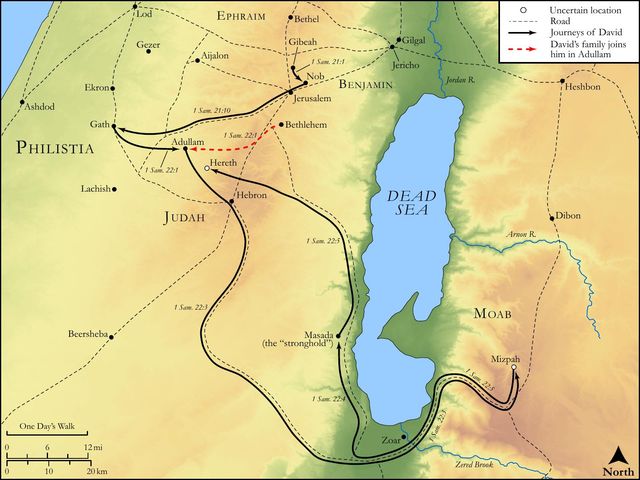
See on the biblical-era map
Study this verse
Public-domain commentary
Matthew Henry
From his Commentary on the Whole Bible. Henry comments on passages, not single verses — this entry covers 1 Samuel 22:6–19. His four-level outline is real structure in the source text, so it is rendered as structure.
We have seen the progress of David's troubles; now here we have the progress of Saul's wickedness. He seems to have laid aside the thoughts of all other business and to have devoted himself wholly to the pursuit of David. He heard at length, by the common fame of the country, that David was discovered (that is, that he appeared publicly and enlisted men into his service); and hereupon he called all his servants about him, and sat down under a tree, or grove, in the high place at Gibeah, with his spear in his hand for a sceptre, intimating the force by which he designed to rule, and the present temper of his spirit, or its distemper rather, which was to kill all that stood in his way. In this bloody court of inquisition,
I.Saul seeks for information against David and Jonathan, Sa1 22:7, Sa1 22:8.
Two things he was willing to suspect and desirous to see proved, that he might wreak his malice upon two of the best and most excellent men he had about him: - 1. That his servant David did lie in wait for him and seek his life, which was utterly false. He really sought David's life, and therefore pretended that David sought his life, though he could not charge him with any overt act that gave the least shadow of suspicion. 2. That his son Jonathan stirred him up to do so, and was confederate with him in compassing and imagining the death of the king. This also was notoriously false. A league of friendship there was between David and Jonathan, but no conspiracy in any evil thing; none of the articles of their covenant carried any mischief to Saul. If Jonathan had agreed, after the death of Saul, to resign to David, in compliance with the revealed will of God, what harm would that do to Saul? Yet thus the best friends to their prince and country have often been odiously represented as enemies to both; even Christ himself was so. Saul took it for granted that Jonathan and David were in a plot against him, his crown and dignity, and was displeased with his servants that they did not give him information of it, supposing that they could not but know it; whereas really there was no such thing. See the nature of a jealous malice, and its pitiful arts to extort discoveries of things that are not. He looked upon all about him as his enemies because they did not say just as he said; and told them, (1.) That they were very unwise, and acted against the interest both of their tribe (for they were Benjamites, and David, if he were advanced, would bring the honour into Judah which was now in Benjamin) and of their families; for David would never be able to give them such rewards as he had for them, of fields and vineyards, and such preferments, to be colonels and captains. (2.) That they were unfaithful: You have conspired against me. What a continual agitation and torment are those in that give way to a spirit of jealousy! If a ruler hearken to lies, all his servants are wicked (Pro 29:12), that is, they seem to be so in his eyes. (3.) That they were very unkind. He thought to work upon their good nature with that word: There is none of you that is so much as sorry for me, or solicitous for me, as some read it. By these reasonings he stirred them up to act vigorously, as the instruments of his malice, that they might take away his suspicions of them.
II.Though he could not learn any thing from his servants against David or Jonathan, yet he got information from Doeg against Ahimelech the priest.
1.An indictment is brought against Ahimelech by Doeg, and he himself is evidence against him, Sa1 22:9, Sa1 22:10. Perhaps Doeg, as bad as he was, would not have given this information if Saul had not extorted it, for had he been very forward to it he would have done it sooner: but now he thinks they must be all deemed traitors if none of them be accusers, and therefore tells Saul what kindness Ahimelech had shown to David, which he himself happened to be an eye-witness of. He had enquired of God for him (which the priest used not to do but for public persons and about public affairs) and he had furnished him with bread and a sword. All this was true; but it was not the whole truth. He ought to have told Saul further that David had made Ahimelech believe he was then going upon the king's business; so that what service he did to David, however it proved, was designed in honour to Saul, and this would have cleared Ahimelech, whom Saul had in his power, and would have thrown all the blame upon David, who was out of his reach.
2.Ahimelech is seized, or summoned rather to appear before the king, and upon this indictment he is arraigned. The king sent for him and all the priests who then attended the sanctuary, whom he supposed to be aiding and abetting; and they, not being conscious of any guilt, and therefore not apprehensive of any danger, came all of them to the king (Sa1 22:11), and none of them attempted to make an escape, or to flee to David for shelter, as they would have done now that he had set up his standard if they had been as much in his interests as Saul suspected they were. Saul arraigns Ahimelech himself with the utmost disdain and indignation (Sa1 22:12): Hear now, thou son of Ahitub; not so much as calling him by his name, much less giving him his title of distinction. By this it appears that he had cast off the fear of God, that he showed no respect at all to his priests, but took a pleasure in affronting them and insulting them. Ahimelech holds up his hand at the bar in those words: "Here I am, my lord, ready to hear my charge, knowing I have done no wrong." He does not object to the jurisdiction of Saul's court, nor insist upon an exemption as a priest, no, not though he is a high priest, to which office that of the judge, or chief magistrate, had not long since been annexed; but Saul having now the sovereignty vested in him, in things pertaining to the king, even the high priest sets himself on a level with common Israelites. Let every soul be subject (even clergymen) to the higher powers.
3.His indictment is read to him (Sa1 22:13), that he, as a false traitor, had joined himself with the son of Jesse in a plot to depose and murder the king. "His design" (says Saul) "was to rise up against me, and thou didst assist him with victuals and arms." See what bad constructions the most innocent actions are liable to, how unsafe those are that live under a tyrannical government, and what reason we have to be thankful for the happy constitution and administration of the government we are under.
4.To this indictment he pleads, Not guilty, Sa1 22:14, Sa1 22:15. He owns the fact, but denies that he did it traitorously or maliciously, or with any design against the king. He pleads that he was so far from knowing of any quarrel between Saul and David that he really took David to have been then as much in favour at court as ever he had been. Observe, He does not plead that David had told him an untruth, and with that had imposed upon him, though really it was so, because he would not proclaim the weakness of so good a man, no, not for his own vindication, especially to Saul, who sought all occasions against him; but he insists upon the settled reputation David had as the most faithful of all the servants of Saul, the honour the king had put upon him in marrying his daughter to him, the use the king had often made of him, and the trust he had reposed on him: "He goes at thy bidding, and is honourable in thy house, and therefore any one would think it a meritorious piece of service to the crown to show him respect, so far from apprehending it to be a crime." He pleads that he had been wont to enquire of God for him when he was sent by Saul upon any expedition, and did it now as innocently as ever he had done it. He protests his abhorrence of the thought of being in a plot against the king: "Be it far from me. I mind my own business, and meddle not with state matters." He begs the king's favour: "Let him not impute any crime to us;" and concludes with a declaration of his innocency: Thy servant knew nothing of all this. Could any man plead with more evidences of sincerity? Had he been tried by a jury of honest Israelites, he would certainly have been acquitted, for who can find any fault in him? But,
5.Saul himself gives judgment against him (Sa1 22:16): Thou shalt surely die, Ahimelech, as a rebel, thou and all thy father's house. What could be more unjust? I saw under the sun the place of judgment, that wickedness was there, Ecc 3:16.
(1.)It was unjust that Saul should himself, himself alone, give judgment in his own cause, without any appeal to judge or prophet, to his privy council, or to a council of war.
(2.)That so fair a plea should be overruled and rejected without any reason given, or any attempt to disprove the allegations of it, but purely with a high hand.
(3.)That sentence should be passed so hastily and with so much precipitation, the judge taking no time himself to consider of it, nor allowing the prisoner any time to move in arrest of judgment.
(4.)That the sentence should be passed not only on Ahimelech, himself, who was the only person accused by Doeg, but on all his father's house, against whom nothing was alleged: must the children be put to death for the fathers?
(5.)That the sentence should be pronounced in passion, not for the support of justice, but for the gratification of his brutish rage.
6.He issues out a warrant (a verbal warrant only) for the immediate execution of this bloody sentence.
(1.)He ordered his footmen to be the executioners of this sentence, but they refused, Sa1 22:17. Hereby he intended to put a further disgrace upon the priests; they may not die by the hands of the men of war (as Kg1 2:29) or his usual ministers of justice, but his footmen must triumph over them, and wash their hands in their blood.
[1.]Never was the command of a prince more barbarously given: Turn and slay the priests of the Lord. This is spoken with such an air of impiety as can scarcely be paralleled. Had he seemed to forget their sacred office or relation to God, and taken no notice of that, he would thereby have intimated some regret that men of that character should fall under his displeasure; but to call them the priests of the Lord, when he ordered his footmen to cut their throats, looked as if, upon that very account, he hated them. God having rejected him, and ordered another to be anointed in his room, he seems well pleased with this opportunity of being revenged on the priests of the Lord, since God himself was out of his reach. What wickedness will not the evil spirit hurry men to, when he gets the dominion! He alleged, in his order that which was utterly false and unproved to him, that they knew when David fled; whereas they knew nothing of the matter. But malice and murder are commonly supported with lies.
[2.]Never was the command of a prince more honourably disobeyed. The footmen had more sense and grace than their master. Though they might expect to be turned out of their places, if not punished and put to death for their refusal, yet, come on them what would, they would not offer to fall upon the priests of the Lord, such a reverence had they for their office, and such a conviction of their innocence.
(2.)He ordered Doeg (the accuser) to be the executioner, and he obeyed. One would have thought that the footmen's refusal would awaken Saul's conscience, and that he would not insist upon the doing of a thing so barbarous as that his footmen startled at the thought of it. But his mind was blinded and his heart hardened, and, if they will not do it, the hands of the witness shall be upon the victims, Deu 17:7. The most bloody tyrants have found out instruments of their cruelty as barbarous as themselves. Doeg is no sooner commanded to fall upon the priests than he does it willingly enough, and, meeting with no resistance, slays with his own hand (for aught that appears) on that same day eighty-five priests that were of the age of ministration, between twenty and fifty, for they wore a linen ephod (Sa1 22:18), and perhaps appeared at this time before Saul in their habits, and were slain in them. This (one would think) was enough to satiate the most blood-thirsty; but the horseleech of persecution still cries, "Give, give." Doeg, by Saul's order no doubt, having murdered the priests, went to their city Nob, and put all to the sword there (Sa1 22:19), men, women, and children, and the cattle too. Barbarous cruelty, and such as one cannot think of without horror! Strange that ever it should enter into the heart of man to be so impious, so inhuman! We may see in this,
[1.]The desperate wickedness of Saul when the Spirit of the Lord had departed from him. Nothing so vile but those may be hurried to it who have provoked God to give them up to their hearts' lusts. He that was so compassionate as to spare Agag and the cattle of the Amalekites, in disobedience to the command of God, could now, with unrelenting bowels, see the priests of the Lord murdered, and nothing spared of all that belonged to them. For that sin God left him to this.
[2.]The accomplishment of the threatenings long since pronounced against the house of Eli; for Ahimelech and his family were descendants from him. Though Saul was unrighteous in doing this, yet God was righteous in permitting it. Now God performed against Eli that at which the ears of those that heard it must needs tingle, as he had told him that he would judge his house for ever Sa1 3:11-13. No word of God shall fall to the ground.
[3.]This may be considered as a great judgment upon Israel, and the just punishment of their desiring a king before the time God intended them one. How deplorable was the state of religion at this time in Israel! Though the ark had long been in obscurity, yet it was some comfort to them that they had the altar, and priests to serve at it; but now to see their priests weltering in their own blood, and the heirs of the priesthood too, and the city of the priests made a desolation, so that the altar of God must needs be neglected for want of attendants, and this by the unjust and cruel order of their own king to satisfy his brutish rage - this could not but go to the heart of all pious Israelites, and make them wish a thousand times they had been satisfied with the government of Samuel and his sons. The worst enemies of their nation could not have done them a greater mischief.
Historical interpretation
Four Centuries of Reception
5 surviving comments on this verse. Each one is dated, so this reads as a timeline rather than a list.
Select a marker to jump to its quote. Markers stagger vertically where authors wrote within a few decades of each other.
Indeed, when Saul heard that the priests had helped David unwittingly, he had them brought to him, and he killed them. It was fitting for you too that innocent blood be hung about your neck, as was Saul’s case. But the Son of David escaped from your hands amid the Gentiles. David was persecuted by Saul, just as the Son was by Herod. The priests were slain because of David, and the infants because of our Lord. Abiathar escaped from the priests, as John did from the infants. In [the person of] Abiathar the priesthood of the house of Eli was brought to an end, and in John the prophecy of the sons of Jacob was terminated.
You put in the front of your letter what would be pleasing, that it is written in the book of 1 Kings [Samuel]: “Samuel served as a boy before the Lord, girded in a linen ephod and having a small duplicate cloak which his mother had made for him and would bring to him day after day when she went up with her husband to offer sacrifice on the day of sacrifice.” Thus you inquire about this linen ephod with which the coming prophet will also be girded, namely, whether it will be a girdle, or, as many believe, some type of clothing. And if you clothe him, how will it be bound together? And why is the adjective linen added after the ephod? You also wrote down to be read the following: “And a man of God came to Eli and said to him, ‘Thus says the Lord: “I revealed myself to the house of your father when they were in the land of Egypt serving in the house of Pharaoh and I chose the house of your father from all the tribes of Israel to be my priest, that they might go up to my altar and burn incense and wear ephods.” ’ ” You took as an exemplar of the entire order of the book to follow that passage where Doeg the Edomite killed the priests at the king’s command. “Doeg of Syrus turned,” the Scripture says, “and fell upon the priests of the Lord and killed on that day three hundred and five men,” or, as the Hebrew reads, “eighty-five men,” all wearing ephods.And Nob, the city of priests, he killed with the edge of the sword, men and women, infants and toddlers, calves and foals and sheep, all to the edge of the sword. But Abiathar, one of the sons of Ahimelech, son of Ahitub, was saved and fled after David. I will not delay now except to anticipate the textual problem where we read “all wearing ephods,” but the Hebrew has “all wearing linen ephods.” You will learn in what follows why I say this. And add this to it: Abiathar, son of Ahimelech, fled to David and went down with David to Keilah, having the ephod in his hand. Then, Saul abandoned his pursuit when David came to Keilah, where, because it was feared that Saul would arrive and besiege the city, David said to Abiathar, “Bring down the ephod of the Lord.” These are excerpts from the book of Kings [Samuel] pushing you to transcend the book of Judges, in which Micah from Mt. Ephraim gave eleven hundred pieces of silver to his mother, which he had promised, who is said to have made graven and molten images out of them. Notice also that in a short while it is called ephod and teraphim, since surely if it is a girdle or a type of clothing, it cannot also be a graven or molten image. Acknowledge the error of almost all Latin thinkers who allege that the ephod and teraphim, named later, were part of the molten images made from this silver which Micah had given to his mother.
While the holy man David was on the run from Saul’s persecution, he fled to a place where he thought he would be safe. He passed by the house of a priest named Ahimelech and accepted loaves from him. In so doing, he acted in the role not of a king only, but of a priest too, because he ate the bread of the presence which “it was unlawful for anyone other than the priests to eat,” as the Lord reminds us in the Gospel. Saul, when later he began to hunt him, was angry with his retainers because none of them was willing to betray David. The story has just been read from the book of the Kingdoms [Samuel]. But there was a man present that day named Doeg, who was an Edomite and the principal herdsman in Saul’s service; he too had come to Ahimelech the priest. He was present again when Saul raged against his followers because none of them would betray David. Doeg revealed where he had seen him. Saul immediately sent for the priest and all his family to be brought before him, and [he] ordered that they be killed. Not one of Saul’s entourage dared raise a hand against the priests of the Lord, even under orders from the king. But this Doeg, who had betrayed David’s whereabouts, was like Judas; he did not recoil from his evil purpose but persisted in bringing forth fruit from that same root even to the end, the kind of fruit typical of a rotten tree. So at the king’s order Doeg killed the priest and all his family, and afterwards the city of the priests was demolished.We have seen, then, that this man Doeg was the enemy of both David the king and Ahimelech the priest. Doeg was a single person, but he represents a whole class of people. Similarly David embodies both king and priest, like one man with a dual personality, though the human race is one. So too at the present time and in our world let us recognize these two groups of people, so that what we sing, or hear sung, may profit us. Let us recognize Doeg still with us today, as we recognize the kingly and priestly body today, and so we shall recognize the body that is opposed to king and priest still. Notice from the outset how mysteriously significant their names are. Doeg is said to mean “movement,” and Edomite means “earthly.” Already you can see what kind of people this “movement,” this Doeg, symbolizes: the kind that does not remain stable forever but is destined to be moved elsewhere. As for “earthly”: why expect any fruit from an earthly person? But the heavenly humans will last forever. So, to put it briefly, there is an earthly kingdom in this world today, but there is also a heavenly kingdom. Each of them has its pilgrim citizens, both the earthly kingdom and the heavenly, the kingdom that is to be uprooted and the kingdom that is to be planted for eternity.
When David was fleeing from Saul, he came to the priest Abimelech. He was received by him and obtained the loaves of proposition and the sword with which he had slain Goliath. The loaves of proposition denoted his role as priest, the consecrated sword his future rank as most powerful king. The Edomite Doeg happened to be there in charge of the mules and reported everything to King Saul. Then Saul was angry and caused Abimelech and the other priests of the same city to be slain by Doeg. This Doeg through whom such events occurred was called the Edomite from the name of his land. The names combined, according to the authority of the fathers, mean “earthquakes.” Such meaning attached to the names is rightly related to the acts of antichrist, for Doeg the Edomite was the foe of David, just as antichrist will be the enemy of Christ. Doeg destroyed priests; antichrist will make martyrs. Doeg through the meaning of his name denotes earthquakes; antichrist will disturb the whole world when with sacrilegious presumption he will constrain it to worship his name. So antichrist is rightly understood by the name of Doeg the Edomite, since he is seen to be similar to him in these striking parallels.
Now he struck the city of the priests with the edge of the sword, etc. With the doctors of Christ slaughtered by the Antichrist, he also seeks to utterly disgrace and eradicate their fame of doctrine, by which they used to courageously combat impious dogma as if barking against it, and fortifying their own life with deeds. But he does not omit attempting to compel by wicked torments all these strong in work, fruitful in generating and nurturing Christ's children, the little ones in Christ still suckling at the breasts of a pious chaste mother, as well as those carrying His sweet yoke and light burden, innocently hearing His voice, and following Him to the eternal pastures of highest blessedness, either to deny their faith in Him or to endure death for Him.
Continue studying 1 Samuel 22:19 across the web’s major study libraries — every link below opens this exact verse, chapter, or book on the destination site.
Read & Compare
 BibleGatewayThis verse in more than 200 translations and 70 languages.
 Bible.comThe YouVersion reader — hundreds of translations, reading plans, and highlights.
 ESV.orgCrossway's official English Standard Version reader.
 NET BibleThe NET translation with 60,000+ translators' notes on every rendering decision.
 STEP BibleTyndale House's free study tool — original text, vocabulary, and scholarly resources.
 BibliaLogos Bible Software's free web reader.
 USCCBThe New American Bible (Revised Edition) with the U.S. bishops' study notes.
Commentaries
 BibleHub CommentariesDozens of classic commentaries on this verse, gathered on one page.
 StudyLightMore than 100 commentary sets — the largest collection on the web.
 BibleRefPlain-English commentary on what this verse means, verse by verse.
 Enduring WordDavid Guzik's free commentary on this chapter, widely used by Bible teachers.
 Bible Study ToolsVerse commentary alongside Greek and Hebrew study aids.
Original Language & Research
- BibleHub InterlinearThe verse word by word — original language, transliteration, and English.
- BibleHub LexiconEvery word's original-language definition and Strong's entry.
 Blue Letter BibleDeep-study tools — Strong's numbers, concordance, and word studies.
 SefariaThe Hebrew text with Rashi and centuries of Jewish commentary.
Sermons, Hymns & Audio


TrulyRandomVerse is not affiliated with these sites and doesn’t control their content. They’re linked because they’re genuinely useful.
Summary
1 Samuel 22:19 records one of the most chilling and tragic events in King Saul's reign: the complete and indiscriminate massacre of Nob, "the city of the priests." This horrific act, carried out at Saul's command, represents the apex of his paranoia and spiritual decline, extending his wrath from the priests themselves to every living thing within their city – men, women, children, infants, and all their livestock – illustrating the devastating consequences of unchecked tyrannical power and a king's profound departure from divine principles.
Context
ShowHideLiterary Context
This verse is the culmination of a rapid descent into tyranny by King Saul, driven by his consuming jealousy and fear of David. The preceding narrative details David's flight from Saul, his desperate visit to Nob where Ahimelech the priest unknowingly provided him with consecrated bread and Goliath's sword, as recounted in 1 Samuel 21:1-9. Doeg the Edomite, Saul's chief herdsman, witnessed this interaction and, seeking to curry favor, maliciously reported it to Saul, twisting the facts to imply a conspiracy between the priests and David, as detailed in 1 Samuel 22:9-10. Enraged, Saul summoned Ahimelech and the entire priestly family, accusing them of treason. When Saul's own loyal guards refused to harm the Lord's priests, Saul commanded Doeg to execute them, resulting in the slaughter of eighty-five priests, as described in 1 Samuel 22:18. Verse 19 then describes the extension of this unholy wrath to the entire city of Nob, ensuring no one was left alive to bear witness or pose any perceived threat. This act stands in stark contrast to David's later actions of mercy and justice, further highlighting the spiritual chasm between the two kings.
Historical & Cultural Context
Nob was a city of priests, likely a Levitical city and a significant cultic center where the tabernacle and its sacred implements, including the ephod, were housed after the destruction of Shiloh. Its status as a priestly city made it a place of sanctuary and spiritual authority, adding a profound layer of sacrilege to Saul's actions. The concept of "holy war" (herem), where an enemy population and their possessions were utterly destroyed, was known in ancient Israel, typically reserved for God's judgment against utterly wicked nations, such as the Amalekites in 1 Samuel 15. For an Israelite king to apply such a devastating decree to an Israelite city, especially one dedicated to the Lord, was an unprecedented act of internal violence and a gross perversion of justice. It signaled Saul's complete disregard for divine law and the sanctity of life, even within his own kingdom, reflecting a tyrannical mindset more akin to pagan rulers than a king chosen by Yahweh.
Key Themes
ShowHideThe massacre at Nob powerfully illustrates several critical themes within 1 Samuel and the broader Old Testament narrative. Foremost is Saul's Spiritual Degeneration, showcasing how far he had fallen from God's favor and the principles of righteous leadership. His paranoia, jealousy, and disobedience, which began much earlier (e.g., 1 Samuel 13:13-14 and 1 Samuel 15:23), culminate in this abhorrent act. The event also underscores the Consequences of Unchecked Anger and Fear, demonstrating how these destructive emotions, especially in a leader, can lead to widespread innocent suffering. The theme of Innocent Suffering is tragically highlighted by the inclusion of "children and sucklings" among the victims, emphasizing the indiscriminate nature of Saul's wrath. Finally, the role of Betrayal and Malice is evident in Doeg the Edomite's actions, who willingly carried out Saul's heinous command when others refused, serving as a chilling example of complicity in evil.
Exposition and Analysis
ShowHideKey Word Analysis
ShowHideNot merely a geographical location, but specifically identified as "the city of the priests." This designation is crucial, highlighting the sacred nature of the target and emphasizing the profound sacrilege of Saul's act. It was a Levitical city, a sanctuary, and likely a place where the tabernacle was housed, making its destruction an attack on the very heart of Israelite worship and divine order.
This primitive root means "to strike" (lightly or severely, literally or figuratively), and in this context, it signifies a violent, decisive, and often lethal blow. When combined with "with the edge of the sword," it forms a powerful idiom denoting utter destruction or "putting to the sword." The choice of this verb underscores the intentionality and totality of the annihilation, leaving no survivors.
This word, meaning "to suck" or "suckling," explicitly refers to infants. Its inclusion in the list of victims ("children and sucklings") emphasizes the extreme brutality and indiscriminate nature of the massacre. It highlights the total lack of mercy and the extent of Saul's irrational rage, which spared no one, not even the most defenseless members of society. This detail serves to evoke profound horror and underscores the moral bankruptcy of Saul's command.
Verse Breakdown
ShowHide"And Nob, the city of the priests,"
This opening clause establishes the specific target of Saul's wrath. The identification of Nob as "the city of the priests" immediately signals the gravity and sacrilege of the impending act, as it was a place dedicated to the Lord and inhabited by His consecrated servants.
"smote he with the edge of the sword,"
This phrase describes the method of destruction, signifying a violent, complete, and merciless slaughter. It implies a military-style execution, leaving no room for escape or surrender, and underscores the intentionality and totality of the annihilation. The repetition of this phrase later in the verse further emphasizes the thoroughness of the destruction.
"both men and women, children and sucklings,"
This enumeration details the human victims, emphasizing the indiscriminate nature of the massacre. The explicit inclusion of "children and sucklings" (infants) is particularly horrifying, highlighting the extreme brutality and the complete absence of compassion or moral restraint in Saul's command.
"and oxen, and asses, and sheep, with the edge of the sword."
The final part of the verse extends the destruction to all livestock, mirroring the comprehensive nature of the herem command typically reserved for God's judgment against foreign enemies. The repetition of "with the edge of the sword" reinforces the thoroughness and finality of the annihilation, ensuring that nothing living remained in Nob.
Literary Devices
ShowHideThe author of 1 Samuel employs several potent Literary Devices in this verse to convey the horror and significance of the event. Enumeration or Cataloging is prominently used through the detailed list of victims ("men and women, children and sucklings, and oxen, and asses, and sheep"). This exhaustive list emphasizes the absolute totality and indiscriminate nature of the destruction, leaving no doubt that nothing was spared. The Repetition of the phrase "with the edge of the sword" serves to underscore the brutal method of execution and the finality of the act, driving home the merciless efficiency of the slaughter. Furthermore, there is a profound Irony and Contrast at play: a king of Israel, chosen by God, applies a form of "holy war" (total destruction) against a sacred Israelite city, "the city of the priests." This stark juxtaposition highlights the perversion of divine justice and the extent of Saul's spiritual and moral decay, turning a concept meant for God's judgment on wicked nations into an instrument of his own paranoid vengeance against his own people. The sheer scale of the atrocity, especially the inclusion of infants and animals, also functions as a form of Hyperbole, not in the sense of exaggeration of fact, but in its dramatic portrayal to evoke maximum shock and condemnation of Saul's actions.
Theological and Thematic Connections
ShowHideThe massacre of Nob stands as a chilling testament to the dangers of unchecked power, the corrosive effects of paranoia, and the tragic consequences when a leader abandons divine principles. It serves as a stark reminder that even those in positions of authority are accountable to God and that their deviation from righteousness can lead to immense suffering for the innocent. This event marks a profound low point in Saul's reign, illustrating the complete spiritual degeneration of a king who, once anointed by God, became consumed by jealousy and fear, ultimately acting with a cruelty that surpassed even the enemies of Israel. The destruction of a priestly city, a place of sanctuary and worship, underscores the sacrilegious nature of Saul's act and his utter disregard for divine law and the sanctity of life.
Reflection and Application
ShowHideThe tragic narrative of Nob compels us to reflect deeply on the nature of power, the fragility of justice, and the devastating impact of sin in leadership. Saul's descent into tyranny, fueled by paranoia and jealousy, serves as a timeless warning against the dangers of unchecked authority and the spiritual decay that can result from refusing to submit to God's will. This story challenges us to cultivate humility, seek wisdom, and maintain a steadfast commitment to righteousness, especially when entrusted with influence over others. It also calls us to recognize and resist injustice, to rebuke the powerful, and to protect the vulnerable who often bear the brunt of others' sin. The innocent suffering at Nob reminds us of the profound value of every life and the imperative to defend those who cannot defend themselves, fostering empathy and compassion in our own hearts and communities, and recognizing that true leadership is marked by service, not self-preservation at any cost.
Questions for Reflection
ShowHideFAQ
ShowHideWhy did Saul command such a horrific massacre against his own people, especially priests?
ShowHideSaul's command for the massacre of Nob was a direct consequence of his escalating paranoia, jealousy, and spiritual decline. He perceived the priests of Nob as collaborators with David, whom he viewed as a rival and a threat to his throne. This perception was fueled by Doeg the Edomite's malicious report, which twisted Ahimelech's innocent aid to David into an act of treason, as seen in 1 Samuel 22:9-10. Saul's deep-seated insecurity and fear of losing his kingdom led him to irrational and extreme acts of violence, demonstrating a profound departure from the righteous leadership expected of an Israelite king. The massacre was an act of vengeance and an attempt to eliminate any perceived support for David, however innocent, solidifying his tyrannical grip on power.
What was the significance of Nob being "the city of the priests"?
ShowHideNob was a Levitical city and a significant cultic center, likely where the tabernacle and its sacred implements were located after the destruction of Shiloh. As "the city of the priests," it was a place dedicated to the service of Yahweh and inhabited by those consecrated to Him. Its destruction was not merely an act of violence against a town but a profound sacrilege, an attack on the very heart of Israelite worship and the divine order. This detail underscores the depth of Saul's spiritual rebellion and his utter disregard for God's covenant and His servants, marking a moment of severe moral and theological transgression.
Christ-Centered Fulfillment
ShowHideThe gruesome account of Nob, a city of priests utterly destroyed by a corrupt king, finds its profound Christ-centered fulfillment in the person and work of Jesus, the ultimate King and High Priest. Saul, a king consumed by sin and paranoia, mercilessly slaughtered innocent priests and their families, embodying the destructive power of fallen humanity and the perversion of divine authority. In stark contrast, Jesus, the true King of Israel (Matthew 2:2), did not destroy His priests but became the perfect High Priest Himself, offering His own life as the ultimate and spotless sacrifice for humanity's sins (Hebrews 4:14 and Hebrews 9:11-14). While Nob's inhabitants, including "children and sucklings," suffered indiscriminately under Saul's rage, Jesus consistently demonstrated boundless compassion for the vulnerable, welcoming children and protecting the weak (Matthew 19:14). The innocent blood shed at Nob foreshadows the ultimate innocent Lamb of God, Jesus Christ, who was "smote" not by an earthly king's wrath, but by divine judgment for the sins of the world, bearing the full weight of humanity's transgression (John 1:29 and Isaiah 53:5). Unlike Saul's reign, which ended in chaos and destruction, Christ's kingdom is one of righteousness, peace, and justice, establishing a new covenant where believers become a "royal priesthood" under His eternal and benevolent rule, ministering in His name (1 Peter 2:9 and Revelation 1:6).