


Nehemiah 11:32
Bible text: King James Version (1769 Blayney text) · Public domain
Bible text: Berean Standard Bible · Public domain
Bible text: American Standard Version (1901) · Public domain
Bible text: World English Bible, Messianic edition · Public domain
Bible text: Young's Literal Translation · Public domain
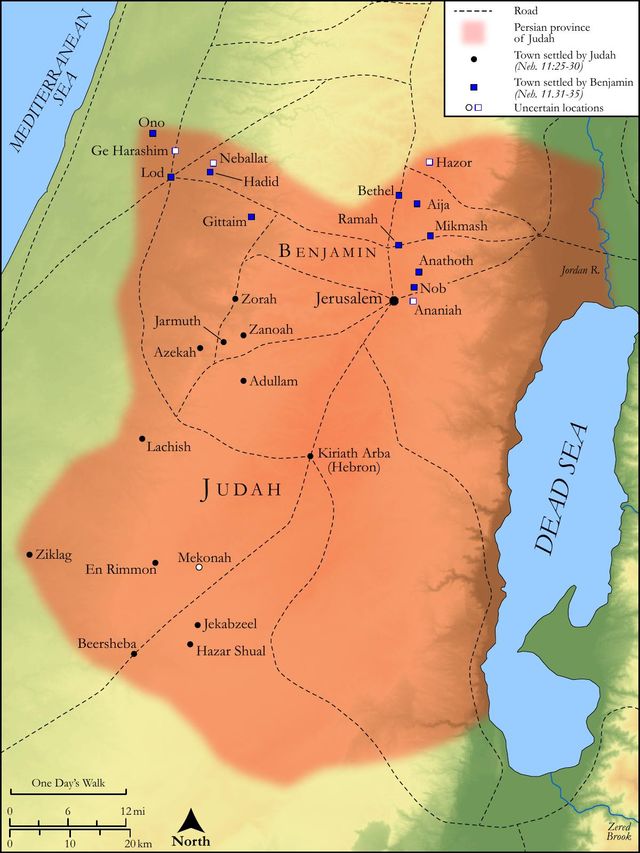
- עֲנָתוֹתa·na·TotAnathothH6068N-properNoun Proper Location
- נֹבnoNobH5011N-properNoun Proper Location
- עֲנָנְיָה'a·Na·ne·YahAnaniahH6055N-properNoun Proper Location
English is a literal word-by-word gloss of the Hebrew, not the KJV's wording. Why?
This is the original text the KJV's translators worked from — each Hebrew word with its own literal English meaning in this verse, prepared by scholars at Tyndale House, Cambridge. The KJV translates whole sentences, not word by word, so its wording differs: one Hebrew word can become several English words, and the KJV may choose “the LORD” where the gloss reads “Yahweh”. Both are faithful — they answer different questions. For the KJV's own rendering, switch to the KJV text.
Details
See on the biblical-era map
Study this verse
Public-domain commentary
Matthew Henry
From his Commentary on the Whole Bible. Henry comments on passages, not single verses — this entry covers Nehemiah 11:20–36.
Having given an account of the principal persons that dwelt in Jerusalem (a larger account of whom he had before, Ch1 9:2, etc.), Nehemiah, in these verses, gives us some account of the other cities, in which dwelt the residue of Israel, Neh 11:20. It was requisite that Jerusalem should be replenished, yet not so as to drain the country. The king himself is served of the field, which will do little service if there be not hands to manage it. Let there therefore be no strife, no envy, no contempt, no ill will, between the inhabitants of the cities and those of the villages; both are needful, both useful, and neither can be spared. 1. The Nethinims, the posterity of the Gibeonites, dwelt in Ophel, which was upon the wall of Jerusalem (Neh 3:26), because they were to do the servile work of the temple, which therefore they must be posted near to, that they might be ready to attend, Neh 11:21. 2. Though the Levites were dispersed through the cities of Judah, yet they had an overseer who resided in Jerusalem, superior of their order and their provincial, to whom they applied for direction, who took care of their affairs and took cognizance of their conduct, whether they did their duty, Neh 11:22. 3. Some of the singers were appointed to look after the necessary repairs of the temple, being ingenious men, and having leisure between their hours of service; they were over the business of the house of God, Neh 11:22. And, it seems, the king of Persia had such a kindness for their office that he allotted a particular maintenance for them, besides what belonged to them as Levites, Neh 11:23. 4. Here is one that was the king's commissioner at Jerusalem. He was of the posterity of Zerah (Neh 11:24); for of that family of Judah there were some new settled in Jerusalem, and not all of Pharez, as appears by that other catalogue, Ch1 9:6. He is said to be at the king's hand, or on the king's part, in all matters concerning the people, to determine controversies that arose between the king's officers and his subjects, to see that what was due to the king from the people was duly paid in and what was allowed by the king for the temple service was duly paid out, and happy it was for the Jews that one of themselves was in this post. 5. Here is an account of the villages, or country towns, which were inhabited by the residue of Israel - the towns in which the children of Judah dwelt (Neh 11:25-30), those that were inhabited by the children of Benjamin (Neh 11:31-35), and divisions for the Levites among both, Neh 11:36. We will now suppose them safe and easy, though few and poor, but by the blessing of God they were likely to increase in wealth and power, and they would have been more likely if there had not been that general profaneness among them, and lukewarmness in religion, with which they were charged in God's name by the prophet Malachi, who, it is supposed, prophesied about this time, and in whom prophecy ceased for some ages, till it revived in the great prophet and his forerunner.
Continue studying Nehemiah 11:32 across the web’s major study libraries — every link below opens this exact verse, chapter, or book on the destination site.
Read & Compare
 BibleGatewayThis verse in more than 200 translations and 70 languages.
 Bible.comThe YouVersion reader — hundreds of translations, reading plans, and highlights.
 ESV.orgCrossway's official English Standard Version reader.
 NET BibleThe NET translation with 60,000+ translators' notes on every rendering decision.
 STEP BibleTyndale House's free study tool — original text, vocabulary, and scholarly resources.
 BibliaLogos Bible Software's free web reader.
 USCCBThe New American Bible (Revised Edition) with the U.S. bishops' study notes.
Commentaries
 BibleHub CommentariesDozens of classic commentaries on this verse, gathered on one page.
 StudyLightMore than 100 commentary sets — the largest collection on the web.
 BibleRefPlain-English commentary on what this verse means, verse by verse.
 Enduring WordDavid Guzik's free commentary on this chapter, widely used by Bible teachers.
 Bible Study ToolsVerse commentary alongside Greek and Hebrew study aids.
Original Language & Research
- BibleHub InterlinearThe verse word by word — original language, transliteration, and English.
- BibleHub LexiconEvery word's original-language definition and Strong's entry.
 Blue Letter BibleDeep-study tools — Strong's numbers, concordance, and word studies.
 SefariaThe Hebrew text with Rashi and centuries of Jewish commentary.
Sermons, Hymns & Audio


TrulyRandomVerse is not affiliated with these sites and doesn’t control their content. They’re linked because they’re genuinely useful.
Summary
Nehemiah 11:32 precisely enumerates three significant towns—Anathoth, Nob, and Ananiah—situated within the ancestral territory of Benjamin, which were meticulously repopulated by the returning Jewish exiles. This verse functions as a vital component of a broader administrative record, meticulously detailing the comprehensive re-establishment of communities beyond Jerusalem's walls, thereby underscoring the diligent and divinely orchestrated effort to restore both the land and its people following the devastation of the Babylonian captivity. It powerfully highlights God's unwavering faithfulness in fulfilling His ancient promises of return and the organized, dedicated labor of the post-exilic community in diligently rebuilding their societal and spiritual foundations.
Context
ShowHideLiterary Context
Nehemiah 11 follows the completion of Jerusalem's walls and the dedication ceremony, marking a transition from physical reconstruction to societal re-establishment. The chapter focuses on the repopulation efforts, first in Jerusalem itself (Nehemiah 11:1-2), and then extending to the surrounding towns and villages in Judah and Benjamin. This detailed enumeration of places and families, including Nehemiah 11:32, serves a crucial administrative and theological purpose: it provides a verifiable record of the returned exiles, demonstrates the fulfillment of God's promises to bring His people back to their land, and emphasizes the continuity of Israelite heritage and tribal territories. These lists are consistent with similar genealogical and geographical records found elsewhere in the post-exilic books, such as Ezra 2 and Nehemiah 7, reinforcing the meticulous nature of the restoration.
Historical & Cultural Context
The setting is the mid-fifth century BC, during the Persian Empire's rule, approximately a century after the initial return from Babylonian exile. The land of Judah had been largely desolate for decades, and the returning exiles faced immense challenges in rebuilding not only infrastructure but also a functioning society. Repopulating the ancestral lands was vital for reasserting their claim to the territory, establishing a stable economy, and preserving their distinct cultural and religious identity. The mention of specific towns, particularly priestly cities like Anathoth and Nob, signifies the return of key societal functions and religious practices. The act of resettlement was not merely practical; it was a profound act of faith, demonstrating belief in God's covenant promises and a commitment to re-establishing the nation in accordance with divine will.
Key Themes
ShowHideNehemiah 11:32, within its broader context, contributes to several significant themes. The most prominent is Restoration and Repopulation, showcasing the meticulous, divinely guided effort to bring life back to the desolate land and its people. This is intimately linked to Divine Providence and Faithfulness, as the very act of returning and resettling fulfills long-standing prophetic promises (e.g., Jeremiah 29:10-14). The detailed lists also highlight Order and Organization, reflecting Nehemiah's administrative genius and the community's commitment to rebuilding a structured society, not just walls. Furthermore, the return to specific historical towns emphasizes the Continuity of Heritage and Identity, reaffirming the people's connection to their ancestral lands and the legacy of their forefathers, ensuring that the post-exilic community saw themselves as the rightful inheritors of God's covenant with Israel, as seen in the broader narrative of Nehemiah 9.
Exposition and Analysis
ShowHideKey Word Analysis
ShowHideAs a plural of a root meaning 'answers' or 'echoes,' this name refers to a place in Palestine and the name of two Israelites. Anathoth was a significant Levitical city in the territory of Benjamin (Joshua 21:18). It is most famously known as the hometown of the prophet Jeremiah (Jeremiah 1:1), who even purchased a field there as a sign of future restoration during the siege of Jerusalem (Jeremiah 32:6-15). Its repopulation here signifies the return of priestly and Levitical families to their traditional dwelling places, vital for the re-establishment of religious life.
Meaning "fruit," Nob was a priestly city located near Jerusalem. It holds historical significance as the place where David received the showbread and Goliath's sword from Ahimelech the priest while fleeing from Saul (1 Samuel 21:1-6). Tragically, it was later destroyed by King Saul for its perceived assistance to David (1 Samuel 22:19). Its inclusion in this list speaks to the comprehensive nature of the repopulation, bringing life back even to places with a history of devastation.
Derived from roots meaning "Jah has covered," Ananiah is the name of an Israelite and a place in Palestine. This town is less prominent in biblical narratives compared to Anathoth or Nob, being mentioned primarily here. Its inclusion, despite its obscurity, underscores the thoroughness of the resettlement efforts, indicating that the restoration extended beyond the major historical or religious centers to encompass the entire tribal territory of Benjamin.
Verse Breakdown
ShowHide"[And] at Anathoth"
This phrase marks the beginning of the list of specific towns in Benjamin. The mention of Anathoth immediately evokes its rich history as a priestly city and the birthplace of the prophet Jeremiah. Its repopulation is not merely a demographic detail but a symbolic act, signifying the return of religious leadership and the re-establishment of a community with deep prophetic roots. It represents a tangible step in the fulfillment of God's promises to restore His people to their ancestral lands.
"Nob"
Following Anathoth, Nob is listed, another priestly city with a significant, albeit tragic, history. Its inclusion highlights the comprehensive nature of the resettlement. The return to Nob, a place once devastated by King Saul's wrath, suggests a theme of healing and renewal. It signifies that God's restoration extends even to places marked by past suffering, bringing new life where there was once destruction and ensuring the continuity of the priestly lineage and its associated functions.
"Ananiah"
The final town listed in this verse, Ananiah, though less historically prominent, is equally important in the context of the repopulation. Its inclusion demonstrates that the resettlement was not limited to famous or historically significant sites but encompassed the entire tribal territory of Benjamin. This detail emphasizes the meticulous and widespread effort to re-establish a complete and functioning society, ensuring that every part of the ancestral land was re-inhabited, contributing to the overall strength and continuity of the post-exilic community.
Literary Devices
ShowHideThe primary literary device employed in Nehemiah 11:32, and indeed throughout much of Nehemiah 11, is Enumeration or Listing. This technique serves to provide a detailed, verifiable record of the towns and families involved in the repopulation, emphasizing the administrative precision and the tangible fulfillment of divine promises. The sheer volume of names and places underscores the comprehensive nature of the restoration project. Furthermore, the inclusion of historically significant places like Anathoth and Nob utilizes Historical Allusion, drawing upon the reader's knowledge of past biblical narratives to add depth and meaning to the current act of repopulation. These allusions connect the present restoration to the broader sweep of Israel's history, reinforcing themes of continuity, divine faithfulness, and the enduring nature of God's covenant with His people. The repetition of similar lists across Ezra and Nehemiah also functions as a form of Reinforcement, emphasizing the importance of these records for identity and heritage.
Theological and Thematic Connections
ShowHideNehemiah 11:32, though a simple list of names, carries profound theological weight. It is a testament to God's unwavering faithfulness to His covenant promises, demonstrating His active involvement in bringing His people back to the land He swore to their ancestors. The meticulous detail of these lists underscores that God's plan is comprehensive, extending even to the seemingly mundane specifics of geography and demography. It highlights the importance of place and community in God's redemptive narrative, showing that the physical re-establishment of Israel was a vital part of their spiritual renewal. This verse also implicitly speaks to the perseverance required in God's work; the returnees faced immense challenges, yet they diligently worked to rebuild not just walls, but a structured, vibrant society, trusting in God's overarching providence.
Reflection and Application
ShowHideThe seemingly dry list of names in Nehemiah 11:32 offers a powerful reminder that God cares about every detail of His plan and our lives. Just as He meticulously oversaw the repopulation of specific towns, ensuring His people were re-established in their ancestral lands, so too does He orchestrate the intricate details of our individual journeys and the communities we are part of. This verse calls us to recognize the divine hand in what might appear to be ordinary or administrative tasks. It encourages us to persevere in "rebuilding" our lives, families, and churches—whether from spiritual desolation, relational brokenness, or societal disruption—trusting that God is working through our diligent efforts. It also underscores the vital role of community and belonging in sustaining faith, reminding us that we are called not to isolated spirituality but to be part of a vibrant, organized body that reflects God's order and purpose.
Questions for Reflection
ShowHideFAQ
ShowHideWhy are these lists of names and places so important in the Bible?
ShowHideThese lists, like the one in Nehemiah 11:32, are crucial for several reasons. First, they provide historical and genealogical accuracy, verifying the identity of the returning exiles and their tribal affiliations, which was essential for land claims and maintaining the covenant lineage. Second, they demonstrate the fulfillment of prophetic promises regarding Israel's return to their land after exile, showcasing God's faithfulness. Third, they highlight the organized and deliberate nature of the post-exilic restoration under leaders like Nehemiah and Ezra, emphasizing the importance of order and administration in God's work. Finally, they underscore the theme of continuity, connecting the present community to their ancestral heritage and the broader narrative of God's people, as seen in similar lists in Ezra 2 and the censuses in Numbers 26.
What is the significance of Anathoth and Nob specifically being mentioned?
ShowHideAnathoth and Nob are significant because they were both priestly cities, indicating the return of the Levitical families crucial for re-establishing temple worship and religious life. Anathoth is particularly notable as the hometown of the prophet Jeremiah, who even purchased land there as a prophetic sign of future restoration (see Jeremiah 32:6-15). Nob holds historical importance as the place where David sought refuge from King Saul and received the showbread (see 1 Samuel 21:1-6). Its tragic destruction by Saul (see 1 Samuel 22:19) makes its repopulation a powerful symbol of healing and restoration, showing that God brings life back even to places marked by past devastation. Their inclusion underscores the comprehensive nature of the return, encompassing both prophetic heritage and historical recovery.
Christ-Centered Fulfillment
ShowHideThe physical repopulation and restoration of towns like Anathoth, Nob, and Ananiah in Nehemiah 11:32 serve as a powerful Old Testament foreshadowing of the comprehensive spiritual restoration found in Jesus Christ. Just as the returning exiles were brought back to their ancestral land to rebuild a physical community, Christ's work on the cross brings humanity back into right relationship with God, rebuilding broken lives and creating a new spiritual community. The meticulous detail of the repopulation lists points to God's precise and intentional plan for redemption, culminating in the ultimate "rebuilder" and "restorer," Jesus, who reconciles all things to Himself (see Colossians 1:19-20). The re-establishment of the physical temple and its surrounding communities in Nehemiah points forward to the building of the spiritual temple, the Church, where believers are living stones built into a holy dwelling place for God (see Ephesians 2:19-22 and 1 Peter 2:4-5). Ultimately, the gathering of the scattered exiles prefigures the grand gathering of all nations and tribes into God's eternal kingdom through the Lamb, Jesus Christ, fulfilling the promise of a people for God from every tongue and nation (see Revelation 7:9-10).