


2 Samuel 13:23
Bible text: King James Version (1769 Blayney text) · Public domain
Bible text: Berean Standard Bible · Public domain
Bible text: American Standard Version (1901) · Public domain
Bible text: World English Bible, Messianic edition · Public domain
Bible text: Geneva Bible (1599) · Public domain
Bible text: Young's Literal Translation · Public domain
- וַיְהִיvay·Hiand it wasH1961Conj-w ¦ V-Qal-ConsecImperf-3msVerb Qal Consecutive Imperfect 3rd Singular Masculineוַandיְהִיit was
- לִשְׁנָתַיִםlish·na·Ta·yimto two yearsH8141Prep-l ¦ N-fdNoun Dual Feminine Absoluteלִtoשְׁנָתַיִםtwo years
- יָמִיםya·MimdaysH3117N-mpNoun Plural Masculine Absolute
- וַיִּהְיוּvai·yih·Yuand they belongedH1961Conj-w ¦ V-Qal-ConsecImperf-3mpVerb Qal Consecutive Imperfect 3rd Plural Masculineוַandיִּהְיוּthey belonged
- גֹזְזִיםgo·ze·ZimshearersH1494V-Qal-Prtcpl-mpVerb Qal Participle Plural Masculine Absolute
- לְאַבְשָׁלוֹםle·'av·sha·Lomto AbsalomH53Prep-l ¦ N-proper-mNoun Proper MasculineלְtoאַבְשָׁלוֹםAbsalom
- בְּבַעַלbe·Va·'alat BaalH1178Prep-b ¦ N-properNoun Proper LocationבְּatבַעַלBaal
- חָצוֹרcha·TzorHazorH1178N-properNoun Proper Location
- אֲשֶׁר'a·SherwhichH834RelParticle Relative
- עִם'im[is] nearH5973PrepPreposition
- אֶפְרָיִם'ef·Ra·yimEphraimH669N-proper-mNoun Proper Masculine
- וַיִּקְרָאvai·yik·Ra'and he invitedH7121Conj-w ¦ V-Qal-ConsecImperf-3msVerb Qal Consecutive Imperfect 3rd Singular Masculineוַandיִּקְרָאhe invited
- אַבְשָׁלוֹם'av·sha·LomAbsalomH53N-proper-mNoun Proper Masculine
- לְכָלle·khol<to> allH3605Prep-l ¦ N-mscNoun Singular Masculine Constructלְ<to>כָלall
- בְּנֵיbe·Nei[the] sons ofH1121N-mpcNoun Plural Masculine Construct
- הַמֶּלֶךְha·Me·lekhthe kingH4428Art ¦ N-msNoun Singular Masculine Absoluteהַtheמֶּלֶךְking
English is a literal word-by-word gloss of the Hebrew, not the KJV's wording. Why?
This is the original text the KJV's translators worked from — each Hebrew word with its own literal English meaning in this verse, prepared by scholars at Tyndale House, Cambridge. The KJV translates whole sentences, not word by word, so its wording differs: one Hebrew word can become several English words, and the KJV may choose “the LORD” where the gloss reads “Yahweh”. Both are faithful — they answer different questions. For the KJV's own rendering, switch to the KJV text.
Details
See on the biblical-era maps

Study this verse
Public-domain commentary
Matthew Henry
From his Commentary on the Whole Bible. Henry comments on passages, not single verses — this entry covers 2 Samuel 13:21–29. His three-level outline is real structure in the source text, so it is rendered as structure.
What Solomon says of the beginning of strife is as true of the beginning of all sin, it is as the letting forth of water; when once the flood-gates are plucked up, an inundation follows; one mischief begets another, and it is hard to say what shall be in the end thereof.
I.We are here told how David resented the tidings of Amnon's sin:
He was very wroth, Sa2 13:21. So he had reason to be, that his own son should do such a wicked thing and draw him to be accessory to it. It would be a reproach to him for not giving him a better education; it would be a blot upon his family, the ruin of his daughter, a bad example to his kingdom, and a wrong to his son's soul. But was it enough for him to be angry? He ought to have punished his son for it, and have put him to open shame; both as a father and as a king he had power to do it. But the Septuagint here adds these words: But he saddened not the spirit of his son Amnon, because he loved him, because he was his first-born. He fell into Eli's error, whose sons made themselves vile, and he frowned not on them. If Amnon was dear to him, his punishing him would have been so much the greater punishment to himself for his own uncleanness. But he cannot bear the shame those must submit to who correct that in others which they are conscious of in themselves, and therefore his anger must serve instead of his justice; and this hardens sinners, Ecc 8:11.
II.How Absalom resented it.
He resolves already to do the part of a judge in Israel; and, since his father will not punish Amnon, he will, from a principle, not of justice or zeal for virtue, but of revenge, because he reckons himself affronted in the abuse done to his sister. Their mother was daughter to a heathen prince (Sa2 3:3), which perhaps they were upbraided with sometimes by their brethren, as children of a stranger. As such a one Absalom thought his sister was now treated; and, if Amnon thought her fit to be made his harlot, he would think him fit to be made his slave. This enraged him, and nothing less than the blood of Amnon will quench his rage. Here we have,
1.The design conceived: Absalom hated Amnon (Sa2 13:22), and he that hateth his brother is a murderer already, and, like Cain, is of that wicked one, Jo1 3:12, Jo1 3:15. Absalom's hatred of his brother's crime would have been commendable, and he might justly have prosecuted him for it by a due course of law, for example to others, and the making of some compensation to his injured sister; but to hate his person, and design his death by assassination, was to put a great affront upon God, by offering to repair the breach of his seventh commandment by the violation of his sixth, as if they were not all alike sacred. But he that said, Do not commit adultery, said also, Do not kill, Jam 2:11.
2.The design concealed. He said nothing to Amnon of this matter, either good or bad, appeared as if he did not know it, and maintained towards him his usual civility, only waiting for a fair opportunity to do him a mischief. That malice is the worst,
(1.)Which is hidden closely, and has no vent given to it. If Absalom had reasoned the matter with Amnon, he might have convinced him of his sin and brought him to repentance; but, saying nothing, Amnon's heart was hardened, and his own more and more embittered against him; therefore rebuking our neighbour is opposed to hating him in our hearts, Lev 19:17. Let passion have vent and it will spend itself.
(2.)Which is gilded over with a show of friendship; so Absalom's was, his words smoother than butter but war in his heart. See Pro 26:26.
(3.)Which is harboured long. Two full years Absalom nursed this root of bitterness, Sa2 13:24. It may be, at first, he did not intend to kill his brother (for, if he had, he might have had as fair an opportunity to do it as he had at last), and only waited for an occasion to disgrace him or do him some other mischief; but in time his hatred ripened to this, that he would be no less than the death of him. If the sun going down once upon the wrath gives such place to the devil (as is intimated, Eph 4:26, Eph 4:27), what would the sunsets of two full years do?
3.The design laid.
(1.)Absalom has a feast at his house in the country, as Nabal had, on occasion of his sheep-shearing, Sa2 13:23. Attentive as Absalom was to his person (Sa2 14:26), and as high as he looked, he knew the state of his flocks and looked well to his herds. Those who have no other care about their estates in the country than how to spend them in the town take a ready way to see the end of them. When Absalom had sheep-shearers he would himself be with them.
(2.)To this feast he invites the king his father, and all the princes of the blood (Sa2 13:24), not only that he might have this opportunity to pay his respects to them, but that he might make himself the more respected among his neighbours. Those that are akin to great folks are apt to value themselves too much on their kindred.
(3.)The king would not go himself, because he would not put him to the expense of his entertainment, Sa2 13:25. It seems Absalom had an estate in his own hands, on which he lived like himself; the king had given it to him, but would have him to be a good husband of it: in both these he is an example to parents, when their children have grown up, to give them a competency to live upon, according to their rank, and then to take care that they do not live above it, especially that they be no way accessory to their doing so. It is prudent for young house-keepers to begin as they can hold out, and not to spend the wool upon the shearing of it.
(4.)Absalom got leave for Amnon, and all the rest of the king's sons, to come and grace his table in the country, Sa2 13:26, Sa2 13:27. Absalom had so effectually concealed his enmity to Amnon that David saw no reason to suspect any design upon him in that particular invitation: "Let my brother Amnon go;" but this would make the stroke more cutting to David that he was himself drawn in to consent to that which gave the opportunity for it, as before, Sa2 13:7. It seems, David's sons, though grown up, continued to pay such a deference to their father as not to go such a small journey as this without leave. Thus ought children, even when they have become men and women, to honour their parents, consult them, and do nothing material without their consent, much less against their mind.
4.The design executed, Sa2 13:28, Sa2 13:29.
(1.)Absalom's entertainment was very plentiful; for he resolves that they shall all be merry with wine, at least concludes that Amnon will be so, for he knew that he was apt to drink to excess. But,
(2.)The orders he gave to his servants concerning Amnon, that they should mingle his blood with his wine, were very barbarous. Had he challenged him, and, in reliance upon the goodness of his cause and the justice of God, fought him himself, though that would have been bad enough, yet it would have been more honourable and excusable (our ancient law, in some cases, allowed trial by battle); but to murder him, as he did, was to copy Cain's example, only that the reason made a difference: Abel was slain for his righteousness, Amnon for his wickedness. Observe the aggravations of this sin: - [1.] He would have Amnon slain when his heart was merry with wine, and he was consequently least apprehensive of danger, least able to resist it, and also least fit to go out of the world; as if his malice aimed to destroy both soul and body, not giving him time to say, Lord, have mercy upon me. What a dreadful surprise hath death been to many, whose hearts have been overcharged with surfeiting and drunkenness! [2.] His servants must be employed to do it, and so involved in the guilt. He was to give the word of command - Smite Amnon; and then they, in obedience to him, and, upon presumption that his authority would bear them out, must kill him. What an impious defiance does he bid to the divine law, when, though the command of God is express, Thou shalt not kill, he bids them kill Amnon, with this warrant, "Have not I commanded you? That is enough. Be courageous, and fear neither God nor man." Those servants are ill taught who obey their masters in contradiction to God, and those are wicked masters who have taught them to do so. Those are too obsequious that will damn their souls to please their masters, whose big words cannot secure them from God's wrath. Masters must always command their servants as those that know they also have a Master in heaven. [3.] He did it in the presence of all the king's sons, of whom it is said (Sa2 8:18) that they were chief rulers; so that it was an affront to public justice which they had the administration of, and to the king his father whom they represented, and a contempt of that sword which should have been a terror to his evil deeds, while his evil deeds, on the contrary, were a terror to those that bore it. [4.] There is reason to suspect that Absalom did this, not only to revenge his sister's quarrel, but to make way for himself to the throne, which he was ambitious of, and which he would stand fair for if Amnon the eldest son was taken off. When the word of command was given Absalom's servants failed not to execute it, being buoyed up with an opinion that their master, being now next heir to the crown (for Chileab was dead, as bishop Patrick thinks), would save them from harm. Now the threatened sword is drawn in David's house which should not depart from it. First, His eldest son falls by it, himself being, by his wickedness, the cause of it, and his father, by his connivance, accessory to it. Secondly, All his sons flee from it, and come home in terror, not knowing how far their brother Absalom's bloody design might extend. See what mischief sin makes in families.
Continue studying 2 Samuel 13:23 across the web’s major study libraries — every link below opens this exact verse, chapter, or book on the destination site.
Read & Compare
 BibleGatewayThis verse in more than 200 translations and 70 languages.
 Bible.comThe YouVersion reader — hundreds of translations, reading plans, and highlights.
 ESV.orgCrossway's official English Standard Version reader.
 NET BibleThe NET translation with 60,000+ translators' notes on every rendering decision.
 STEP BibleTyndale House's free study tool — original text, vocabulary, and scholarly resources.
 BibliaLogos Bible Software's free web reader.
 USCCBThe New American Bible (Revised Edition) with the U.S. bishops' study notes.
Commentaries
 BibleHub CommentariesDozens of classic commentaries on this verse, gathered on one page.
 StudyLightMore than 100 commentary sets — the largest collection on the web.
 BibleRefPlain-English commentary on what this verse means, verse by verse.
 Enduring WordDavid Guzik's free commentary on this chapter, widely used by Bible teachers.
 Bible Study ToolsVerse commentary alongside Greek and Hebrew study aids.
Original Language & Research
- BibleHub InterlinearThe verse word by word — original language, transliteration, and English.
- BibleHub LexiconEvery word's original-language definition and Strong's entry.
 Blue Letter BibleDeep-study tools — Strong's numbers, concordance, and word studies.
 SefariaThe Hebrew text with Rashi and centuries of Jewish commentary.
Sermons, Hymns & Audio


TrulyRandomVerse is not affiliated with these sites and doesn’t control their content. They’re linked because they’re genuinely useful.
Summary
After two full years of simmering resentment and calculated planning following the rape of his sister Tamar by their half-brother Amnon, 2 Samuel 13:23 marks the pivotal moment Absalom initiates his long-awaited revenge. This verse meticulously sets the stage for a tragic and destructive turn within David's royal household, revealing Absalom's patient and deceptive plotting as he prepares a seemingly innocent festive gathering—a sheepshearing event—to which he extends an invitation to all the king's sons, specifically targeting Amnon for assassination. It powerfully underscores the dangerous consequences of unaddressed sin and the insidious, destructive power of harbored bitterness within a family and a kingdom.
Context
ShowHideLiterary Context
This verse serves as a crucial narrative hinge in the unfolding tragedy of David's family, immediately following the horrific account of Amnon's sexual assault on Tamar and Absalom's subsequent, chillingly silent rage (2 Samuel 13:1-22). The "two full years" mentioned here are not a period of reconciliation or healing, but rather a deliberate and ominous interval that underscores Absalom's cold-blooded planning and the depth of his vengeful resolve. This passage directly precedes the execution of Absalom's meticulously orchestrated plot against Amnon, culminating in Amnon's murder and Absalom's subsequent flight (2 Samuel 13:24-39). The entire section is part of a larger, somber narrative detailing the domestic troubles, moral decay, and divine judgment within David's house, directly fulfilling the prophecy pronounced by Nathan in 2 Samuel 12:10, that "the sword shall never depart from your house." The narrative skillfully builds suspense, meticulously showcasing Absalom's patience, cunning, and treachery as he orchestrates his revenge.
Historical & Cultural Context
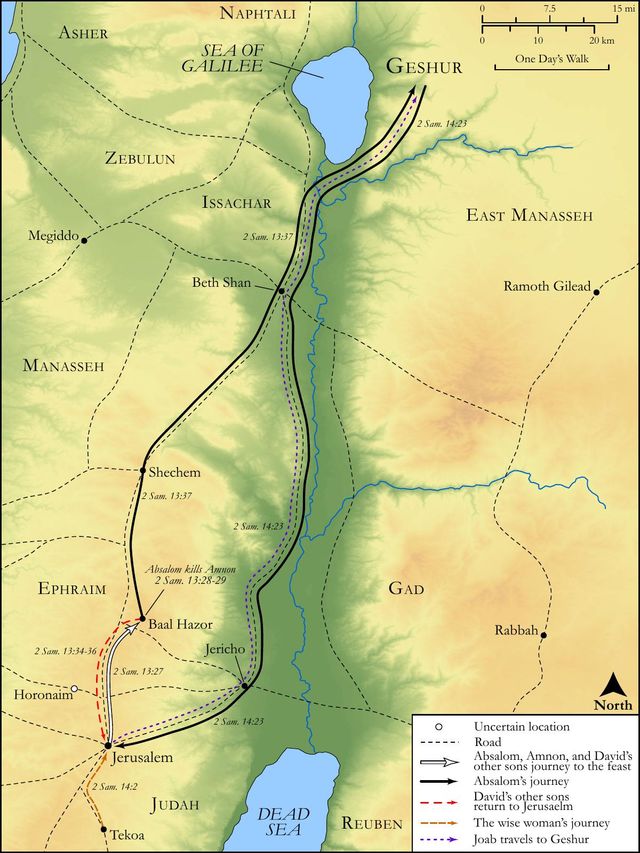
Sheepshearing was a significant annual event in ancient Israel, comparable in its social and economic importance to a harvest festival. It was a time of great celebration, feasting, and often revelry, involving large gatherings of family, servants, and guests. Such events could last for several days and were known for their lavish hospitality and abundance, sometimes leading to excessive indulgence and drunkenness, as vividly illustrated by the story of Nabal's feast in 1 Samuel 25:2-11. Absalom's choice of a sheepshearing festival in Baalhazor, a location likely on his own estate near Ephraim, provided both a culturally plausible and seemingly innocent reason for gathering the royal sons, and a somewhat remote setting conducive to his sinister plan. This cultural backdrop highlights Absalom's profound cunning in exploiting a customary festive occasion as a deceptive veil for his murderous intentions, making his invitation appear innocuous while masking a deadly trap.
Key Themes
ShowHideThis verse powerfully contributes to several overarching themes within the book of 2 Samuel and the broader Deuteronomistic History. Firstly, it exemplifies the destructive consequences of unaddressed sin and the breakdown of justice within David's household, directly echoing the divine judgment pronounced upon David for his own sins in 2 Samuel 12:10-12. David's lamentable failure to punish Amnon adequately for his abhorrent crime against Tamar creates a dangerous vacuum of justice that Absalom feels compelled to fill with his own brand of vengeance. Secondly, it highlights the chilling theme of calculated revenge and deception. Absalom's two years of silent brooding are not a period of forgiveness or reconciliation, but rather a testament to meticulous, cold-blooded planning, demonstrating the insidious and corrosive nature of harbored bitterness. The seemingly innocent invitation to a celebratory event serves as a treacherous trap, showcasing Absalom's profound duplicity. Finally, the verse underscores the inherent fragility of royal succession and family dynamics within David's nascent kingdom, where internal strife, moral failings, and the pursuit of personal retribution threaten to unravel the very fabric of the monarchy.
Exposition and Analysis
ShowHideKey Word Analysis
ShowHideThis word, appearing in the plural with "two full," emphasizes the significant passage of time. The two years were not merely an elapsed period but a deliberate interval, allowing Absalom's anger to mature into a cold, calculated resolve for revenge. This extended duration highlights the premeditated nature of his actions, contrasting sharply with Amnon's impulsive and immediate sin. It signifies a period of patient, methodical planning rather than a spontaneous outburst of rage.
Derived from a root meaning "to cut off" or "to shear," this term refers to the workers engaged in the annual shearing of sheep. As discussed, sheepshearing festivals were major social and economic events, typically accompanied by feasting and celebration. Absalom's choice of this occasion is profoundly significant; it provides a culturally acceptable and seemingly innocent reason to gather the royal family, especially Amnon, without arousing suspicion. It serves as a perfect, deceptive cover for his sinister intentions, demonstrating his cunning exploitation of social custom for a deadly purpose.
This verb, meaning "to call out to," "to summon," or "to invite," appears innocuous on the surface, implying hospitality and familial gathering. However, in this specific context, it carries a chilling undertone of manipulation and entrapment. Absalom's invitation is not a genuine gesture of reconciliation or fellowship but a carefully calculated lure designed to bring his intended victim into a vulnerable and isolated position. The specific mention of "all the king's sons" further emphasizes the breadth of his deceptive hospitality, making the trap appear more natural and less targeted.
Verse Breakdown
ShowHide"And it came to pass after two full years"
This opening clause immediately establishes the passage of a significant and deliberate amount of time since the rape of Tamar. The "two full years" are presented not as a period of healing or forgetting, but rather as a calculated interval during which Absalom's anger has solidified into a cold, methodical plan for revenge, highlighting his patience and cunning approach.
"that Absalom had sheepshearers in Baalhazor, which [is] beside Ephraim"
This clause sets the precise scene for the impending tragedy. It describes the occasion—a sheepshearing festival, a time traditionally associated with feasting and revelry—and its strategic location. Baalhazor, near Ephraim, was likely Absalom's own estate, providing him with complete control over the environment and a degree of remoteness, making it an ideal, isolated setting for his plot to unfold without immediate detection or intervention.
"and Absalom invited all the king's sons"
This final clause reveals Absalom's deceptive and treacherous strategy. The invitation, seemingly a gesture of familial goodwill for a festive occasion, is in fact a meticulously laid trap. By inviting "all the king's sons," Absalom creates an appearance of general hospitality and normalcy, cunningly masking his specific and singular intention to isolate and eliminate Amnon, the primary target of his long-held and festering vengeance.
Literary Devices
ShowHideThe verse effectively employs several literary devices to build profound tension and reveal character. Foreshadowing is prominently used, as the "two full years" of ominous silence following Tamar's rape strongly hint at a brewing storm, indicating that Absalom's quietude is not forgiveness but a chilling prelude to a violent and premeditated act. The seemingly mundane yet festive setting of the sheepshearing event, starkly juxtaposed with Absalom's sinister and murderous intentions, creates a powerful sense of irony. What should inherently be a joyous and communal family gathering becomes, through Absalom's manipulation, the tragic stage for a fratricide. Furthermore, the narrative masterfully builds suspense by revealing Absalom's patient and meticulous preparation without immediately disclosing his full, deadly plan, thereby leaving the reader to anticipate the inevitable and tragic outcome of his deeply harbored bitterness.
Theological and Thematic Connections
ShowHide2 Samuel 13:23 serves as a stark and sobering reminder of the devastating ripple effects of unaddressed sin and the perilous consequences of unpunished injustice. David's lamentable failure to act decisively and justly in the immediate aftermath of Amnon's heinous crime created a moral vacuum within his household that Absalom felt compelled to fill with his own brand of brutal vengeance. This verse powerfully underscores the profound theological truth that sin, when left unpunished, unrepented, or unaddressed, often begets further sin and a cascading cycle of violence and tragedy, thereby fulfilling the prophetic warning that "the sword shall never depart from your house" (2 Samuel 12:10). Absalom's calculated revenge, meticulously cloaked in deceptive hospitality, stands in stark and chilling contrast to God's righteous call for justice tempered with mercy, for genuine forgiveness, and for true reconciliation. It vividly highlights the destructive nature of unbridled bitterness and the human tendency to seek personal retribution rather than trusting in divine justice or pursuing restorative paths of peace.
Reflection and Application
ShowHideThis verse serves as a profound and timeless cautionary tale for individuals, families, and communities across all generations. Absalom's two years of silent, brooding plotting vividly demonstrate the corrosive power of unaddressed bitterness and the inherent danger of allowing resentment to fester unchecked within the heart. When deep wrongs are not confronted justly, when forgiveness is withheld, or when reconciliation is neglected, the seeds of future conflict, destructive actions, and profound tragedy are inevitably sown. For us today, this passage is a powerful and urgent call to deal with sin and interpersonal conflict promptly, openly, and justly, rather than allowing anger, resentment, or a desire for personal revenge to consume our souls. It challenges us to honestly examine our own hearts for any harbored resentment, urging us to actively seek reconciliation, courageously offer forgiveness, and faithfully trust in God's ultimate and perfect justice, rather than taking matters into our own fallible hands. It reminds us that true and lasting peace comes not from vengeance or retribution, but from living in accordance with God's righteous and loving ways, even when faced with deep personal hurt and profound injustice.
Questions for Reflection
ShowHideFAQ
ShowHideWhy did Absalom wait "two full years" before acting?
ShowHideAbsalom's two-year waiting period was not a sign of forgetting or forgiving Amnon's heinous crime against Tamar, but rather a deliberate and meticulously calculated strategy. This extended silence allowed the initial shock and outrage surrounding the event to subside, making his subsequent invitation to the sheepshearing festival appear more natural and less suspicious to King David and the other royal sons. It also afforded Absalom ample time to meticulously plan the assassination, ensuring he could execute his revenge at an opportune moment and in a setting where he had complete control. This chilling patience underscores his profound cunning and the depth of his vengeful resolve, transforming a spontaneous desire for retribution into a cold, premeditated act. It also highlights King David's lamentable failure to address the injustice, which tragically allowed Absalom's bitterness to fester and grow into a deadly plot.
What was the significance of the "sheepshearers" event?
ShowHideThe sheepshearing festival was a major annual event in ancient Israel, marking the culmination of the shearing season. It was a time of great celebration, feasting, and often revelry, akin to a modern harvest festival. Wealthy landowners would host lavish banquets, inviting family, friends, and workers, sometimes for several days. Absalom chose this event precisely because its festive and communal nature provided a perfect, culturally acceptable cover for his sinister plot. It offered a plausible, innocent reason to gather all the king's sons, including Amnon, in a somewhat remote location (Baalhazor, near Ephraim) where Absalom had control and could execute his plan without immediate suspicion or intervention. This cultural context profoundly underscores Absalom's deceptive brilliance in using a joyous and customary occasion as a deadly trap.
Christ-Centered Fulfillment
ShowHideThe tragic narrative of 2 Samuel 13:23, with Absalom's chillingly calculated revenge and the resulting fratricide, stands in stark and profound contrast to the redemptive work of Jesus Christ. While Absalom patiently plotted murder, exploiting a festive occasion as a deceptive trap, Christ patiently endured suffering, willingly offering his own life as a perfect sacrifice for the redemption of humanity. Absalom's actions vividly highlight the destructive power of human vengeance and the endless cycle of violence that inevitably results from unaddressed sin and a thirst for retribution, a cycle that ultimately led to the cross. Jesus, the true and righteous Son of David, did not come to exact revenge for the myriad wrongs committed against Him or His Father; instead, He came to offer radical forgiveness and ultimate reconciliation. He is the ultimate "Lamb of God, who takes away the sin of the world!" (John 1:29) who willingly laid down His life, not at a sheepshearing festival of earthly revelry, but on the cross of Calvary, to bear the weight of the world's sin. Unlike Absalom, whose actions brought division, death, and further sorrow to David's house, Christ's patient endurance, self-sacrificial love, and resurrection bring eternal life, profound peace, and true justice, breaking the destructive cycle of vengeance and offering a transformative path to genuine reconciliation with God and with one another (Romans 5:8, Colossians 1:19-20).