


2 Samuel 13:25
Bible text: King James Version (1769 Blayney text) · Public domain
Bible text: King James Version with Strong's numbers · Public domain
Bible text: Berean Standard Bible · Public domain
Bible text: American Standard Version (1901) · Public domain
Bible text: World English Bible, Messianic edition · Public domain
Bible text: Geneva Bible (1599) · Public domain
Bible text: Young's Literal Translation · Public domain
- וַיֹּאמֶרvai·Yo·merand he saidH559Conj-w ¦ V-Qal-ConsecImperf-3msVerb Qal Consecutive Imperfect 3rd Singular Masculineוַandיֹּאמֶרhe said
- הַמֶּלֶךְha·Me·lekhthe kingH4428Art ¦ N-msNoun Singular Masculine Absoluteהַtheמֶּלֶךְking
- אֶל'eltoH413PrepPreposition
- אַבְשָׁלוֹם'av·sha·LomAbsalomH53N-proper-mNoun Proper Masculine
- אַל'almay [we] notH408NegParticle Negative
- בְּנִיbe·Nimy O sonH1121N-msc ¦ 1csNoun Singular Masculine ConstructבְּנִO sonיmy
- אַל'almay notH408NegParticle Negative
- נָאna'pleaseH4994PrtParticle Interjection
- נֵלֵךְne·leKhwe goH1980V-Qal-Imperf-1cpVerb Qal Imperfect 1st Plural common gender
- כֻּלָּנוּku·La·nuall of usH3605N-msc ¦ 1cpNoun Singular Masculine Constructכֻּלָּall ofנוּus
- וְלֹאve·Lo'and notH3808Conj-w ¦ NegParticle Negativeוְandלֹאnot
- נִכְבַּדnikh·Badwe will be heavyH3513V-Qal-Imperf-1cpVerb Qal Imperfect 1st Plural common gender
- עָלֶיךָ'a·Lei·khaon youH5921Prep ¦ 2msPreposition Definiteעָלֶיonךָyou
- וַיִּפְרָץvai·yif·rotzand he urgedH6555Conj-w ¦ V-Qal-ConsecImperf-3msVerb Qal Consecutive Imperfect 3rd Singular Masculineוַandיִּפְרָץhe urged
- בּוֹbo<in> <the> himPrep-b ¦ 3msSuffix Personal 3rd Singular Masculineבּ<in> <the>וֹhim
- וְלֹאve·lo'and notH3808Conj-w ¦ NegParticle Negativeוְandלֹאnot
- אָבָה'a·Vahhe was willingH14V-Qal-Perf-3msVerb Qal Perfect 3rd Singular Masculine
- לָלֶכֶתla·Le·khetto goH1980Prep-l ¦ V-Qal-InfVerb Qal Infinitive Constructלָtoלֶכֶתgo
- וַיְבָרֲכֵהוּVay·va·ra·Khe·huand he blessed himH1288Conj-w ¦ V-Piel-ConsecImperf-3ms ¦ 3msVerb Piel Consecutive Imperfect 3rd Singular Masculineוַandיְבָרֲכֵhe blessedהוּhim
English is a literal word-by-word gloss of the Hebrew, not the KJV's wording. Why?
This is the original text the KJV's translators worked from — each Hebrew word with its own literal English meaning in this verse, prepared by scholars at Tyndale House, Cambridge. The KJV translates whole sentences, not word by word, so its wording differs: one Hebrew word can become several English words, and the KJV may choose “the LORD” where the gloss reads “Yahweh”. Both are faithful — they answer different questions. For the KJV's own rendering, switch to the KJV text.
Details
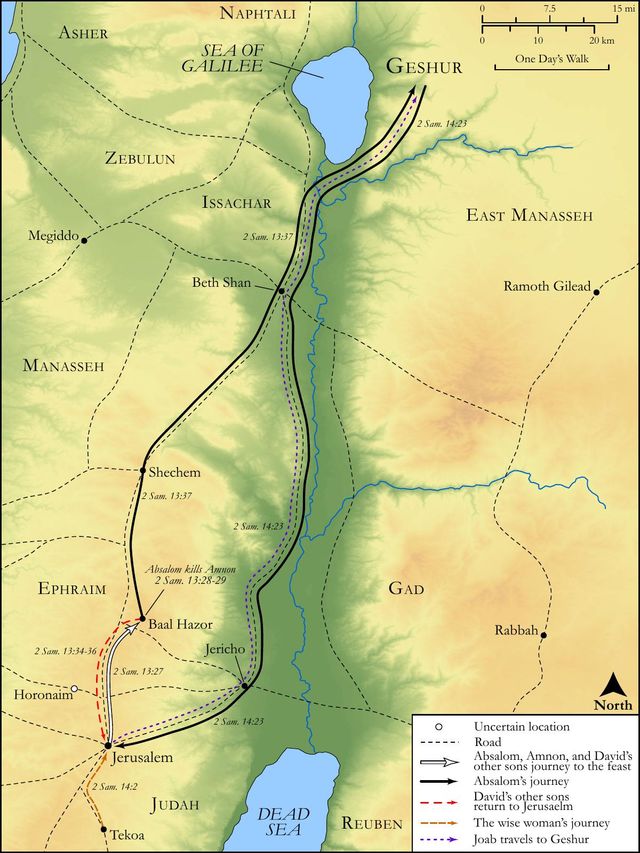
See on the biblical-era maps

Study this verse
Public-domain commentary
Matthew Henry
From his Commentary on the Whole Bible. Henry comments on passages, not single verses — this entry covers 2 Samuel 13:21–29. His three-level outline is real structure in the source text, so it is rendered as structure.
What Solomon says of the beginning of strife is as true of the beginning of all sin, it is as the letting forth of water; when once the flood-gates are plucked up, an inundation follows; one mischief begets another, and it is hard to say what shall be in the end thereof.
I.We are here told how David resented the tidings of Amnon's sin:
He was very wroth, Sa2 13:21. So he had reason to be, that his own son should do such a wicked thing and draw him to be accessory to it. It would be a reproach to him for not giving him a better education; it would be a blot upon his family, the ruin of his daughter, a bad example to his kingdom, and a wrong to his son's soul. But was it enough for him to be angry? He ought to have punished his son for it, and have put him to open shame; both as a father and as a king he had power to do it. But the Septuagint here adds these words: But he saddened not the spirit of his son Amnon, because he loved him, because he was his first-born. He fell into Eli's error, whose sons made themselves vile, and he frowned not on them. If Amnon was dear to him, his punishing him would have been so much the greater punishment to himself for his own uncleanness. But he cannot bear the shame those must submit to who correct that in others which they are conscious of in themselves, and therefore his anger must serve instead of his justice; and this hardens sinners, Ecc 8:11.
II.How Absalom resented it.
He resolves already to do the part of a judge in Israel; and, since his father will not punish Amnon, he will, from a principle, not of justice or zeal for virtue, but of revenge, because he reckons himself affronted in the abuse done to his sister. Their mother was daughter to a heathen prince (Sa2 3:3), which perhaps they were upbraided with sometimes by their brethren, as children of a stranger. As such a one Absalom thought his sister was now treated; and, if Amnon thought her fit to be made his harlot, he would think him fit to be made his slave. This enraged him, and nothing less than the blood of Amnon will quench his rage. Here we have,
1.The design conceived: Absalom hated Amnon (Sa2 13:22), and he that hateth his brother is a murderer already, and, like Cain, is of that wicked one, Jo1 3:12, Jo1 3:15. Absalom's hatred of his brother's crime would have been commendable, and he might justly have prosecuted him for it by a due course of law, for example to others, and the making of some compensation to his injured sister; but to hate his person, and design his death by assassination, was to put a great affront upon God, by offering to repair the breach of his seventh commandment by the violation of his sixth, as if they were not all alike sacred. But he that said, Do not commit adultery, said also, Do not kill, Jam 2:11.
2.The design concealed. He said nothing to Amnon of this matter, either good or bad, appeared as if he did not know it, and maintained towards him his usual civility, only waiting for a fair opportunity to do him a mischief. That malice is the worst,
(1.)Which is hidden closely, and has no vent given to it. If Absalom had reasoned the matter with Amnon, he might have convinced him of his sin and brought him to repentance; but, saying nothing, Amnon's heart was hardened, and his own more and more embittered against him; therefore rebuking our neighbour is opposed to hating him in our hearts, Lev 19:17. Let passion have vent and it will spend itself.
(2.)Which is gilded over with a show of friendship; so Absalom's was, his words smoother than butter but war in his heart. See Pro 26:26.
(3.)Which is harboured long. Two full years Absalom nursed this root of bitterness, Sa2 13:24. It may be, at first, he did not intend to kill his brother (for, if he had, he might have had as fair an opportunity to do it as he had at last), and only waited for an occasion to disgrace him or do him some other mischief; but in time his hatred ripened to this, that he would be no less than the death of him. If the sun going down once upon the wrath gives such place to the devil (as is intimated, Eph 4:26, Eph 4:27), what would the sunsets of two full years do?
3.The design laid.
(1.)Absalom has a feast at his house in the country, as Nabal had, on occasion of his sheep-shearing, Sa2 13:23. Attentive as Absalom was to his person (Sa2 14:26), and as high as he looked, he knew the state of his flocks and looked well to his herds. Those who have no other care about their estates in the country than how to spend them in the town take a ready way to see the end of them. When Absalom had sheep-shearers he would himself be with them.
(2.)To this feast he invites the king his father, and all the princes of the blood (Sa2 13:24), not only that he might have this opportunity to pay his respects to them, but that he might make himself the more respected among his neighbours. Those that are akin to great folks are apt to value themselves too much on their kindred.
(3.)The king would not go himself, because he would not put him to the expense of his entertainment, Sa2 13:25. It seems Absalom had an estate in his own hands, on which he lived like himself; the king had given it to him, but would have him to be a good husband of it: in both these he is an example to parents, when their children have grown up, to give them a competency to live upon, according to their rank, and then to take care that they do not live above it, especially that they be no way accessory to their doing so. It is prudent for young house-keepers to begin as they can hold out, and not to spend the wool upon the shearing of it.
(4.)Absalom got leave for Amnon, and all the rest of the king's sons, to come and grace his table in the country, Sa2 13:26, Sa2 13:27. Absalom had so effectually concealed his enmity to Amnon that David saw no reason to suspect any design upon him in that particular invitation: "Let my brother Amnon go;" but this would make the stroke more cutting to David that he was himself drawn in to consent to that which gave the opportunity for it, as before, Sa2 13:7. It seems, David's sons, though grown up, continued to pay such a deference to their father as not to go such a small journey as this without leave. Thus ought children, even when they have become men and women, to honour their parents, consult them, and do nothing material without their consent, much less against their mind.
4.The design executed, Sa2 13:28, Sa2 13:29.
(1.)Absalom's entertainment was very plentiful; for he resolves that they shall all be merry with wine, at least concludes that Amnon will be so, for he knew that he was apt to drink to excess. But,
(2.)The orders he gave to his servants concerning Amnon, that they should mingle his blood with his wine, were very barbarous. Had he challenged him, and, in reliance upon the goodness of his cause and the justice of God, fought him himself, though that would have been bad enough, yet it would have been more honourable and excusable (our ancient law, in some cases, allowed trial by battle); but to murder him, as he did, was to copy Cain's example, only that the reason made a difference: Abel was slain for his righteousness, Amnon for his wickedness. Observe the aggravations of this sin: - [1.] He would have Amnon slain when his heart was merry with wine, and he was consequently least apprehensive of danger, least able to resist it, and also least fit to go out of the world; as if his malice aimed to destroy both soul and body, not giving him time to say, Lord, have mercy upon me. What a dreadful surprise hath death been to many, whose hearts have been overcharged with surfeiting and drunkenness! [2.] His servants must be employed to do it, and so involved in the guilt. He was to give the word of command - Smite Amnon; and then they, in obedience to him, and, upon presumption that his authority would bear them out, must kill him. What an impious defiance does he bid to the divine law, when, though the command of God is express, Thou shalt not kill, he bids them kill Amnon, with this warrant, "Have not I commanded you? That is enough. Be courageous, and fear neither God nor man." Those servants are ill taught who obey their masters in contradiction to God, and those are wicked masters who have taught them to do so. Those are too obsequious that will damn their souls to please their masters, whose big words cannot secure them from God's wrath. Masters must always command their servants as those that know they also have a Master in heaven. [3.] He did it in the presence of all the king's sons, of whom it is said (Sa2 8:18) that they were chief rulers; so that it was an affront to public justice which they had the administration of, and to the king his father whom they represented, and a contempt of that sword which should have been a terror to his evil deeds, while his evil deeds, on the contrary, were a terror to those that bore it. [4.] There is reason to suspect that Absalom did this, not only to revenge his sister's quarrel, but to make way for himself to the throne, which he was ambitious of, and which he would stand fair for if Amnon the eldest son was taken off. When the word of command was given Absalom's servants failed not to execute it, being buoyed up with an opinion that their master, being now next heir to the crown (for Chileab was dead, as bishop Patrick thinks), would save them from harm. Now the threatened sword is drawn in David's house which should not depart from it. First, His eldest son falls by it, himself being, by his wickedness, the cause of it, and his father, by his connivance, accessory to it. Secondly, All his sons flee from it, and come home in terror, not knowing how far their brother Absalom's bloody design might extend. See what mischief sin makes in families.
Continue studying 2 Samuel 13:25 across the web’s major study libraries — every link below opens this exact verse, chapter, or book on the destination site.
Read & Compare
 BibleGatewayThis verse in more than 200 translations and 70 languages.
 Bible.comThe YouVersion reader — hundreds of translations, reading plans, and highlights.
 ESV.orgCrossway's official English Standard Version reader.
 NET BibleThe NET translation with 60,000+ translators' notes on every rendering decision.
 STEP BibleTyndale House's free study tool — original text, vocabulary, and scholarly resources.
 BibliaLogos Bible Software's free web reader.
 USCCBThe New American Bible (Revised Edition) with the U.S. bishops' study notes.
Commentaries
 BibleHub CommentariesDozens of classic commentaries on this verse, gathered on one page.
 StudyLightMore than 100 commentary sets — the largest collection on the web.
 BibleRefPlain-English commentary on what this verse means, verse by verse.
 Enduring WordDavid Guzik's free commentary on this chapter, widely used by Bible teachers.
 Bible Study ToolsVerse commentary alongside Greek and Hebrew study aids.
Original Language & Research
- BibleHub InterlinearThe verse word by word — original language, transliteration, and English.
- BibleHub LexiconEvery word's original-language definition and Strong's entry.
 Blue Letter BibleDeep-study tools — Strong's numbers, concordance, and word studies.
 SefariaThe Hebrew text with Rashi and centuries of Jewish commentary.
Sermons, Hymns & Audio


TrulyRandomVerse is not affiliated with these sites and doesn’t control their content. They’re linked because they’re genuinely useful.
Summary
Second Samuel 13:25 captures a pivotal and tragically ironic exchange between King David and his son Absalom, setting the stage for the violent climax of Absalom's premeditated revenge against Amnon. David, exhibiting a blend of paternal concern and practical caution, declines Absalom's invitation for the entire royal household to attend a sheep-shearing feast, citing the potential logistical and financial burden. Despite David's refusal to attend personally, Absalom's relentless and manipulative insistence, culminating in David's seemingly benign blessing, tragically enables Absalom's sinister plot to proceed, underscoring David's profound lack of discernment regarding the deep-seated malice festering within his own family.
Context
ShowHideLiterary Context
This verse is intricately woven into the dark tapestry of David's family dysfunction, immediately following the abhorrent rape of Tamar by her half-brother Amnon in 2 Samuel 13:1-19. David's muted and inadequate response to Amnon's sin, described as merely being "very wroth" but taking no punitive action (2 Samuel 13:21), left Tamar's full brother, Absalom, consumed by a silent, simmering hatred for two full years (2 Samuel 13:22). Absalom's invitation to the sheep-shearing feast, extended to all the king's sons, including Amnon, is not an act of genuine hospitality but a meticulously crafted trap, a calculated move to isolate and eliminate his half-brother. David's initial refusal in this verse, followed by Absalom's unwavering persistence and David's subsequent blessing, builds intense dramatic tension, directly preceding the violent and tragic fulfillment of Absalom's premeditated revenge against Amnon (2 Samuel 13:28-29).
Historical & Cultural Context
Sheep-shearing feasts in ancient Israel were significant annual events, often marking a time of prosperity and joyous celebration, akin to a harvest festival. These gatherings were typically large, boisterous affairs, sometimes extending over several days, characterized by abundant feasting, drinking, and revelry. Such occasions provided a natural and unsuspecting cover for Absalom's sinister intentions, as the presence of numerous guests and the general atmosphere of indulgence would make a violent act less conspicuous and easier to conceal. David's concern about being "chargeable" (a burden) reflects the substantial cost and logistical effort involved in hosting the king and his large retinue, which would include numerous servants, guards, and provisions. This practical consideration was a common aspect of royal hospitality in that day, where the host bore a significant financial and resource strain, highlighting David's genuine, albeit tragically misplaced, concern for Absalom's resources.
Key Themes
ShowHideThis verse powerfully contributes to several overarching themes within the book of 2 Samuel and the broader narrative of David's reign. It starkly illustrates the devastating consequences of unaddressed sin, as David's failure to justly punish Amnon directly fuels Absalom's vengeful plot, fulfilling the prophetic judgment against David's house. The passage also vividly portrays Absalom's calculated manipulation and deceptive nature, as he masterfully uses a seemingly innocent social custom to achieve his murderous aims. Furthermore, David's recurring motif of parental blindness and lack of full discernment, despite his initial caution, is highlighted, demonstrating how his personal failings lead to profound tragedy within his own household, echoing the divine judgment pronounced in 2 Samuel 12:10-11. The fragility and internal strife of the royal family are vividly portrayed, revealing the deep fissures tearing apart David's kingdom from within.
Exposition and Analysis
ShowHideKey Word Analysis
ShowHideDerived from a root meaning "to build," this word refers to a male offspring, often implying a builder or inheritor of the family name. In David's address, "my son," it underscores the paternal relationship and affection that David still holds for Absalom, a stark contrast to the murderous intentions Absalom harbors. This term highlights the tragic familial bond being exploited and ultimately broken.
This primitive root means "to be heavy" or "weighty." While it can denote honor or glory, in this context, David uses it to express a concern about the significant financial and logistical burden his and his sons' presence would impose on Absalom. It signifies a substantial imposition of resources and effort, revealing David's practical, yet tragically superficial, understanding of the invitation's true implications.
This verb, meaning "to break out" or "to urge strongly," conveys Absalom's unwavering determination and manipulative intent. It signifies that he is not merely suggesting or inviting, but actively pushing and insisting, demonstrating his calculated resolve to ensure Amnon's presence at the feast, regardless of David's initial reluctance.
Verse Breakdown
ShowHide"And the king said to Absalom, Nay, my son, let us not all now go, lest we be chargeable unto thee."
David's initial response is a firm refusal, rooted in a practical concern. He expresses a paternal consideration for Absalom's resources, fearing that hosting the entire royal entourage would be an excessive financial and logistical burden. His address, "my son," reveals a tender affection, tragically highlighting David's limited understanding of the true, sinister nature of Absalom's invitation.
"And he pressed him:"
This concise clause powerfully conveys Absalom's relentless insistence and manipulative resolve. It underscores his single-minded focus on his hidden agenda, demonstrating that his persistence is not born of genuine hospitality but is a strategic move to ensure his meticulously planned plot unfolds precisely as intended.
"howbeit he would not go, but blessed him."
Despite Absalom's strong urging, David remains steadfast in his decision not to attend personally, indicating a degree of prudence. However, his subsequent action of "blessing him" (Absalom) serves as a tragic concession. While seemingly benign—perhaps an attempt to appease his son or express goodwill—this blessing inadvertently removes David's protective presence and, by implication, grants Absalom the freedom to proceed with the feast, tragically facilitating his murderous scheme.
Literary Devices
ShowHideThe passage masterfully employs several literary devices to heighten its dramatic impact and underscore the unfolding tragedy. Dramatic Irony is profoundly evident, as the audience is privy to Absalom's murderous plot against Amnon, while King David remains largely oblivious, citing a mundane concern about being "chargeable." This creates a chilling contrast between David's paternal affection and Absalom's cold, calculated malice. Foreshadowing permeates the tense exchange, subtly hinting at the impending tragedy. Absalom's insistent "pressing" builds significant suspense, signaling to the discerning reader that his intentions are far from innocent and that a sinister event is on the horizon. The stark contrast between David's cautious prudence and Absalom's relentless, manipulative determination vividly underscores the profound dysfunction within the royal family and the dark, vengeful path Absalom has chosen.
Theological and Thematic Connections
ShowHideThis seemingly simple exchange between father and son is fraught with profound theological significance, serving as a powerful illustration of the insidious nature of unaddressed sin and its devastating, far-reaching consequences. David's failure to act decisively and justly against Amnon's heinous crime created a vacuum of justice that Absalom, consumed by bitterness and a thirst for vengeance, filled with his own violent agenda. The passage underscores the biblical principle that sin, when left unpunished, unconfessed, or unrepented, festers and produces bitter fruit, often extending its destructive reach far beyond the initial transgression, impacting entire families and communities. It also highlights the critical importance of spiritual discernment, especially for those in leadership, as David's inability to perceive the true depth of Absalom's malice and the calculated nature of his invitation ultimately contributes to the unfolding tragedy. The narrative serves as a stark reminder that evil often operates under a veil of normalcy, using social customs and familial ties as a deceptive cover for its destructive schemes.
Reflection and Application
ShowHideThe tragic events surrounding 2 Samuel 13:25 offer profound lessons for contemporary believers, particularly regarding the critical need for discernment and the imperative to address sin and conflict biblically and proactively. David's well-intentioned but ultimately misguided caution, coupled with his inability to grasp the true depth of Absalom's vengeful heart, serves as a sobering cautionary tale for all who lead, whether in families, churches, or communities. We are called to cultivate spiritual sensitivity, praying for wisdom to discern not only the obvious dangers but also the subtle undercurrents of malice, manipulation, or unresolved bitterness that might exist in our relationships. This passage reminds us that unresolved sin, whether our own or that of others, does not simply disappear; it festers and can erupt in devastating ways, often under the guise of normalcy or even hospitality. It compels us to be proactive in seeking reconciliation, pursuing justice, and confronting sin with grace and truth, rather than allowing resentment to take root and lead to destructive outcomes that can tear apart the fabric of our relationships and communities.
Questions for Reflection
ShowHideFAQ
ShowHideWhy was David seemingly so blind to Absalom's true intentions, despite his initial caution?
ShowHideDavid's apparent blindness can be attributed to several complex factors. Firstly, his own past failures, particularly the Bathsheba affair and the subsequent murder of Uriah, may have dulled his spiritual sensitivity and moral authority, making him less capable of discerning and confronting sin within his own household. The prophet Nathan's declaration that "the sword shall never depart from your house" (2 Samuel 12:10) was already at work, and David might have been emotionally exhausted or overwhelmed by the consequences of his own actions, leading to a form of parental fatigue or denial. Secondly, it is inherently difficult for a parent to imagine such extreme treachery, especially murder, from their own child; David's paternal love, though flawed, may have clouded his judgment, leading him to interpret Absalom's persistence as mere youthful enthusiasm or respect, rather than a calculated, murderous plot. Finally, the narrative itself highlights David's struggle with effective leadership and discipline within his family, a recurring theme that culminates in the tragic events involving Amnon, Tamar, and Absalom, demonstrating a pattern of passive or inadequate responses to familial crises.
What was the significance of a "sheep-shearing feast" in this context, beyond being a social gathering?
ShowHideA sheep-shearing feast was a significant annual event in ancient Israel, marking the culmination of a prosperous season for shepherds and their families. It was a time of great celebration, feasting, and often revelry, similar to a harvest festival, where large quantities of food and wine would be consumed. In this context, its significance is profoundly strategic for Absalom's plot. First, it provided a natural and unsuspecting cover for Absalom's murderous intentions. The large gathering, the consumption of alcohol, and the general atmosphere of celebration would make it easier to isolate Amnon and carry out the assassination without immediate suspicion, as the chaos and indulgence of the feast would mask the violence. Second, it was an occasion where all the king's sons would naturally be expected to attend, making Absalom's invitation seem innocuous and even customary. This allowed Absalom to gather his intended victim and the other princes in one place, under the guise of a festive occasion, thereby facilitating his premeditated act of revenge against Amnon.
Christ-Centered Fulfillment
ShowHideThe tragic narrative of David's family, encapsulated in 2 Samuel 13:25, profoundly underscores the devastating consequences of sin and the profound brokenness of humanity, ultimately pointing to the perfect Kingship and redemptive work of Jesus Christ. David, despite being a man after God's own heart, was a flawed king whose personal sins and failures to exercise justice led to deep-seated family dysfunction and division, fulfilling the prophecy that "the sword shall never depart from your house" (2 Samuel 12:10). His inability to discern Absalom's true intentions and his passive handling of Amnon's sin stand in stark contrast to Christ, the perfect Son and King, who possesses absolute discernment of hearts and motives (John 2:24-25) and whose reign brings perfect justice and eternal peace (Isaiah 9:6-7). The manipulative plot of Absalom, leading to the murder of his brother, vividly foreshadows the ultimate rebellion against God and the destructive power of sin that separates humanity from its Creator. However, unlike Amnon, who was a wicked man, the ultimate "Lamb of God" is Jesus Christ (John 1:29), who, though innocent and without sin, was sacrificed not by a vengeful brother but by the will of God to take away the sin of the world. Through Christ's perfect sacrifice on the cross and His glorious resurrection, the cycle of sin, vengeance, and family brokenness, so tragically evident in David's house, is decisively broken, offering true reconciliation with God and restoration for all who believe (Colossians 1:19-20).