


2 Samuel 13:22
Bible text: King James Version (1769 Blayney text) · Public domain
Bible text: Berean Standard Bible · Public domain
Bible text: American Standard Version (1901) · Public domain
Bible text: World English Bible, Messianic edition · Public domain
Bible text: Geneva Bible (1599) · Public domain
Bible text: Young's Literal Translation · Public domain
- וְלֹאve·lo'and notH3808Conj-w ¦ NegParticle Negativeוְandלֹאnot
- דִבֶּרdi·Berhe spokeH1696V-Piel-Perf-3msVerb Piel Perfect 3rd Singular Masculine
- אַבְשָׁלוֹם'av·sha·LomAbsalomH53N-proper-mNoun Proper Masculine
- עִם'imwithH5973PrepPreposition
- אַמְנוֹן'am·NonAmnonH550N-proper-mNoun Proper Masculine
- לְמֵרָעle·me·Ra'<to> from badH7451Prep-l ¦ Prep-m ¦ Adj-msAdjective Singular Masculine Absoluteלְ<to>מֵfromרָעbad
- וְעַדve·'adand untoH5704Conj-w ¦ PrepPrepositionוְandעַדunto
- טוֹבTovgoodH2896Adj-msAdjective Singular Masculine Absolute
- כִּיkiforH3588PrtParticle Conditional
- שָׂנֵאsa·Ne'he hatedH8130V-Qal-Perf-3msVerb Qal Perfect 3rd Singular Masculine
- אַבְשָׁלוֹם'av·sha·lOmAbsalomH53N-proper-mNoun Proper Masculine
- אֶת'et<obj.>H853DirObjMParticle Object Indicator
- אַמְנוֹן'am·NonAmnonH550N-proper-mNoun Proper Masculine
- עַל'alonH5921PrepPreposition
- דְּבַרde·Var[the] thingH1697N-mscNoun Singular Masculine Construct
- אֲשֶׁר'a·Sher<of> thatH834RelParticle Relative
- עִנָּה'i·Nahhe had humbledH6031V-Piel-Perf-3msVerb Piel Perfect 3rd Singular Masculine
- אֵת'et<obj.>H853DirObjMParticle Object Indicator
- תָּמָרta·MarTamarH8559N-proper-fNoun Proper Feminine
- אֲחֹתוֹ'a·cho·Tohis sisterH269N-fsc ¦ 3msNoun Singular Feminine Constructאֲחֹתsisterוֹhis
English is a literal word-by-word gloss of the Hebrew, not the KJV's wording. Why?
This is the original text the KJV's translators worked from — each Hebrew word with its own literal English meaning in this verse, prepared by scholars at Tyndale House, Cambridge. The KJV translates whole sentences, not word by word, so its wording differs: one Hebrew word can become several English words, and the KJV may choose “the LORD” where the gloss reads “Yahweh”. Both are faithful — they answer different questions. For the KJV's own rendering, switch to the KJV text.
Details
See on the biblical-era maps
Study this verse
Public-domain commentary
Matthew Henry
From his Commentary on the Whole Bible. Henry comments on passages, not single verses — this entry covers 2 Samuel 13:21–29. His three-level outline is real structure in the source text, so it is rendered as structure.
What Solomon says of the beginning of strife is as true of the beginning of all sin, it is as the letting forth of water; when once the flood-gates are plucked up, an inundation follows; one mischief begets another, and it is hard to say what shall be in the end thereof.
I.We are here told how David resented the tidings of Amnon's sin:
He was very wroth, Sa2 13:21. So he had reason to be, that his own son should do such a wicked thing and draw him to be accessory to it. It would be a reproach to him for not giving him a better education; it would be a blot upon his family, the ruin of his daughter, a bad example to his kingdom, and a wrong to his son's soul. But was it enough for him to be angry? He ought to have punished his son for it, and have put him to open shame; both as a father and as a king he had power to do it. But the Septuagint here adds these words: But he saddened not the spirit of his son Amnon, because he loved him, because he was his first-born. He fell into Eli's error, whose sons made themselves vile, and he frowned not on them. If Amnon was dear to him, his punishing him would have been so much the greater punishment to himself for his own uncleanness. But he cannot bear the shame those must submit to who correct that in others which they are conscious of in themselves, and therefore his anger must serve instead of his justice; and this hardens sinners, Ecc 8:11.
II.How Absalom resented it.
He resolves already to do the part of a judge in Israel; and, since his father will not punish Amnon, he will, from a principle, not of justice or zeal for virtue, but of revenge, because he reckons himself affronted in the abuse done to his sister. Their mother was daughter to a heathen prince (Sa2 3:3), which perhaps they were upbraided with sometimes by their brethren, as children of a stranger. As such a one Absalom thought his sister was now treated; and, if Amnon thought her fit to be made his harlot, he would think him fit to be made his slave. This enraged him, and nothing less than the blood of Amnon will quench his rage. Here we have,
1.The design conceived: Absalom hated Amnon (Sa2 13:22), and he that hateth his brother is a murderer already, and, like Cain, is of that wicked one, Jo1 3:12, Jo1 3:15. Absalom's hatred of his brother's crime would have been commendable, and he might justly have prosecuted him for it by a due course of law, for example to others, and the making of some compensation to his injured sister; but to hate his person, and design his death by assassination, was to put a great affront upon God, by offering to repair the breach of his seventh commandment by the violation of his sixth, as if they were not all alike sacred. But he that said, Do not commit adultery, said also, Do not kill, Jam 2:11.
2.The design concealed. He said nothing to Amnon of this matter, either good or bad, appeared as if he did not know it, and maintained towards him his usual civility, only waiting for a fair opportunity to do him a mischief. That malice is the worst,
(1.)Which is hidden closely, and has no vent given to it. If Absalom had reasoned the matter with Amnon, he might have convinced him of his sin and brought him to repentance; but, saying nothing, Amnon's heart was hardened, and his own more and more embittered against him; therefore rebuking our neighbour is opposed to hating him in our hearts, Lev 19:17. Let passion have vent and it will spend itself.
(2.)Which is gilded over with a show of friendship; so Absalom's was, his words smoother than butter but war in his heart. See Pro 26:26.
(3.)Which is harboured long. Two full years Absalom nursed this root of bitterness, Sa2 13:24. It may be, at first, he did not intend to kill his brother (for, if he had, he might have had as fair an opportunity to do it as he had at last), and only waited for an occasion to disgrace him or do him some other mischief; but in time his hatred ripened to this, that he would be no less than the death of him. If the sun going down once upon the wrath gives such place to the devil (as is intimated, Eph 4:26, Eph 4:27), what would the sunsets of two full years do?
3.The design laid.
(1.)Absalom has a feast at his house in the country, as Nabal had, on occasion of his sheep-shearing, Sa2 13:23. Attentive as Absalom was to his person (Sa2 14:26), and as high as he looked, he knew the state of his flocks and looked well to his herds. Those who have no other care about their estates in the country than how to spend them in the town take a ready way to see the end of them. When Absalom had sheep-shearers he would himself be with them.
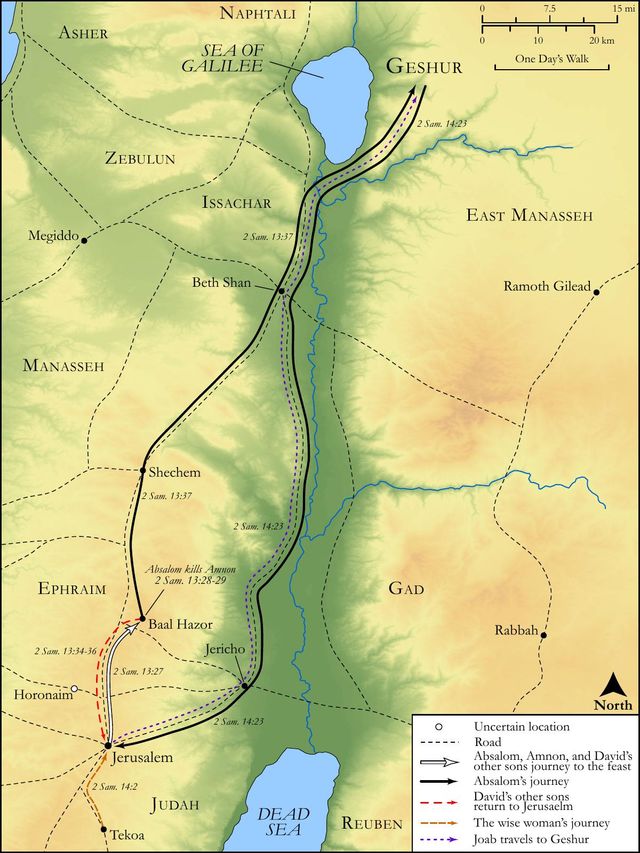
(2.)To this feast he invites the king his father, and all the princes of the blood (Sa2 13:24), not only that he might have this opportunity to pay his respects to them, but that he might make himself the more respected among his neighbours. Those that are akin to great folks are apt to value themselves too much on their kindred.
(3.)The king would not go himself, because he would not put him to the expense of his entertainment, Sa2 13:25. It seems Absalom had an estate in his own hands, on which he lived like himself; the king had given it to him, but would have him to be a good husband of it: in both these he is an example to parents, when their children have grown up, to give them a competency to live upon, according to their rank, and then to take care that they do not live above it, especially that they be no way accessory to their doing so. It is prudent for young house-keepers to begin as they can hold out, and not to spend the wool upon the shearing of it.
(4.)Absalom got leave for Amnon, and all the rest of the king's sons, to come and grace his table in the country, Sa2 13:26, Sa2 13:27. Absalom had so effectually concealed his enmity to Amnon that David saw no reason to suspect any design upon him in that particular invitation: "Let my brother Amnon go;" but this would make the stroke more cutting to David that he was himself drawn in to consent to that which gave the opportunity for it, as before, Sa2 13:7. It seems, David's sons, though grown up, continued to pay such a deference to their father as not to go such a small journey as this without leave. Thus ought children, even when they have become men and women, to honour their parents, consult them, and do nothing material without their consent, much less against their mind.
4.The design executed, Sa2 13:28, Sa2 13:29.
(1.)Absalom's entertainment was very plentiful; for he resolves that they shall all be merry with wine, at least concludes that Amnon will be so, for he knew that he was apt to drink to excess. But,
(2.)The orders he gave to his servants concerning Amnon, that they should mingle his blood with his wine, were very barbarous. Had he challenged him, and, in reliance upon the goodness of his cause and the justice of God, fought him himself, though that would have been bad enough, yet it would have been more honourable and excusable (our ancient law, in some cases, allowed trial by battle); but to murder him, as he did, was to copy Cain's example, only that the reason made a difference: Abel was slain for his righteousness, Amnon for his wickedness. Observe the aggravations of this sin: - [1.] He would have Amnon slain when his heart was merry with wine, and he was consequently least apprehensive of danger, least able to resist it, and also least fit to go out of the world; as if his malice aimed to destroy both soul and body, not giving him time to say, Lord, have mercy upon me. What a dreadful surprise hath death been to many, whose hearts have been overcharged with surfeiting and drunkenness! [2.] His servants must be employed to do it, and so involved in the guilt. He was to give the word of command - Smite Amnon; and then they, in obedience to him, and, upon presumption that his authority would bear them out, must kill him. What an impious defiance does he bid to the divine law, when, though the command of God is express, Thou shalt not kill, he bids them kill Amnon, with this warrant, "Have not I commanded you? That is enough. Be courageous, and fear neither God nor man." Those servants are ill taught who obey their masters in contradiction to God, and those are wicked masters who have taught them to do so. Those are too obsequious that will damn their souls to please their masters, whose big words cannot secure them from God's wrath. Masters must always command their servants as those that know they also have a Master in heaven. [3.] He did it in the presence of all the king's sons, of whom it is said (Sa2 8:18) that they were chief rulers; so that it was an affront to public justice which they had the administration of, and to the king his father whom they represented, and a contempt of that sword which should have been a terror to his evil deeds, while his evil deeds, on the contrary, were a terror to those that bore it. [4.] There is reason to suspect that Absalom did this, not only to revenge his sister's quarrel, but to make way for himself to the throne, which he was ambitious of, and which he would stand fair for if Amnon the eldest son was taken off. When the word of command was given Absalom's servants failed not to execute it, being buoyed up with an opinion that their master, being now next heir to the crown (for Chileab was dead, as bishop Patrick thinks), would save them from harm. Now the threatened sword is drawn in David's house which should not depart from it. First, His eldest son falls by it, himself being, by his wickedness, the cause of it, and his father, by his connivance, accessory to it. Secondly, All his sons flee from it, and come home in terror, not knowing how far their brother Absalom's bloody design might extend. See what mischief sin makes in families.
Continue studying 2 Samuel 13:22 across the web’s major study libraries — every link below opens this exact verse, chapter, or book on the destination site.
Read & Compare
 BibleGatewayThis verse in more than 200 translations and 70 languages.
 Bible.comThe YouVersion reader — hundreds of translations, reading plans, and highlights.
 ESV.orgCrossway's official English Standard Version reader.
 NET BibleThe NET translation with 60,000+ translators' notes on every rendering decision.
 STEP BibleTyndale House's free study tool — original text, vocabulary, and scholarly resources.
 BibliaLogos Bible Software's free web reader.
 USCCBThe New American Bible (Revised Edition) with the U.S. bishops' study notes.
Commentaries
 BibleHub CommentariesDozens of classic commentaries on this verse, gathered on one page.
 StudyLightMore than 100 commentary sets — the largest collection on the web.
 BibleRefPlain-English commentary on what this verse means, verse by verse.
 Enduring WordDavid Guzik's free commentary on this chapter, widely used by Bible teachers.
 Bible Study ToolsVerse commentary alongside Greek and Hebrew study aids.
Original Language & Research
- BibleHub InterlinearThe verse word by word — original language, transliteration, and English.
- BibleHub LexiconEvery word's original-language definition and Strong's entry.
 Blue Letter BibleDeep-study tools — Strong's numbers, concordance, and word studies.
 SefariaThe Hebrew text with Rashi and centuries of Jewish commentary.
Sermons, Hymns & Audio


TrulyRandomVerse is not affiliated with these sites and doesn’t control their content. They’re linked because they’re genuinely useful.
Summary
Second Samuel 13:22 offers a chilling glimpse into Absalom's calculated and ominous response to the horrific sexual assault of his sister Tamar by their half-brother Amnon. Rather than expressing immediate anger or seeking reconciliation, Absalom maintained a profound and deliberate silence, speaking "neither good nor bad." This quietude was not born of indifference but of a deep-seated, festering hatred that foreshadowed the brutal vengeance he would meticulously plan and execute, exposing the tragic unraveling of moral order within King David's own royal household.
Context
ShowHideLiterary Context
This verse is a critical turning point in the unfolding tragedy of David's family, directly following the traumatic account of Amnon's rape of Tamar. The preceding narrative meticulously details Amnon's manipulative scheme, Tamar's desperate pleas for mercy, and her subsequent public humiliation and profound grief, tearing her royal robe and putting ashes on her head (2 Samuel 13:1-19). Crucially, King David, upon hearing of the heinous atrocity, was "very angry" but conspicuously failed to take any decisive action or administer justice against Amnon, his firstborn son (2 Samuel 13:21). Absalom's chilling silence in verse 22 stands in stark contrast to Tamar's public lament and David's passive anger, serving as a dramatic pivot. It marks the precise moment where Absalom's immediate grief for his beloved sister transmutes into a cold, premeditated desire for vengeance, setting the stage for the dramatic escalation of familial conflict that would culminate in Amnon's murder two years later (2 Samuel 13:28-29).
Historical & Cultural Context
The events of 2 Samuel 13:22 are deeply embedded within the patriarchal, monarchical society of ancient Israel, where family honor, especially that of royal women, was of paramount importance. Sexual assault was not merely a personal offense but a profound dishonor to the entire family, often requiring a strong, punitive response, which could include legal action or even a death sentence for the perpetrator, particularly if the victim was a virgin and betrothed (Deuteronomy 22:25-27). The king, as the ultimate arbiter of justice and the divinely appointed leader, was expected to uphold the law and protect his subjects, especially those within his own household. David's profound failure to administer justice against Amnon for his egregious crime was a significant dereliction of both his royal and paternal duty. This inaction created a dangerous vacuum of justice, which Absalom, as Tamar's full brother and a prince, felt compelled to fill, albeit through a path of personal vengeance rather than legal recourse. This context underscores the gravity of David's failure and the cultural imperative that fueled Absalom's simmering, silent rage.
Key Themes
ShowHideThis verse powerfully contributes to several overarching themes prevalent throughout the book of 2 Samuel. Firstly, it starkly highlights the consequences of unaddressed sin and injustice. David's failure to punish Amnon for his heinous act allowed a grievous wrong to fester, creating an environment where bitterness, a desire for personal retribution, and ultimately, murder, could flourish. Secondly, it underscores the dangerous theme of human vengeance versus divine justice. Absalom's silent hatred is a chilling example of human vengeance, contrasting sharply with the righteous justice God expects and, at times, executes. Thirdly, the verse deepens the tragic portrayal of family dysfunction and moral decay within David's royal household, demonstrating how sin can ripple through generations and undermine even a divinely chosen lineage. This internal strife, rooted in unaddressed sin, foreshadows the broader rebellion Absalom would later mount against David, fueled by deep-seated grievances and a perceived lack of justice (2 Samuel 15:1-12). Finally, it speaks to the destructive power of suppressed anger and hatred, revealing how quiet, internalized resentment can be far more dangerous and lead to more devastating outcomes than open confrontation.
Exposition and Analysis
ShowHideKey Word Analysis
ShowHideThe phrase "neither good nor bad" (Hebrew, lōʾ-ṭôb wĕlōʾ-rāʿ) is an idiomatic expression that signifies a complete cessation of communication. It is not merely a neutral silence, but an ominous one, indicating that Absalom refused to engage with Amnon in any capacity, whether in a conciliatory or confrontational manner. This deliberate non-communication reveals a profound, unyielding resentment and a mind already set on a course of action that precludes any possibility of verbal engagement or reconciliation. Absalom's silence was an active, rather than passive, response, signaling deep internal plotting and a complete break in their fraternal relationship.
The verb sânêʾ denotes a profound, active, and enduring animosity, far beyond a fleeting emotion. It implies a settled disposition of enmity, a deep-seated aversion that consumes the individual. Absalom's hatred for Amnon was not simply anger but a visceral, all-encompassing loathing born from the brutal violation of his beloved sister Tamar and the profound dishonor brought upon his family. This intense hatred was the driving force behind his ominous silence and his subsequent, meticulously planned vengeful actions.
This verb, used in the Piel stem, carries the strong connotation of violent subjugation, humiliation, and violation, often specifically referring to rape. The text emphasizes that Amnon did not merely "sleep with" Tamar but "forced" or "violated" her, highlighting the egregious nature of the act and the profound trauma and dishonor inflicted upon her. This specific term underscores the gravity of Amnon's sin and provides the righteous basis for Absalom's intense, consuming hatred and his subsequent desire for retribution.
Verse Breakdown
ShowHide"And Absalom spake unto his brother Amnon neither good nor bad"
This initial clause immediately establishes the chilling tone of Absalom's response. It highlights his deliberate and complete cessation of communication with Amnon. This silence is not born of shock or confusion, but of a cold, calculating resolve. It communicates a deep, unyielding grudge that has moved beyond the realm of words into a realm of premeditated action. The absence of speech is itself a powerful form of communication, signaling a profound and irreparable break in their fraternal relationship and an ominous future.
"for Absalom hated Amnon, because he had forced his sister Tamar."
This second clause provides the explicit and morally compelling reason for Absalom's silence and his subsequent actions. His hatred was not arbitrary or irrational but deeply rooted in Amnon's despicable act of violating Tamar. The phrase "because he had forced his sister Tamar" serves as the moral justification for Absalom's deep-seated animosity, framing his hatred as a righteous response to a grave injustice and a profound dishonor to his family. This hatred, born of righteous indignation for his sister's suffering, would consume him and ultimately lead to tragic consequences, demonstrating the destructive power of unaddressed sin and personal vengeance.
Literary Devices
ShowHideThe verse employs several potent literary devices to convey its chilling message. Foreshadowing is prominently used, as Absalom's chilling silence and deep-seated hatred unmistakably point towards future violent retribution, culminating in Amnon's murder. The phrase "neither good nor bad" is a masterful use of Litotes (a form of understatement), conveying a far more intense and dangerous emotional state than a simple neutral statement would imply. It is a silence pregnant with menace and premeditation. The verse also utilizes Juxtaposition by contrasting Absalom's quiet, seething hatred with the public distress of Tamar and the passive anger of King David, highlighting the varied and often inadequate responses of characters to profound injustice. Furthermore, the Repetition of Absalom's name and the explicit statement of his hatred underscore the depth and permanence of his animosity. The entire verse functions as a dramatic Turning Point, shifting the narrative from the immediate aftermath of the assault to the long-term, devastating consequences of unaddressed sin and the unfolding tragedy of David's royal house.
Theological and Thematic Connections
ShowHideThis verse serves as a stark reminder of the destructive power of unaddressed sin and the perilous path of personal vengeance. When justice is not administered by proper authority, or when forgiveness and reconciliation are withheld, bitterness can take root and grow into a consuming hatred that leads to further sin and devastation. Absalom's silent brooding illustrates the danger of allowing grievances to fester, transforming righteous anger into a desire for retribution that ultimately usurps God's prerogative to judge. The narrative implicitly critiques David's failure to act decisively as king and father, showing how such inaction can inadvertently fuel a cycle of violence and dysfunction within a family and, by extension, within a nation. The theological lesson is clear: sin, especially when unpunished or unrepented, has far-reaching and devastating consequences, often leading to a spiral of pain and destruction that impacts many and undermines divine order.
Reflection and Application
ShowHideAbsalom's chilling silence serves as a powerful warning against the dangers of suppressed anger and unaddressed bitterness. When we experience deep hurt or injustice, it is natural to feel anger, but how we process and respond to that anger determines whether it leads to healing and reconciliation or to destruction. Allowing resentment to fester in silence, as Absalom did, can lead to a consuming hatred that ultimately harms ourselves and others, often in ways more devastating than the initial offense. This verse challenges us to confront injustice righteously, either by seeking proper channels for justice, pursuing genuine reconciliation where possible, or, when those avenues are closed, entrusting our grievances to God, who alone is the perfect judge. It underscores the importance of healthy communication, the courageous practice of forgiveness, and the active pursuit of healing, rather than allowing silent rage to dictate our actions and poison our relationships. The tragedy of David's family reminds us that sin's consequences are far-reaching, and that our responses to injustice can either perpetuate cycles of harm or break them through grace and truth, reflecting God's character.
Questions for Reflection
ShowHideFAQ
ShowHideWhy did Absalom remain silent towards Amnon, rather than confronting him directly?
ShowHideAbsalom's silence was not a sign of indifference or passive resignation, but rather a deliberate, calculated, and deeply ominous response. It indicated that his anger had solidified into a cold, festering hatred and a premeditated desire for vengeance. Direct confrontation might have led to an immediate resolution or intervention by King David, but Absalom's silence allowed his hatred to deepen and his plan for retribution to mature over two years, culminating in Amnon's murder at a sheep-shearing feast (2 Samuel 13:28). It was a sign of a mind already set on a path of no return, where words were no longer relevant or sufficient to address the profound injustice.
What was King David's responsibility in the escalation of this family tragedy?
ShowHideKing David bears significant responsibility for the tragic escalation of events. While he was "very angry" when he heard about Amnon's crime against Tamar, the text explicitly states that he did not "punish Amnon his son" (2 Samuel 13:21). As king, David was the ultimate arbiter of justice in Israel, and as a father, he had a moral and legal obligation to address such a heinous act within his own household. His failure to administer justice created a dangerous vacuum, allowing Absalom's bitterness to fester and leading him to take matters into his own hands. David's inaction demonstrated a profound weakness in leadership and contributed directly to the subsequent violence, murder, and eventual rebellion within his family.
How does this incident reflect on the moral state of David's royal household?
ShowHideThis incident reveals a profound moral decay and dysfunction within David's royal household, despite God's covenant blessings upon him. Amnon's incestuous rape of Tamar, David's failure to administer justice, and Absalom's subsequent vengeful murder expose a family riddled with sin, a lack of accountability, and a breakdown of moral order. It illustrates that even a divinely chosen king and his family are not immune to the devastating consequences of sin when it is allowed to take root and go unaddressed. This moral unraveling within the royal family foreshadows the broader troubles and rebellions that would plague David's reign, demonstrating how personal sin can have national consequences.
Christ-Centered Fulfillment
ShowHideThe tragic narrative of 2 Samuel 13:22, with its themes of grievous sin, unaddressed injustice, and the destructive power of human vengeance, finds its ultimate resolution and profound contrast in the person and work of Jesus Christ. Absalom's silent, festering hatred, meticulously planned and leading to murder, stands in stark opposition to the divine justice and perfect love embodied by Christ. Where human systems of justice fail, as David's did, Christ perfectly upholds God's righteous standards. He is the one who truly "takes away the sin of the world" (John 1:29), not by overlooking sin, but by becoming the ultimate sacrifice for it, thereby satisfying divine justice and offering true reconciliation to God (Romans 3:23-26). Unlike Absalom's vengeful act, which perpetuated a cycle of violence and further brokenness, Christ's death on the cross broke the power of sin and death, offering forgiveness, peace, and true healing to all who believe (Ephesians 2:13-16). He calls His followers not to silent hatred or personal retribution, but to love their enemies, pray for those who persecute them, and overcome evil with good (Matthew 5:43-48; Romans 12:21), demonstrating a radical, divine way of dealing with injustice and hurt that transcends human vengeance and offers true redemption.