


Judges 19:10
Bible text: King James Version (1769 Blayney text) · Public domain
Bible text: King James Version with Strong's numbers · Public domain
Bible text: Berean Standard Bible · Public domain
Bible text: American Standard Version (1901) · Public domain
Bible text: World English Bible, Messianic edition · Public domain
Bible text: Geneva Bible (1599) · Public domain
Bible text: Young's Literal Translation · Public domain
- וְלֹאve·lo'and notH3808Conj-w ¦ NegParticle Negativeוְandלֹאnot
- אָבָה'a·Vahhe was willingH14V-Qal-Perf-3msVerb Qal Perfect 3rd Singular Masculine
- הָאִישׁha·'Ishthe manH376Art ¦ N-msNoun Singular Masculine Absoluteהָtheאִישׁman
- לָלוּןla·Lunto spend [the] nightH3885Prep-l ¦ V-Qal-InfVerb Qal Infinitive Constructלָtoלוּןspend [the] night
- וַיָּקָםvai·Ya·komand he aroseH6965Conj-w ¦ V-Qal-ConsecImperf-3msVerb Qal Consecutive Imperfect 3rd Singular Masculineוַandיָּקָםhe arose
- וַיֵּלֶךְvai·Ye·lekhand he wentH1980Conj-w ¦ V-Qal-ConsecImperf-3msVerb Qal Consecutive Imperfect 3rd Singular Masculineוַandיֵּלֶךְhe went
- וַיָּבֹאvai·ya·Vo'and he cameH935Conj-w ¦ V-Qal-ConsecImperf-3msVerb Qal Consecutive Imperfect 3rd Singular Masculineוַandיָּבֹאhe came
- עַד'adtoH5704PrepPreposition
- נֹכַחNo·khachoppositeH5227Adj-mscAdjective Numerical Singular Masculine Construct
- יְבוּסye·VusJebusH2982N-properNoun Proper Location
- הִיאhi'thatH1931Pro-3fsPronoun Personal 3rd Singular Feminine
- יְרוּשָׁלִָםye·ru·sha·Lim[is] JerusalemH3389N-properNoun Proper Location
- וְעִמּוֹve·'i·Moand [were] with himH5973Conj-w ¦ Prep ¦ 3msPreposition Definiteוְandעִמּ[were] withוֹhim
- צֶמֶדTze·meda pair ofH6776N-mscNoun Singular Masculine Construct
- חֲמוֹרִיםcha·mo·RimdonkeysH2543N-cpNoun Plural common gender Absolute
- חֲבוּשִׁיםcha·vu·ShimsaddledH2280V-Qal-PassPrtcpl-mpVerb Qal Participle Passive Plural Masculine Absolute
- וּפִילַגְשׁוֹu·fi·lag·Shoand his concubineH6370Conj-w ¦ N-fsc ¦ 3msNoun Singular Feminine Constructוּandפִילַגְשׁconcubineוֹhis
- עִמּוֹi·Mo[was] with himH5973Prep ¦ 3msPreposition Definiteעִמּ[was] withוֹhim
English is a literal word-by-word gloss of the Hebrew, not the KJV's wording. Why?
This is the original text the KJV's translators worked from — each Hebrew word with its own literal English meaning in this verse, prepared by scholars at Tyndale House, Cambridge. The KJV translates whole sentences, not word by word, so its wording differs: one Hebrew word can become several English words, and the KJV may choose “the LORD” where the gloss reads “Yahweh”. Both are faithful — they answer different questions. For the KJV's own rendering, switch to the KJV text.
Details
See on the biblical-era maps
Study this verse
Public-domain commentary
Matthew Henry
From his Commentary on the Whole Bible. Henry comments on passages, not single verses — this entry covers Judges 19:1–15. His four-level outline is real structure in the source text, so it is rendered as structure.
The domestic affairs of this Levite would not have been related thus largely but to make way for the following story of the injuries done him, in which the whole nation interested themselves. Bishop Hall's first remark upon this story is, That there is no complain of a public ordered state but there is a Levite at one end of it, either as an agent or as a patient. In Micah's idolatry a Levite was active; in the wickedness of Gibeah a Levite was passive; no tribe shall sooner feel the want of government than that of Levi; and, in all the book of Judges, no mention is made of any of that tribe, but of these two. This Levite was of Mount Ephraim, Jdg 19:1. He married a wife of Bethlehem-Judah. She is called his concubine, because she was not endowed, for perhaps he had nothing to endow her with, being himself a sojourner and not settled; but it does not appear that he had any other wife, and the margin calls her a wife, a concubine, Jdg 19:1. She came from the same city that Micah's Levite came from, as if Bethlehem-Judah owed a double ill turn to Mount Ephraim, for she was as bad for a Levite's wife as the other for a Levite.
I.This Levite's concubine played the whore and eloped from her husband, Jdg 19:2.
The Chaldee reads it only that she carried herself insolently to him, or despised him, and, he being displeased at it, she went away from him, and (which was not fair) was received and entertained at her father's house. Had her husband turned her out of doors unjustly, her father ought to have pitied her affliction; but, when she treacherously departed from her husband to embrace the bosom of a stranger, her father ought not to have countenanced her sin. Perhaps she would not have violated her duty to her husband if she had not known too well where she should be kindly received. Children's ruin is often owing very much to parents' indulgence.
II.The Levite went himself to court her return.
It was a sign there was no king, no judge, in Israel, else she would have been prosecuted and put to death as an adulteress; but, instead of that, she is addressed in the kindest manner by her injured husband, who takes a long journey on purpose to beseech her to be reconciled, Jdg 19:3. If he had put her away, it would have been a crime in him to return to her again, Jer 3:1. But, she having gone away, it was a virtue in him to forgive the offence, and, though the party wronged, to make the first motion to her to be friends again. It is part of the character of the wisdom from above that it is gentle and easy to be entreated. He spoke friendly to her, or comfortably (for so the Hebrew phrase of speaking to the heart commonly signifies), which intimates that she was in sorrow, penitent fore what she had done amiss, which probably he heard of when he came to fetch her back. Thus God promises concerning adulterous Israel (Hos 2:14), I will bring her into the wilderness, and speak comfortably to her.
III.Her father made him very welcome, and, by his extraordinary kindness to him, endeavoured to atone for the countenance he had given his daughter in withdrawing from him, and to confirm him in his disposition to be reconciled to her.
1.He entertains him kindly, rejoices to see him (Jer 3:3), treats him generously for three days, Jdg 19:4. And the Levite, to show that he was perfectly reconciled, accepted his kindness, and we do not find that he upbraided him or his daughter with what had been amiss, but was as easy and as pleasant as at his first wedding-feast. It becomes all, but especially Levites, to forgive as God does. Every thing among them gave a hopeful prospect of their living comfortably together for the future; but, could they have foreseen what befel them within one day or two, how would all their mirth have been embittered and turned into mourning! When the affairs of our families are in the best posture we ought to rejoice with trembling, because we know not what troubles one day may bring forth. We cannot foresee what evil is near us, but we ought to consider what may be, that we may not be secure, as if tomorrow must needs be as this day and much more abundant, Isa 56:12.
2.He is very earnest for his stay, as a further demonstration of his hearty welcome. The affection he had for him, and the pleasure he took in his company, proceeded,
(1.)From a civil regard to him as his son-in-law and an ingrafted branch of his own house. Note, Love and duty are due to those to whom we are related by marriage as well as to those who are bone of our bone: and those that show kindness as this Levite did may expect to receive kindness as he did. And,
(2.)From a pious respect to him as a Levite, a servant of God's house; if he was such a Levite as he should be (and nothing appears to the contrary) he is to be commended for courting his stay, finding his conversation profitable, and having opportunity to learn from him the good knowledge of the Lord, hoping also that the Lord will do him good because he has a Levite to be his son-in-law, and will bless him for his sake.
[1.]He forces him to stay the fourth day, and this was kind; not knowing when they might be together again, he engages him to stay as long as he possibly could. The Levite, though nobly treated, was very urgent to be gone. A good man's heart is where his business is; for as a bird that wanders from her nest so is the man that wanders form his place. It is a sign a man has either little to do at home, or little heart to do what he has to do, when he can take pleasure in being long abroad where he has nothing to do. It is especially good to see a Levite willing to go home to his few sheep in the wilderness. Yet this Levite was overcome by importunity and kind persuasion to stay longer than he intended, Jdg 19:5-7. We ought to avoid the extreme of an over-easy yielding, to the neglect of our duty on the one hand, and that of moroseness and wilfulness, to the neglect of our friends and their kindness on the other hand. Our Saviour, after his resurrection, was prevailed upon to stay with his friends longer than he at first intimated to be his purpose, Luk 24:28, Luk 24:29.
[2.]He forces him to stay till the afternoon of the fifth day, and this, as it proved, was unkind, Jdg 19:8, Jdg 19:9. He would by no means let him go before dinner, promises him he shall have dinner early, designing thereby, as he had done the day before, to detain him another night; but the Levite was intent on the house of the Lord at Shiloh (Jdg 19:18), and, being impatient to get thither, would stay no longer. Had they set out early, they might have reached some better lodging-place than that which they were now constrained to take up with, nay, they might have got to Shiloh. Note, Our friends' designed kindnesses often prove, in the event, real injuries; what is meant for our welfare becomes a trap. Who knows what is good for a man in this life? The Levite was unwise in setting out so late; he might have got home better if he had staid a night longer and taken the day before him.
IV.In his return home he was forced to lodge at Gibeah, a city in the tribe of Benjamin, afterwards called Gibeah of Saul, which lay on his road towards Shiloh and Mount Ephraim. When it drew towards night, and the shadows of the evening were stretched out, they began to think (as it behoves us to do when we observe the day of our life hastening towards a period) where they must lodge. When night came they could not pursue their journey. He that walketh in darkness knoweth not whither he goes. They could not but desire rest, for which the night was intended, as the day for labour.
1.The servant proposed that they should lodge in Jebus, afterwards Jerusalem, but as yet in the possession of Jebusites. "Come," said the servant, "let us lodge in this city of the Jebusites," Jdg 19:11. And, if they had done so, it is probable they would have had much better usage than they met with in Gibeah of Benjamin. Debauched and profligate Israelites are worse and much more dangerous than Canaanites themselves. But the master, as became one of God's tribe, would by no means quarter, no, not one night, in a city of strangers (Jdg 19:12), not because he questioned his safety among them, but he was not willing, if he could possibly avoid it, to have so much intimacy and familiarity with them as a night's lodging came to, nor to be so much beholden to them. By shunning this place he would witness against the wickedness of those that contracted friendship and familiarity with these devoted nations. Let Israelites, Levites especially, associate with Israelites, and not with the sons of the stranger.
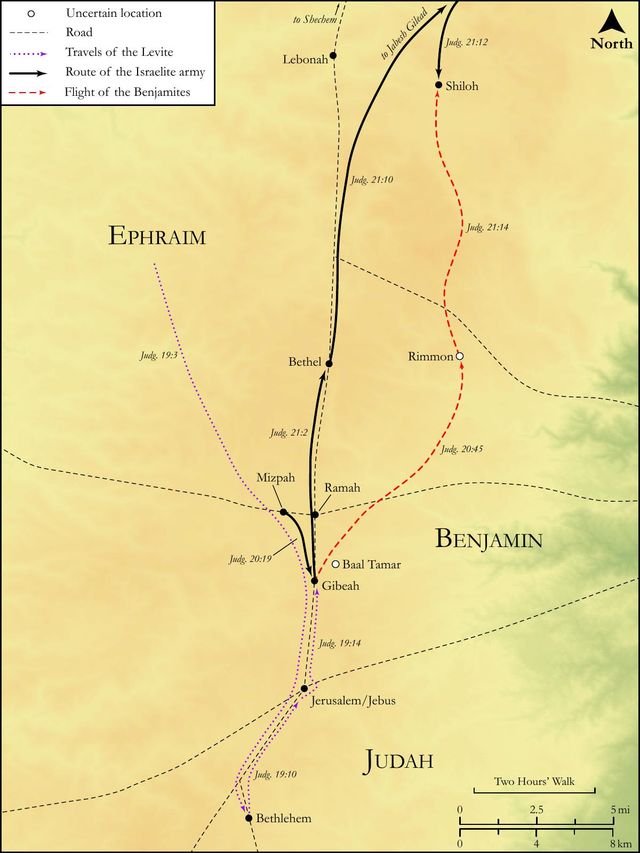
2.Having passed by Jebus, which was about five or six miles from Bethlehem (the place whence they came), and not having daylight to bring them to Ramah, they stopped at Gibeah (Jdg 19:13-15); there they sat down in the street, nobody offering them a lodging. In these countries, at that time, there were no inns, or public-houses, in which, as with us, travellers might have entertainment for their money, but they carried entertainment along with them, as this Levite did (Jdg 19:19), and depended upon the courtesy and hospitality of the inhabitants for a lodging. Let us take occasion hence, when we are in journeys, to thank God for this, among other conveniences of travelling, that there are inns to entertain strangers, and in which they may be welcome and well accommodated for their money. Surely there is no country in the world wherein one may stay at home with more satisfaction, or go abroad with more comfort, than in our own nation. This traveller, though a Levite (and to those of that tribe God had particularly commanded his people to be kind upon all occasions), met with very cold entertainment at Gibeah: No man took them into his house. If they had any reason to think he was a Levite perhaps that made those ill-disposed people the more shy of him. There are those who will have this laid to their charge at the great day, I was a stranger and you took me not in.
Historical interpretation
Historical reception
1 surviving comment on this verse from the historical church.
Concubine: She was his lawful wife, but even lawful wives are frequently in scripture called concubines. See above, chap. 8 ver. 31-ver. 16. Jemini. That is, Benjamin.
Continue studying Judges 19:10 across the web’s major study libraries — every link below opens this exact verse, chapter, or book on the destination site.
Read & Compare
 BibleGatewayThis verse in more than 200 translations and 70 languages.
 Bible.comThe YouVersion reader — hundreds of translations, reading plans, and highlights.
 ESV.orgCrossway's official English Standard Version reader.
 NET BibleThe NET translation with 60,000+ translators' notes on every rendering decision.
 STEP BibleTyndale House's free study tool — original text, vocabulary, and scholarly resources.
 BibliaLogos Bible Software's free web reader.
 USCCBThe New American Bible (Revised Edition) with the U.S. bishops' study notes.
Commentaries
 BibleHub CommentariesDozens of classic commentaries on this verse, gathered on one page.
 StudyLightMore than 100 commentary sets — the largest collection on the web.
 BibleRefPlain-English commentary on what this verse means, verse by verse.
 Enduring WordDavid Guzik's free commentary on this chapter, widely used by Bible teachers.
 Bible Study ToolsVerse commentary alongside Greek and Hebrew study aids.
Original Language & Research
- BibleHub InterlinearThe verse word by word — original language, transliteration, and English.
- BibleHub LexiconEvery word's original-language definition and Strong's entry.
 Blue Letter BibleDeep-study tools — Strong's numbers, concordance, and word studies.
 SefariaThe Hebrew text with Rashi and centuries of Jewish commentary.
Sermons, Hymns & Audio


TrulyRandomVerse is not affiliated with these sites and doesn’t control their content. They’re linked because they’re genuinely useful.
Summary
Judges 19:10 marks a pivotal and tragic turning point in one of the Bible's most disturbing narratives, chronicling the Levite's obstinate refusal to accept safe lodging for the night. Despite the late hour and the availability of secure hospitality, his insistence on departing and journeying towards the unconquered Jebusite stronghold of Jebus (later Jerusalem) sets in motion a chain of events that exposes the profound moral decay and societal breakdown characteristic of the Judges period, ultimately leading to horrific acts of violence and depravity.
Context
ShowHideLiterary Context
This verse immediately follows a prolonged and insistent display of hospitality from the concubine's father in Bethlehem, who repeatedly urged the Levite to extend his stay, offering comfort and safety (Judges 19:4-9). The father's pleas, born of genuine concern for their well-being and the dangers of night travel, stand in stark contrast to the Levite's determined impatience to depart as evening descends. This narrative juxtaposition highlights the Levite's poor judgment and a misplaced sense of urgency, directly propelling him and his company into perilous, unfamiliar territory. The subsequent verses (Judges 19:11-15) vividly portray their arrival in Gibeah, a town within the Israelite tribe of Benjamin, where they shockingly find no hospitality, further underscoring the severe erosion of customary societal norms and the escalating danger that culminates in the horrific events described in Judges 19:22-30. The Levite's fateful decision in this verse acts as the direct catalyst for the unfolding tragedy.
Historical & Cultural Context
The Book of Judges consistently depicts a period of profound moral, social, and political anarchy in Israel, encapsulated by the recurring refrain: "In those days there was no king in Israel; everyone did what was right in his own eyes" (e.g., Judges 17:6 and Judges 21:25). Travel during this era was inherently fraught with danger, especially at dusk or night, due to the prevalence of bandits, wild animals, and the general lawlessness that permeated the land. The specific mention of "Jebus, which is Jerusalem," carries immense historical and cultural weight. At this point in history, Jerusalem was not an Israelite city but a formidable Jebusite stronghold, a Canaanite enclave that the Israelites had failed to conquer and dispossess (Judges 1:21). Approaching or even passing near such a fortified, non-Israelite city, particularly with vulnerable travelers like a woman and asses laden with supplies, was an extremely risky proposition, powerfully emphasizing the Levite's profound lack of foresight and the perilous nature of the landscape he chose to navigate.
Key Themes
ShowHideJudges 19:10 profoundly contributes to several overarching themes within the book. Firstly, it starkly exemplifies the theme of human stubbornness and poor decision-making, where the Levite's impatience and self-will override prudent counsel and lead directly to catastrophic consequences. Secondly, it highlights the acute vulnerability of the individual and the family unit in a society devoid of central authority, moral cohesion, or the protective structures of a functioning community. The traveling party, though seemingly equipped with "two asses saddled," is exposed to the inherent dangers of the road and the moral corruption of the towns they encounter. Thirdly, the precise mention of "Jebus, which is Jerusalem," serves as a potent foreshadowing of danger and impurity. This unconquered pagan city, a stark symbol of Israel's incomplete conquest of the land and the lingering presence of idolatry, stands in stark contrast to the ideal of a holy nation. The Levite's proximity to it, even if he ultimately bypasses it, signals an entry into a zone of profound moral ambiguity and impending violence, setting the stage for the unparalleled wickedness he soon encounters not in a foreign enclave, but within the Israelite town of Gibeah, demonstrating that the moral decay had deeply infiltrated the heart of Israel itself.
Exposition and Analysis
ShowHideKey Word Analysis
ShowHideDerived from H3885, a primitive root meaning "to stop (usually over night); by implication, to stay permanently; hence (in a bad sense) to be obstinate (especially in words, to complain)." Its use here emphasizes the Levite's active and willful refusal to accept the hospitality and safety repeatedly offered by his father-in-law. The preceding verses (Judges 19:4-9) underscore that "tarrying" was the wise, prudent, and safe option, yet the Levite's stubborn will overrides this common-sense discretion, setting him on a path of escalating danger and ultimately, tragedy.
Meaning "trodden, i.e. threshing-place; Jebus, the original name of Jerusalem." This is the ancient name for the city that would later become Jerusalem. At the time of the Judges, it was inhabited by the Jebusites, a Canaanite people whom the Israelites had failed to dispossess (Judges 1:21). Its mention here is crucial for historical context and to underscore the foreign, non-Israelite, and potentially hostile nature of the territory the Levite was approaching. It represents a lingering pocket of paganism and a significant failure of Israel to fully occupy and purify the promised land.
A dual form (in allusion to its two main hills), probably meaning "founded peaceful." The narrator's parenthetical explanation "which is Jerusalem" serves as a vital editorial note, identifying the ancient Jebus for later readers who would know the city by its more famous and historically significant name. This clarification highlights the historical continuity of the site while simultaneously emphasizing the stark contrast between its current unconquered, pagan status in the Judges period and its future significance as the capital of Israel under King David (2 Samuel 5:6-9). The juxtaposition subtly reminds the reader of the turbulent, unfulfilled, and morally ambiguous state of Israel during the time of the Judges.
Verse Breakdown
ShowHide"But the man would not tarry that night"
This opening clause immediately establishes the Levite's stubborn resolve and imprudent decision. Despite the clear advantages of safety and the repeated urgings to stay (Judges 19:4-9), he makes a conscious and willful choice to press on. This refusal to accept safe lodging and wise counsel is the critical first link in a chain of poor judgments that directly leads to the subsequent tragedy. It highlights a recurring theme in Judges: human will overriding prudence, often with dire and devastating consequences.
"but he rose up and departed"
This phrase emphasizes the Levite's active, decisive, and determined action. He physically implements his refusal to stay, initiating the dangerous journey. The verb "rose up" (וַיָּקָם, vayyāqom, from H6965) often implies a significant or resolute action in biblical narrative, here marking a pivotal, ill-advised departure from safety into the unknown. The departure (from H3212, yâlak) signifies the beginning of the journey into peril.
"and came over against Jebus, which [is] Jerusalem"
This is a key geographical and historical detail, revealing the Levite's chosen route. His journey takes him past or near Jebus, the unconquered Jebusite city. The narrator's clarification ("which is Jerusalem") provides a crucial historical marker for the audience, situating the narrative within the broader history of Israel. The choice to approach a foreign stronghold, rather than seeking refuge in a nearby Israelite town like Ramah or Gibeah (which he later enters), underscores his poor judgment and the heightened risk he willingly embraces, moving from a place of safety to one of potential hostility.
"and [there were] with him two asses saddled, his concubine also [was] with him"
This final clause details the composition of the traveling party. The "two asses saddled" (H6776, tsemed, "yoke or team"; H2543, chămôwr, "male ass"; H2280, châbash, "saddled") indicate their means of transport and the presence of baggage, suggesting a planned and equipped journey. The mention of "his concubine also [was] with him" (H6370, pîylegesh) is chillingly significant. Her presence, along with the animals, highlights her extreme vulnerability as a dependent party (often considered property in that cultural context) and the exposed nature of the entire group. This detail sets the stage for her tragic fate, emphasizing that she is a passive participant in a journey dictated solely by the Levite's dangerous choices.
Literary Devices
ShowHideJudges 19:10 employs several potent literary devices that amplify its dramatic and thematic impact. Foreshadowing is prominently used, as the Levite's stubborn refusal to "tarry" and his decision to venture near the unconquered Jebusite city immediately signals impending danger. The narrative carefully builds suspense, implying that this ill-advised journey will not end well. The stark contrast between the father-in-law's persistent, life-affirming hospitality and the Levite's impatient, self-destructive determination creates a profound irony, as the Levite's desire for expediency ultimately leads to a far more protracted, horrifying, and devastating ordeal. Furthermore, the narrative pacing in this section is deliberate; the quick transition from the father-in-law's earnest pleas to the Levite's immediate, resolute departure accelerates the plot towards the inevitable tragedy, emphasizing the swiftness of his poor decision and its rapid, catastrophic unfolding. The specific naming of "Jebus, which is Jerusalem," also functions as a form of historical gloss or anachronism, providing crucial context for the reader who would know the city by its later name, while simultaneously highlighting the precarious, unfulfilled, and morally compromised state of Israel during this chaotic period.
Theological and Thematic Connections
ShowHideJudges 19:10, though detailing a seemingly simple travel decision, is deeply imbued with profound theological significance, serving as a microcosm of the spiritual and moral decay that plagued Israel during the Judges period. The Levite's refusal to heed wise counsel and his insistence on his own perilous path mirrors the broader societal trend where "everyone did what was right in his own eyes" (Judges 21:25). This self-reliance, coupled with a blatant disregard for prudence and safety, even in the face of obvious danger, ultimately leads to profound suffering and the unleashing of human depravity. The episode underscores the theological truth that human autonomy, unchecked by wisdom, community, or divine guidance, inevitably descends into chaos, violence, and moral collapse. It serves as a stark warning about the devastating consequences of neglecting discernment and prioritizing personal convenience or impatience over safety, sound judgment, and the well-being of others, setting the stage for one of the Bible's most disturbing accounts of moral and spiritual deterioration.
Reflection and Application
ShowHideThe Levite's decision in Judges 19:10 serves as a sobering and enduring reminder of the profound and often unforeseen impact of seemingly small choices, particularly when made in haste, out of stubbornness, or in defiance of wise counsel. In our own lives, we are frequently confronted with moments where prudence dictates patience, caution, or the humble seeking of advice, yet our impatience, desire for immediate gratification, or a misguided sense of self-sufficiency can lead us down perilous paths. This verse challenges us to cultivate deep discernment, to value the counsel of others, and to recognize that true wisdom often involves waiting, carefully assessing risks, and prioritizing safety, integrity, and the well-being of those around us over mere convenience or expediency. It prompts us to critically consider the environments we choose to enter, the company we keep, and the potential ripple effects of our decisions, not just for ourselves but especially for those who are vulnerable or dependent on us. The narrative's tragic outcome powerfully illustrates that neglecting sound judgment and succumbing to self-will can have far-reaching and devastating impacts, underscoring the timeless importance of living thoughtfully, responsibly, and with spiritual discernment in a world that, much like the turbulent era of the Judges, can be fraught with moral hazards and unexpected dangers.
Questions for Reflection
ShowHideFAQ
ShowHideWhy did the Levite refuse to stay the night, especially when it was getting dark?
ShowHideThe biblical text does not explicitly state the Levite's precise motivation, but the narrative strongly implies impatience and a stubborn resolve to depart. The repeated emphasis on his father-in-law's earnest urging to "tarry" (Judges 19:4-9) suggests that staying was the clearly prudent and safe option. He may have felt a social obligation to conclude his visit after a certain period of hospitality, or simply possessed an unyielding desire to be on his way. However, his decision was undeniably imprudent, as travel after dusk in that period was exceptionally dangerous due to bandits, wild animals, and the pervasive lawlessness characteristic of the time of the Judges (Judges 17:6). His refusal to "tarry" directly sets the stage for the subsequent, horrific tragedy.
What is the significance of "Jebus, which is Jerusalem" in this context?
ShowHideThe mention of "Jebus, which is Jerusalem" is profoundly significant. At the time of the Judges, Jerusalem was not an Israelite city but a formidable, unconquered Jebusite (Canaanite) stronghold. The Israelites had notoriously failed to dispossess its inhabitants (Judges 1:21). By approaching this unconquered, foreign city, even if only passing by, the Levite was intentionally venturing into potentially hostile and pagan territory. The narrator's parenthetical clarification that Jebus is Jerusalem serves to inform later readers of the city's identity, which would become Israel's capital under David (2 Samuel 5:6-9). Simultaneously, it highlights the incomplete conquest of the land and the lingering pockets of paganism and danger within Israel's borders, foreshadowing the moral darkness and depravity the Levite is about to encounter, even if he bypasses Jebus for an Israelite town like Gibeah.
Christ-Centered Fulfillment
ShowHideThe dark and disturbing narrative of Judges 19:10, and indeed the entire Book of Judges, powerfully illustrates humanity's desperate need for a true King and a perfect Shepherd. The Levite, a figure meant to represent spiritual leadership, demonstrates a profound lack of wisdom, discernment, and protection for those under his care, mirroring the spiritual anarchy of a people "without a king" where "everyone did what was right in his own eyes" (Judges 21:25). This chaotic backdrop, where even those meant to uphold God's law fail spectacularly, ultimately points to Christ. Unlike the Levite who leads his party into danger and ultimately abandonment, Jesus is the Good Shepherd who not only leads His sheep but also lays down His very life for them (John 10:11). He is the true King who brings divine order out of human chaos, establishes perfect justice, and provides ultimate safety, rest, and eternal refuge for His people (Matthew 11:28-30). The failures of human leaders and the perils of a world without divine guidance, so vividly portrayed in Judges, underscore the profound and indispensable necessity of Christ's perfect leadership, His sacrificial love, and His establishment of a secure and everlasting kingdom where His followers find true guidance and an unshakeable dwelling place, far surpassing any earthly "tarrying" or temporary safety. He is the ultimate "Jerusalem" – the heavenly city of peace and the eternal dwelling place of God, a stark and glorious contrast to the unconquered, dangerous Jebus of the Judges era, and the moral wilderness of a world without Him.