


Genesis 38:13
Bible text: King James Version (1769 Blayney text) · Public domain
Bible text: Berean Standard Bible · Public domain
Bible text: American Standard Version (1901) · Public domain
Bible text: World English Bible, Messianic edition · Public domain
Bible text: Geneva Bible (1599) · Public domain
Bible text: Young's Literal Translation · Public domain
- וַיֻּגַּדvai·yu·Gadand it was toldH5046Conj-w ¦ V-Hophal-ConsecImperf-3msVerb Hophal Consecutive Imperfect 3rd Singular Masculineוַandיֻּגַּדit was told
- לְתָמָרle·ta·Marto TamarH8559Prep-l ¦ N-proper-fNoun Proper FeminineלְtoתָמָרTamar
- לֵאמֹרle·Mor<to> sayingH559Prep-l ¦ V-Qal-InfVerb Qal Infinitive Constructלֵ<to>אמֹרsaying
- הִנֵּהhi·Nehthere!H2009PrtParticle Interjection
- חָמִיךְcha·Mikhyour father-in-lawH2524N-msc ¦ 2fsNoun Singular Masculine Constructחָמִיfather-in-lawךְyour
- עֹלֶה'o·Leh[is] going upH5927V-Qal-Prtcpl-msVerb Qal Participle Singular Masculine Absolute
- תִמְנָתָהtim·Na·tahTimnah towardsH8553N-proper ¦ SfxNoun Proper LocationתִמְנָתָTimnahהtowards
- לָגֹזla·Gozto shearH1494Prep-l ¦ V-Qal-InfVerb Qal Infinitive Constructלָtoגֹזshear
- צֹאנוֹtzo·Nohis sheepH6629N-csc ¦ 3msNoun Singular common gender Constructצֹאנsheepוֹhis
English is a literal word-by-word gloss of the Hebrew, not the KJV's wording. Why?
This is the original text the KJV's translators worked from — each Hebrew word with its own literal English meaning in this verse, prepared by scholars at Tyndale House, Cambridge. The KJV translates whole sentences, not word by word, so its wording differs: one Hebrew word can become several English words, and the KJV may choose “the LORD” where the gloss reads “Yahweh”. Both are faithful — they answer different questions. For the KJV's own rendering, switch to the KJV text.
Details
See on the biblical-era maps


Study this verse
Public-domain commentary
Matthew Henry
From his Commentary on the Whole Bible. Henry comments on passages, not single verses — this entry covers Genesis 38:12–23. His two-level outline is real structure in the source text, so it is rendered as structure.
It is a very ill-favoured story that is here told concerning Judah; one would not have expected such folly in Israel. Judah had buried his wife; and widowers have need to stand upon their guard with the utmost caution and resolution against all fleshly lusts. He was unjust to his daughter-in-law, either through negligence or design, in not giving her his surviving son, and this exposed her to temptation.
I.Tamar wickedly prostituted herself as a harlot to Judah, that, if the son might not, the father might raise up seed to the deceased.
Some excuse this by suggesting that, though she was a Canaanite, yet she had embraced the true religion, and believed the promise made to Abraham and his seed, particularly that of the Messiah, who was to descend from the loins of Judah, and that she was therefore thus earnestly desirous to have a child by one of that family that she might have the honour, or at least stand fair for the honour, of being the mother of the Messiah. And, if this was indeed her desire, it had its success; she is one of the four women particularly named in the genealogy of Christ, Mat 1:3. Her sinful practice was pardoned, and her good intention was accepted, which magnifies the grace of God, but can by no means be admitted to justify or encourage the like. Bishop Patrick thinks it probable that she hoped Shelah, who was by right her husband, might have come along with his father, and that he might have been allured to her embraces. There was a great deal of plot and contrivance in Tamar's sin.
1.She took an opportunity for it, when Judah had a time of mirth and feasting with his sheep-shearers. Note, Time of jollity often prove times of temptation, particularly to the sin of uncleanness; when men are fed to the full, the reins are apt to be let loose.
2.She exposed herself as a harlot in an open place, Gen 38:14. Those that are, and would be, chaste, must be keepers at home, Tit 2:5. It should seem, it was the custom of harlots, in those times, to cover their faces, that, though they were not ashamed, yet they might seem to be so. The sin of uncleanness did not then go so barefaced as it does now.
II.Judah was taken in the snare, and though it was ignorantly that he was guilty of incest with his daughter-in-law (not knowing who she was), yet he was willfully guilty of fornication: whoever she was, he knew she was not his wife, and therefore not to be touched. Nor was his sin capable, in the least, of such a charitable excuse as some make for Tamar, that though the action was bad the intention possibly might be good. Observe,
1.Judah's sin began in the eye (Gen 38:15): He saw her. Note, Those have eyes, and hearts too, full of adultery (as it is Pe2 2:14), that catch at every bait that presents itself to them and are as tinder to every spark. We have need to make a covenant with our eyes, and to turn them from beholding vanity, lest the eye infect the heart.
2.It added to the scandal that the hire of a harlot (than which nothing is more infamous) was demanded, offered, and accepted - a kid from the flock, a goodly price at which her chastity and honour were valued! Nay, had the consideration been thousands of rams, and ten thousand rivers of oil, it had not been a valuable consideration. The favour of God, the purity of the soul, the peace of conscience, and the hope of heaven, are too precious to be exposed to sale at any such rates; the Topaz of Ethiopia cannot equal them: what are those profited that lose their souls to gain the world?
3.It turned to the reproach of Judah that he left his jewels in pawn for a kid. Note, Fleshly lusts are not only brutish, but sottish, and ruining to men's secular interests. It is plain that whoredom, as well as wine, and new wine, takes away the heart first, else it would never take away the signet and the bracelets.
III.He lost his jewels by the bargain; he sent the kid, according to this promise, to redeem his pawn, but the supposed harlot could not be found. He sent it by his friend (who was indeed his back-friend, because he was aiding and abetting in his evil deeds) the Adullamite, who came back without the pledge. It is a good account (if it be but true) of any place which they here gave, there is no harlot in this place; for such sinners are the scandals and plagues of any place. Judah sits down content to lose his signet and his bracelets, and forbids his friend to make any further enquiry after them, giving this reason, lest we be shamed, Gen 38:23. Either,
1.Lest his sin should come to be known publicly, and be talked of. Fornication and uncleanness have ever been looked upon as scandalous things and the reproach and shame of those that are convicted of them. Nothing will make those blush that are not ashamed of these.
2.Lest he should be laughed at as a fool for trusting a strumpet with his signet and his bracelets. He expresses no concern about the sin, to get that pardoned, only about the shame, to prevent that. Note, There are many who are more solicitous to preserve their reputation with men than to secure the favour of God and a good conscience; lest we be shamed goes further with them than lest we be damned.
Continue studying Genesis 38:13 across the web’s major study libraries — every link below opens this exact verse, chapter, or book on the destination site.
Read & Compare
 BibleGatewayThis verse in more than 200 translations and 70 languages.
 Bible.comThe YouVersion reader — hundreds of translations, reading plans, and highlights.
 ESV.orgCrossway's official English Standard Version reader.
 NET BibleThe NET translation with 60,000+ translators' notes on every rendering decision.
 STEP BibleTyndale House's free study tool — original text, vocabulary, and scholarly resources.
 BibliaLogos Bible Software's free web reader.
 USCCBThe New American Bible (Revised Edition) with the U.S. bishops' study notes.
Commentaries
 BibleHub CommentariesDozens of classic commentaries on this verse, gathered on one page.
 StudyLightMore than 100 commentary sets — the largest collection on the web.
 BibleRefPlain-English commentary on what this verse means, verse by verse.
 Enduring WordDavid Guzik's free commentary on this chapter, widely used by Bible teachers.
 Bible Study ToolsVerse commentary alongside Greek and Hebrew study aids.
Original Language & Research
- BibleHub InterlinearThe verse word by word — original language, transliteration, and English.
- BibleHub LexiconEvery word's original-language definition and Strong's entry.
 Blue Letter BibleDeep-study tools — Strong's numbers, concordance, and word studies.
 SefariaThe Hebrew text with Rashi and centuries of Jewish commentary.
Sermons, Hymns & Audio


TrulyRandomVerse is not affiliated with these sites and doesn’t control their content. They’re linked because they’re genuinely useful.
Summary
Genesis 38:13 serves as the critical turning point in the narrative of Judah and Tamar, revealing the precise intelligence that empowers Tamar to execute her audacious plan. This verse details the communication Tamar receives regarding Judah's imminent journey to Timnath for the annual sheep shearing, an event that provides her with the strategic opportunity to confront him and secure her rightful place and lineage within the family, following Judah's failure to fulfill his levirate obligations.
Context
ShowHideLiterary Context
This verse is situated within the highly significant, yet often perplexing, digression from the main narrative of Joseph, which spans Genesis 37 through Genesis 39. Chapter 38 interrupts the flow of Joseph's story to focus on Judah, one of the patriarchs from whom the messianic line would emerge. Immediately preceding Genesis 38:13, Judah's wife, Shua's daughter, has died and the period of mourning has concluded, as noted in Genesis 38:12. This emotional vulnerability and the conclusion of his mourning period set the stage for Judah's journey and Tamar's subsequent actions. The verse itself acts as the narrative trigger, informing Tamar of Judah's plans, which she then leverages for her own strategic purposes, leading directly into her disguise and encounter with Judah.
Historical & Cultural Context
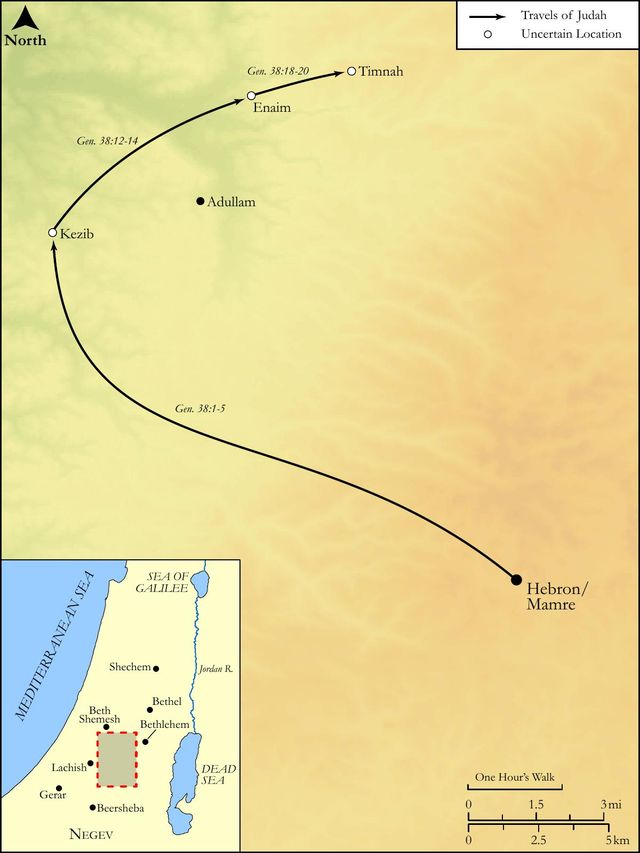
Sheep shearing in ancient Israel was far more than a mere agricultural task; it was a significant annual event, akin to a harvest festival, often accompanied by feasting, celebration, and social interaction. It marked a period of prosperity and communal gathering. Timnath, located in the Shephelah (the low hills between the Judean mountains and the coastal plain), was a known Philistine town, indicating Judah's travel beyond his immediate tribal territory. The cultural expectation of levirate marriage (Yibbum), where a brother-in-law was obligated to marry his deceased brother's widow to raise an heir, is paramount to understanding Tamar's predicament. Judah's failure to give Shelah to Tamar, despite his promise in Genesis 38:11, left her in a precarious, childless widowhood, without social or economic security. Her actions, though unconventional, were born out of a desperate need to secure her rights and lineage within a patriarchal society.
Key Themes
ShowHideGenesis 38 is rich with theological and narrative themes. One prominent theme is Divine Providence, demonstrating God's sovereign hand guiding the lineage of the Messiah despite human sin, deception, and moral failings. Another is Justice and Righteousness, particularly Judah's failure to uphold his familial and covenantal obligations, contrasted with Tamar's determined pursuit of justice, which Judah himself ultimately affirms. The theme of Lineage and Inheritance is central, highlighting the critical importance of continuing the family name and securing an heir in ancient Israelite society, especially for the preservation of the covenant promises. Finally, the chapter showcases Female Agency, as Tamar, a woman with limited societal power, employs remarkable cunning and resolve to secure her future and contribute to the messianic line.
Exposition and Analysis
ShowHideKey Word Analysis
ShowHideThis primitive root means "to front, i.e., stand boldly out opposite; by implication (causatively), to manifest; figuratively to announce (always by word of mouth to one present)." The use of "told" here indicates a direct, verbal communication to Tamar, suggesting she received specific, actionable intelligence about Judah's movements. This was not a rumor but a confirmed report, enabling her strategic planning.
Derived from a root related to affinity, this term precisely identifies Judah's relationship to Tamar. It underscores the familial obligation and the levirate expectation that Judah was failing to uphold. The fact that he is her "father in law" makes his dereliction of duty particularly egregious and Tamar's subsequent actions a direct response to a breach of family covenant.
This verb means "to cut off; specifically to shear a flock or shave the hair." In the context of sheep, it refers to the annual removal of wool. This act signals a specific time and place—the sheep shearing festival—which was known to be a public, often festive, and sometimes raucous event. Tamar's knowledge of this particular activity and its associated social environment was crucial for her plan to succeed.
Verse Breakdown
ShowHide"And it was told Tamar, saying,"
This opening clause immediately establishes Tamar as the recipient of vital information. The passive construction "it was told" implies that the news reached her, possibly through a messenger or common knowledge, but the emphasis is on the fact that she was informed. This highlights her active role in seeking or receiving intelligence, which is foundational to her subsequent actions.
"Behold thy father in law goeth up to Timnath"
This part specifies the subject (Judah, identified by his relationship to Tamar) and his destination and direction of travel. "Goeth up" (עֹלֶה, ‘oleh) suggests an ascent, which could be literal (Timnath was in a higher elevation relative to some surrounding areas) or simply a standard idiom for traveling to a place. The mention of Timnath is crucial, as it provides the specific geographical setting for the unfolding drama and indicates a journey away from Judah's usual residence.
"to shear his sheep."
This final phrase clarifies the purpose of Judah's journey. The act of "sheep shearing" was a well-known annual event that carried significant social and economic implications. It was a time of gathering, feasting, and often a less formal atmosphere, providing the ideal context for Tamar's plan to intercept Judah away from the scrutiny of his home.
Literary Devices
ShowHideThe verse employs Foreshadowing by setting the stage for Tamar's decisive action, hinting at the confrontation that is about to occur. The seemingly mundane detail of Judah's travel to shear sheep becomes a pivotal moment, functioning as a Catalyst for the entire dramatic episode of Genesis 38. The concise reporting of information ("it was told Tamar") also serves as a form of Narrative Economy, swiftly conveying the necessary intelligence without elaborate detail, focusing the reader's attention on the impending events. Furthermore, the mention of "Timnath" and "sheep shearing" provides crucial Setting details that are not just geographical but also culturally significant, enriching the reader's understanding of why Tamar chose this specific moment and place for her confrontation.
Theological and Thematic Connections
ShowHideThe narrative initiated by Genesis 38:13 profoundly illustrates God's sovereign ability to work through complex, even morally ambiguous, human actions to achieve His divine purposes. Despite the ethical dilemmas presented by Tamar's disguise and Judah's initial failures, the story ultimately underscores the preservation of the messianic lineage through Judah. This highlights that God's plan is not contingent upon human perfection but rather unfolds through the often-messy realities of human history, demonstrating His faithfulness to His covenant promises. Tamar's desperate pursuit of an heir, driven by Judah's neglect of his levirate duty, becomes a testament to the vital importance of lineage in the unfolding of God's redemptive plan.
Reflection and Application
ShowHideGenesis 38:13, as the trigger for Tamar's bold actions, invites us to reflect on the nature of divine providence and human agency. In a world where justice is often delayed or denied, Tamar's story, though unconventional, reminds us that God can use unexpected means and individuals to bring about His purposes. It challenges us to consider our own responses when promises are broken or duties neglected. While Tamar's methods are not prescriptive for us, her determination to secure her rightful place and contribute to the lineage of promise speaks to the importance of perseverance and faith in the face of adversity. The narrative ultimately affirms that God's redemptive plan is robust enough to encompass human failings and triumphs, guiding history towards its ultimate Christ-centered fulfillment.
Questions for Reflection
ShowHideFAQ
ShowHideWhy is the story of Judah and Tamar inserted here, interrupting the Joseph narrative?
ShowHideThe placement of Genesis 38, interrupting the flow of Joseph's story, serves several crucial theological and narrative purposes. Theologically, it highlights the importance of the Abrahamic covenant's continuation through Judah's lineage, which is the messianic line. It provides a stark contrast between Judah's moral failings and eventual repentance and Joseph's unwavering integrity, setting up a deeper understanding of the brothers' characters. Narratively, it ensures that the foundational story of the tribe of Judah, from whom kings and ultimately the Messiah would come, is established before the family's descent into Egypt, providing essential context for future developments in Israel's history.
What was the significance of sheep shearing in ancient Israelite society?
ShowHideSheep shearing was a major annual event in the agrarian society of ancient Israel, akin to a harvest. It was a time of significant economic activity, as wool was a valuable commodity used for clothing, tents, and trade. Beyond its economic importance, it was often accompanied by feasting, celebrations, and social gatherings, making it a festive and public occasion. This context explains why Judah, a prominent patriarch, would travel for it and why Tamar would choose this specific event to execute her plan, knowing it would offer an opportunity for encounter away from the usual household scrutiny.
Did Tamar's actions align with God's law?
ShowHideTamar's actions, particularly her disguise as a prostitute, were certainly unconventional and outside typical societal norms. However, her primary motivation was to secure her rightful lineage and an heir, which Judah had unjustly withheld by failing to give her Shelah in levirate marriage, as promised in Genesis 38:11. Judah himself, in Genesis 38:26, acknowledges her as "more righteous" than he, implying that her desperate pursuit of justice and the continuation of the family line, though unorthodox in method, was ultimately affirmed in light of Judah's own failure to uphold his covenantal duty and the broader divine plan.
Christ-Centered Fulfillment
ShowHideThe seemingly scandalous narrative initiated by Genesis 38:13, leading to Tamar's unconventional actions and the birth of Perez and Zerah, is profoundly Christ-centered. Tamar, a Gentile woman, is notably listed in the genealogy of Jesus Christ, alongside Rahab, Ruth, and the wife of Uriah. This inclusion powerfully underscores God's sovereign choice to work through unexpected individuals and circumstances, even those marked by human sin, societal transgression, and moral ambiguity, to bring about His redemptive plan. It foreshadows the universal scope of Christ's salvation, demonstrating that God's grace extends beyond conventional boundaries and includes all who believe, regardless of their past or origin. The preservation of the messianic line through such a complex and humanly flawed story highlights God's unwavering faithfulness to His covenant promises, ensuring the arrival of the Savior of the world through the lineage of Judah, ultimately fulfilling the ancient prophecies concerning the seed of the woman.