


Joel 2:13
Bible text: King James Version (1769 Blayney text) · Public domain
Bible text: King James Version with Strong's numbers · Public domain
Bible text: Berean Standard Bible · Public domain
Bible text: American Standard Version (1901) · Public domain
Bible text: World English Bible, Messianic edition · Public domain
Bible text: Geneva Bible (1599) · Public domain
Bible text: Young's Literal Translation · Public domain
- וְקִרְעוּve·kir·'Uand tearH7167Conj-w ¦ V-Qal-Imp-2mpVerb Qal Imperative 2nd Plural Masculineוְandקִרְעוּtear
- לְבַבְכֶםle·vav·Khemyour heartH3824N-msc ¦ 2mpNoun Singular Masculine Constructלְבַבְheartכֶםyour
- וְאַלve·'aland may not [it be]H408Conj-w ¦ NegParticle Negativeוְandאַלmay not [it be]
- בִּגְדֵיכֶםbig·dei·Khemyour garmentsH899N-mpc ¦ 2mpNoun Plural Masculine Constructבִּגְדֵיgarmentsכֶםyour
- וְשׁוּבוּve·Shu·vuand returnH7725Conj-w ¦ V-Qal-Imp-2mpVerb Qal Imperative 2nd Plural Masculineוְandשׁוּבוּreturn
- אֶל'eltoH413PrepPreposition
- יְהוָהYah·wehYahwehH3068N-properNoun Proper Title
- אֱלֹהֵיכֶם'e·lo·hei·Khemyour GodH430N-mpc ¦ 2mpNoun Plural Masculine ConstructאֱלֹהֵיGodכֶםyour
- כִּיkiforH3588PrtParticle Conditional
- חַנּוּןcha·Nun[is] graciousH2587Adj-msAdjective Singular Masculine Absolute
- וְרַחוּםve·ra·Chumand compassionateH7349Conj-w ¦ Adj-msAdjective Singular Masculine Absoluteוְandרַחוּםcompassionate
- הוּאHu'heH1931Pro-3msPronoun Personal 3rd Singular Masculine
- אֶרֶךְ'E·rekhlong ofH750Adj-mscAdjective Singular Masculine Construct
- אַפַּיִם'a·Pa·yimanger<s>H639N-mdNoun Dual Masculine Absolute
- וְרַבve·ravand great ofH7227Conj-w ¦ Adj-mscAdjective Singular Masculine Constructוְandרַבgreat of
- חֶסֶדChe·sedcovenant loyaltyH2617N-msNoun Singular Masculine Absolute
- וְנִחָםve·ni·Chamand relentingH5162Conj-w ¦ V-Niphal-Prtcpl-msVerb Niphal Participle Singular Masculine Absoluteוְandנִחָםrelenting
- עַל'alonH5921PrepPreposition
- הָרָעָהha·ra·'Ah<the> harmH7451Art ¦ N-fsNoun Singular Feminine Absoluteהָ<the>רָעָהharm
English is a literal word-by-word gloss of the Hebrew, not the KJV's wording. Why?
This is the original text the KJV's translators worked from — each Hebrew word with its own literal English meaning in this verse, prepared by scholars at Tyndale House, Cambridge. The KJV translates whole sentences, not word by word, so its wording differs: one Hebrew word can become several English words, and the KJV may choose “the LORD” where the gloss reads “Yahweh”. Both are faithful — they answer different questions. For the KJV's own rendering, switch to the KJV text.
Details
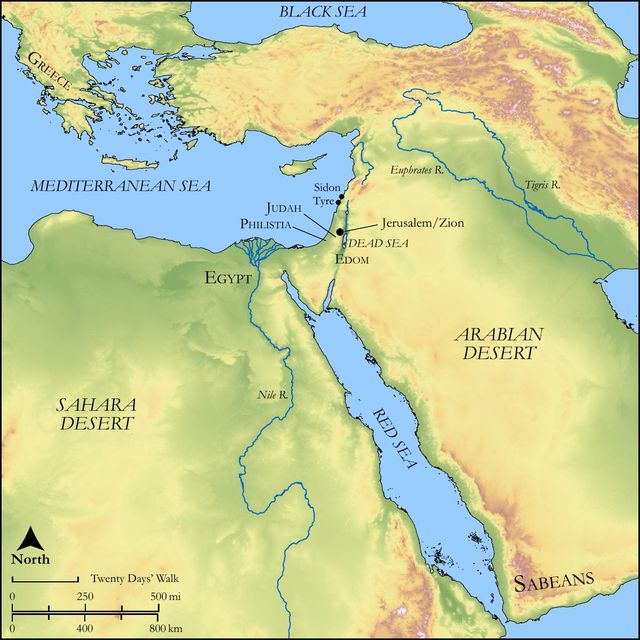
See on the biblical-era map
Study this verse
Public-domain commentary
Matthew Henry
From his Commentary on the Whole Bible. Henry comments on passages, not single verses — this entry covers Joel 2:12–17. His four-level outline is real structure in the source text, so it is rendered as structure.
We have here an earnest exhortation to repentance, inferred from that desolating judgment described and threatened in the foregoing verses: Therefore now turn you to the Lord. 1. "Thus you must answer the end and intention of the judgment; for it was sent for this end, to convince you of your sins, to humble you for them, to reduce you to your right minds and to your allegiance." God brings us into straits, that he may bring us to repentance and so bring us to himself. 2. "Thus you may stay the progress of the judgment. Things are bad with you, but thus you may prevent their growing worse; nay, if you take this course, they will soon grow better." Here is a gracious invitation,
I.To a personal repentance, exercised in the soul, every family apart, and their wives apart, Zac 12:12.
When the judgments of God are abroad, each person is concerned to contribute his quota to the common supplications, having contributed to the common guilt. Every one must mend one and mourn for one, and then we should all be mended and all found among God's mourners. Observe,
1.What we are here called to, which will teach us what it is to repent, for it is the same that the Lord our God still requires of us, we having all made work for repentance.
(1.)We must be truly humbled for our sins, must be sorry we have by sin offended God, and ashamed we have by sin wronged ourselves, both wronged our judgments and wronged our interests. There must be outward expressions of sorrow and shame, fasting, and weeping, and mourning; tears for the sin that procured it. But what will the outward expressions of sorrow avail if the inward impressions be not agreeable, and not only accompany them, but be the root and spring of them, and give rise to them? And therefore it follows, Rend your heart, and not your garments; not but that, according to the custom of that age, it was proper for them to rend their garments, in token of great grief for their sins and a holy indignation against themselves for their folly; but, "Rest not in the doing of that, as if that were sufficient, but be more in care to accommodate your spirits than to accommodate your dress to a day of fasting and humiliation; nay, rend not your garments at all, unless withal you rend your hearts, for the sign without the thing signified is but a jest and a mockery, and an affront to God." Rending the heart is that which God looks for and requires; that is the broken and contrite heart which he will not despise, Psa 51:17. When we are greatly grieved in soul for sin, so that it even cuts us to the heart to think how we have dishonoured God and disparaged ourselves by it, when we conceive an aversion to sin, and earnestly desire and endeavor to get clear of the principles of it and never to return to the practice of it, then we rend our hearts for it, and then will God rend the heavens and come down to us with mercy.
(2.)We must be thoroughly converted to our God, and come home to him when we fall out with sin. Turn you even to me, said the Lord (Joe 2:12), and again (Joe 2:13), Turn unto the Lord your God. Our fasting and weeping are worth nothing if we do not with them turn to God as our God. When we are fully convinced that it is our duty and interest to keep in with him, and are heartily sorry we have ever turned the back upon him, and thereupon, by a firm and fixed resolution, make his glory our end, his will our rule, and his favour our felicity, then we return to the Lord our God, and this we are all commanded and invited to do, and to do it quickly.
2.What arguments are here used to persuade this people thus to turn to the Lord, and to turn to him with all their hearts. When the heart is rent for sin, and rent from it, then it is prepared to turn entirely to God, and to be devoted entirely to him, and he will have it all or none. Now, to bring ourselves to this, let us consider,
(1.)We are sure that he is, in general, a good God. We must turn to the Lord our God, not only because he has been just and righteous in punishing us for our sins, the fear of which should drive us to him, but because he is gracious and merciful, in receiving upon us our repentance, the hope of which should draw us to him. He is gracious and merciful, delights not in the death of sinners, but desires that they may turn and live. He is slow to anger against those that offend him, but of great kindness towards those that desire to please him. These very expressions are used in God's proclamation of his name when he caused his goodness, and with it all his glory, to pass before Moses, Exo 34:6, Exo 34:7. He repents him of the evil, not that he changes his mind, but, when the sinner's mind is changed, God's way towards him is changed; the sentence is reversed, and the curse of the law is taken off. Note, That is genuine, ingenuous, and evangelical repentance, which arises from a firm belief of the mercy of God, which we have sinned against, and yet are not in despair. Repent, for the kingdom of heaven is at hand. The goodness of God, if it be rightly understood, instead of emboldening us to go on in sin, will be the most powerful inducement to repentance, Psa 130:4. The act of indemnity brings those to God whom the act of attainder frightened from him.
(2.)We have reason to hope that he will, upon our repentance, give us that good which by sin we have forfeited and deprived ourselves of (Joe 2:14), that he will return and repent, that he will not proceed against us as he has done, but will act in favour of us. Therefore let us repent of our sins against him, and return to him in a way of duty, because then we may hope that he will repent of his judgments against us and return to us in a way of mercy. Now observe,
[1.]The manner of expectation is very humble and modest: Who knows if he will? Some think it is expressed thus doubtfully to check the presumption and security of the people, and to quicken them to a holy carefulness and liveliness in their repentance, as Jos 24:19. Or, rather, it is expressed doubtfully because it is the removal of a temporal judgment that they here promise themselves, of which we cannot be so confident as we can that, in general, God is gracious and merciful. There is no question at all to be made but that if we truly repent of our sins God will forgive them, and be reconciled to us; but whether he will remove this or the other affliction which we are under may well be questioned, and yet the probability of it should encourage us to repent. Promises of temporal good things are often made with a peradventure. It may be, you shall be hid, Zep 2:3. David's sin is pardoned, and yet the child shall die, and, when David prayed for its life, he said, as here, Who can tell whether God will begracious to me in this matter likewise? Sa2 12:22. The Ninevites repented and reformed upon such a consideration as this, Jon 3:9.
[2.]The matter of expectation is very pious. They hope God will return and repent, and leave a blessing behind him, not as if he were about to go from them, and they could be content with any blessing in lieu of his presence, but behind him, that is, "After he has ceased his controversy with us, he will bestow a blessing upon us;" and what is it? It is a meat-offering and a drink-offering to the Lord our God. The fruits of the earth are called a blessing (Isa 45:8) because they depend upon God's blessing and are necessary blessings to us. They had been deprived of these, and that which grieved them most while they were so was that God's altar was deprived of its offerings and God's priests of their maintenance; that therefore which they comfort themselves with the prospect of in their return of plenty is that then there shall be meat-offerings and drink-offerings in abundance brought to God's altar, which they more desired than to see the wonted abundance of meat and drink brought to their own tables. Thus when Hezekiah was in hopes that he should recover of his sickness he asked, What is the sign that I shall go up, not to the thrones of judgment, or to the councilboard, but to the house of the Lord? Isa 38:22. Note, The plentiful enjoyment of God's ordinances in their power and purity is the most valuable instance of a nation's prosperity and the greatest blessing that can be desired. If God give the blessing of meat-offering and the drink-offering, that will bring along with it other blessings, will sanctify them, sweeten them, and secure them.
II.They are here called to a public national repentance, to be exercised in the solemn assembly, as a national act, for the glory of God and the excitement of one another, and that the neighbouring nations might know and observe what it was that qualified them for God's gracious returns in mercy to them, which they would be the admiring witnesses of. Let us see here,
1.How the congregation must be called together, Joe 2:15, Joe 2:16. The trumpet was blown (Joe 2:1), to sound an alarm of war; but now it must be blown in order to a treaty of peace. God is willing to show mercy to his people if he do but find them in a frame fit for it; and therefore, Call them together; sanctify a fast. By the law many annual feasts were appointed, but only one day in the year was to be observed as a fast, the day of atonement, a day to afflict the soul; and, if they had kept close to God and their duty, there would have been no occasion to observe any more; but now that they had by sin brought the judgments of God upon them they are often called to fasting. What was said Joe 1:14 is here repeated: "Call a solemn assembly; gather the people (press them to come together upon this errand); sanctify the congregation; appoint a time for solemn preparation beforehand and put them in mind to prepare themselves. Let not the greatest be excused, but assemble the elders, the judges and magistrates. Let not the meanest be passed by, but gather the children, and those that suck the breasts." It is good to bring little children, as soon as they are capable of understanding any thing, to religious assemblies, that they may be trained up betimes in the way wherein they should go; but these were brought even when they were at the breast and were kept fasting, that by their cries for the breast the hearts of the parents might be moved to repent of sin, which God might justly so visit upon their children that the tongue of the sucking child might cleave to the roof of his mouth (Lam 4:4), and that on them God might have compassion, as he had on the infants of Nineveh, Jon 4:11. New-married people must not be exempted: Let the bridegroom go forth of his chamber and the bride out of her closet; let them not take state upon them as usual, not put on their ornaments, nor indulge themselves in mirth, but address themselves to the duties of the public fast with as much gravity and sadness as any of their neighbours. Note, Private joys must always give way to public sorrows, both those for affliction and those for sin.
2.How the work of the day must be carried on, Joe 2:17.
(1.)The priests, the Lord's ministers, must preside in the congregation, and be God's mouth to the people, and theirs to God; who should stand in the gap to turn away the wrath of God but those whose business it was to make intercession upon ordinary occasions?
(2.)They must officiate between the porch and the altar. There they used to attend about the sacrifices, and therefore now that they have no sacrifices to offer, or next to none, there they must offer up spiritual sacrifices. There the people must see them weeping and wrestling, like their father Jacob, and be helped into the same devout frame. Ministers must themselves be affected with those things wherewith they desire to affect others. It was between the porch and the altar that Zechariah the son of Jehoiada was put to death for his faithfulness; that precious blood God would require at their hands, and therefore, to turn away the judgment threatened for it, there they must weep.
(3.)They must pray. Words here are put into their mouths, which they might in their prayers enlarge upon. Their petition must be, Spare thy people, O Lord! God's people, when they are in distress, can expect no relief against God's justice but what comes from his mercy. They cannot say, Lord, right us, but, Lord, spare us. We deserve the correction; we need it; but, Lord, mitigate it. The sinner's supplication is, Spare us, good Lord. Their plea must be taken from the relation wherein they stand to God ("They are thy people, and thy heritage, therefore have compassion on them"), but especially from the concern of God's glory in their trouble - "Lord, give not thy heritage to reproach, to the reproach of famine; let not the land of Canaan, that has so long been celebrated as the glory of all lands, now be made the scorn of all lands; let not the heathen rule over them, as they will easily do when thy heritage is thus impoverished and disabled to subsist. Let not the heathen make them a proverb, or a by-word" (so some read it); "let it never be said, As poor and beggarly as an Israelite." Note, The maintaining of the credit of the nation among its neighbours is a blessing to be desired and prayed for by all that wish well to it. But that reproach of the church is especially to be dreaded and deprecated which reflects upon God: "Let them not say among the people, Where is their God - that God who has promised to help them, whom they have boasted so much of and put such a confidence in?" If God's heritage be destroyed, the neighbours will say, "God was either weak and could not relieve them or unkind and would not." Deu 32:37, Where are now their gods in whom they trusted? And Sennacherib thus triumphs over them. Where are they gods of Hamath and Arpad? But it must by no means be suffered that they should say of Israel, Where is their God? For we are sure that our God is in the heavens (Psa 115:2, Psa 115:3), is in his temple, Psa 11:4.
Historical interpretation
Three Centuries of Reception
5 surviving comments on this verse. Each one is dated, so this reads as a timeline rather than a list.
Select a marker to jump to its quote. Markers stagger vertically where authors wrote within a few decades of each other.
Let each one confess his sin, I beseech you, brethren, while he who has sinned is still in this world, while his confession can be admitted, while the satisfaction and remission effected through the priest is pleasing with the Lord. Let us turn to the Lord with our whole mind, and, expressing repentance for our sin with true grief, let us implore God’s mercy. Let the soul prostrate itself before him; let sorrow give satisfaction to him; let our every hope rest upon him. He himself tells how we ought to ask. He says, “Return to me with all your hearts, in fasting and in weeping, and in mourning, and rend your hearts, not your garments.” Let us return to the Lord with a whole heart; let us placate his wrath and displeasure by fastings, weepings and mournings, as he himself admonishes.
Another disease is added to the original cause and a new wound inflicted, and all that is contrary is applied, all that is dangerous is drunk. Under this evil especially does this brotherhood toil, adding new sins on top of old faults. Therefore it has burst forth into vice, and more grievously still, is now racked by a most destructive wasting disease. What then shall I now do, I who as priest am compelled to cure? It is very late in such cases. But even so, if there is any one of you who can bear to be cut and cauterized, I can still do it. Behold the scalpel of the prophet: “Return,” he says, “to the Lord your God and together with fasting and weeping and mourning rend your hearts.” Do not fear this incision, dearly beloved. David bore it. He lay in filthy ashes and had his appearance disfigured by a covering of rough sackcloth. He who had once been accustomed to precious stones and to the purple clothed his soul in fasting. He whom the seas, the forests, the rivers used to serve, and to whom the bountiful land promised wealth, now consumed in floods of tears those eyes with which he had beheld the glory of God. This ancestor of Mary, the ruler of the Jewish kingdom, confessed that he was unhappy and wretched.
(Verse 12 and following) Now therefore says the Lord: Turn to me with all your heart, with fasting, weeping, and mourning; and tear your hearts, not your clothing, and turn to the Lord your God; for he is gracious and merciful, slow to anger, and of great kindness, and relents from punishing. Who knows if he will turn and forgive, and leave a blessing behind him, a sacrifice and offering to the Lord your God? LXX: And now says the Lord our God: Turn to me with all your heart, with fasting, with sackcloth, with weeping, and with mourning; and tear your hearts, not your clothing, and turn to the Lord your God; for he is merciful and compassionate, patient and full of mercy, and repents of evil. Who knows if he will turn and have mercy on him, and leave behind him a blessing, sacrifice, and offering to the Lord our God? The beginning chapter from the place where it is written: Blow the trumpet in Zion, shout in my holy mountain; let all the inhabitants of the earth be troubled, until that place where we read: Great is the day of the Lord and very terrible, who shall be able to endure it? By the translation of locusts, it announces the coming of the Chaldeans, and what evil things are to come to the people. Now it provokes them to repentance, and exhorts them to turn to the Lord, so that, being corrected in their whole mind, they do not suffer what the Lord threatens, and the sense is: All the things that are contained in the previous discourse, therefore I have spoken, so that I might terrify you with my threat. But convert to me with your whole heart, and show repentance of the mind with fasting and weeping and lamentation; so that now, fasting, you may afterwards be satisfied; now, weeping, you may afterwards laugh; now, lamenting, you may afterwards be comforted. And because it is customary, in times of sadness and adversity, to tear one's garments, as the high priest is mentioned to have done to increase the guilt of the Savior in the Gospel (Matthew 26), and as we read that Paul and Barnabas, upon hearing words of blasphemy, did (Acts 14); therefore, I command you, never tear your garments, but rather the hearts that are full of sins, which, like wineskins, will burst open if they are not torn willingly. And when you have done this, return to your Lord God, whom your previous sins have made a stranger to you: and do not despair of the forgiveness of sins because of their magnitude; for great mercy will wipe away great sins. For He is kind and merciful, preferring the repentance of sinners to their death, patient and abundant in mercy, not imitating human impatience; but waiting for our repentance for a long time: and He is steadfast, whether the sinner repents of his wickedness, so that if we repent of our sins and He repents of His threats, He will not inflict the evils He has threatened, and by the change of our decision, He Himself will change. However, in this place, we should not consider malice contrary to virtue, but rather affliction, according to what we read elsewhere: Sufficient unto the day is the evil thereof (Matt. VI, 34). And: If there is malice in the city, which the Lord does not bring (Amos III, 6). Similarly, because he had said above, kind and merciful, patient and abundant in mercy, and excellent, or repentant over malice, lest the greatness of mercy make us negligent, he joins in the person of the Prophet and says: Who knows whether he will turn and forgive, and leave behind a blessing? I exhort, he says, that which is mine, to repentance, and I know that God is ineffably merciful, saying with David: Have mercy on me, O God, according to your great mercy, and according to the multitude of your tender mercies, blot out my iniquity (Psalm 50, 1, 2). But because we cannot comprehend the depth of the riches and wisdom and knowledge of God, I hesitate and wish rather than presume, saying: who knows if he will turn and forgive? What someone says, either it is impossible or difficult must be felt: Sacrifice and offering to the Lord our God, so that after he has given the blessing and forgiven our sins, we may be able to offer sacrifices to God.
“Rend your hearts, not your garments,” that is, have recourse to thoughts of compunction, soften the obduracy of your thinking, accept beneficial advice, abandon the way of vice and travel by that way which leads directly to God. After all, many are the founts of compassion and mercy that flow from him, and in his exercise of longsuffering he is not in the custom of putting his threats into effect. In fact, he indicated as much by saying “repenting of the troubles,” that is, by instilling dread by the threats of punishment, and by the changes in human beings for the better transforming the threats into something pleasant. The God of all, you see, does not intend one thing at one time and another thing at another, or like us repent of what he does. Rather, while making threats he has mercy within himself, and he offers it to those who are sorry for their sins, and while making promises of good things he knows those who are good and those who are unworthy of his gifts, extending them to the former and giving to the latter the opposite of what he promises.
How well does the holy prophet teach that the seeds of good works must be watered by a river of tears! No seeds germinate unless they are watered; nor does fruit come forth from the seed if deprived of the aid of water. Accordingly, we too, if we wish to keep the fruits of our seeds, let us not stop watering our seeds with tears that must be poured out more from the heart than from the body. Therefore it is said to us through the prophet that we rend “our hearts and not our garments,” something we can do when we recall that we ourselves, even if not in deed, frequently sin at least in thought. Because the “earthly tent burdens the thoughtful mind” and our land does not cease to produce thorns and thistles for us. We are unable to get to eating our bread, unless we will have been worn out by weariness and the sweat of our brow.
Continue studying Joel 2:13 across the web’s major study libraries — every link below opens this exact verse, chapter, or book on the destination site.
Read & Compare
 BibleGatewayThis verse in more than 200 translations and 70 languages.
 Bible.comThe YouVersion reader — hundreds of translations, reading plans, and highlights.
 ESV.orgCrossway's official English Standard Version reader.
 NET BibleThe NET translation with 60,000+ translators' notes on every rendering decision.
 STEP BibleTyndale House's free study tool — original text, vocabulary, and scholarly resources.
 BibliaLogos Bible Software's free web reader.
 USCCBThe New American Bible (Revised Edition) with the U.S. bishops' study notes.
Commentaries
 BibleHub CommentariesDozens of classic commentaries on this verse, gathered on one page.
 StudyLightMore than 100 commentary sets — the largest collection on the web.
 BibleRefPlain-English commentary on what this verse means, verse by verse.
 Enduring WordDavid Guzik's free commentary on this chapter, widely used by Bible teachers.
 Bible Study ToolsVerse commentary alongside Greek and Hebrew study aids.
Original Language & Research
- BibleHub InterlinearThe verse word by word — original language, transliteration, and English.
- BibleHub LexiconEvery word's original-language definition and Strong's entry.
 Blue Letter BibleDeep-study tools — Strong's numbers, concordance, and word studies.
 SefariaThe Hebrew text with Rashi and centuries of Jewish commentary.
Sermons, Hymns & Audio


TrulyRandomVerse is not affiliated with these sites and doesn’t control their content. They’re linked because they’re genuinely useful.
Summary
Joel 2:13 is a profound call to authentic repentance, urging the people of Judah to move beyond superficial displays of sorrow to a deep, internal transformation of the heart. It emphasizes that God desires genuine contrition and a sincere turning away from sin, motivated by His inherent character as a God who is gracious, merciful, slow to anger, abundant in kindness, and willing to relent from impending judgment when His people truly seek Him. This verse serves as a pivotal invitation to return to the LORD, grounded in the assurance of His compassionate nature.
Context
ShowHideLiterary Context
Joel 2:13 is situated within a dramatic prophetic oracle delivered by Joel concerning the "Day of the LORD." The preceding verses (Joel 2:1-11) vividly describe a devastating locust plague, portrayed as a precursor to or a manifestation of this great and terrible day, characterized by darkness, desolation, and an invading army. Joel 2:12 immediately precedes our verse, issuing a direct divine appeal: "Therefore also now, saith the LORD, turn ye even to me with all your heart, and with fasting, and with weeping, and with mourning." Joel 2:13 then specifies the nature of this turning, contrasting outward ritual with inward sincerity, and provides the theological basis for such a response by detailing God's character. The subsequent verses (Joel 2:14-17) outline the potential for God's relenting and call for a solemn assembly of national repentance, leading into promises of restoration if the people obey.
Historical & Cultural Context
The immediate historical backdrop is a severe locust plague and drought that has ravaged the land of Judah, causing widespread famine and despair (as described in Joel 1). In Israel, rending garments was a common and highly visible expression of intense grief, mourning, or distress, often accompanied by wailing, fasting, and wearing sackcloth. Examples include Jacob tearing his clothes at the news of Joseph's supposed death, or David's reaction to Saul's death. Joel's prophecy, however, critiques the potential for these outward rituals to become mere performance, devoid of genuine internal change. He calls for a repentance that transcends cultural custom, demanding a heart-level transformation that aligns with the covenant relationship between Yahweh and His people in the land of Judah.
Key Themes
ShowHideThis verse powerfully encapsulates several major themes central to the book of Joel and broader Old Testament theology. Firstly, it highlights the theme of Authentic Repentance, emphasizing that God desires internal sincerity over external ritual. The call to "rend your heart, and not your garments" directly challenges superficial religiosity, a theme also echoed by other prophets like Isaiah and Amos. Secondly, it beautifully articulates the Compassionate Character of God. The description of the LORD as "gracious and merciful, slow to anger, and of great kindness" is a foundational theological declaration, first revealed to Moses in Exodus 34:6 and frequently reiterated throughout the Old Testament, such as in Psalm 103:8. This portrayal provides the ultimate motivation and hope for repentance, assuring the people that God is willing to relent from judgment. Lastly, the verse touches upon the theme of Divine Relenting and Restoration, implying that God's actions are often contingent on humanity's response, and He is eager to turn from "evil" (calamity or judgment) when His people genuinely return to Him.
Exposition and Analysis
ShowHideKey Word Analysis
ShowHideMeaning "to tear" or "to rend," literally or figuratively. In this context, it is used metaphorically to contrast with the literal tearing of garments, emphasizing an internal, spiritual tearing open of one's innermost being in genuine brokenness and humility before God. It signifies a radical, painful, and necessary breaking of pride and self-reliance.
Referring to the innermost organ, signifying the seat of intellect, emotion, and will. Joel uses it to denote the true locus of repentance—not merely outward actions, but a profound internal transformation of one's core being, where true sorrow for sin and a desire for change reside.
Meaning "gracious." This attribute describes God's inherent disposition to show favor and compassion, even to those who do not deserve it. It is a fundamental aspect of His character that provides the basis for hope and the motivation for sincere repentance, assuring the supplicant that God is disposed to forgive and restore.
Verse Breakdown
ShowHide"And rend your heart, and not your garments"
This imperative opens the verse with a powerful contrast. While rending garments was a traditional outward sign of grief and repentance in ancient Israel, Joel declares it insufficient if unaccompanied by a deep, internal brokenness. The "heart" (lêbâb) represents the core of one's being—the mind, will, and emotions. The command is to tear open this inner self, exposing its sin and vulnerability, rather than merely performing a visible, yet potentially hollow, ritual.
"and turn unto the LORD your God"
This clause reveals the purpose of the internal rending: a genuine turning (shûwb, H7725) or repentance back to Yahweh. This "turning" is not just a change of mind but a reorientation of one's entire life, priorities, and allegiance from sin and self to the covenant God. The possessive "your God" underscores the intimate relationship that the people of Israel have with Him, emphasizing that their return is to the One who has already bound Himself to them.
"for he is gracious and merciful, slow to anger, and of great kindness, and repenteth him of the evil"
This final, extensive clause provides the theological foundation and motivation for the call to repentance. It describes God's character as inherently compassionate and patient. He is "gracious" (channûwn) and "merciful" (rachûwm), demonstrating unmerited favor and deep compassion. He is "slow to anger" (ʼârêk ʼaph, literally "long of nose/nostril," signifying patience) and "of great kindness" (rab chêçêd, abundant in covenant loyalty and steadfast love). The phrase "and repenteth him of the evil" (nâcham him of the raʻ) signifies God's willingness to change His course of action regarding impending judgment or calamity when His people genuinely turn to Him. It does not imply a change in God's perfect character, but a change in His interaction with humanity based on their response to His call.
Literary Devices
ShowHideJoel 2:13 effectively employs Antithesis by contrasting "rend your heart" with "and not your garments," highlighting the difference between internal sincerity and external ritual. This creates a powerful rhetorical impact, underscoring the prophet's central message. The phrase "slow to anger" is a vivid Idiom, literally translating to "long of nostrils," which in Hebrew thought signifies patience and forbearance, as a person's anger was often associated with rapid breathing through the nostrils. The entire description of God's attributes ("gracious and merciful, slow to anger, and of great kindness") functions as a Theological Credo or Litany, a well-established formula in the Old Testament that serves to remind the audience of Yahweh's unchanging, compassionate character, providing a strong basis for hope and an invitation to repentance. Finally, the use of "heart" as the seat of true repentance is a powerful instance of Metonymy, where the physical organ represents the entire inner person—intellect, emotion, and will.
Theological and Thematic Connections
ShowHideJoel 2:13 stands as a timeless theological statement on the nature of true repentance and the unwavering character of God. It asserts that God's primary desire is not for outward religious performance, but for a transformed heart that genuinely grieves over sin and turns back to Him in faith. This profound truth is rooted in the revelation of God's attributes: His grace, mercy, patience, and abundant kindness. These qualities assure humanity that repentance is never in vain, as God is always willing to relent from deserved judgment and extend forgiveness and restoration to those who sincerely seek Him. This verse serves as a foundational text for understanding divine compassion and the reciprocal nature of the covenant relationship, where human obedience and repentance evoke God's redemptive response.
Reflection and Application
ShowHideJoel 2:13 remains profoundly relevant for believers today, serving as a powerful challenge to examine the depth and authenticity of our faith and repentance. In a world often preoccupied with external appearances and superficial displays, this verse calls us to cultivate a radical sincerity in our relationship with God. It pushes us beyond mere religious rituals—whether attending services, reciting prayers, or engaging in acts of service—to a place of genuine heart-level transformation. True repentance is not just saying "sorry" but involves a profound sorrow for sin that leads to a turning away from it and a turning towards God. This verse reminds us that God's character is one of boundless mercy and patience, always ready to forgive and restore those who genuinely humble themselves and seek Him. Our motivation for repentance is not fear of punishment alone, but the profound assurance of God's gracious and compassionate nature, which invites us into a deeper, more intimate walk with Him.
Questions for Reflection
ShowHideFAQ
ShowHideWhat does "rend your heart, and not your garments" truly mean?
ShowHideThis phrase is a powerful call for genuine, internal repentance over mere outward religious ritual. Rending garments was a common practice in Israel to express deep grief or distress, as seen when Jacob tore his clothes upon hearing of Joseph's supposed death. However, Joel insists that such external displays are insufficient if the heart—the seat of one's will, emotions, and intellect—remains unchanged. True repentance involves a "tearing open" of one's inner being, a profound sorrow for sin, and a sincere turning to God, as echoed in Psalm 51:17, which speaks of a broken and contrite heart as God's desired sacrifice. It's a call for authenticity and depth in one's spiritual life.
How does God "repent" of evil? Does this mean God changes His mind or character?
ShowHideThe Hebrew word translated "repenteth him" (H5162, nâcham) in this context refers to God relenting or changing His course of action regarding an impending judgment or calamity ("evil," H7451, raʻ). It does not imply a change in God's perfect, unchanging character or His eternal decrees. Rather, it signifies that God, in His sovereignty and mercy, responds to human repentance. When humanity turns from sin, God, in His compassion, may choose to withhold or alter the judgment He had declared. This demonstrates His relational nature and His desire for humanity's restoration rather than their destruction, consistent with His attributes as "gracious and merciful, slow to anger, and of great kindness," as also seen in Jonah 3:10 where God "repented of the evil, that he had said that he would do unto them; and he did it not."
Christ-Centered Fulfillment
ShowHideJoel 2:13 finds its ultimate fulfillment in the person and work of Jesus Christ, who perfectly embodies the very attributes of God described in the verse and makes true heart-repentance possible. The call to "rend your heart, and not your garments" foreshadows the New Covenant emphasis on internal transformation over external law or ritual, as taught by Jesus in the Sermon on the Mount. He declared that true righteousness must exceed that of the scribes and Pharisees, moving beyond outward conformity to the law to address the heart's intentions (e.g., Matthew 5:21-28). Furthermore, the gracious and merciful character of God, "slow to anger, and of great kindness," is perfectly revealed in Jesus, who came not to condemn the world but to save it (John 3:17). His life, death, and resurrection demonstrate God's ultimate act of kindness and mercy, providing the means for humanity to truly "turn unto the LORD their God" through faith in Him (Acts 3:19). Through Christ, the "evil" of sin and its consequences are atoned for, allowing God to "repent him of the evil" (i.e., withhold judgment) for all who believe, offering forgiveness and eternal life instead (Romans 5:8-9). Thus, Joel's ancient call to repentance is fully realized in the gospel, inviting all to a heart-rending turning to the gracious Savior.