


2 Samuel 1:11
Bible text: King James Version (1769 Blayney text) · Public domain
Bible text: Berean Standard Bible · Public domain
Bible text: American Standard Version (1901) · Public domain
Bible text: World English Bible, Messianic edition · Public domain
Bible text: Geneva Bible (1599) · Public domain
Bible text: Young's Literal Translation · Public domain
- וַיַּחֲזֵקvai·ya·cha·Zekand he took holdH2388Conj-w ¦ V-Hiphil-ConsecImperf-3msVerb Hiphil Consecutive Imperfect 3rd Singular Masculineוַandיַּחֲזֵקhe took hold
- דָּוִדda·VidDavidH1732N-proper-mNoun Proper Masculine
- בִּבְגָדָיוbiv·ga·dovon his garmentsH899Prep-b ¦ N-mpc ¦ 3msNoun Plural Masculine Constructבִּonבְגָדָיgarmentsוhis
- וַיִּקְרָעֵםvai·yik·ra·'Emand he tore themH7167Conj-w ¦ V-Qal-ConsecImperf-3ms ¦ 3mpVerb Qal Consecutive Imperfect 3rd Singular Masculineוַandיִּקְרָעֵhe toreםthem
- וְגַםve·Gamand alsoH1571Conj-w ¦ AdvAdverbוְandגַםalso
- כָּלkolallH3605N-mscNoun Singular Masculine Construct
- הָאֲנָשִׁיםha·'a·na·Shimthe menH582Art ¦ N-mpNoun Plural Masculine Absoluteהָtheאֲנָשִׁיםmen
- אֲשֶׁר'a·SherwhoH834RelParticle Relative
- אִתּוֹ'i·To[were] with himH854Prep ¦ 3msPreposition Definiteאִתּ[were] withוֹhim
English is a literal word-by-word gloss of the Hebrew, not the KJV's wording. Why?
This is the original text the KJV's translators worked from — each Hebrew word with its own literal English meaning in this verse, prepared by scholars at Tyndale House, Cambridge. The KJV translates whole sentences, not word by word, so its wording differs: one Hebrew word can become several English words, and the KJV may choose “the LORD” where the gloss reads “Yahweh”. Both are faithful — they answer different questions. For the KJV's own rendering, switch to the KJV text.
Details
See on the biblical-era maps

Study this verse
Public-domain commentary
Matthew Henry
From his Commentary on the Whole Bible. Henry comments on passages, not single verses — this entry covers 2 Samuel 1:11–16. His three-level outline is real structure in the source text, so it is rendered as structure.
Here is, I. David's reception of these tidings. So far was he from falling into a transport of joy, as the Amalekite expected, that he fell into a passion of weeping, rent his clothes (Sa2 1:11), mourned and fasted (Sa2 1:12), not only for his people Israel and Jonathan his friend but for Saul his enemy. This he did, not only as a man of honour, in observance of that decorum which forbids us to insult over those that are fallen, and requires us to attend our relations to the grave with respect, whatever we lost by their life or got by their death, but as a good man and a man of conscience, that had forgiven the injuries Saul had done him and bore him no malice. He knew it, before his son wrote it (Pro 24:17, Pro 24:18), that if we rejoice when our enemy falls the Lord sees it, and it displeases him; and that he who is glad at calamities shall not go unpunished, Pro 17:5. By this it appears that those passages in David's psalms which express his desire of, and triumph in, the ruin of his enemies, proceeded not from a spirit of revenge, nor any irregular passion, but from a holy zeal for the glory of God and the public good; for by what he did here, when he heard of Saul's death, we may perceive that his natural temper was very tender, and that he was kindly affected even to those that hated him. He was very sincere, no question, in his mourning for Saul, and it was not pretended, or a copy of his countenance only. His passion was so strong, on this occasion, that it moved those about him; all that were with him, at least in complaisance to him, rent their clothes, and they fasted till even, in token of their sorrow; and probably it was a religious fast: they humbled themselves under the hand of God, and prayed for the repairing of the breaches made upon Israel by this defeat.
II.The reward he gave to him that brought him the tidings.
Instead of preferring him, he put him to death, judged him out of his own mouth, as a murderer of his prince, and ordered him to be forthwith executed for the same. What a surprise was this to the messenger, who thought he should have favour shown him for his pains. In vain did he plead that he had Saul's order for it, that it was a real kindness to him, that he must inevitably have died; all those pleas are overruled: "Thy mouth has testified against thee, saying, I have slain the Lord's anointed (Sa2 1:16), therefore thou must die." Now,
1.David herein did not do unjustly. For,
(1.)The man was an Amalekite. This, lest he should have mistaken it in his narrative, he made him own a second time, Sa2 1:13. That nation, and all that belonged to it, were doomed to destruction, so that, in slaying him, David did what his predecessor should have done and was rejected for not doing.
(2.)He did himself confess the crime, so that the evidence was, by the consent of all laws, sufficient to convict him; for every man is presumed to make the best of himself. If he did as he said, he deserved to die for treason (Sa2 1:14), doing that which, it is probable, he heard Saul's own armour-bearer refuse to do; if not, yet by boasting that he had done it he plainly showed that if there had been occasion he would have done it, and would have made nothing of it; and, by boasting of it to David, he showed what opinion he had of him, that he would rejoice in it, as one altogether like himself, which was an intolerable affront to him who had himself once and again refused to stretch forth his hand against the Lord's anointed. And his lying to David, if indeed it was a lie, was highly criminal, and proved, as sooner or later that sin will prove, lying against his own head.
2.He did honourably and well. Hereby he demonstrated the sincerity of his grief, discouraged all others from thinking by doing the like to ingratiate themselves with him, and did that which might probably oblige the house of Saul and win upon them, and recommend him to the people as one that was zealous for public justice, without regard to his own private interest. We may learn from it that to give assistance to any in murdering themselves, directly or indirectly, if done wittingly, incurs the guilt of blood, and that the lives of princes ought to be, in a special manner, precious to us.
Continue studying 2 Samuel 1:11 across the web’s major study libraries — every link below opens this exact verse, chapter, or book on the destination site.
Read & Compare
 BibleGatewayThis verse in more than 200 translations and 70 languages.
 Bible.comThe YouVersion reader — hundreds of translations, reading plans, and highlights.
 ESV.orgCrossway's official English Standard Version reader.
 NET BibleThe NET translation with 60,000+ translators' notes on every rendering decision.
 STEP BibleTyndale House's free study tool — original text, vocabulary, and scholarly resources.
 BibliaLogos Bible Software's free web reader.
 USCCBThe New American Bible (Revised Edition) with the U.S. bishops' study notes.
Commentaries
 BibleHub CommentariesDozens of classic commentaries on this verse, gathered on one page.
 StudyLightMore than 100 commentary sets — the largest collection on the web.
 BibleRefPlain-English commentary on what this verse means, verse by verse.
 Enduring WordDavid Guzik's free commentary on this chapter, widely used by Bible teachers.
 Bible Study ToolsVerse commentary alongside Greek and Hebrew study aids.
Original Language & Research
- BibleHub InterlinearThe verse word by word — original language, transliteration, and English.
- BibleHub LexiconEvery word's original-language definition and Strong's entry.
 Blue Letter BibleDeep-study tools — Strong's numbers, concordance, and word studies.
 SefariaThe Hebrew text with Rashi and centuries of Jewish commentary.
Sermons, Hymns & Audio


TrulyRandomVerse is not affiliated with these sites and doesn’t control their content. They’re linked because they’re genuinely useful.
Summary
Upon receiving the devastating news of King Saul's death and the tragic demise of his beloved friend Jonathan, David's immediate and profound reaction, as recorded in encapsulates a moment of intense, authentic grief and traditional mourning. This deeply symbolic act of tearing garments, mirrored by all his accompanying men, underscores not only David's personal sorrow for Jonathan but also his profound respect for Saul as God's anointed king, setting a tone of lament rather than triumph in the face of a national tragedy that marked a pivotal transition in Israel's history.
Context
ShowHideLiterary Context
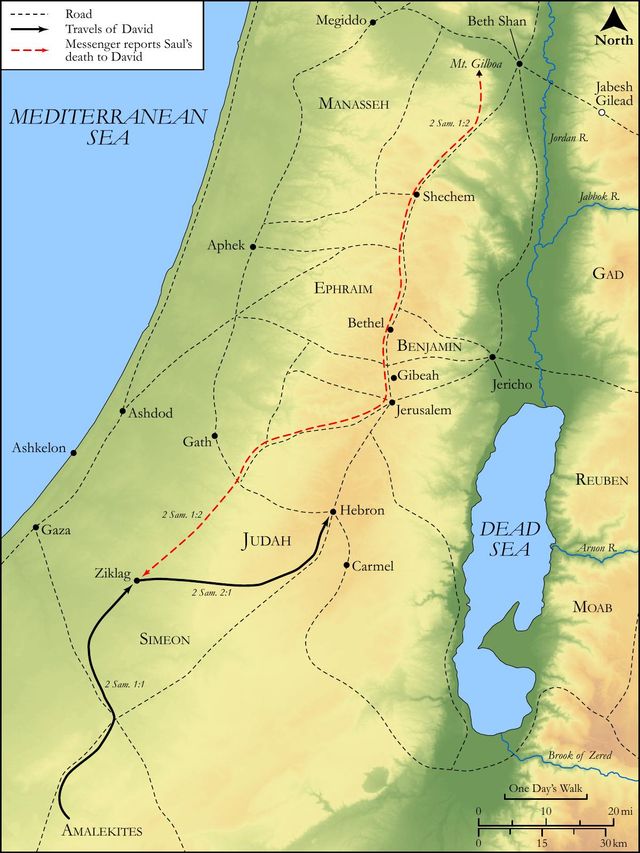
This pivotal verse immediately follows the dramatic and controversial report of an Amalekite, who claims to have delivered the final, fatal blow to King Saul on Mount Gilboa, subsequently bringing Saul's crown and armlet to David in the expectation of reward. The preceding verses (2 Samuel 1:1-10) detail this encounter, establishing the gravity of the news and the Amalekite's self-serving narrative. David's visceral reaction in 2 Samuel 1:11 is followed by his swift interrogation and execution of the Amalekite (2 Samuel 1:13-16) for laying hands on the Lord's anointed. This sequence then sets the stage for the poignant "Lament of the Bow" over Saul and Jonathan (2 Samuel 1:17-27), which further solidifies David's character. His actions demonstrate deep respect for divine appointment and genuine affection for Jonathan, rather than any opportunistic joy at the removal of his long-time adversary.
Historical & Cultural Context
In Israel, the tearing of garments was a deeply ingrained and universally understood cultural practice signifying profound distress, mourning, horror, or indignation. It was a public and often immediate physical manifestation of internal turmoil, not merely a symbolic act but a genuine expression of a broken heart or a shocked spirit, often accompanied by wailing, fasting, and covering oneself with dust or sackcloth. For David, mourning Saul, despite years of relentless persecution, was also an act of profound respect for the office of the king, God's anointed. This principle was paramount to David, who consistently upheld it even when Saul sought his life, as seen in his refusal to harm Saul in the cave at Engedi (1 Samuel 24:6) and again at Hachilah (1 Samuel 26:9-11). This cultural practice provided a visible, communal outlet for overwhelming emotion.
Key Themes
ShowHideDavid's reaction in this verse powerfully contributes to several overarching themes within 2 Samuel and the broader Deuteronomistic History. Firstly, it emphatically emphasizes David's righteous character and his consistent reverence for God's chosen leaders, even when those leaders are flawed or antagonistic towards him. This contrasts sharply with the Amalekite's mercenary attitude and sets David apart as a "man after God's own heart" (1 Samuel 13:14). Secondly, it highlights the theme of profound grief and lament in the face of national tragedy and deep personal loss, particularly for Jonathan, whose extraordinary bond with David is a central motif throughout 1 Samuel and 2 Samuel. Finally, the communal nature of the mourning, with "all the men that were with him" joining in, underscores the theme of solidarity and shared sorrow within the nascent community forming around David, recognizing the immense loss for all Israel.
Exposition and Analysis
ShowHideKey Word Analysis
ShowHideThis verb (חָזַק) is a primitive root meaning "to fasten upon," "to seize," or "to be strong." In this context, it describes a deliberate and forceful action, indicating that David did not merely touch his clothes but grasped them firmly with intent to tear. This underscores the intentionality and intensity of his emotional response, a powerful physical manifestation of his internal shock and grief.
The term (בֶּגֶד) refers to an outer garment or cloak. Tearing the outer garment was a visible, public act, not a private one. The act of tearing one's clothes was often accompanied by other outward signs of mourning, such as putting dust on one's head or sitting in ashes, further emphasizing the depth and public nature of the emotional state.
This verb (קָרַע) literally means "to tear," "to rip," or "to cut." In the context of garments, it denotes a deliberate, forceful act of tearing one's clothing as a public and visceral expression of intense emotion. It is a common biblical idiom for profound grief, mourning (e.g., Genesis 37:34), horror (e.g., 2 Kings 18:37), or despair (e.g., Job 1:20). David's immediate action signifies an overwhelming, unfeigned sorrow and shock.
This term (אֱנוֹשׁ) refers to "a mortal," or "a man in general." Its use here emphasizes the shared humanity and vulnerability of David's company. It highlights that the grief was not limited to David alone but was a collective experience, demonstrating the solidarity and shared emotional impact of the news on all who were with him.
Verse Breakdown
ShowHide"Then David took hold on his clothes, and rent them;"
This clause describes David's immediate, physical, and deeply symbolic reaction to the news of Saul's death. The act of taking hold and tearing his clothes signifies profound grief, shock, and lament. It is a public display of his inner turmoil, demonstrating a genuine sorrow for the fallen king and his beloved friend Jonathan, rather than any sense of relief or triumph over his adversary. This action immediately establishes David's character as one who respects God's anointed and mourns national tragedy.
"and likewise all the men that [were] with him:"
This second clause highlights the communal nature of the mourning. David's men, who had followed him through years of hardship and exile, joined him in this act of lament. This demonstrates their loyalty to David, their shared understanding of the gravity of the situation, and their participation in the collective sorrow over the death of Israel's king and his heir. It underscores a unity of purpose and emotion within David's company, reflecting a shared recognition of the national tragedy and the deep respect they held for David's leadership and values.
Literary Devices
ShowHideThe verse primarily employs Symbolism and Parallelism. The act of tearing clothes is highly Symbolic, representing a profound internal state of grief, shock, and despair. It is a non-verbal communication that transcends mere words, conveying the depth of David's sorrow for both Saul, the fallen king, and Jonathan, his dearest friend. This symbolic gesture is a recurring motif throughout biblical literature, understood throughout Israel as an outward manifestation of a shattered spirit. Furthermore, the phrase "and likewise all the men that [were] with him" creates a powerful Parallelism of action, emphasizing the shared nature of the grief. This parallelism not only underscores the widespread impact of the news but also highlights the solidarity and shared emotional response of David's loyal followers, reinforcing the communal aspect of the tragedy and the deep respect they held for David's leadership and the gravity of the national loss.
Theological and Thematic Connections
ShowHideDavid's response in 2 Samuel 1:11 is a powerful theological statement, demonstrating his unwavering respect for God's anointing, even upon a flawed and persecuting king. His grief is not merely for Jonathan, his beloved friend, but also for Saul, the Lord's anointed, whose death represents a national tragedy and a disruption of the divinely established order. This act of lament, rather than celebration, positions David as a man whose heart aligns with God's purposes, prioritizing divine appointment and national well-being over personal vindication. It foreshadows his just and compassionate reign, rooted in a deep reverence for God's sovereignty and a profound understanding of the sanctity of God's chosen instruments. This moment solidifies David's moral authority and spiritual integrity before his ascension to the throne.
Reflection and Application
ShowHideDavid's raw and immediate expression of grief in 2 Samuel 1:11 offers a profound model for how we, as believers, are called to respond to loss and tragedy. In a world that often encourages stoicism, superficiality, or even schadenfreude, David demonstrates the authenticity of human emotion, reminding us that sorrow is a legitimate and even necessary part of the human experience. His mourning for Saul, his persecutor, challenges us to cultivate a spirit of respect and compassion even for those who have wronged us, recognizing their inherent dignity and, in some cases, their divinely appointed roles. This passage also highlights the power of communal grief, showing that bearing one another's burdens in times of sorrow strengthens bonds and provides vital support. We are invited to lament with those who lament, to share in the pain of others, and to find solace in shared vulnerability, trusting that God is present even in our deepest sorrows, and that true leadership involves empathy and shared humanity.
Questions for Reflection
ShowHideFAQ
ShowHideWhy did David mourn Saul, his enemy?
ShowHideDavid's mourning for Saul was multifaceted and deeply significant, demonstrating his profound character. Firstly, it reflected his unwavering respect for Saul's position as "the Lord's anointed" (1 Samuel 24:6). Despite Saul's relentless pursuit and attempts on David's life, David consistently refused to harm him, recognizing that Saul's authority came from God. David understood that to rejoice in the fall of God's chosen king, even a flawed one, would be to disrespect divine sovereignty and God's established order. Secondly, David's grief was genuine for the national tragedy that Saul's death represented for Israel; it was a moment of profound weakness and vulnerability for the nation. Thirdly, and perhaps most personally, David mourned the loss of Jonathan, Saul's son and David's dearest friend, whose death was inextricably linked to Saul's on Mount Gilboa. David's poignant lament in 2 Samuel 1:19-27 makes this clear, especially his heartfelt words for Jonathan: "I am distressed for you, my brother Jonathan; very pleasant have you been to me; your love to me was wonderful, passing the love of women" (2 Samuel 1:26).
Was tearing clothes a common practice in ancient Israel, and what did it signify?
ShowHideYes, tearing clothes was a very common and highly significant practice in Israel. It was a powerful non-verbal expression of intense emotion, primarily signifying profound grief or mourning (e.g., Genesis 37:34 when Jacob believed Joseph was dead, or Job 1:20 upon hearing of his children's deaths). Beyond mourning, it could also express horror or indignation (e.g., at blasphemy, as seen when the high priest tore his robes in Matthew 26:65), extreme distress or despair, or even repentance (though less commonly for this specific act). The act was public and immediate, often accompanied by other signs of lament like wailing, fasting, or putting dust on one's head, making the inner turmoil visibly manifest to the community.
Christ-Centered Fulfillment
ShowHideDavid's profound grief and lament over the death of Saul, the Lord's anointed, even his persecutor, finds its ultimate fulfillment and transformation in the person and work of Jesus Christ. While David mourned the death of a king who ultimately failed and brought about a national crisis, Christ, the true King of Israel and the ultimate Anointed One, willingly laid down His life, not as a victim of battle, but as the Lamb of God who takes away the sin of the world. David's respect for Saul's anointing foreshadows the perfect reverence due to Christ, who is God's eternally appointed King and High Priest, "anointed with the oil of gladness beyond your companions" (Hebrews 1:9). Unlike Saul, whose death brought sorrow and a temporary vacuum of leadership, Christ's death, though initially causing profound grief to His disciples (Luke 24:17), ultimately led to His glorious resurrection and the triumph over sin and death, bringing eternal life and hope to all who believe (Romans 6:9-10). The communal mourning of David and his men for a fallen earthly king points forward to the universal sorrow for humanity's sin that necessitated Christ's sacrifice, and the ultimate communal joy of those who find redemption and new life in the resurrected Lord Jesus Christ. His suffering and death, though a source of sorrow, were the means by which God's ultimate plan of salvation was accomplished, turning lament into everlasting praise and ushering in a new covenant of grace (Isaiah 53:3-5; Hebrews 9:15).