


Acts 14:14
- ἈκούσαντεςAkousantesHaving heardG191V-AAP-NPMVerb Aorist Active Participle Nominative Plural Masculine
- δὲdehoweverG1161CONJConjunction
- οἱhoitheG3588T-NPMDefinite article Nominative Plural Masculine
- ἀπόστολοιapostoloiapostlesG652N-NPMNoun Nominative Plural Masculine
- ΒαρναβᾶςBarnabasBarnabasG921N-NSM-PNoun Nominative Singular Masculine Individual
- καὶkaiandG2532CONJConjunction
- ΠαῦλοςPaulosPaulG3972N-NSM-PNoun Nominative Singular Masculine Individual
- διαρρήξαντεςdiarrēxanteshaving tornG1284V-AAP-NPMVerb Aorist Active Participle Nominative Plural Masculine
- τὰtatheG3588T-APNDefinite article Accusative Plural Neuter
- ἱμάτιαhimatiagarmentsG2440N-APNNoun Accusative Plural Neuter
- αὐτῶνautōnof themG846P-GPMPersonal pronoun Genitive Plural Masculine
- ἐξεπήδησανexepēdēsanrushed outV-AAI-3PVerb Aorist Active Indicative 3rd Plural
- εἰςeisintoG1519PREPPreposition
- τὸνtontheG3588T-ASMDefinite article Accusative Singular Masculine
- ὄχλονochloncrowdG3793N-ASMNoun Accusative Singular Masculine
- κράζοντεςkrazontescrying outG2896V-PAP-NPMVerb Present Active Participle Nominative Plural Masculine
English is a literal word-by-word gloss of the Greek, not the KJV's wording. Why?
This is the original text the KJV's translators worked from — each Greek word with its own literal English meaning in this verse, prepared by scholars at Tyndale House, Cambridge. The KJV translates whole sentences, not word by word, so its wording differs: one Greek word can become several English words, and the KJV may choose “charity” where the gloss reads “love”. Both are faithful — they answer different questions. For the KJV's own rendering, switch to the KJV text.
Details
See on the biblical-era map
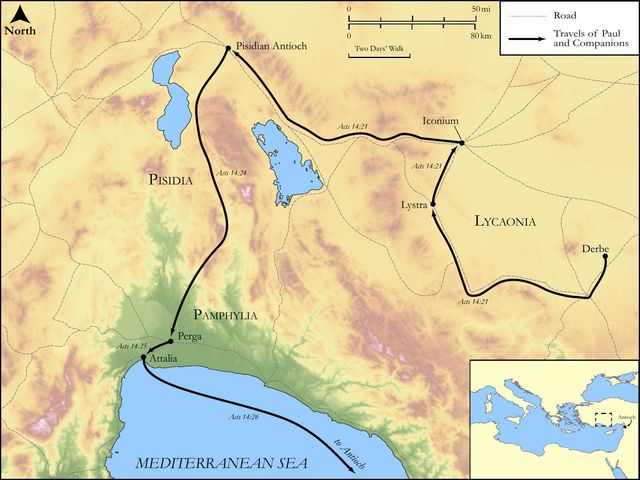
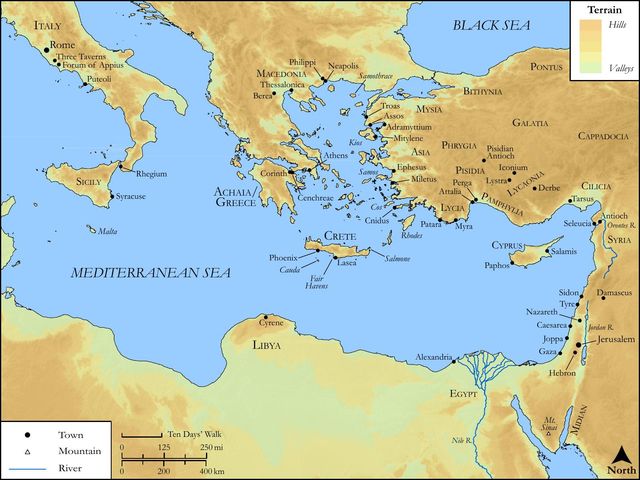
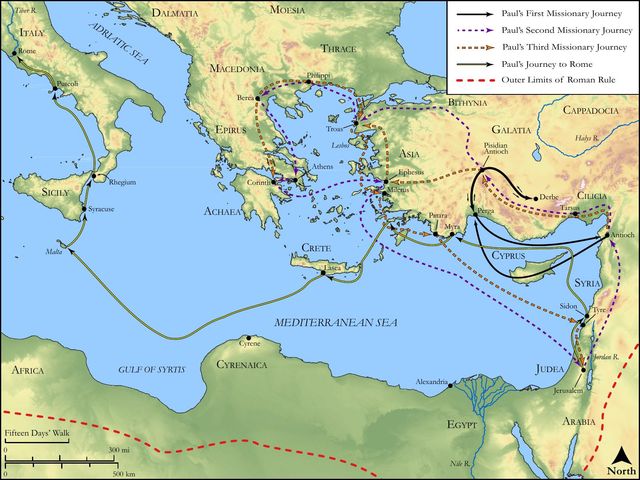
Study this verse
Public-domain commentary
Matthew Henry
From his Commentary on the Whole Bible. Henry comments on passages, not single verses — this entry covers Acts 14:8–18. His four-level outline is real structure in the source text, so it is rendered as structure.
In these verses we have,
I.A miraculous cure wrought by Paul at Lystra upon a cripple that had been lame from his birth, such a one as was miraculously cured by Peter and John, Act 3:2. That introduced the gospel among the Jews, this among the Gentiles; both that and this were designed to represent the impotency of all the children of men in spiritual things: they are lame from their birth, till the grace of God puts strength into them; for it was when we were yet without strength that Christ died for the ungodly, Rom 5:6. Observe here,
1.The deplorable case of the poor cripple (Act 14:8): He was impotent in his feet, disabled (so the word is) to such a degree that it was impossible he should set his foot to the ground, to lay any stress upon it. It was well known that he had been so from his mother's womb, and that he never had walked, nor could stand up. We should take occasion hence to thank God for the use of our limbs; and those who are deprived of it may observe that their case is not singular.
2.The expectation that was raised in him of a cure (Act 14:9): He heard Paul preach, and, it is likely, was much affected with what he heard, believed that the messengers, having their commission thence, had a divine power going along with them, and were therefore able to cure him of his lameness. This Paul was aware of, by the spirit of discerning that he had, and perhaps the aspect of his countenance did in part witness for him: Paul perceived that he had faith to be healed; desired it, hoped for it, had such a thing in his thoughts, which it does not appear that the lame man Peter healed had, for he expected no more than an alms. There was not found such great faith in Israel as was among the Gentiles, Mat 8:10.
3.The cure wrought: Paul, perceiving that he had faith to be healed, brought the word and healed him, Psa 107:20. Note, God will not disappoint the desires that are of his own kindling, nor the hopes of his own raising. Paul spoke to him with a loud voice, either because he was at some distance, or to show that the true miracles, wrought by the power of Christ, were far unlike the lying wonders wrought by deceivers, that peeped, and muttered, and whispered, Isa 8:19. God saith, I have not spoken in secret, in a dark place of the earth, Isa 45:19. Paul spoke to him with a loud voice, that the people about might take notice, and have their expectations raised of the effect. It does not appear that this cripple was a beggar; it is said (Act 14:8) that he sat, not that he sat begging. But we may imagine how melancholy it was to him to see other people walking about him, and himself disabled; and therefore how welcome Paul's word was to him, "Stand upright on thy feet; help thyself, and God shall help thee; try whether thou hast strength, and thou shalt find that thou hast." Some copies read it, I say unto thee, in the name of the Lord Jesus Christ, Stand upright on thy feet. It is certain that this is implied, and very probably was expressed, by Paul, and power went along with this word; for presently he leaped and walked, leaped up from the place where he sat, and not only stood upright, but to show that he was perfectly cured, and that immediately, he walked to and fro before them all. Herein the scripture was fulfilled, that when the wilderness of the Gentile world is made to blossom as the rose then shall the lame man leap as a hart, Isa 35:1, Isa 35:6. Those that by the grace of God are cured of their spiritual lameness must show it by leaping with a holy exultation and walking in a holy conversation.
II.The impression which this cure made upon the people:
they were amazed at it, had never seen nor heard the like, and fell into an ecstacy of wonder. Paul and Barnabas were strangers, exiles, refugees, in their country; every thing concurred to make them mean and despicable: yet the working of this one miracle was enough to make them in the eyes of this people truly great and honourable, though the multitude of Christ's miracles could not screen him from the utmost contempt among the Jews. We find here,
1.The people take them for gods (Act 14:11): They lifted up their voices with an air of triumph, saying in their own language (for it was the common people that said it), in the speech of Lycaonia, which was a dialect of the Greek, The gods are come down to us in the likeness of men. They imagined that Paul and Barnabas had dropped down to them out of the clouds, and that they were some divine powers, no less than gods, though in the likeness of men. This notion of the thing agreed well enough with the pagan theology, and the fabulous account they had of the visits which their gods made to this lower world; and proud enough they were to think that they should have a visit made to them. They carried this notion so far here that they pretended to tell which of their gods they were, according to the ideas their poets had given them of the gods (Act 14:12): They called Barnabas Jupiter; for, if they will have him to be a god, it is as easy to make him the prince of their gods as not. It is probable that he was the senior, and the more portly comely man, that had something of majesty in his countenance. And Paul they called Mercury, who was the messenger of the gods, that was sent on their errands; for Paul, though he had not the appearance that Barnabas had, was the chief speaker, and had a greater command of language, and perhaps appeared to have something mercurial in his temper and genius. Jupiter used to take Mercury along with him, they said, and, if he make a visit to their city, they will suppose he does so now.
2.The priest thereupon prepares to do sacrifice to them, Act 14:13. The temple of Jupiter was, it seems, before the gate of their city, as its protector and guardian; and the priest of that idol and temple, hearing the people cry out thus, took the hint presently, and thought it was time for him to bestir himself to do his duty: many a costly sacrifice he had offered to the image of Jupiter, but if Jupiter be among them himself - in propria persona, it concerns him to do him the utmost honours imaginable; and the people are ready to join with him in it. See how easily vain minds are carried away with a popular outcry. If the crowd give a shout, Here is Jupiter, the priest of Jupiter takes the first hint, and offers his service immediately. When Christ, the Son of God, came down, and appeared in the likeness of men, and did many, very many miracles, yet they were so far from doing sacrifice to him that they made him a sacrifice to their pride and malice: He was in the world, and the world knew him not; he came to his own, and his own received him not; but Paul and Barnabas, upon the working of one miracle, are immediately deified. The same power of the god of this world which prejudices the carnal mind against truth makes errors and mistakes to find easy admission; and both ways his turn is served. They brought oxen, to be sacrificed to them, and garlands, with which to crown the sacrifices. These garlands were made up of flowers and ribbons; and they gilded the horns of the oxen they sacrificed.
Victimae ad supplicium saginantur,
hostiae ad poenam corenantur.
So beasts for sacrifice do feed,
First to be crown'd, and then to bleed.
- So Octavius in Minutius Felix.
III.Paul and Barnabas protest against this undue respect paid them, and with much ado prevent it.
Many of the heathen emperors called themselves gods, and took a pride in having divine honours paid them: but Christ's ministers, though real benefactors to mankind, while these tyrants only pretended to be so, refused those honours when they were so tendered. Whose successor therefore he is who sits in the temple of God, and shows that he is god (Th2 2:4), and who is adored as our lord god, the pope, it is easy to say. Observe,
1.The holy indignation which Paul and Barnabas conceived at this: When they heard this, they rent their clothes. We do not find that they rent their clothes when the people vilified them, and spoke of stoning them; they could bear this without disturbance: but when they deified them, and spoke of worshipping them, they could not bear it, but rent their clothes, as being more concerned for God's honour than their own.
2.The pains they took to prevent it. They did not connive at it, nor say, "If people will be deceived, let them be deceived," much less suggest to themselves and one another that it might contribute both to the safety of their persons and the success of their ministry if they suffered the people to continue in this mistake, and so they might make a good hand of an ill thing. No, God's truth needs not the service of man's lie. Christ had put honour enough upon them in making them apostles, they needed not assume either the honour of princes or the honour of gods; they appeared with much more magnificent titles when they were called the ambassadors of Christ, and the stewards of the mysteries of God, than when they were called Jupiter and Mercury. Let us see how they prevented it.
(1.)They ran in among the people, as soon as they heard of it, and would not so much as stay awhile to see what the people would do. Their running in, like servants, among the people, showed that they were far from looking upon themselves as gods, or taking state upon them; they did not stand still, expecting honours to be done them, but plainly declined them by thrusting themselves into the crowd. They ran in, as men in earnest, with as much concern as Aaron ran in between the living and the dead, when the plague was begun.
(2.)They reasoned with them, crying out, that all might hear, "Sirs, why do you these things?" Why do you go about to make gods of us? It is the most absurd thing you can do; for,
[1.]"Our nature will not admit it: We also are men of like passions with you" homoiopatheis: it is the same word that is used concerning Elias, Jam 5:18, where we render it, subject to like passions as we are. "We are men, and therefore you wrong yourselves if you expect that from us which is to be had in God only; and you wrong God if you give that honour to us, or to any other man, which is to be given to God only. We not only have such bodies as you see, but are of like passions with you, have hearts fashioned like as other men (Psa 33:15); for, as in water face answers to face, so doth the heart of man to man, Pro 27:19. We are naturally subject to the same infirmities of the human nature, and liable to the same calamities of the human life; not only men, but sinful men and suffering men, and therefore will not be deified."
[2.]"Our doctrine is directly against it. Must we be added to the number of your gods whose business it is to abolish the gods you have? We preach unto you that you should turn from these vanities unto the living God. If we should suffer this, we should confirm you in that which it is our business to convert you from:" and so they take this occasion to show them how just and necessary it was that they should turn to God from idols, Th1 1:9. When they preached to the Jews, who hated idolatry, they had nothing to do but to preach the grace of God in Christ, and needed not, as the prophets in dealing with their fathers, to preach against idolatry: but, when they had to do with the Gentiles, they must rectify their mistakes in natural religion, and bring them off from the gross corruptions of that. See here what they preached to the Gentiles.
First, That the gods which they and their fathers worshipped, and all the ceremonies of their worship of them were vanities, idle things, unreasonable, unprofitable, which no rational account could be given of, nor any real advantage gained from. Idols are often called vanities in the Old Testament, Deu 32:21; Kg1 10:13; Jer 14:22. An idol is nothing in the world (Co1 8:4): it is not at all what it is pretended to be, it is a cheat, it is a counterfeit; it deceives those that trust to it and expect relief from it. Therefore turn from these vanities, turn from them with abhorrence and detestation, as Ephraim did (Hos 14:8): "What have I to do any more with idols? I will never again be thus imposed upon."
Secondly, That the God to whom they would have them turn is the living God. They had hitherto worshipped dead images, that were utterly unable to help them (Isa 64:9), or (as they now attempted) dying men, that would soon be disabled to help them; but now they are persuaded to worship a living God, who has life in himself, and life for us, and lives for evermore.
Thirdly, That this God is the creator of the world, the fountain of all being and power: "He made heaven and earth, and the sea, and all things therein, even those things which you worship as gods, so that he is the God of your gods. You worship gods which you made, the creatures of your own fancy, and the work of your own hands. We call you to worship the true God, and cheat not yourselves with pretenders; worship the Sovereign Lord of all, and disparage not yourselves in bowing down to his creatures and subjects."
Fourthly, That the world owed it to his patience that he had not destroyed them long ere this for their idolatry (Act 14:16): In times past, for many ages, unto this day, he suffered all nations to walk in their own ways. These idolaters, that were called from the service of other gods, might think, "Have we not served these gods hitherto, and our fathers before us, time out of mind; and why may we not as well go on to serve them still?" - No, your serving them was a trial of God's patience, and it was a miracle of mercy that you were not cut off for it. But, though he did not destroy you for it while you were in ignorance, and knew no better (Act 17:30) yet now that he has sent his gospel into the world, and by it has made a clear discovery of himself and his will to all nations, and not to the Jews only, if you still continue in your idolatry he will not bear with you as he has done. All the nations that had not the benefit of divine revelation, that is, all but the Jews, he suffered to walk in their own ways, for they had nothing to check them, or control them, but their own consciences, their own thoughts (Rom 2:15), no scriptures, no prophets; and then they were the more excusable if they mistook their way: but now that God has sent a revelation into the world which is to be published to all nations the case is altered. We may under-stand it as a judgment upon all nations that God suffered them to walk in their own ways, gave them up to their own hearts' lusts; but now the time is come when the veil of the covering spread over all nations should be taken off (Isa 25:7), and now you will no longer be excused in these vanities, but must turn from them. Note, 1. God's patience with us hitherto should lead us to repentance, and not encourage us to presume upon the continuance of it, while we continue to provoke him. 2. Our having done ill while we were in ignorance will not bear us out in doing ill when we are better taught.
Fifthly, That even when they were not under the direction and correction of the word of God, yet they might have known, and should have known, to do better by the works of God, Act 14:17. Though the Gentiles had not the statutes and judgments that the Jews had to witness for God against all pretenders, no tables of testimony or tabernacle of testimony, yet he left not himself without witness; besides the witness for God within them (the dictates of natural conscience), they had witnesses for God round about them - the bounty of common providence. Their having no scriptures did in part excuse them, and therefore God did not destroy them for their idolatry, as he did the Jewish nation. This however did not wholly excuse them, but that notwithstanding this they were highly criminal and deeply guilty before God; for there were other witnesses for God, sufficient to inform them that he and he only is to be worshipped, and that to him they owed all their services from whom they received all their comforts, and therefore that they were guilty of the highest injustice and ingratitude imaginable, in alienating them from him. God, having not left himself without witness, has not left us without a guide, and so has left us without excuse; for whatever is a witness for God is a witness against us, if we give that glory to any other which is due to him only. 1. The bounties of common providence witness to us that there is a God, for they are all dispensed wisely and with design. The rain and fruitful seasons could not come by chance, nor are there any of the vanities of the heathen that can give rain, neither can the heavens of themselves give showers, Jer 14:22. All the powers of nature witness to us a sovereign power in the God of nature, from whom they are derived, and on whom they depend. It is not the heaven that gives us rain, but God that gives us rain from heaven, he is the Father of the rain, Job 38:28. 2. The benefits we have by these bounties witness to us that we ought to make our acknowledgments not to the creatures who are made serviceable to us, but to the Creator who makes them so. He left not himself without witness, in that he did good. God seems to reckon the instances of his goodness to be more pregnant, cogent proofs of his title to our homage and adoration than the evidences of his greatness; for his goodness is his glory. The earth is full of his goodness; his tender mercies are over all his works; and therefore they praise him, Psa 145:9, Psa 145:10. God does us good, in preserving to us his air to breathe in, his ground to go upon, the light of his sun to see by; but, because the most sensible instance of the goodness of Providence to each of us in particular is that of the daily provision made by it of meat and drink for us, the apostle chooses to insist upon that, and shows how God does us good, (1.) In preparing it for us, and that by a long train of causes which depend upon him as the first cause: The heavens hear the earth; the earth hears the corn, and wine, and oil; and they hear Jezreel. Hos 2:21, Hos 2:22. He does us good in giving us rain from heaven - rain for us to drink, for if there were no rain there would be no springs of water and we should soon die for thirst - rain for our land to drink, for our meat as well as drink we have from the rain; in giving us this, he gives us fruitful seasons. If the heavens be as iron, the earth will soon be as brass, Lev 26:19. This is the river of God which greatly enriches the earth, and by it God prepares us corn, Psa 65:9-13. Of all the common operations of providence, the heathen chose to form their notion of the supreme God by that which bespeaks terror, and is proper to strike an awe of him upon us, and this was the thunder; and therefore they called Jupiter the thunderer, and represented him with a thunderbolt in his hand; and it appears by Psa 29:3 that this ought not to be overlooked; but the apostle here, to engage us to worship God, sets before us his beneficence, that we may have good thoughts of him in every thing wherein we have to do with him - may love him and delight in him, as one that does good, does good to us, does good to all, in giving rain from heaven and fruitful seasons; and if at any time rain be withheld, or the seasons be unfruitful, we may thank ourselves; it is our sin that turns away these good things from us which were coming to us, and stops the current of God's favours. (2.) In giving us the comforts of it. It is he that fills our hearts with food and gladness. God is rich in mercy to all (Rom 10:12): he gives us richly all things to enjoy (Ti1 6:17), is not only a benefactor, but a bountiful one, not only gives us the things we need, but gives us to enjoy them (Ecc 2:24): He fills our hearts with food, that is, he gives us food to our hearts' content, or according to our hearts' desire; not merely for necessity, but plenty, dainty, and variety. Even those nations that had lost the knowledge of him, and worshipped other gods, yet he filled their houses, filled their mouths, filled their bellies (Job 22:18; Psa 17:14) with good things. The Gentiles that lived without God in the world, yet lived upon God, which Christ urges as a reason why we should do good to those that hate us, Mat 5:44, Mat 5:45. Those heathen had their hearts filled with food; this was their felicity and satisfaction, they desired no more; but these things will not fill the soul (Eze 7:19), nor will those that know how to value their own souls be satisfied with them; but the apostles put themselves in as sharers in the divine beneficence. We must all own that God fills our hearts with food and gladness; not only food, that we may live, but gladness, that we may live cheerfully; to him we owe it that we do not all our days eat in sorrow. Note, We must thank God, not only for our food, but for our gladness - that he gives us leave to be cheerful, cause to be cheerful, and hearts to be cheerful. And, if our hearts be filled with food and gladness, they ought to be filled with love and thankfulness, and enlarged in duty and obedience, Deu 8:10; Deu 28:47.
Lastly, The success of this prohibition which the apostles gave to the people (Act 14:18): By these sayings, with much ado, they restrained the people from doing sacrifice to them, so strongly were these idolaters set upon their idolatry. It was not enough for the apostles to refuse to be deified (this would be construed only a pang of modesty), but they resented it, they showed the people the evil of it, and all little enough, for they could scarcely restrain them from it, and some of them were ready to blame the priest, that he did not go on with his business notwithstanding. We may see here what gave rise to the pagan idolatry; it was terminating those regards in the instruments of our comfort which should have passed through them to the Author. Paul and Barnabas had cured a cripple, and therefore the people deified them, instead of glorifying God for giving them such power, which should make us very cautious that we do not give that honour to another, or take it to ourselves, which is due to God only.
Historical interpretation
Three Centuries of Reception
5 surviving comments on this verse. Each one is dated, so this reads as a timeline rather than a list.
Select a marker to jump to its quote. Markers stagger vertically where authors wrote within a few decades of each other.
First by the sight they checked them, by rending their garments. This did Joshua the son of Nun upon the occasion of the defeat of the people. Then think not that this action was unworthy of them: for such was the eagerness, they would not otherwise have restrained it would not otherwise have quenched the conflagration. Therefore when need is to do something that is fit to be done, let us not decline it. For if even after all this they hardly persuaded them, if they had not acted thus, what might have been the consequence? For if they had not done thus, they would have been thought to make a show of humility, and to be all the more desirous of the honor. And observe their language, how in rebuking it is moderated, alike full of wonder and of rebuke. This above all it was that hindered them, the saying, "Preaching unto you to turn from these vanities unto God." We are men indeed, they say, but greater than these: for these are dead things. Mark how they not only subvert the false, but teach the true, saying nothing about things invisible-"Who made," say they, "heaven and earth, and the sea, and all things that are therein."
Let us imitate them: let us think nothing our own, seeing even faith itself is not our own, but more God's than ours. "For by grace are ye saved through faith; and this," saith he, "not of ourselves; it is the gift of God." Then let us not think great things of ourselves, nor be puffed up, being as we are, men, dust and ashes, smoke and shadow.
"Which when the Apostles, Barnabas and Paul, heard of, they rent their clothes, and ran in among the people, crying out, and saying, Sirs, why do ye these things? We also are men of like passions with you." See how on all occasions they are clean from the lust of glory, not only not coveting, but even repudiating it when offered: just as Peter also said, "Why gaze ye on us, as though by our own power or holiness we had made him to walk"? so these also say the same. And Joseph also said of the dreams, "Is not their interpretation of God?" And Daniel in like manner, "And to me also, not through the wisdom that is in me was it revealed." And Paul everywhere says this, as when he says, "And for these things who is sufficient? Not that we are sufficient of ourselves to think aught as of ourselves, but our sufficiency is of God."
Mark the vehemence with which all this is done by the Apostles: "rent their clothes, ran in, cried out," all from strong affection of the soul, revolted by the things that were done. For it was a grief, indeed a grief inconsolable, that they should needs be thought gods, and introduce idolatry, the very thing which they came to destroy! This also was a contrivance of the devil-but he did not prevail. But what say they? "We also are men of like passions with you." At the very outset they overthrew the evil. They said not simply, "Men," but "As ye." Then, that they may not seem to honor the gods, hear what they add: "Preaching unto you, that ye should turn from these vanities unto the living God, Who made heaven, the sea, and all things that are therein." Observe how they nowhere mention things invisible.
Having torn their clothes, they rushed out into the crowd, and so on. They, fearing, tear their garments because they were being honored with the worship of gods. For this is a custom of the Jews whenever they hear anything blasphemous and as if against God. But Herod, because he did not give honor to God but acquiesced to the excessive favor of the people, was immediately struck by an angel.
Continue studying Acts 14:14 across the web’s major study libraries — every link below opens this exact verse, chapter, or book on the destination site.
Read & Compare
 BibleGatewayThis verse in more than 200 translations and 70 languages.
 Bible.comThe YouVersion reader — hundreds of translations, reading plans, and highlights.
 ESV.orgCrossway's official English Standard Version reader.
 NET BibleThe NET translation with 60,000+ translators' notes on every rendering decision.
 STEP BibleTyndale House's free study tool — original text, vocabulary, and scholarly resources.
 BibliaLogos Bible Software's free web reader.
 USCCBThe New American Bible (Revised Edition) with the U.S. bishops' study notes.
Commentaries
 BibleHub CommentariesDozens of classic commentaries on this verse, gathered on one page.
 StudyLightMore than 100 commentary sets — the largest collection on the web.
 BibleRefPlain-English commentary on what this verse means, verse by verse.
 Enduring WordDavid Guzik's free commentary on this chapter, widely used by Bible teachers.
 Bible Study ToolsVerse commentary alongside Greek and Hebrew study aids.
Original Language & Research
- BibleHub InterlinearThe verse word by word — original language, transliteration, and English.
- BibleHub LexiconEvery word's original-language definition and Strong's entry.
 Blue Letter BibleDeep-study tools — Strong's numbers, concordance, and word studies.
 CNTR CollationThe earliest Greek manuscripts of this verse, collated letter by letter.
Sermons, Hymns & Audio


TrulyRandomVerse is not affiliated with these sites and doesn’t control their content. They’re linked because they’re genuinely useful.
Summary
Acts 14:14 vividly portrays the immediate and vehement reaction of the apostles, Barnabas and Paul, when they learned that the people of Lystra intended to offer sacrifices to them, believing them to be gods. Their response—rending their clothes and rushing into the crowd, crying out—underscores their profound distress and unwavering commitment to redirecting all worship and glory solely to the one true God, firmly rejecting any form of idolatry or self-exaltation.
Context
ShowHideLiterary Context
This verse is a pivotal moment following Paul's miraculous healing of a man lame from birth in Lystra, as recounted in Acts 14:8-10. The healing deeply impressed the local inhabitants, who, steeped in their pagan traditions, immediately concluded that Barnabas and Paul were gods who had descended to earth. They identified Barnabas as Zeus and Paul as Hermes, the chief speaker, and began preparations to offer sacrifices to them, bringing oxen and garlands to the city gates (Acts 14:11-13). Acts 14:14 captures the apostles' horrified and decisive intervention, setting the stage for Paul's subsequent sermon in Acts 14:15-18, where he explicitly refutes their idolatrous assumptions and proclaims the living God.
Historical & Cultural Context
Lystra was a Roman colony in the region of Lycaonia, a rural area known for its strong adherence to traditional Greco-Roman polytheistic beliefs. The people were familiar with myths of gods visiting earth in human form, such as the story of Zeus and Hermes visiting Philemon and Baucis. Their immediate leap to deifying Barnabas and Paul reflects their cultural worldview, where miraculous power was often attributed to divine beings. The act of "rending their clothes" was a deeply significant cultural gesture, particularly in Jewish tradition, signifying extreme grief, shock, horror, or indignation, especially in response to blasphemy or perceived sacrilege. For Barnabas and Paul, this was not merely a sign of surprise, but a public, visceral protest against the profound theological error and insult to God's exclusive glory.
Key Themes
ShowHideActs 14:14 powerfully contributes to several overarching themes in the book of Acts. Firstly, it highlights the rejection of idolatry and the supremacy of the one true God, a constant message throughout the early Christian mission, particularly as the gospel expanded into pagan territories. The apostles' actions emphatically declare that worship belongs to God alone, echoing the foundational commandment against other gods found in Exodus 20:3. Secondly, the verse showcases apostolic humility and integrity, demonstrating that true spiritual authority deflects glory from self to God. Despite performing a miracle, they vehemently refused any personal honor, standing in stark contrast to the human tendency towards self-exaltation. This humility is further articulated in their subsequent declaration in Acts 14:15, where they emphasize their shared humanity. Finally, it exemplifies the apostles' zeal for God's glory, illustrating their passionate commitment to defending God's honor and ensuring He receives all due praise, prioritizing theological truth over personal popularity or gain.
Exposition and Analysis
ShowHideKey Word Analysis
ShowHideThis verb signifies a violent tearing apart, often used in the context of garments. Its use here emphasizes the extreme and visceral nature of the apostles' reaction. It was not a gentle tearing, but a forceful, public act of protest, conveying profound distress, indignation, and spiritual horror at the blasphemous intent of the Lystrans.
This compound verb, formed from "into" and "to leap," vividly describes a sudden, forceful, and urgent movement. It paints a picture of the apostles not merely walking, but leaping or rushing into the crowd with great haste and intensity. This conveys their desperate urgency to intervene and stop the impending idolatry before it could take place.
This verb means to "croak" or scream, indicating a loud, often desperate or urgent vocalization. It suggests a passionate, perhaps even hoarse, outcry rather than a calm address. This loud shouting was necessary to capture the attention of the excited multitude and convey the gravity of their message amidst the chaotic scene of impending sacrifice.
Verse Breakdown
ShowHide"Which when the apostles, Barnabas and Paul, heard of"
This clause establishes the immediate cause of their reaction: the apostles became aware of the Lystrans' intention to offer sacrifices to them. The phrasing highlights that it was not merely a rumor, but a clear understanding of the impending idolatry that triggered their response.
"they rent their clothes"
This action is a powerful non-verbal communication. As detailed in the cultural context, it was a traditional Jewish expression of extreme grief, shock, or indignation, particularly in the face of blasphemy or sacrilege. For Barnabas and Paul, it was a public, unmistakable sign of their utter horror and vehement rejection of the Lystrans' attempt to worship them as gods.
"and ran in among the people"
This describes their urgent and forceful physical response. They did not passively observe or calmly approach, but actively and quickly moved into the midst of the excited crowd. This demonstrates their proactive and desperate attempt to stop the idolatrous act from proceeding.
"crying out"
This final phrase indicates their vocal and passionate protest. Their shouts were meant to draw attention, interrupt the proceedings, and communicate the urgency and gravity of their message, which would then be elaborated upon in the subsequent verses. It signifies their commitment to verbally correcting the profound misunderstanding.
Literary Devices
ShowHideActs 14:14 is rich in Dramatic Irony, as the audience knows Barnabas and Paul are mere mortals and servants of God, while the Lystrans mistakenly perceive them as divine beings. This creates tension and highlights the profound theological chasm between pagan belief and Christian truth. The apostles' actions employ Hyperbole in their intensity; rending clothes and rushing into a crowd are exaggerated responses that underscore the extreme nature of their spiritual indignation. This serves to emphasize the gravity of idolatry from the apostles' perspective. Furthermore, there is a strong Contrast between the Lystrans' misguided reverence and the apostles' humble humanity, setting the stage for Paul's subsequent sermon which explicitly clarifies their true identity and the nature of the one true God. The scene is also highly Dramatic, characterized by rapid action and intense emotion, capturing the reader's attention and conveying the urgency of the apostles' mission.
Theological and Thematic Connections
ShowHideActs 14:14 serves as a powerful theological statement on the absolute exclusivity of God's glory and the inherent sinfulness of idolatry. The apostles' extreme reaction underscores the non-negotiable truth that worship is due to God alone, and any attempt to deify humans or created things is a grave offense against His sovereignty and holiness. Their actions model a profound humility that deflects all praise from themselves, demonstrating that true spiritual authority always points beyond itself to the source of all power and goodness. This incident is a vivid illustration of the early church's unwavering commitment to monotheism in a polytheistic world, challenging pagan assumptions and laying the groundwork for a theology that elevates God above all human achievement or perception. It teaches us that guarding God's glory must be a primary concern for all believers.
Reflection and Application
ShowHideThe apostles' visceral response in Acts 14:14 offers a timeless and potent challenge to believers today. In a world that often elevates human achievement, charisma, or even spiritual giftedness to an unhealthy degree, this passage serves as a stark reminder to guard against any form of hero-worship or the subtle idolatry of self. We are called to cultivate a profound humility, recognizing that any good accomplished through us is solely by God's grace and for His glory, not our own. Just as Barnabas and Paul vehemently rejected the praise of men, we too must be quick to deflect adoration and point others to the true source of all blessing. This passage also calls us to a zealous defense of God's unique glory, prompting us to confront and correct any attitudes or practices—within ourselves or our communities—that diminish His supreme worth or attribute His power to human means.
Questions for Reflection
ShowHideFAQ
ShowHideWhy was "rending their clothes" such a significant act for Barnabas and Paul?
ShowHideRending clothes was a powerful and culturally recognized gesture, particularly in ancient Jewish society, signifying extreme grief, shock, or indignation. It was a common response to blasphemy or anything considered a profound abomination against God. For Barnabas and Paul, this act was not merely a display of emotion but a public, dramatic, and unmistakable protest against the Lystrans' attempt to worship them, which they considered a grave insult to the one true God and a violation of the first commandment (Exodus 20:3). It communicated their utter horror at the thought of receiving divine honor.
What does this passage teach us about Christian leadership?
ShowHideThis passage profoundly illustrates the essence of Christ-centered leadership: humility and glory-deflection. True Christian leaders, like Barnabas and Paul, are not to seek or accept worship for themselves, but to consistently redirect all praise and attention to God. Their immediate and vehement reaction demonstrates that a leader's primary concern should be the honor of God, not personal aggrandizement. It teaches that authentic spiritual authority is characterized by a deep reverence for God's unique sovereignty and a zealous commitment to ensuring that He alone receives all glory, even when performing powerful works through His servants (1 Peter 4:11).
Christ-Centered Fulfillment
ShowHideActs 14:14, with the apostles' fervent rejection of deification, powerfully foreshadows and reflects the ultimate humility and glory-deflection exemplified by Jesus Christ Himself. While Barnabas and Paul were mere men who refused divine honor, Jesus, though fully God, "did not consider equality with God as something to be grasped" (Philippians 2:6), but emptied Himself, taking the form of a servant. Throughout His earthly ministry, Jesus consistently pointed to the Father, declaring, "I can do nothing on my own" (John 5:30) and "the words that I speak to you I do not speak on my own authority; but the Father who dwells in me does His works" (John 14:10). The apostles' actions in Lystra, therefore, are a human echo of the divine pattern set by Christ, who, despite being worthy of all worship, humbled Himself, always seeking the Father's glory (John 17:4), and ultimately became the Lamb of God who takes away the sin of the world (John 1:29). Their refusal of glory anticipates the truth that all glory belongs to Him who is both fully God and fully man, the one mediator between God and humanity (1 Timothy 2:5).