


Ezra 9:3
Bible text: King James Version (1769 Blayney text) · Public domain
Bible text: Berean Standard Bible · Public domain
Bible text: American Standard Version (1901) · Public domain
Bible text: World English Bible, Messianic edition · Public domain
Bible text: Geneva Bible (1599) · Public domain
Bible text: Young's Literal Translation · Public domain
- וּכְשָׁמְעִיu·khe·sha·me·'Iand just as I heardH8085Conj-w ¦ Prep-k ¦ V-Qal-Inf ¦ 1csVerb Qal Infinitive Constructוּandכְjust asשָׁמְעִheardיI
- אֶת'et<obj.>H853DirObjMParticle Object Indicator
- הַדָּבָרha·da·Varthe matterH1697Art ¦ N-msNoun Singular Masculine Absoluteהַtheדָּבָרmatter
- הַזֶּהha·Zeh<the> thisH2088Art ¦ PrtParticle Demonstrativeהַ<the>זֶּהthis
- קָרַעְתִּיka·Ra'·tiI toreH7167V-Qal-Perf-1csVerb Qal Perfect 1st Singular common gender
- אֶת'et<obj.>H853DirObjMParticle Object Indicator
- בִּגְדִיbig·Dimy garmentH899N-msc ¦ 1csNoun Singular Masculine Constructבִּגְדִgarmentיmy
- וּמְעִילִיu·me·'i·Liand my robeH4598Conj-w ¦ N-msc ¦ 1csNoun Singular Masculine Constructוּandמְעִילִrobeיmy
- וָאֶמְרְטָהva·'em·re·Tahand I pulled out !H4803Conj-w ¦ V-Qal-ConsecImperf-1cs ¦ SfxVerb Qal Consecutive Imperfect 1st Singular common genderוָandאֶמְרְטָI pulled outה!
- מִשְּׂעַרmi·se·'Arsome of [the] hair ofH8181Prep-m ¦ N-mscNoun Singular Masculine Constructמִsome ofשְּׂעַר[the] hair of
- רֹאשִׁיro·Shimy headH7218N-msc ¦ 1csNoun Singular Masculine Constructרֹאשִׁheadיmy
- וּזְקָנִיu·ze·ka·Niand my beardH2206Conj-w ¦ N-csc ¦ 1msNoun Singular common gender Constructוּandזְקָנִbeardיmy
- וָאֵשְׁבָהva·'e·she·Vahand I sat down !H3427Conj-w ¦ V-Qal-ConsecImperf-1cs ¦ SfxVerb Qal Consecutive Imperfect 1st Singular common genderוָandאֵשְׁבָI sat downה!
- מְשׁוֹמֵםme·sho·MemappalledH8074V-Piel-Prtcpl-msVerb Piel Participle Singular Masculine Absolute
English is a literal word-by-word gloss of the Hebrew, not the KJV's wording. Why?
This is the original text the KJV's translators worked from — each Hebrew word with its own literal English meaning in this verse, prepared by scholars at Tyndale House, Cambridge. The KJV translates whole sentences, not word by word, so its wording differs: one Hebrew word can become several English words, and the KJV may choose “the LORD” where the gloss reads “Yahweh”. Both are faithful — they answer different questions. For the KJV's own rendering, switch to the KJV text.
Details
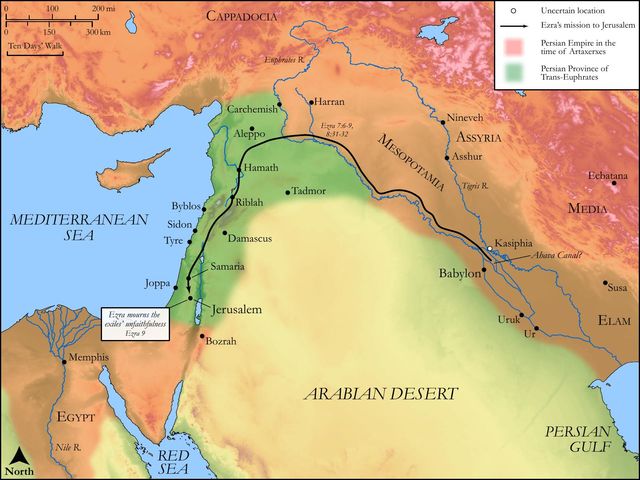
See on the biblical-era map
Study this verse
Public-domain commentary
Matthew Henry
From his Commentary on the Whole Bible. Henry comments on passages, not single verses — this entry covers Ezra 9:1–4. His three-level outline is real structure in the source text, so it is rendered as structure.
Ezra, like Barnabas when he came to Jerusalem and saw the grace of God to his brethren there, no doubt was glad, and exhorted them all that with purpose of heart they would cleave to the Lord, Act 11:23. He saw nothing amiss (many corruptions lurk out of the view of the most vigilant rulers); but here is a damp upon his joys: information is brought him that many of the people, yea, and some of the rulers, had married wives out of heathen families, and joined themselves in affinity with strangers. Observe,
I.What the sin was that they were guilty of:
it was mingling with the people of those lands (Ezr 9:2), associating with them both in trade and in conversation, making themselves familiar with them, and, to complete the affinity, taking their daughters in marriages to their sons. We are willing to hope that they did not worship their gods, but that their captivity had cured them of their idolatry: it is said indeed that they did according to their abominations; but that (says bishop Patrick) signifies here only the imitation of the heathen in promiscuous marriages with any nation whatsoever, which by degrees would lead them to idolatry. Herein,
1.They disobeyed the express command of God, which forbade all intimacy with the heathen, and particularly in matrimonial contracts, Deu 7:3.
2.They profaned the crown of their peculiarity, and set themselves upon a level with those above whom God had by singular marks of his favour, of late as well as formerly, dignified them.
3.They distrusted the power of God to protect and advance them, and were led by carnal policy, hoping to strengthen themselves and make an interest among their neighbours by these alliances. A practical disbelief of God's all-sufficiency is at the bottom of all the sorry shifts we make to help ourselves.
4.They exposed themselves, and much more their children, to the peril of idolatry, the very sin, and introduced by this very way, that had cone been the ruin of their church and nation.
II.Who were the persons that were guilty of this sin, not only some of the unthinking people of Israel, that knew no better, but many of the priests and Levites, whose office it was to teach the law, and this law among the rest, and in whom, by reason of their elevation above common Israelites, it was a greater crime. It was a diminution to the sons of that tribe to match into any other tribe, and they seldom did except into the royal tribe; but for them to match with heathen, with Canaanites, and Hittites, and I know not whom, was such a disparagement as, if they had had any sense, though not of duty, yet of honour, one would think, they would never have been guilty of. Yet this was not the worst: The hand of the princes and rulers, who by their power should have prevented or reformed this high misdemeanour, was chief in this trespass. If princes be in a trespass, they will be charged as chief in it, because of the influence their examples will have upon others. Many will follow their pernicious ways. But miserable is the case of that people whose leaders debauch them and cause them to err.
III.The information that was given of this to Ezra.
It was given by the persons that were most proper to complain, the princes, those of them that had kept their integrity and with it their dignity; they could not have accused others if they themselves had not been free from blame. It was given to the person who had power to mend the matter, who, as a ready scribe in the law of God, could argue with them, and, as king's commissioner, could awe them. It is probable that these princes had often endeavoured to redress this grievance and could not; but now they applied to Ezra, hoping that his wisdom, authority, and interest, would prevail to do it. Those that cannot of themselves reform public abuses may yet do good service by giving information to those that can.
IV.The impression this made upon Ezra (Ezr 9:3):
He rent his clothes, plucked off his hair, and sat down astonished. Thus he expressed the deep sense he had,
1.Of the dishonour hereby done to God. It grieved him to the heart to think that a people called by his name should so grossly violate his law, should be so little benefited by his correction, and make such bad returns for his favours.
2.Of the mischief the people had hereby done to themselves and the danger they were in of the wrath of God breaking out against them. Note,
(1.)The sins of others should be our sorrow, and the injury done by them to God's honour and the souls of men is what we should lay to heart.
(2.)Sorrow for sin must be great sorrow; such Ezra's was, as for an only son or a first-born.
(3.)The scandalous sins of professors are what we have reason to be astonished at. We may stand amazed to see men contradict, disparage, prejudice, ruin, themselves. Strange that men should act so inconsiderately and so inconsistently with themselves! Upright men are astonished at it.
V.The influence which Ezra's grief for this had upon others.
We may suppose that he went up to the house of the Lord, there to humble himself, because he had an eye to God in his grief and that was the proper place for deprecating his displeasure. Public notice was soon taken of it, and all the devout serious people that were at hand assembled themselves to him, it should seem of their own accord, for nothing is said of their being sent, to, Ezr 9:4. Note,
1.It is the character of good people that they tremble at God's word; they stand in awe of the authority of its precepts and the severity and justice of its threatenings, and to those that do so will God look, Isa 66:2.
2.Those that tremble at the word of God cannot but tremble at the sins of men, by which the law of God is broken and his wrath and curse are incurred.
3.The pious zeal of one against sin may perhaps provoke very many to the like, as the apostle speaks in another case, Co2 9:2. Many will follow who have not consideration, talent, and courage, enough to lead in a good work.
4.All good people ought to own those that appear and act in the cause of God against vice and profaneness, to stand by them, and do what they can to strengthen their hands.
Historical interpretation
Historical reception
1 surviving comment on this verse from the historical church.
And when I had heard this word, I tore my garment, etc. Ezra reveals the deepest sorrow of his heart, he tore his clothing, plucked the hairs of his head and beard; he sits in mourning, so that by such dishonoring of his body and clothing, along with the sorrow of his face, he might more quickly rouse all hearts to repentance either for their own or their brothers' sins, because clothing is often used to signify our deeds, which either bring us to glory if clean, or to destruction if soiled, and do not commend themselves with the splendid love of the bridegroom. By the hairs of the head are meant thoughts, which arise from the hidden root of the heart, as if from the inner chambers of the brain. These, if upright, should be preserved: but if reproved, ought to be cut off. Hence, about Samuel, who was to be holy, his mother says: "And a razor shall not come upon his head" (1 Sam. 1:11). And to the apostles, the Lord says: "And not a hair of your head shall perish," because surely all the thoughts of the saints are worthy of eternal remembrance before the Lord. But truly, the sinner, that he may be cleansed from his iniquities, must cast away from himself reproveable thoughts, that is, the sources and incentives of evil deeds. Hence, the leper in Leviticus, when he has received healing, among other ceremonies of purification, is also commanded to shave off all the hair of his body, so that being thus cleansed, he might be worthy to enter the camp (cf. Lev. 14). Because then we are perfectly cleansed from the foulness of vices when we strive to expel not only harmful actions but also thoughts from ourselves. The beard too, which is a sign of male sex and age, is customarily taken to signify virtue. The high priest tore his cloak and tunic, to signify that the people he ruled had less perfect deeds, and whose deficiency needed to be mended through repentance and renewed in better behavior. He plucked the hairs of his head, so that he might signify to the same people that wicked thoughts must be uprooted from their hearts, and room given for useful ones to be born anew. He also plucked the hairs of his beard, so that even in the virtues they seemed to possess, they might be humbled, and reminded that these small or non-existent things were mixed with vices and not esteemed in the examination of the inner judge. He sat in mourning, to teach that through the lamentations of repentance, forgiveness for such a great offense ought to be sought. Nor is it to be wondered at if the actions of such a good leader soon bore great virtue among the subjects. Consider what follows:
Continue studying Ezra 9:3 across the web’s major study libraries — every link below opens this exact verse, chapter, or book on the destination site.
Read & Compare
 BibleGatewayThis verse in more than 200 translations and 70 languages.
 Bible.comThe YouVersion reader — hundreds of translations, reading plans, and highlights.
 ESV.orgCrossway's official English Standard Version reader.
 NET BibleThe NET translation with 60,000+ translators' notes on every rendering decision.
 STEP BibleTyndale House's free study tool — original text, vocabulary, and scholarly resources.
 BibliaLogos Bible Software's free web reader.
 USCCBThe New American Bible (Revised Edition) with the U.S. bishops' study notes.
Commentaries
 BibleHub CommentariesDozens of classic commentaries on this verse, gathered on one page.
 StudyLightMore than 100 commentary sets — the largest collection on the web.
 BibleRefPlain-English commentary on what this verse means, verse by verse.
 Enduring WordDavid Guzik's free commentary on this chapter, widely used by Bible teachers.
 Bible Study ToolsVerse commentary alongside Greek and Hebrew study aids.
Original Language & Research
- BibleHub InterlinearThe verse word by word — original language, transliteration, and English.
- BibleHub LexiconEvery word's original-language definition and Strong's entry.
 Blue Letter BibleDeep-study tools — Strong's numbers, concordance, and word studies.
 SefariaThe Hebrew text with Rashi and centuries of Jewish commentary.
Sermons, Hymns & Audio


TrulyRandomVerse is not affiliated with these sites and doesn’t control their content. They’re linked because they’re genuinely useful.
Summary
Ezra 9:3 vividly portrays the prophet and scribe Ezra's profound and immediate anguish upon hearing of the returned exiles' widespread intermarriage with pagan peoples. This act, a direct violation of God's covenant commands, elicits an extreme, culturally significant display of grief: Ezra tears his garments, plucks hair from his head and beard, and sits utterly "astonied." This visceral reaction underscores the immense spiritual shock and sorrow he experiences at the community's rapid relapse into a sin that had historically led to Israel's judgment and exile, powerfully conveying his deep zeal for God's holiness and the purity of His covenant people.
Context
ShowHideLiterary Context
Ezra 9:3 serves as the dramatic climax of the initial report brought to Ezra concerning the spiritual defilement of the returned exiles. The preceding verses Ezra 9:1-2 detail the shocking news: the people of Israel, including the priests and Levites, had not separated themselves from the surrounding pagan nations but had taken wives from among them, mingling their "holy seed" with these idolatrous peoples. This revelation comes after the joyful return from Babylonian captivity and the initial efforts to rebuild the temple and community life. Ezra's immediate and intense physical reaction in verse 3 is the first recorded response to this profound spiritual crisis, setting the stage for his subsequent prayer of confession and intercession Ezra 9:5-15 and the difficult, painful reforms that follow in Ezra 10. His personal anguish powerfully reflects the spiritual brokenness and covenant unfaithfulness of the entire community.
Historical & Cultural Context
The events described in Ezra 9 are set in the post-exilic period, approximately 458 BC, during the reign of Artaxerxes I. The Jewish people had recently returned to Judah after seventy years of Babylonian exile, a period of judgment widely understood as a consequence of their persistent idolatry and covenant unfaithfulness. The prohibition against intermarriage with pagan nations was a foundational and ancient command, explicitly stated in passages such as Deuteronomy 7:3-4 and Exodus 34:15-16. The purpose of this command was not racial discrimination but spiritual preservation: to prevent Israel from being led astray into idolatry and to maintain their distinct identity as God's holy people, a "kingdom of priests and a holy nation" Exodus 19:6. Ezra's physical expressions of grief—tearing garments and plucking hair—were culturally recognized and extreme signs of profound sorrow, horror, and lament in Scripture, as when Jacob "rent his clothes" for his son, signifying deep distress or identification with a great calamity or sin.
Key Themes
ShowHideEzra's visceral reaction in this verse profoundly highlights several key themes central to the book of Ezra and the broader biblical narrative. The foremost theme is the seriousness of covenant disobedience, particularly concerning the purity of God's people and the pervasive danger of syncretism. The intermarriage was not a minor social misstep but a direct affront to God's holiness and a grave threat to Israel's unique spiritual identity, echoing the very sins that led to the previous exile. This passage also underscores the theme of corporate responsibility and lament, as Ezra, though personally innocent of this specific sin, deeply identifies with the sin of the nation and expresses profound spiritual agony on their behalf. His intense zeal for God's Law and the holiness of the covenant people is another prominent theme, demonstrating the deep grief that true faithfulness can provoke in the face of widespread spiritual compromise. This passage serves as a stark reminder of the ongoing need for spiritual separation and distinctiveness for God's people in a fallen world, a theme that resonates throughout the Old and New Testaments, for example, in 2 Corinthians 6:14-18.
Exposition and Analysis
ShowHideKey Word Analysis
ShowHideThis verb signifies a violent tearing or ripping. In Israel, tearing one's outer garment was a common, highly visible expression of intense grief, shock, horror, or indignation. It symbolized a breaking or rending of the heart or spirit, a dramatic display of internal anguish made manifest. Ezra's act of tearing both his "garment" (an outer robe) and his "mantle" (a cloak or inner garment, often of finer quality) indicates an extreme, almost desperate, level of distress, going beyond a mere conventional display of sorrow. It signifies a profound spiritual crisis.
This verb means to pull out, pluck off, or make bald. The act of plucking hair from the head and beard was an even more severe and humiliating expression of lament than tearing clothes. It signified profound self-abasement, extreme humiliation, and a deep sense of despair or identification with a great calamity or sin. It was a visible sign of utter desolation and a personal sharing in the disgrace of the nation, reflecting a complete emotional and spiritual collapse in the face of such profound unfaithfulness.
This powerful verb conveys a state of being desolate, appalled, stupefied, or dumbfounded. It describes a profound, almost paralyzing shock that leaves one utterly overwhelmed and speechless by the magnitude or devastation of an event. Ezra was not merely surprised or disappointed; he was utterly devastated, rendered motionless and speechless by the enormity of the people's transgression. This word highlights the depth of his spiritual agony and the profound sense of hopelessness he felt at that moment, as if the very spiritual foundations of the restored community had been laid waste.
Verse Breakdown
ShowHide"And when I heard this thing,"
This clause immediately establishes the catalyst for Ezra's extreme reaction. "This thing" refers directly to the devastating report detailed in Ezra 9:1-2, specifically the widespread intermarriage of the returned exiles, including the priests and Levites, with the pagan peoples of the land. The phrase underscores the sudden and shocking nature of the revelation to Ezra, who had likely held high hopes for the spiritual purity of the restored community after their return from exile.
"I rent my garment and my mantle,"
This describes Ezra's initial, culturally significant act of profound grief and horror. Tearing both his outer garment (Hebrew: beged) and his mantle (Hebrew: mᵉʻîyl), which was often a more distinguished or priestly robe, signifies an extraordinary depth of anguish. It was a public and unmistakable declaration of his utter dismay and spiritual agony over the people's sin, symbolizing a tearing of the very fabric of their covenant relationship with God and the purity of the community.
"and plucked off the hair of my head and of my beard,"
This action intensifies the display of distress, moving beyond conventional mourning practices to an act of extreme self-abasement and identification with national disgrace. Plucking hair from the head and beard was a sign of utter humiliation, deep despair, and a visceral sharing in the shame and brokenness brought about by the people's transgression. It indicates a complete emotional and spiritual breakdown, far exceeding mere disappointment or anger, reflecting a profound sense of defilement and despair.
"and sat down astonied."
Following his violent physical expressions of grief, Ezra's final action is to sit down in a state of profound, paralyzed shock. The word "astonied" (Hebrew: shâmêm) conveys a sense of desolation and stupefaction, suggesting that the enormity of the sin rendered him speechless and immobile. He was overwhelmed, perhaps feeling a sense of utter hopelessness or despair at the depth of the people's spiritual compromise so soon after their return from exile, a judgment for similar sins. This posture of stunned silence highlights the overwhelming nature of the revelation.
Literary Devices
ShowHideEzra 9:3 powerfully employs several literary devices to convey the intensity of Ezra's reaction and the gravity of the people's sin. The most prominent is Hyperbole, as Ezra's actions—tearing two layers of clothing and violently plucking hair from his head and beard—are an exaggerated yet culturally understood demonstration of extreme anguish, far beyond typical sorrow. This hyperbole effectively communicates the profound horror and despair he felt, emphasizing the extraordinary nature of the spiritual crisis. Symbolism is also central: the torn garments symbolize the rending of the covenant relationship and the spiritual brokenness of the nation, while the plucked hair signifies deep humiliation, self-abasement, and identification with the people's disgrace and defilement. The phrase "sat down astonied" uses Pathos, evoking a strong sense of pity and empathy in the reader for Ezra's overwhelming grief and the tragic state of the people. The vivid, almost shocking imagery creates a powerful emotional impact, underscoring the gravity of the sin and Ezra's unwavering commitment to God's holiness.
Theological and Thematic Connections
ShowHideEzra's profound reaction in this verse serves as a powerful theological statement about the seriousness of sin, particularly covenant unfaithfulness and spiritual compromise. His grief is not merely personal disappointment but a deep spiritual agony rooted in a profound understanding of God's holiness, the sanctity of the covenant, and the devastating consequences of disobedience. It highlights that sin, especially against clear divine commands, should provoke deep spiritual distress in those who truly reverence God and His Law. Ezra's lament also underscores the concept of corporate solidarity and identification with the sin of the community, a theme seen throughout Scripture where righteous individuals intercede and mourn for the sins of their people, bearing their shame. This passage reminds us that true spiritual leadership often involves keenly feeling the spiritual pulse of the community and lamenting over its disobedience, rather than merely condemning from a distance. It calls believers to a similar sensitivity to sin and a zeal for God's glory and the purity of His people, recognizing the profound impact of unfaithfulness.
Reflection and Application
ShowHideEzra's visceral reaction to the spiritual compromise of his people offers a profound challenge and a compelling model for believers today. It compels us to consider our own sensitivity to sin, both individually and corporately. In a world often characterized by indifference or a casual attitude towards moral and spiritual compromise, Ezra's "astonied" state reminds us that sin, particularly against God's clear commands, should evoke a deep spiritual distress and a holy grief. Are we truly grieved by the sins within the church or our own lives, or have we become desensitized to the gravity of unfaithfulness? This passage also speaks powerfully to the nature of spiritual leadership, calling those in positions of influence not just to teach or correct, but to genuinely lament over the spiritual condition of their flock, identifying with their struggles and failures, and bearing their burden. Ultimately, Ezra's response underscores the enduring importance of maintaining spiritual purity and distinctness from worldly influences, just as Israel was called to be set apart as God's holy nation. Our response to sin, whether personal or corporate, should reflect a profound reverence for God's holiness and a passionate desire for His people to walk in integrity and obedience.
Questions for Reflection
ShowHideFAQ
ShowHideWhy was intermarriage such a serious sin, provoking such an extreme reaction from Ezra?
ShowHideIntermarriage was not merely a social or cultural issue; it was a direct violation of God's explicit covenant commands given to Israel, particularly in Deuteronomy 7:3-4 and Exodus 34:15-16. The primary concern was not racial purity but spiritual purity. God commanded His people to be set apart as a holy nation, and intermarriage with pagan peoples was forbidden because it inevitably led to idolatry and the corruption of Israel's worship of the one true God. The surrounding nations worshipped false gods, practiced detestable customs, and would inevitably lead Israel astray, just as they had done repeatedly before the exile. For Ezra, this immediate relapse into such a foundational sin, so soon after returning from exile (which was itself a judgment for idolatry), represented a profound betrayal of God's covenant and a threat to the very spiritual identity and survival of the restored community. His extreme reaction reflected the gravity of this spiritual compromise and the potential for God's renewed judgment.
Were Ezra's physical actions (tearing clothes, plucking hair) typical for expressing grief in ancient Israel?
ShowHideTearing one's garment was indeed a common and widely recognized cultural expression of extreme grief, sorrow, or indignation in ancient Israel and among the nations round about, seen in various biblical accounts like Job 1:20 or Genesis 37:34. However, Ezra's additional act of plucking hair from his head and beard was an even more severe and less common expression of lament. It signified a profound, almost desperate, level of anguish, self-abasement, and humiliation, often associated with a complete breakdown or identification with a great calamity or national disgrace. It went beyond typical mourning to convey utter desolation and a deep spiritual agony, making his reaction particularly intense and noteworthy. His actions were a public and dramatic demonstration of the depth of his spiritual pain and the severity of the sin.
Christ-Centered Fulfillment
ShowHideEzra's profound grief and identification with the sin of his people, expressed through his extreme lament, powerfully foreshadows the ultimate one who would fully identify with humanity's sin and bear its crushing weight: Jesus Christ. While Ezra grieved over the people's unfaithfulness to the old covenant, Christ, as the perfect Lamb of God, would come to take away the sin of the world John 1:29. Ezra's "astonied" state reflects the horror of sin's defilement and its devastating impact on God's people, but it is Christ who, though sinless, "became sin for us, so that in him we might become the righteousness of God" 2 Corinthians 5:21. His own lament over Jerusalem's rejection of God's ways Matthew 23:37 echoes Ezra's anguish, yet Christ's response culminated not in despair, but in the redemptive act of the cross. Through His perfect obedience and sacrificial death, Jesus fulfilled the Law that Israel continually broke, providing the true means of spiritual purity and separation from the world's defilement. He established a new covenant where holiness is not achieved through human effort or ritualistic separation, but through union with Him, making us a truly holy people, set apart by His blood and indwelt by His Spirit Hebrews 9:14; 1 Peter 1:15-16. Thus, Ezra's lament points us to the One who fully bore our griefs and carried our sorrows, bringing about a salvation that truly purifies, restores, and enables His people to live in genuine holiness before God.