


Ezra 9:4
Bible text: King James Version (1769 Blayney text) · Public domain
Bible text: King James Version with Strong's numbers · Public domain
Bible text: Berean Standard Bible · Public domain
Bible text: American Standard Version (1901) · Public domain
Bible text: World English Bible, Messianic edition · Public domain
Bible text: Geneva Bible (1599) · Public domain
Bible text: Young's Literal Translation · Public domain
- וְאֵלַיve·'e·Laiand to meH413Conj-w ¦ Prep ¦ 1csPrepositionוְandאֵלַtoיme
- יֵאָסְפוּye·'a·se·Futhey gatheredH622V-Niphal-Imperf-3mpVerb Niphal Imperfect 3rd Plural Masculine
- כֹּלkoleveryH3605N-msNoun Singular Masculine Absolute
- חָרֵדcha·Red[person] tremblingH2730Adj-msAdjective Singular Masculine Absolute
- בְּדִבְרֵיbe·div·Reiat [the] words ofH1697Prep-b ¦ N-mpcNoun Plural Masculine Constructבְּatדִבְרֵי[the] words of
- אֱלֹהֵי'e·lo·hei[the] God ofH430N-mpcNoun Plural Masculine Construct
- יִשְׂרָאֵלYis·ra·'ElIsraelH3478N-properNoun Proper Location
- עַל'alonH5921PrepPreposition
- מַעַלMa·'al[the] unfaithfulness ofH4604N-mscNoun Singular Masculine Construct
- הַגּוֹלָהha·go·Lahthe exile[s]H1473Art ¦ N-fsNoun Singular Feminine Absoluteהַtheגּוֹלָהexile[s]
- וַאֲנִיva·'a·Niand IH589Conj-w ¦ Pro-1csPronoun Personal 1st Singular common genderוַandאֲנִיI
- יֹשֵׁבyo·Shev[was] sittingH3427V-Qal-Prtcpl-msVerb Qal Participle Singular Masculine Absolute
- מְשׁוֹמֵםme·sho·MemappalledH8074V-Piel-Prtcpl-msVerb Piel Participle Singular Masculine Absolute
- עַד'aduntilH5704PrepPreposition
- לְמִנְחַתle·min·Chat<to> [the] offering ofH4503Prep-l ¦ N-fscNoun Singular Feminine Constructלְ<to>מִנְחַת[the] offering of
- הָעָרֶבha·'A·revthe eveningH6153Art ¦ N-msNoun Singular Masculine Absoluteהָtheעָרֶבevening
English is a literal word-by-word gloss of the Hebrew, not the KJV's wording. Why?
This is the original text the KJV's translators worked from — each Hebrew word with its own literal English meaning in this verse, prepared by scholars at Tyndale House, Cambridge. The KJV translates whole sentences, not word by word, so its wording differs: one Hebrew word can become several English words, and the KJV may choose “the LORD” where the gloss reads “Yahweh”. Both are faithful — they answer different questions. For the KJV's own rendering, switch to the KJV text.
Details
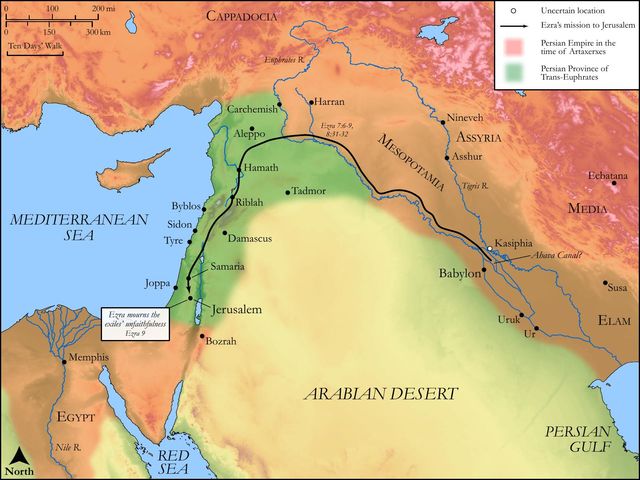
See on the biblical-era map
Study this verse
Public-domain commentary
Matthew Henry
From his Commentary on the Whole Bible. Henry comments on passages, not single verses — this entry covers Ezra 9:1–4. His three-level outline is real structure in the source text, so it is rendered as structure.
Ezra, like Barnabas when he came to Jerusalem and saw the grace of God to his brethren there, no doubt was glad, and exhorted them all that with purpose of heart they would cleave to the Lord, Act 11:23. He saw nothing amiss (many corruptions lurk out of the view of the most vigilant rulers); but here is a damp upon his joys: information is brought him that many of the people, yea, and some of the rulers, had married wives out of heathen families, and joined themselves in affinity with strangers. Observe,
I.What the sin was that they were guilty of:
it was mingling with the people of those lands (Ezr 9:2), associating with them both in trade and in conversation, making themselves familiar with them, and, to complete the affinity, taking their daughters in marriages to their sons. We are willing to hope that they did not worship their gods, but that their captivity had cured them of their idolatry: it is said indeed that they did according to their abominations; but that (says bishop Patrick) signifies here only the imitation of the heathen in promiscuous marriages with any nation whatsoever, which by degrees would lead them to idolatry. Herein,
1.They disobeyed the express command of God, which forbade all intimacy with the heathen, and particularly in matrimonial contracts, Deu 7:3.
2.They profaned the crown of their peculiarity, and set themselves upon a level with those above whom God had by singular marks of his favour, of late as well as formerly, dignified them.
3.They distrusted the power of God to protect and advance them, and were led by carnal policy, hoping to strengthen themselves and make an interest among their neighbours by these alliances. A practical disbelief of God's all-sufficiency is at the bottom of all the sorry shifts we make to help ourselves.
4.They exposed themselves, and much more their children, to the peril of idolatry, the very sin, and introduced by this very way, that had cone been the ruin of their church and nation.
II.Who were the persons that were guilty of this sin, not only some of the unthinking people of Israel, that knew no better, but many of the priests and Levites, whose office it was to teach the law, and this law among the rest, and in whom, by reason of their elevation above common Israelites, it was a greater crime. It was a diminution to the sons of that tribe to match into any other tribe, and they seldom did except into the royal tribe; but for them to match with heathen, with Canaanites, and Hittites, and I know not whom, was such a disparagement as, if they had had any sense, though not of duty, yet of honour, one would think, they would never have been guilty of. Yet this was not the worst: The hand of the princes and rulers, who by their power should have prevented or reformed this high misdemeanour, was chief in this trespass. If princes be in a trespass, they will be charged as chief in it, because of the influence their examples will have upon others. Many will follow their pernicious ways. But miserable is the case of that people whose leaders debauch them and cause them to err.
III.The information that was given of this to Ezra.
It was given by the persons that were most proper to complain, the princes, those of them that had kept their integrity and with it their dignity; they could not have accused others if they themselves had not been free from blame. It was given to the person who had power to mend the matter, who, as a ready scribe in the law of God, could argue with them, and, as king's commissioner, could awe them. It is probable that these princes had often endeavoured to redress this grievance and could not; but now they applied to Ezra, hoping that his wisdom, authority, and interest, would prevail to do it. Those that cannot of themselves reform public abuses may yet do good service by giving information to those that can.
IV.The impression this made upon Ezra (Ezr 9:3):
He rent his clothes, plucked off his hair, and sat down astonished. Thus he expressed the deep sense he had,
1.Of the dishonour hereby done to God. It grieved him to the heart to think that a people called by his name should so grossly violate his law, should be so little benefited by his correction, and make such bad returns for his favours.
2.Of the mischief the people had hereby done to themselves and the danger they were in of the wrath of God breaking out against them. Note,
(1.)The sins of others should be our sorrow, and the injury done by them to God's honour and the souls of men is what we should lay to heart.
(2.)Sorrow for sin must be great sorrow; such Ezra's was, as for an only son or a first-born.
(3.)The scandalous sins of professors are what we have reason to be astonished at. We may stand amazed to see men contradict, disparage, prejudice, ruin, themselves. Strange that men should act so inconsiderately and so inconsistently with themselves! Upright men are astonished at it.
V.The influence which Ezra's grief for this had upon others.
We may suppose that he went up to the house of the Lord, there to humble himself, because he had an eye to God in his grief and that was the proper place for deprecating his displeasure. Public notice was soon taken of it, and all the devout serious people that were at hand assembled themselves to him, it should seem of their own accord, for nothing is said of their being sent, to, Ezr 9:4. Note,
1.It is the character of good people that they tremble at God's word; they stand in awe of the authority of its precepts and the severity and justice of its threatenings, and to those that do so will God look, Isa 66:2.
2.Those that tremble at the word of God cannot but tremble at the sins of men, by which the law of God is broken and his wrath and curse are incurred.
3.The pious zeal of one against sin may perhaps provoke very many to the like, as the apostle speaks in another case, Co2 9:2. Many will follow who have not consideration, talent, and courage, enough to lead in a good work.
4.All good people ought to own those that appear and act in the cause of God against vice and profaneness, to stand by them, and do what they can to strengthen their hands.
Historical interpretation
Historical reception
1 surviving comment on this verse from the historical church.
And all those who feared the Lord gathered to me, etc. O, what a great change of things! It was previously said that the treachery of princes and magistrates led many to luxury, and now with a good prince turned to lamentation, and indicating through his grief and tears what should be done by sinners, it is said that all those who feared the word of God, which threatens to punish transgressors, gathered to him. O, how much pious examples help good teachers! Ezras spoke nothing at all, but, having only heard of the crime, it is written that he was turned to tears and weeping, and drew the crowd of the faithful to him not by shouting, but by mourning. It is added:
Continue studying Ezra 9:4 across the web’s major study libraries — every link below opens this exact verse, chapter, or book on the destination site.
Read & Compare
 BibleGatewayThis verse in more than 200 translations and 70 languages.
 Bible.comThe YouVersion reader — hundreds of translations, reading plans, and highlights.
 ESV.orgCrossway's official English Standard Version reader.
 NET BibleThe NET translation with 60,000+ translators' notes on every rendering decision.
 STEP BibleTyndale House's free study tool — original text, vocabulary, and scholarly resources.
 BibliaLogos Bible Software's free web reader.
 USCCBThe New American Bible (Revised Edition) with the U.S. bishops' study notes.
Commentaries
 BibleHub CommentariesDozens of classic commentaries on this verse, gathered on one page.
 StudyLightMore than 100 commentary sets — the largest collection on the web.
 BibleRefPlain-English commentary on what this verse means, verse by verse.
 Enduring WordDavid Guzik's free commentary on this chapter, widely used by Bible teachers.
 Bible Study ToolsVerse commentary alongside Greek and Hebrew study aids.
Original Language & Research
- BibleHub InterlinearThe verse word by word — original language, transliteration, and English.
- BibleHub LexiconEvery word's original-language definition and Strong's entry.
 Blue Letter BibleDeep-study tools — Strong's numbers, concordance, and word studies.
 SefariaThe Hebrew text with Rashi and centuries of Jewish commentary.
Sermons, Hymns & Audio


TrulyRandomVerse is not affiliated with these sites and doesn’t control their content. They’re linked because they’re genuinely useful.
Summary
Ezra 9:4 vividly portrays the profound spiritual and emotional anguish of the scribe Ezra upon discovering the pervasive intermarriage among the returned exiles, a direct and grievous violation of God's covenant commands. It captures a pivotal moment where Ezra, deeply "astonied" by the people's unfaithfulness, is joined by a faithful remnant who likewise "trembled" at the solemn words of the God of Israel, setting the stage for a period of corporate lament and a desperate plea for divine mercy and renewal.
Context
ShowHideLiterary Context
Ezra 9:4 immediately follows Ezra's shocking discovery of the widespread intermarriage between the returned exiles and the pagan peoples of the land, a transgression detailed in Ezra 9:1-2. The preceding verses reveal the deep spiritual compromise permeating the community, including priests, Levites, and even leaders, who had disregarded God's explicit commands against such unions (e.g., Deuteronomy 7:3-4). Ezra's visceral reaction in Ezra 9:3—tearing his garment, pulling out his hair and beard—demonstrates his profound distress and identification with the sin of his people. Verse 4 then describes the gathering of those who shared his spiritual anguish, forming a sympathetic community around him as he remained in a state of shock until the evening sacrifice, thereby preparing the narrative for his subsequent fervent prayer of confession in Ezra 9:5-15.
Historical & Cultural Context
The events of Ezra 9 unfold approximately 80 years after the first wave of exiles returned to Jerusalem under Zerubbabel, and roughly a decade after the temple's reconstruction. Ezra, a priest and skilled scribe in the Law of Moses, had recently arrived from Babylon with a commission from King Artaxerxes to re-establish the Mosaic Law and temple worship among the repatriated community (Ezra 7:6-10). The issue of intermarriage was a critical threat to the distinct identity and spiritual purity of Israel, a lesson they were meant to have learned from the Babylonian exile, which was largely a consequence of their idolatry and disobedience. The "evening sacrifice" (Hebrew: minchat 'erev) was a daily ritual, typically offered around 3 PM, signifying a time of prayer and atonement, making it a natural moment for Ezra's deep reflection and subsequent supplication, as seen in other biblical accounts like Daniel 9:21.
Key Themes
ShowHideThis verse powerfully contributes to several key themes within the book of Ezra and the broader post-exilic narrative. Firstly, it highlights the reverence for God's Word, as seen in those who "trembled at the words of the God of Israel," indicating a deep conviction regarding divine commands and their violation. This theme is central to Ezra's mission and the restoration of covenant faithfulness. Secondly, it underscores the theme of corporate responsibility and sin, demonstrating that the transgressions of individuals have a collective impact on the community, necessitating a communal response of sorrow and repentance. Ezra's personal anguish reflects a profound godly sorrow over sin, not just intellectual disapproval but a visceral grief over the spiritual state of his people, mirroring the sentiment expressed in Psalm 119:136. Finally, the verse sets the stage for spiritual renewal and reform, as Ezra's profound reaction and the gathering of the faithful remnant initiate the process of confronting and addressing the sin, paving the way for the covenant renewal described in Ezra 10.
Exposition and Analysis
ShowHideKey Word Analysis
ShowHideThis word signifies a profound emotional and physical reaction, implying fear, awe, and deep concern. It denotes a spiritual sensitivity and reverence for divine commands, indicating those whose consciences were acutely pricked by the discovery of the national sin. This "trembling" is a mark of true piety and a humble submission to God's authority, distinguishing those who genuinely fear the Lord from those who are indifferent to His will.
In this context, "words" refers to the divine commands, statutes, and principles revealed by God, particularly through the Mosaic Law. It encompasses not just spoken utterances but also the entire body of God's revealed truth, which carries absolute authority and demands faithful obedience. The trembling is a response to the gravity and binding nature of these divine pronouncements.
This powerful word conveys a state of desolation, utter shock, or appalled silence. It describes a profound emotional and spiritual paralysis, far beyond mere surprise. Ezra's "astonied" state suggests a deep sense of ruin, devastation, and grief over the spiritual compromise of his people, as if the very foundation of their covenant relationship with God had been shattered. It indicates a righteous indignation and a heavy burden for the purity and honor of God's name among His people.
Verse Breakdown
ShowHide"Then were assembled unto me every one that trembled at the words of the God of Israel"
This clause describes the immediate effect of Ezra's public lament and distress. It highlights a faithful remnant within the community—those whose hearts were sensitive to God's revealed will. Their "trembling" signifies a profound reverence for Scripture and a recognition of the severe implications of disobedience. This assembly around Ezra underscores the presence of a core group who shared his spiritual burden and concern for the nation's purity, indicating a nascent movement towards repentance and reform.
"because of the transgression of those that had been carried away"
This specifies the precise reason for the collective anguish: the "transgression" (Hebrew: maʻal, H4604, implying an act of unfaithfulness, treachery, or sacrilege against God) committed by the returned exiles (Hebrew: gôwlâh, H1473, "exiles" or "those carried away"). The phrase "those that had been carried away" emphasizes that even after the chastisement of exile, the people had fallen back into the very sins that led to their dispersion. This highlights the deep-seated spiritual problem and the recurring cycle of disobedience in Israel's history, threatening the very purpose of their return to the land.
"and I sat astonied until the evening sacrifice"
This final clause vividly portrays Ezra's prolonged state of profound shock and grief. His "astonied" posture, a picture of utter desolation, signifies the depth of his spiritual pain and the weight of the corporate sin he bore. The duration "until the evening sacrifice" indicates a significant period of silent, agonizing contemplation and mourning, a time often associated with prayer and communion with God. This extended period of lamentation precedes his fervent prayer of confession, demonstrating the depth of his brokenness before the Lord.
Literary Devices
ShowHideEzra 9:4 employs several powerful literary devices to convey the gravity of the situation and Ezra's profound reaction. The phrase "every one that trembled at the words of the God of Israel" uses Synecdoche, where a part (their trembling) stands for the whole person, emphasizing their defining characteristic of reverence for God's law. This also borders on Personification, as the "words of God" are depicted as having a tangible effect, causing a physical and emotional reaction in those who hear them. Ezra's state of being "astonied" is a form of Hyperbole, an exaggeration used for emphasis, vividly portraying the extreme depth of his shock and sorrow, suggesting a state of utter paralysis and desolation. The mention of "the evening sacrifice" functions as Symbolism, pointing to a specific time of day associated with prayer, atonement, and drawing near to God, thus framing Ezra's silent anguish within a liturgical and spiritual context, foreshadowing his subsequent intercessory prayer. The entire scene serves as a dramatic Contrast to the casual disobedience of the people, highlighting the profound spiritual sensitivity of Ezra and the faithful remnant.
Theological and Thematic Connections
ShowHideEzra 9:4 serves as a poignant theological statement on the nature of sin, corporate responsibility, and the necessity of godly sorrow. It underscores that true reverence for God's word ("trembling at the words") is not merely intellectual assent but a profound, visceral response to its authority and the gravity of disobedience. The collective "transgression" highlights the interconnectedness of God's people, where the sin of some impacts the spiritual well-being of the whole community, necessitating a corporate response. Ezra's "astonied" state exemplifies a righteous grief over sin, a brokenness that precedes genuine repentance and spiritual renewal, demonstrating that true spiritual leadership often begins with profound lament. This verse sets the stage for the crucial process of confession and purification, reminding us that restoration begins with acknowledging the depth of our failings before a holy God and responding with a contrite spirit.
Reflection and Application
ShowHideEzra 9:4 offers a powerful mirror for contemporary believers and the church, challenging us to examine our own posture toward God's word and the reality of sin. Do we possess a similar "trembling" reverence for Scripture, allowing its truth to penetrate our hearts and expose areas of compromise, both individually and corporately? Ezra's profound "astonishment" at the people's transgression calls us to cultivate a godly sorrow over sin, not just intellectual disapproval but a deep, heart-wrenching grief over spiritual apathy, moral compromise, and disobedience within our communities and the wider world. This kind of brokenness is not weakness but a divine prerequisite for genuine repentance and spiritual renewal. The gathering of the faithful remnant around Ezra reminds us of the importance of solidarity among those who uphold God's standards and are willing to stand for purity, even when it exposes uncomfortable truths. It encourages us to engage in periods of deep reflection and intercession when confronted with serious spiritual issues, allowing God's Spirit to cultivate within us a profound sensitivity to His holiness and a passion for His glory.
Questions for Reflection
ShowHideFAQ
ShowHideWhat does it mean to "tremble at the words of the God of Israel"?
ShowHideTo "tremble at the words of the God of Israel" signifies a profound reverence, awe, and deep respect for God's revealed will and commands. It's not merely a fear of punishment, but a holy fear that stems from recognizing God's absolute authority, holiness, and the gravity of His truth. Those who "tremble" are spiritually sensitive individuals whose consciences are pricked by disobedience, demonstrating a humble and submissive heart towards divine instruction. This attitude is highly valued by God, as seen in Isaiah 66:2.
Why was Ezra "astonied" until the evening sacrifice?
ShowHideEzra's state of being "astonied" (Hebrew: shamem) indicates a profound shock, desolation, and deep grief. It was an extreme emotional and spiritual response to the discovery of widespread intermarriage among the returned exiles, a direct and severe violation of God's covenant commands. His prolonged state "until the evening sacrifice" (typically around 3 PM) signifies a period of intense, silent lament and contemplation. This was not just intellectual disapproval but a visceral sorrow over the spiritual compromise of his people, reflecting the immense burden he carried for their purity and faithfulness to God. The evening sacrifice was a customary time for prayer and drawing near to God, making it a fitting moment for Ezra's deep anguish to culminate in his subsequent prayer of confession in Ezra 9:5.
Christ-Centered Fulfillment
ShowHideEzra 9:4, with its depiction of profound sorrow over sin and the desperate need for purity, finds its ultimate fulfillment in Jesus Christ. Ezra's "astonied" state, a righteous grief over the transgression of his people, foreshadows the perfect sorrow of Christ, who bore the weight of humanity's sin, not merely as an empathetic observer but as the sin-bearer. While Ezra mourned the people's disobedience, Jesus Himself became "a man of sorrows and acquainted with grief" (Isaiah 53:3) for the transgressions of all humanity. The "trembling at the words of the God of Israel" points to Christ, who perfectly embodied obedience to every word of God, even to the point of death on a cross (Philippians 2:8). He is the ultimate "Lamb of God who takes away the sin of the world" (John 1:29), offering Himself as the perfect and final "evening sacrifice" that truly atones for all "transgression," bringing reconciliation between God and humanity (Hebrews 9:26). Through His perfect life, atoning death, and resurrection, Christ not only removes the guilt of sin but also empowers His followers to live lives that "tremble" at God's word and grieve over sin, drawing them into a new covenant of purity and obedience, fulfilling the deepest longings expressed in Ezra's lament and establishing a people zealous for good works (Titus 2:14).