


Genesis 37:29
Bible text: King James Version (1769 Blayney text) · Public domain
Bible text: Berean Standard Bible · Public domain
Bible text: American Standard Version (1901) · Public domain
Bible text: World English Bible, Messianic edition · Public domain
Bible text: Geneva Bible (1599) · Public domain
Bible text: Young's Literal Translation · Public domain
- וַיָּשָׁבvai·Ya·shovand he returnedH7725Conj-w ¦ V-Qal-ConsecImperf-3msVerb Qal Consecutive Imperfect 3rd Singular Masculineוַandיָּשָׁבhe returned
- רְאוּבֵןre·'u·VenReubenH7205N-proper-mNoun Proper Masculine
- אֶל'eltoH413PrepPreposition
- הַבּוֹרha·Borthe pitH953Art ¦ N-msNoun Singular Masculine Absoluteהַtheבּוֹרpit
- וְהִנֵּהve·hi·Nehand there!H2009Conj-w ¦ PrtParticle Interjectionוְandהִנֵּהthere!
- אֵין'einnotH369N-mscNoun Singular Masculine Construct
- יוֹסֵףyo·SefJosephH3130N-proper-mNoun Proper Masculine
- בַּבּוֹרba·Bor[was] in the pitH953Prep-b ¦ N-msNoun Singular Masculine Absoluteבַּ[was] in theבּוֹרpit
- וַיִּקְרַעvai·yik·Ra'and he toreH7167Conj-w ¦ V-Qal-ConsecImperf-3msVerb Qal Consecutive Imperfect 3rd Singular Masculineוַandיִּקְרַעhe tore
- אֶת'et<obj.>H853DirObjMParticle Object Indicator
- בְּגָדָיוbe·ga·Davhis clothesH899N-mpc ¦ 3msNoun Plural Masculine Constructבְּגָדָיclothesוhis
English is a literal word-by-word gloss of the Hebrew, not the KJV's wording. Why?
This is the original text the KJV's translators worked from — each Hebrew word with its own literal English meaning in this verse, prepared by scholars at Tyndale House, Cambridge. The KJV translates whole sentences, not word by word, so its wording differs: one Hebrew word can become several English words, and the KJV may choose “the LORD” where the gloss reads “Yahweh”. Both are faithful — they answer different questions. For the KJV's own rendering, switch to the KJV text.
Details
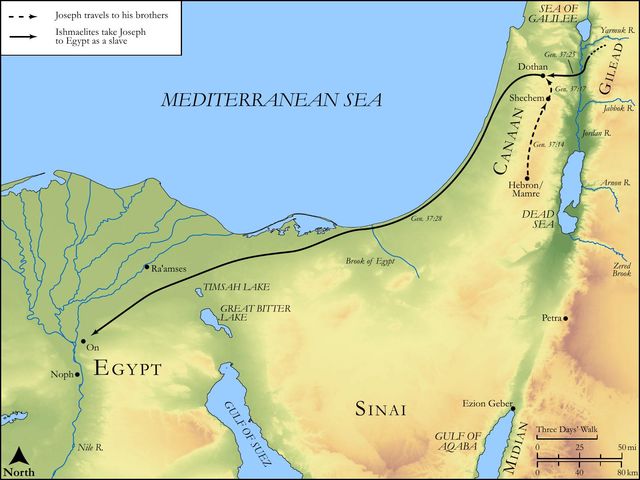
See on the biblical-era maps


Study this verse
Public-domain commentary
Matthew Henry
From his Commentary on the Whole Bible. Henry comments on passages, not single verses — this entry covers Genesis 37:23–30.
We have here the execution of their plot against Joseph. 1. They stripped him, each striving to seize the envied coat of many colours, Gen 37:23. Thus, in imagination, they degraded him from the birthright, of which perhaps this was the badge, grieving him, affronting their father, and making themselves sport, while they insulted over him. "Now, Joseph, where is the fine coat?" Thus our Lord Jesus was stripped of his seamless coat, and thus his suffering saints have first been industriously divested of their privileges and honours, and then made the off-scouring of all things. 2. They went about to starve him, throwing him into a dry pit, to perish there with hunger and cold, so cruel were their tender mercies, Gen 37:24. Note, Where envy reigns pity is banished, and humanity itself is forgotten, Pro 27:4. So full of deadly poison is malice that the more barbarous any thing is the more grateful it is. Now Joseph begged for his life, in the anguish of his soul (Gen 42:21), entreated, by all imaginable endearments, that they would be content with his coat and spare his life. He pleads innocence, relation, affection, submission; he weeps and makes supplication, but all in vain. Reuben alone relents and intercedes for him, Gen 42:22. But he cannot prevail to save Joseph from the horrible pit, in which they resolve he shall die by degrees, and be buried alive. Is this he to whom his brethren must do homage? Note, God's providences often seem to contradict his purposes, even then they are serving them, and working at a distance towards the accomplishment of them. 3. They slighted him when he was in distress, and were not grieved for the affliction of Joseph; for when he was pining away in the pit, bemoaning his own misery, and with a languishing cry calling to them for pity, they sat down to eat bread, Gen 37:25. (1.) They felt no remorse of conscience for the sin; if they had, it would have spoiled their appetite for their meat, and the relish of it. Note, A great force put upon conscience commonly stupefies it, and for the time deprives it both of sense and speech. Daring sinners are secure ones. But the consciences of Joseph's brethren, though asleep now, were roused long afterwards, Gen 42:21. (2.) They were now pleased to think how they were freed from the fear of their brother's dominion over them, and that, on the contrary, they had turned the wheel upon him. They made merry over him, as the persecutors over the two witnesses that had tormented them, Rev 11:10. Note, Those that oppose God's counsels may possibly prevail so far as to think they have gained their point, and yet be deceived. 4. They sold him. A caravan of merchants very opportunely passed by (Providence so ordering it), and Judah made the motion that they should sell Joseph to them, to be carried far enough off into Egypt, where, in all probability, he would be lost, and never heard of more. (1.) Judah proposed it in compassion to Joseph (Gen 37:26): "What profit is it if we slay our brother? it will be less guilt, and more gain, to sell him." Note, When we are tempted to sin, we should consider the unprofitableness of it. It is what there is nothing to be got by. (2.) They acquiesced in it, because they thought that if he were sold for a slave he would never be a lord, if sold into Egypt he would never be their lord; yet all this was working towards it. Note, The wrath of man shall praise God, and the remainder of wrath he will restrain, Psa 76:10. Joseph's brethren were wonderfully restrained from murdering him, and their selling him was as wonderfully turned to God's praise. As Joseph was sold by the contrivance of Judah for twenty pieces of silver, so was our Lord Jesus for thirty, and by one of the same name too, Judas. Reuben (it seems) had gone away from his brethren, when they sold Joseph, intending to come round some other way to the pit, and to help Joseph out of it, and return him safely to his father. This was a kind project, but, if it had taken effect, what had become of God's purpose concerning his preferment in Egypt? Note, There are many devices in man's heart, many devices of the enemies of God's people to destroy them and of their friends to help them, which perhaps are both disappointed, as these were; but the counsel of the Lord, that shall stand. Reuben thought himself undone, because the child was sold: I, whither shall I go? Gen 37:30. He being the eldest, his father would expect from him an accounts of Joseph; but, as it proved, they would all have been undone if he had not been sold.
Continue studying Genesis 37:29 across the web’s major study libraries — every link below opens this exact verse, chapter, or book on the destination site.
Read & Compare
 BibleGatewayThis verse in more than 200 translations and 70 languages.
 Bible.comThe YouVersion reader — hundreds of translations, reading plans, and highlights.
 ESV.orgCrossway's official English Standard Version reader.
 NET BibleThe NET translation with 60,000+ translators' notes on every rendering decision.
 STEP BibleTyndale House's free study tool — original text, vocabulary, and scholarly resources.
 BibliaLogos Bible Software's free web reader.
 USCCBThe New American Bible (Revised Edition) with the U.S. bishops' study notes.
Commentaries
 BibleHub CommentariesDozens of classic commentaries on this verse, gathered on one page.
 StudyLightMore than 100 commentary sets — the largest collection on the web.
 BibleRefPlain-English commentary on what this verse means, verse by verse.
 Enduring WordDavid Guzik's free commentary on this chapter, widely used by Bible teachers.
 Bible Study ToolsVerse commentary alongside Greek and Hebrew study aids.
Original Language & Research
- BibleHub InterlinearThe verse word by word — original language, transliteration, and English.
- BibleHub LexiconEvery word's original-language definition and Strong's entry.
 Blue Letter BibleDeep-study tools — Strong's numbers, concordance, and word studies.
 SefariaThe Hebrew text with Rashi and centuries of Jewish commentary.
Sermons, Hymns & Audio


TrulyRandomVerse is not affiliated with these sites and doesn’t control their content. They’re linked because they’re genuinely useful.
Summary
Genesis 37:29 captures the shocking moment of Reuben's return to the dry pit, only to discover Joseph's absence, an event that immediately triggers his culturally significant act of tearing his clothes in a profound display of grief and dismay. This pivotal scene not only underscores Reuben's personal anguish and the failure of his protective intentions but also dramatically advances the narrative of Joseph's betrayal, setting in motion the complex chain of events that will ultimately lead him to Egypt and shape the destiny of Jacob's family.
Context
ShowHideLiterary Context
This verse is strategically placed within the dramatic narrative of Joseph's early life, immediately following the climax of his brothers' malicious plot. Earlier, Reuben, as the eldest, had attempted to mitigate their murderous intent by persuading them to cast Joseph into a dry pit, secretly intending to rescue him later and return him to their father, Jacob (Genesis 37:21-22). However, while Reuben was absent, perhaps tending to the flocks or otherwise engaged, the remaining brothers seized the opportunity to sell Joseph to a passing caravan of Ishmaelites, effectively removing him from their lives and thwarting Reuben's rescue plan (Genesis 37:28). Thus, Reuben's return to the pit and his discovery of Joseph's disappearance serves as a critical turning point, not only revealing the extent of his brothers' treachery but also precipitating his profound despair and setting the stage for the elaborate deception they would perpetrate upon their grieving father.
Historical & Cultural Context
In the days of the patriarchs, the act of tearing one's clothes was a deeply ingrained and highly visible cultural expression of extreme emotional distress, signifying profound grief, horror, despair, or indignation. It was not merely a symbolic gesture but a public declaration of one's inner turmoil, often accompanied by wailing or throwing dust on one's head. For Reuben, as the eldest son of Jacob and Leah, the cultural expectation of responsibility for his younger siblings would have been immense. His position as firstborn carried significant duties, including the protection and well-being of the family. The 'pit' (Hebrew: bôwr) was typically a dry cistern or a dungeon, often used for storage or as a temporary prison, and its emptiness would have immediately signaled a grave and unexpected turn of events, compounding Reuben's distress and sense of failure.
Key Themes
ShowHideGenesis 37:29 contributes significantly to several overarching themes within the Joseph narrative and the book of Genesis as a whole. Firstly, it underscores the destructive power of familial betrayal and envy, illustrating how deep-seated animosity among siblings can lead to horrific acts, as seen in the brothers' conspiracy against Joseph, which began with their initial jealousy (Genesis 37:4) and culminated in his sale into slavery. Secondly, the verse subtly points to the theme of divine sovereignty operating amidst human sin and failure. While Reuben's good intentions were thwarted and his brothers acted maliciously, Joseph's removal from the pit and subsequent journey to Egypt were paradoxically orchestrated by God for a greater purpose, as Joseph himself would later articulate (Genesis 50:20). Finally, it highlights the theme of grief and loss, not only through Reuben's immediate reaction but also foreshadowing the profound sorrow Jacob would experience for years, believing his beloved son to be dead (Genesis 37:34-35).
Exposition and Analysis
ShowHideKey Word Analysis
ShowHideThis verb signifies "to turn back" or "to return," often with the implication of going back to a previous state or place. In this context, it highlights Reuben's deliberate action of returning to the pit, fulfilling his earlier intention to rescue Joseph. His return is fraught with expectation, which is then dramatically shattered.
This term refers to a "pit hole," specifically one used as a cistern or a dungeon. It denotes a deep, often dry, excavation. The choice of this word emphasizes the desolate and confined nature of Joseph's initial imprisonment and the stark reality of its emptiness upon Reuben's discovery.
A primitive root meaning "to rend" or "to tear," literally or figuratively. This powerful verb describes the physical act of tearing one's clothes, a common and highly visible expression of profound grief, horror, or extreme emotional distress among the people of that day. It signifies an overwhelming, uncontrollable outburst of sorrow.
This noun refers to "a covering" or "clothing" in general. When combined with "rent," it points to the specific garments that are torn, emphasizing the public and personal nature of Reuben's lament. The act of tearing one's clothes was a deeply symbolic gesture, signifying a rupture in one's life or a profound sense of loss.
Verse Breakdown
ShowHide"And Reuben returned unto the pit"
This clause establishes the setting and the agent of the action. Reuben's return is purposeful, driven by his earlier, secret intent to rescue Joseph. His absence from the initial sale suggests he was unaware of his brothers' escalated treachery, making his discovery all the more shocking.
"and, behold, Joseph [was] not in the pit"
The interjection "behold" (Hebrew: hinneh) emphasizes the sudden, shocking realization. This is the pivotal moment of discovery, where Reuben's hopes are dashed, and the full extent of his brothers' actions (though he doesn't yet know the details) begins to dawn on him. The absence of Joseph signifies the failure of his plan and the dire implications for the family.
"and he rent his clothes"
This immediate and visceral reaction is a powerful, culturally significant act of profound grief, horror, and despair. It signifies Reuben's overwhelming sorrow, his sense of responsibility, and the realization of the catastrophic turn of events. It is a public display of his inner turmoil and the depth of his anguish over Joseph's fate and the failure of his protective efforts.
Literary Devices
ShowHideGenesis 37:29 employs several potent literary devices to convey the dramatic impact of Reuben's discovery. The most prominent is Dramatic Irony, as the reader is already privy to the fact that Joseph has been sold into slavery (Genesis 37:28), while Reuben remains ignorant of this escalated treachery. This knowledge heightens the tension and underscores the tragic futility of his rescue attempt, making his shock and despair all the more poignant. The act of "renting his clothes" is a powerful Symbolism, representing not just personal grief but a rupture in the family unit and a profound sense of irreparable loss and failure. This physical manifestation of sorrow is a visual cue for the depth of his anguish. Furthermore, the scene serves as Foreshadowing, hinting at the prolonged and intense grief that Jacob, the father, will soon experience upon believing Joseph to be dead (Genesis 37:34-35). The narrative also masterfully uses Pathos, evoking strong feelings of pity and sorrow for Reuben, who, despite his past moral failings, genuinely intended to save his brother and is now confronted with a devastating reality beyond his control.
Theological and Thematic Connections
ShowHideReuben's profound despair in Genesis 37:29 serves as a powerful theological commentary on human responsibility and the consequences of sin. His anguish underscores the deep pain and regret that accompany moral failure and betrayal, particularly within the sacred bonds of family. The brothers' actions demonstrate the destructive power of envy, malice, and deception, initiating a long period of suffering for Jacob and his household. Yet, even amidst such egregious human sin and Reuben's thwarted good intentions, the narrative subtly points to the overarching theme of divine sovereignty. This seemingly tragic event, born of human wickedness, was paradoxically a crucial step in God's larger redemptive plan, demonstrating His ability to orchestrate events and bring about His purposes even through the darkest human actions. It also highlights the biblical understanding of grief and lament, portraying a raw and culturally appropriate expression of overwhelming sorrow in response to a catastrophic event.
Reflection and Application
ShowHideReuben's visceral reaction in Genesis 37:29 offers a poignant and multifaceted lesson for believers today. His profound distress reminds us that even our most well-intentioned efforts can be undermined by the sin or malice of others, leading to deep disappointment and regret. It underscores the heavy burden of responsibility, especially within family and community, and the profound pain that accompanies betrayal and moral failure. For us, this narrative powerfully reinforces the truth that God's sovereign plan often unfolds through complex human interactions, including moments of sin, suffering, and apparent defeat. We are called to trust that even in the face of overwhelming despair and seemingly insurmountable obstacles, God is actively at work, guiding events toward His ultimate purposes. This passage challenges us to consider our own responses to disappointment and betrayal, and to cultivate a faith that recognizes God's hand even when circumstances appear chaotic or tragic, believing that He can indeed bring good out of the most challenging situations.
Questions for Reflection
ShowHideFAQ
ShowHideWhy did Reuben tear his clothes?
ShowHideReuben tore his clothes as a culturally recognized and profound expression of extreme grief, shock, and despair. Among the sons of Jacob, this act was a public and deeply symbolic manifestation of overwhelming sorrow, horror, or indignation. For Reuben, it signified his profound dismay over the failure of his secret plan to rescue Joseph (Genesis 37:21-22) and the dire consequences of his brothers' actions, particularly as the eldest son bearing a heavy burden of responsibility for his family.
Did Reuben know Joseph would be sold into slavery?
ShowHideNo, the biblical text strongly indicates Reuben was unaware of his brothers' decision to sell Joseph to the Ishmaelites. His initial intention was to return to the pit later and rescue Joseph, restoring him to their father, Jacob (Genesis 37:21-22). His intense distress upon finding the pit empty confirms his ignorance of the sale and his non-complicity in that specific act, though he was present for the earlier conspiracy to harm Joseph.
Christ-Centered Fulfillment
ShowHideThe dramatic narrative of Joseph, epitomized by Reuben's anguish over his apparent loss in Genesis 37:29, profoundly foreshadows the redemptive work of Jesus Christ. Just as Joseph was rejected by his own brothers, seemingly abandoned to death, and then elevated to a position of power through divine providence to save his family and countless others from famine, so too was Jesus rejected and betrayed by His own people (John 1:11), suffering an unjust death on the cross (Philippians 2:8). Yet, through His suffering and death, God raised Him up, making Him the ultimate Savior and Lord (Acts 2:36). Joseph's journey from the pit to the palace, from rejection to reconciliation, illustrates God's sovereign plan to bring salvation through the innocent suffering of the righteous. In Christ, we see the complete fulfillment of this pattern: His 'descent' into death was not an end but the means by which God accomplished humanity's greatest rescue, offering spiritual and eternal sustenance to all who believe, demonstrating how God uses the innocent suffering of the righteous to accomplish His salvific purposes for humanity (Romans 5:8).