


Genesis 43:12
Bible text: King James Version (1769 Blayney text) · Public domain
Bible text: King James Version with Strong's numbers · Public domain
Bible text: Berean Standard Bible · Public domain
Bible text: American Standard Version (1901) · Public domain
Bible text: World English Bible, Messianic edition · Public domain
Bible text: Geneva Bible (1599) · Public domain
Bible text: Young's Literal Translation · Public domain
- וְכֶסֶףve·Khe·sefand silverH3701Conj-w ¦ N-msNoun Singular Masculine Absoluteוְandכֶסֶףsilver
- מִשְׁנֶהmish·NehdoubleH4932N-msNoun Singular Masculine Absolute
- קְחוּke·ChutakeH3947V-Qal-Imp-2mpVerb Qal Imperative 2nd Plural Masculine
- בְיֶדְכֶםve·yed·Khemin your handH3027Prep-b ¦ N-csc ¦ 2mpNoun Singular common gender Constructבְinיֶדְhandכֶםyour
- וְאֶתve·'Etand <obj.>H853Conj-w ¦ DirObjMParticle Object Indicatorוְandאֶת<obj.>
- הַכֶּסֶףha·Ke·sefthe silverH3701Art ¦ N-msNoun Singular Masculine Absoluteהַtheכֶּסֶףsilver
- הַמּוּשָׁבha·mu·Shavthat was returnedH7725Art ¦ V-Hophal-PassPrtcpl-msVerb Hophal Participle Passive Singular Masculine Absoluteהַthatמּוּשָׁבwas returned
- בְּפִיbe·Fiin [the] mouth ofH6310Prep-b ¦ N-mscNoun Singular Masculine Constructבְּinפִי[the] mouth of
- אַמְתְּחֹתֵיכֶם'am·te·cho·tei·Khemyour sacksH572N-fpc ¦ 2mpNoun Plural Feminine Constructאַמְתְּחֹתֵיsacksכֶםyour
- תָּשִׁיבוּta·Shi·vuyou will take backH7725V-Hiphil-Imperf-2mpVerb Hiphil Imperfect 2nd Plural Masculine
- בְיֶדְכֶםve·yed·Khemin your handH3027Prep-b ¦ N-csc ¦ 2mpNoun Singular common gender Constructבְinיֶדְhandכֶםyour
- אוּלַי'u·LaiperhapsH194AdvAdverb
- מִשְׁגֶּהmish·Geh[was] a mistakeH4870N-msNoun Singular Masculine Absolute
- הוּאHu'itH1931Pro-3msPronoun Personal 3rd Singular Masculine
English is a literal word-by-word gloss of the Hebrew, not the KJV's wording. Why?
This is the original text the KJV's translators worked from — each Hebrew word with its own literal English meaning in this verse, prepared by scholars at Tyndale House, Cambridge. The KJV translates whole sentences, not word by word, so its wording differs: one Hebrew word can become several English words, and the KJV may choose “the LORD” where the gloss reads “Yahweh”. Both are faithful — they answer different questions. For the KJV's own rendering, switch to the KJV text.
Details
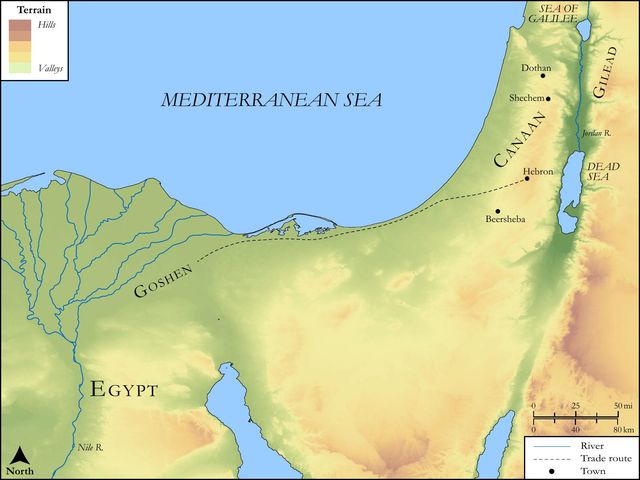
See on the biblical-era maps


Study this verse
Public-domain commentary
Matthew Henry
From his Commentary on the Whole Bible. Henry comments on passages, not single verses — this entry covers Genesis 43:11–14.
Observe here, I. Jacob's persuasibleness. He would be ruled by reason, though they were his inferiors that urged it. He saw the necessity of the case; and, since there was no remedy, he consented to yield to the necessity (Gen 43:11): "If it must be so now, take your brother. If no corn can be had but upon those terms, we may as well expose him to the perils of the journey as suffer ourselves and families, and Benjamin amongst the rest, to perish for want of bread." Skin for skin, and all that a man has, even a Benjamin, the dearest of all, will he give for his life. No death so dreadful as that by famine, Lam 4:9. Jacob had said (Gen 42:38), My son shall not go down; but now he is over-persuaded to consent. Note, It is no fault, but our wisdom and duty, to alter our purposes and resolutions when there is a good reason for our so doing. Constancy is a virtue, but obstinacy is not. It is God's prerogative not to repent, and to make unchangeable resolves.
II.Jacob's prudence and justice, which appeared in three things:
- 1. He sent back the money which they had found in the sacks' mouths, with this discreet construction of it, Peradventure it was an oversight. Note, Honesty obliges us to make restitution, not only of that which comes to us by our own fault, but of that which comes to us by the mistakes of others. Though we get it by oversight, if we keep it when the oversight is discovered, it is kept by deceit. In the stating of accounts, errors must be excepted, even those that make for us as well as those that make against us. Jacob's words furnish us with a favourable construction to put upon that which we are tempted to resent as an injury and affront; pass it by, and say, Peradventure it was an oversight. 2. He sent double money, as much again as they took the time before, upon supposition that the price of corn might have risen, - or to show a generous spirit, that they might be the more likely to find generous treatment with the man, the lord of the land. 3. He sent a present of such things as the land afforded, and as were scarce in Egypt - balm and honey, etc. (Gen 43:11), the commodities that Canaan exported, Gen 37:25. Note, (1.) Providence dispenses its gifts variously. Some countries produce one commodity, others another, that commerce may be preserved. (2.) Honey and spice will never make up the want of bread-corn. The famine was sore in Canaan, and yet they had balm and myrrh, etc. We may live well enough upon plain food without dainties; but we cannot live upon dainties without plain food. Let us thank God that that which is most needful and useful is generally most cheap and common. (3.) A gift in secret pacifies wrath, Pro 21:14. Jacob's sons were unjustly accused as spies, yet Jacob was willing to be at the expense of a present, to pacify the accuser. Sometimes we must not think it too much to buy peace even where we may justly demand it, and insist upon it as our right.
III.Jacob's piety appearing in his prayer:
God Almighty give you mercy before the man! Gen 43:14. Jacob had formerly turned an angry brother into a kind one with a present and a prayer; and here he betakes himself to the same tried method, and it sped well. Note, Those that would find mercy with men must seek it of God, who has all hearts in his hands, and turns them as he pleases.
IV.Jacob's patience.
He concludes all with this: "If I be bereaved of my children, I am bereaved; If I must part with them thus one after another, I must acquiesce, and say, The will of the Lord be done." Note, It is our wisdom to reconcile ourselves to the sorest afflictions, and make the best of them; for there is nothing got by striving with our Maker, Sa2 15:25, Sa2 15:26.
Continue studying Genesis 43:12 across the web’s major study libraries — every link below opens this exact verse, chapter, or book on the destination site.
Read & Compare
 BibleGatewayThis verse in more than 200 translations and 70 languages.
 Bible.comThe YouVersion reader — hundreds of translations, reading plans, and highlights.
 ESV.orgCrossway's official English Standard Version reader.
 NET BibleThe NET translation with 60,000+ translators' notes on every rendering decision.
 STEP BibleTyndale House's free study tool — original text, vocabulary, and scholarly resources.
 BibliaLogos Bible Software's free web reader.
 USCCBThe New American Bible (Revised Edition) with the U.S. bishops' study notes.
Commentaries
 BibleHub CommentariesDozens of classic commentaries on this verse, gathered on one page.
 StudyLightMore than 100 commentary sets — the largest collection on the web.
 BibleRefPlain-English commentary on what this verse means, verse by verse.
 Enduring WordDavid Guzik's free commentary on this chapter, widely used by Bible teachers.
 Bible Study ToolsVerse commentary alongside Greek and Hebrew study aids.
Original Language & Research
- BibleHub InterlinearThe verse word by word — original language, transliteration, and English.
- BibleHub LexiconEvery word's original-language definition and Strong's entry.
 Blue Letter BibleDeep-study tools — Strong's numbers, concordance, and word studies.
 SefariaThe Hebrew text with Rashi and centuries of Jewish commentary.
Sermons, Hymns & Audio


TrulyRandomVerse is not affiliated with these sites and doesn’t control their content. They’re linked because they’re genuinely useful.
Summary
Genesis 43:12 records Jacob's precise instructions to his sons as they prepare for their critical second journey to Egypt. Driven by a profound commitment to integrity and prudence, he commands them to take double the necessary money for their new grain purchase and, crucially, to return the money they mysteriously discovered in their sacks after their initial trip, assuming it was an unintentional oversight by the Egyptians. This verse illuminates Jacob's moral uprightness, practical wisdom, and cautious approach in navigating a perilous and uncertain situation.
Context
ShowHideLiterary Context
This verse is a pivotal moment in the unfolding drama of Jacob's family during a severe famine, immediately preceding their second descent into Egypt. Following their first journey, where they encountered Joseph (unbeknownst to them) and were accused of being spies, they were instructed to bring their youngest brother, Benjamin, to prove their honesty. The discovery of their money returned in their sacks upon their arrival home, as detailed in Genesis 42:27-28, caused immense fear and distress. Jacob was initially resolute in his refusal to send Benjamin, fearing further harm, as expressed in Genesis 42:38. However, the intensifying famine and Judah's solemn pledge for Benjamin's safety and return (see Genesis 43:8-9) finally compelled Jacob to agree. Thus, Genesis 43:12 serves as Jacob's final, meticulous instructions before they embark on this perilous and emotionally charged return trip.
Historical & Cultural Context
The broader historical context is a severe famine gripping the entire region, forcing people to seek provisions in Egypt, which had prepared for such a crisis under Joseph's administration. Travel between Canaan and Egypt was common but fraught with dangers, including bandits and the risks associated with foreign governments. The cultural expectation regarding financial transactions and integrity was high; any perceived theft or dishonesty could have severe repercussions, especially when dealing with powerful foreign officials. Jacob's meticulousness in returning the money reflects a strong cultural value placed on honesty and avoiding even the appearance of impropriety, particularly when seeking favor or conducting business in a foreign land. The "mouth of your sacks" refers to the opening or top of the grain bags where the money was typically placed for payment or storage.
Key Themes
ShowHideThis verse contributes significantly to several key themes within the book of Genesis and the broader biblical narrative. Firstly, it highlights the theme of Integrity and Righteousness, as Jacob prioritizes moral uprightness over personal gain, even in a time of extreme hardship. His insistence on returning the money underscores a deep-seated commitment to justice and honesty, reflecting the character traits God desires from His people. Secondly, the theme of Prudence and Preparation is evident in Jacob's instruction to take "double money," demonstrating his practical wisdom and foresight in anticipating potential needs or rectifying past ambiguities. Thirdly, while not explicitly stated in this verse, Jacob's actions are implicitly undergirded by a theme of Divine Providence, as he ultimately entrusts his sons to God's mercy in Genesis 43:14, balancing human responsibility with divine reliance. This passage also subtly reinforces the theme of Reconciliation and Restoration, as Jacob's actions pave the way for his sons to approach Joseph with a clear conscience, unknowingly moving closer to the restoration of their family.
Exposition and Analysis
ShowHideGenesis 43:12 provides a profound glimpse into Jacob's character, revealing his unwavering commitment to righteousness and his pragmatic approach to navigating challenging circumstances. His instructions are not merely practical but deeply ethical.
Key Word Analysis
ShowHideA primitive root; to take (in the widest variety of applications); accept, bring, buy, carry away, drawn, fetch, get, infold, [idiom] many, mingle, place, receive(-ing), reserve, seize, send for, take (away, -ing, up), use, win. Here, "take" signifies a deliberate act of procurement, emphasizing Jacob's proactive command for his sons to acquire the necessary funds for their journey and transactions. It's an active verb indicating preparation and readiness.
From שָׁנָה; properly, a repetition, i.e. a duplicate (copy of a document), or a double (in amount); by implication, a second (in order, rank, age, quality or location); college, copy, double, fatlings, next, second (order), twice as much. The term "double" here refers specifically to twice the amount of money. This instruction is critical, serving both as a provision for the new purchase and as an explicit overpayment to cover the mysteriously returned funds, ensuring no debt or suspicion of wrongdoing remains.
From שָׁגָה; an error; oversight. This word encapsulates Jacob's interpretation of the returned money. He assumes it was an unintentional mistake or an inadvertent act by the Egyptian officials, rather than a deliberate gift or a trap. This assumption underpins his insistence on restitution, highlighting his desire to correct any potential wrong, even if it was not his family's fault, aligning with a strong sense of moral obligation.
Verse Breakdown
ShowHide"And take double money in your hand"
Jacob's first command is practical and prudent. "Double money" (Hebrew: mishneh keçeph) implies not just enough for the new purchase, but an additional amount to cover the previous transaction, ensuring they have more than sufficient funds. This foresight aims to prevent any financial shortfall or accusation of insufficient payment, reflecting Jacob's careful planning and responsible leadership. The phrase "in your hand" (Hebrew: b'yadchem) emphasizes that the money should be readily available and under their direct control.
"and the money that was brought again in the mouth of your sacks, carry [it] again in your hand"
This is the core of Jacob's ethical instruction. He refers to the money mysteriously found in their sacks after their first journey (Genesis 42:27-28). The phrase "brought again" (Hebrew: hûshav) signifies that the money was returned to them. Jacob insists that this specific money, which was not rightfully theirs, must be taken back to Egypt. The repetition of "in your hand" underscores the importance of this money being distinct and ready for restitution, demonstrating his family's integrity.
"peradventure it [was] an oversight"
This phrase (Hebrew: ûlay mishgeh hû') reveals Jacob's rationale for returning the money. He attributes its return to an "oversight" or an unintentional error on the part of the Egyptians, rather than a deliberate act. This interpretation drives his moral imperative: if it was a mistake, they must correct it and not profit from another's error. This demonstrates Jacob's scrupulous honesty and his desire to avoid any appearance of impropriety, even in a situation where he could have easily rationalized keeping the money.
Literary Devices
ShowHideThe verse employs several literary devices that enrich its meaning. Repetition is prominent, with "money" and "hand" appearing multiple times, emphasizing both the financial aspect of the journey and the direct, personal responsibility of the sons. The phrase "carry it again in your hand" echoes the earlier instruction to "take double money in your hand," creating a sense of deliberate action and accountability. There is also a subtle Irony at play, as Jacob's meticulous efforts to correct what he perceives as an "oversight" are unknowingly directed towards Joseph, who orchestrated the money's return as part of his larger, divinely guided plan to test and reconcile with his brothers. This highlights the theme of Divine Sovereignty working behind human actions, even those driven by the purest intentions. The verse also showcases Characterization, revealing Jacob as a man of deep integrity and practical wisdom, contrasting with his earlier, more deceptive tendencies.
Theological and Thematic Connections
ShowHideJacob's instructions in Genesis 43:12 powerfully illustrate the biblical emphasis on integrity, honesty, and restitution. His insistence on returning the money, even when it was not his family's doing, exemplifies a profound commitment to righteousness that transcends immediate personal gain. This act is not merely about avoiding accusation but about living with a clear conscience before God and man. It underscores the principle that one should not profit from another's error or misfortune, reflecting a high moral standard that anticipates later Mosaic law concerning found property and restitution. Jacob's prudence in taking "double money" also highlights the importance of responsible preparation and foresight, balancing faith with practical wisdom in navigating life's uncertainties.
Reflection and Application
ShowHideJacob's meticulous instructions in Genesis 43:12 offer enduring lessons for believers today, underscoring the timeless importance of integrity and honesty in all aspects of life. In a world often driven by self-interest and the pursuit of gain, Jacob's example challenges us to prioritize righteousness, even when it means personal sacrifice or inconvenience. We are called to be scrupulous in our financial dealings, our relationships, and our professional conduct, ensuring that we not only avoid wrongdoing but also rectify any unintended benefits or errors. This verse encourages us to cultivate a clear conscience, valuing ethical behavior above all else. Furthermore, Jacob's prudence in taking "double money" reminds us of the wisdom in being well-prepared and responsible, while ultimately trusting in God's sovereign hand to guide us through life's challenges, just as Jacob entrusted Benjamin to divine mercy. Our actions should reflect a commitment to truth and fairness, building a reputation of trustworthiness that honors God.
Questions for Reflection
ShowHideFAQ
ShowHideWhy did Jacob insist on returning the money found in the sacks?
ShowHideJacob insisted on returning the money to uphold his family's integrity and avoid any appearance of wrongdoing or theft. He assumed the money's return was an "oversight" (Hebrew: mishgeh) or an unintentional mistake by the Egyptians, and he did not want to profit from another's error. This demonstrates his strong moral compass and commitment to the principle of restitution, ensuring his family would approach the Egyptian authorities with a clear conscience, as seen in his later prayer in Genesis 43:14.
What is the significance of Jacob telling his sons to take "double money"?
ShowHideTaking "double money" (Hebrew: mishneh keçeph) served two primary purposes. First, it ensured they had sufficient funds for their new grain purchase, preventing any financial shortfall. Second, and more importantly, it provided an explicit amount to cover the money that was mysteriously returned from their previous trip, thereby preventing any accusation of dishonesty or outstanding debt. This reflects Jacob's profound prudence and foresight, demonstrating his desire to act with utmost integrity and leave no room for suspicion, aligning with his character as depicted throughout Genesis 43.
Christ-Centered Fulfillment
ShowHideWhile Jacob's actions in Genesis 43:12 demonstrate human integrity and a desire for restitution, they ultimately point to the perfect righteousness and restorative work of Christ. Jacob sought to correct an "oversight" and prevent any appearance of sin, but Christ, in His perfect life, never had an "oversight" or blemish, fulfilling all righteousness (see Matthew 3:15). More profoundly, Christ made the ultimate restitution, not for a mistake of others, but for the deliberate sins of humanity. He paid a "double" price—His very life—to redeem us, returning us to a right relationship with God that we could never achieve on our own (as declared in 1 Peter 2:24). His sacrifice on the cross is the ultimate act of integrity, fulfilling all divine justice and making full restitution for our spiritual debt, allowing us to be truly reconciled to God (as proclaimed in 2 Corinthians 5:21). Jacob's carefulness foreshadows the meticulous and complete work of the Messiah, who perfectly satisfied the demands of God's holiness and redeemed us from the "oversight" of our fallen nature.