


Genesis 43:22
Bible text: King James Version (1769 Blayney text) · Public domain
Bible text: Berean Standard Bible · Public domain
Bible text: American Standard Version (1901) · Public domain
Bible text: World English Bible, Messianic edition · Public domain
Bible text: Geneva Bible (1599) · Public domain
Bible text: Young's Literal Translation · Public domain
- וְכֶסֶףve·Khe·sefand silverH3701Conj-w ¦ N-msNoun Singular Masculine Absoluteוְandכֶסֶףsilver
- אַחֵר'a·CherotherH312Adj-msAdjective Singular Masculine Absolute
- הוֹרַדְנוּho·Rad·nuwe have brought downH3381V-Hiphil-Perf-1cpVerb Hiphil Perfect 1st Plural common gender
- בְיָדֵנוּve·ya·De·nuin our handH3027Prep-b ¦ N-csc ¦ 1cpNoun Singular common gender Constructבְinיָדֵhandנוּour
- לִשְׁבָּרlish·borto buyH7666Prep-l ¦ V-Qal-InfVerb Qal Infinitive Constructלִtoשְׁבָּרbuy
- אֹכֶל'O·khelfoodH400N-msNoun Singular Masculine Absolute
- לֹאlo'notH3808NegParticle Negative
- יָדַעְנוּya·Da'·nuwe knowH3045V-Qal-Perf-1cpVerb Qal Perfect 1st Plural common gender
- מִיmiwho?H4310InterrogPronoun Interrogative
- שָׂםsamdid he putH7760V-Qal-Perf-3msVerb Qal Perfect 3rd Singular Masculine
- כַּסְפֵּנוּkas·Pe·nuour silverH3701N-msc ¦ 1cpNoun Singular Masculine Constructכַּסְפֵּsilverנוּour
- בְּאַמְתְּחֹתֵינוּbe·'am·te·cho·Tei·nuin our sacksH572Prep-b ¦ N-fpc ¦ 1cpNoun Plural Feminine Constructבְּinאַמְתְּחֹתֵיsacksנוּour
English is a literal word-by-word gloss of the Hebrew, not the KJV's wording. Why?
This is the original text the KJV's translators worked from — each Hebrew word with its own literal English meaning in this verse, prepared by scholars at Tyndale House, Cambridge. The KJV translates whole sentences, not word by word, so its wording differs: one Hebrew word can become several English words, and the KJV may choose “the LORD” where the gloss reads “Yahweh”. Both are faithful — they answer different questions. For the KJV's own rendering, switch to the KJV text.
Details
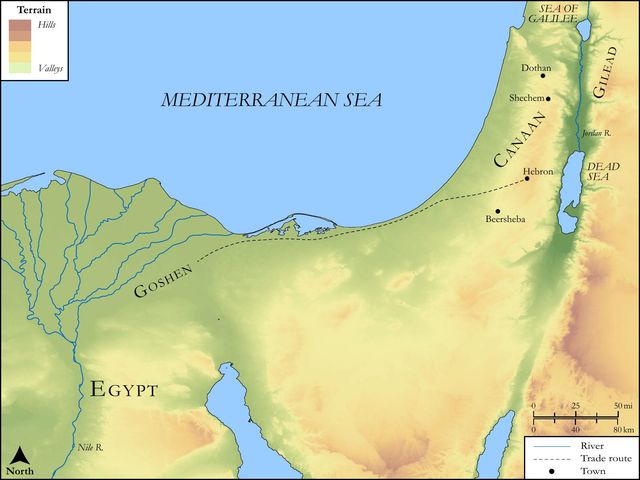
See on the biblical-era maps


Study this verse
Public-domain commentary
Matthew Henry
From his Commentary on the Whole Bible. Henry comments on passages, not single verses — this entry covers Genesis 43:15–25.
Jacob's sons, having got leave to take Benjamin with them, were observant of the orders their father had given them, and went down the second time into Egypt to buy corn. If we should ever know what a famine of the word means, let us not think it much to travel as far for spiritual food as they did for corporal food. Now here we have an account of what passed between them and Joseph's steward, who, some conjecture, was in the secret, and knew them to be Joseph's brethren, and helped to humour the thing; I rather think not, because no man was permitted to be present when Joseph afterwards made himself known to them, Gen 45:1. Observe, 1. Joseph's steward has orders from his master (who was busy selling corn, and receiving money) to take them to his house, and make ready for their entertainment. Though Joseph saw Benjamin there, he would not leave his work at working-time, nor trust another with it. Note, Business must take place of civility in its season. Our needful employments must not be neglected, no, not to pay respect to our friends. 2. Even this frightened them: They were afraid, because they were brought into Joseph's house, Gen 43:18. The just challenges of their own consciences, and Joseph's violent suspicions of them, forbade them to expect any favour, and suggested to them that this was done with a bad design upon them. Note, Those that are guilty and timorous are apt to make the worst of every thing. Now they thought they should be reckoned with about the money in the sacks' mouths, and should be charged as cheats, and men not fit to be dealt with, who had taken advantage of the hurry of the market to carry off their corn unpaid for. They therefore laid the case before the steward, that he, being apprized of it, might stand between them and danger; and, as a substantial proof of their honesty, before they were charged with taking back their money they produced it. Note, Integrity and uprightness will preserve us, and will clear themselves as the light of the morning. 3. The steward encouraged them (Gen 43:23): Peace be to you, fear not; though he knew not what his master drove at, yet he was aware these were men whom he meant no harm to, while he thus amused them; and therefore he directs them to look at the divine Providence in the return of their money: Your God, and the God of your father, has given you treasure in your sacks. Observe, (1.) Hereby he shows that he had no suspicion at all of dishonesty in them: for of what we get by deceit we cannot say, "God gives it to us." (2.) Hereby he silences their further enquiry about it. "Ask not how it came thither; Providence brought it to you, and let that satisfy you." (3.) It appears by what he said that, by his good master's instructions, he was brought to the knowledge of the true God, the God of the Hebrews. It may justly be expected that those who are servants in religious families should take all fit occasions to speak of God and his providence with reverence and seriousness. (4.) He directs them to look up to God, and acknowledge his providence in the good bargain they had. We must own ourselves indebted to God, as our God and the God of our fathers (a God in covenant with us and them) for all our successes and advantages, and the kindnesses of our friends; for every creature is that to us, and no more, which God makes it to be. The steward encouraged them, not only in words but in deeds; for he made very much of them till his master came, Gen 43:24.
Continue studying Genesis 43:22 across the web’s major study libraries — every link below opens this exact verse, chapter, or book on the destination site.
Read & Compare
 BibleGatewayThis verse in more than 200 translations and 70 languages.
 Bible.comThe YouVersion reader — hundreds of translations, reading plans, and highlights.
 ESV.orgCrossway's official English Standard Version reader.
 NET BibleThe NET translation with 60,000+ translators' notes on every rendering decision.
 STEP BibleTyndale House's free study tool — original text, vocabulary, and scholarly resources.
 BibliaLogos Bible Software's free web reader.
 USCCBThe New American Bible (Revised Edition) with the U.S. bishops' study notes.
Commentaries
 BibleHub CommentariesDozens of classic commentaries on this verse, gathered on one page.
 StudyLightMore than 100 commentary sets — the largest collection on the web.
 BibleRefPlain-English commentary on what this verse means, verse by verse.
 Enduring WordDavid Guzik's free commentary on this chapter, widely used by Bible teachers.
 Bible Study ToolsVerse commentary alongside Greek and Hebrew study aids.
Original Language & Research
- BibleHub InterlinearThe verse word by word — original language, transliteration, and English.
- BibleHub LexiconEvery word's original-language definition and Strong's entry.
 Blue Letter BibleDeep-study tools — Strong's numbers, concordance, and word studies.
 SefariaThe Hebrew text with Rashi and centuries of Jewish commentary.
Sermons, Hymns & Audio


TrulyRandomVerse is not affiliated with these sites and doesn’t control their content. They’re linked because they’re genuinely useful.
Summary
Genesis 43:22 records the earnest declaration of Jacob's sons to Joseph's steward, explaining their genuine bewilderment regarding the mysteriously returned money from their previous journey to Egypt. They emphasize that they have brought additional funds specifically to purchase food and assert their complete ignorance as to who placed the original money back into their sacks, highlighting their desperate desire to appear honest and avoid any accusation of wrongdoing.
Context
ShowHideLiterary Context
This verse is situated at a pivotal moment in the unfolding drama of Joseph and his brothers, specifically upon their second arrival in Egypt. Following the severe famine that gripped the land, Jacob had reluctantly sent his sons to Egypt for grain. During their first trip, Joseph, now the powerful governor, had secretly orchestrated the return of their money into their sacks (Genesis 42:27-28). This discovery filled them with terror and confusion, leading to Jacob's initial refusal to send Benjamin on the second trip. However, the escalating famine and Judah's solemn pledge for Benjamin's safety finally compelled Jacob to send them, instructing them to take double money, including the returned funds, to give back to the man (Genesis 43:1-14). Upon their arrival at Joseph's house, before their audience with him, the brothers proactively address the steward, seeking to clear their names regarding the perplexing financial situation. Their anxiety and immediate confession underscore the gravity of their predicament and their desire for integrity.
Historical & Cultural Context
The nations of that day were characterized by strict laws regarding property and theft, with severe penalties often including enslavement or death, particularly for foreigners. In a land like Egypt, a powerful empire, foreigners were vulnerable and dependent on the good graces of officials. The famine itself was a widespread and devastating event, making access to food a matter of life and death, and placing immense pressure on families. The act of bringing "other money" (new funds) for food, along with the original money, was a culturally appropriate gesture of honesty and an attempt to rectify any perceived wrong. The brothers' fear of being accused of theft was not unfounded; it reflected the very real dangers and lack of legal recourse they would face as outsiders in a foreign judicial system, especially given the stern demeanor of the Egyptian governor they had encountered previously.
Key Themes
ShowHideThis verse contributes significantly to several overarching themes within the book of Genesis. It highlights Divine Providence, as the brothers are unknowingly caught in Joseph's intricate plan, which is ultimately God's plan for their preservation and the continuation of the covenant line. Their bewilderment ("we cannot tell") underscores the hidden nature of God's workings, even as He orchestrates events for His purposes (Genesis 50:20). The verse also powerfully illustrates the Transformation of Character among Joseph's brothers. Their proactive honesty here stands in stark contrast to their past deception regarding Joseph's fate (e.g., Genesis 37:31-33). This moment reveals a newfound commitment to Integrity and Responsibility, a crucial step towards their eventual reconciliation with Joseph and with God. Furthermore, the theme of Sustenance and Survival in the face of famine underscores humanity's dependence on God's provision, even when it comes through unexpected or confusing means.
Exposition and Analysis
ShowHideKey Word Analysis
ShowHideMeaning "properly, hinder; generally, next, other, etc.; (an-) other man, following, next, strange." In this context, it emphasizes that the money they brought down was distinct from the money found in their sacks; it was fresh, new funds specifically for the purpose of buying food, thereby reinforcing their honest intentions.
A primitive word referring to "a hand (the open one (indicating power, means, direction, etc.),)." Here, "in our hands" signifies that they personally carried and presented this money, implying their direct responsibility and transparent action. It conveys the idea of having the means and the intention to pay legitimately.
A primitive root meaning "to know (properly, to ascertain by seeing); used in a great variety of senses, figuratively, literally, euphemistically and inferentially (including observation, care, recognition; and causatively, instruction, designation, punishment, etc.)." The phrase "we cannot tell" (literally, "we did not know") conveys their absolute and genuine ignorance regarding the identity of the person who returned the money. It is a profound expression of bewilderment and a sincere plea of innocence, not an attempt to evade responsibility.
Verse Breakdown
ShowHide"And other money have we brought down in our hands to buy food:"
This initial clause establishes the brothers' legitimate purpose for their return to Egypt. They are not attempting to cheat or steal but have come prepared with new funds to purchase the necessary provisions. The phrase "in our hands" emphasizes their direct and honest action, signaling their intention to engage in a proper commercial transaction. It serves as a preemptive defense against any suspicion of ill intent.
"we cannot tell who put our money in our sacks."
This second, crucial clause addresses the perplexing and terrifying discovery from their first journey. The declaration "we cannot tell" (Hebrew: lo' yada'nu) is a powerful admission of complete ignorance and genuine bewilderment. It underscores their vulnerability and their desperate desire to clear their names. They are not fabricating a story but truthfully stating their lack of knowledge, which ironically highlights Joseph's unseen, orchestrating hand. This transparency marks a significant shift from their past deceptive behaviors.
Literary Devices
ShowHideThe verse employs several literary devices to enhance its meaning and impact. There is profound Irony, as the brothers genuinely declare their ignorance of who put the money in their sacks, while the reader is fully aware that it was Joseph, their estranged brother, orchestrating these events. This creates dramatic tension and highlights the hidden hand of divine providence at work. The brothers' proactive confession and their emphasis on honesty also serve as a form of Character Development, contrasting sharply with their earlier deceptions. Their current integrity, born out of fear and genuine bewilderment, Foreshadows the eventual reconciliation and the revelation of Joseph's identity, which will bring their transformation to full fruition. The very act of their sincere, yet ignorant, explanation also builds Suspense, as the reader anticipates Joseph's response to their dilemma and the unfolding of his larger plan.
THEOLOGICAL AND THEMATIC CONNECTIONS
ShowHideThis poignant moment in Genesis 43:22 serves as a powerful illustration of God's sovereign hand at work, even through the most confusing and bewildering circumstances. The brothers' genuine ignorance of Joseph's actions mirrors humanity's often limited perspective on God's intricate plans. Their newfound commitment to honesty, born out of fear and a desire to do what is right, highlights the transformative power of difficult experiences in shaping character and preparing hearts for reconciliation.
Reflection and Application
ShowHideThe brothers' earnest confession in Genesis 43:22 offers profound lessons for contemporary believers. Their decision to be transparent and honest, even when faced with a bewildering and potentially dangerous situation, underscores the enduring value of integrity. In a world where expediency often trumps truth, this passage reminds us that our character, particularly our commitment to honesty, is a profound witness to our faith. We are called to live with integrity in all our dealings, whether in business, relationships, or personal conduct, reflecting the righteousness of God. Furthermore, the brothers' bewilderment ("we cannot tell") resonates deeply with our own experiences of navigating life's confusing and uncertain moments. Just as Joseph's hand was hidden from them, God's sovereign plan often unfolds in ways we cannot fully comprehend. This should cultivate in us a spirit of trust, encouraging us to lean on God's wisdom and goodness even when circumstances are unclear, knowing that He is working all things for our good and His glory (Romans 8:28). Their humility in admitting ignorance and seeking to make things right is a model for our own spiritual growth, fostering a willingness to confess our shortcomings and pursue reconciliation.
Questions for Reflection
ShowHideFAQ
ShowHideWhy were the brothers so worried about the returned money?
ShowHideThe brothers were gravely concerned because finding the money in their sacks made them appear as thieves, a serious accusation in that day, especially for foreigners in a powerful land like Egypt. Theft could lead to severe penalties, including enslavement or even death. They feared it was a trap orchestrated by the Egyptian governor (Joseph) to find a pretext to accuse, imprison, or enslave them, particularly after Joseph's initially stern reception during their first visit. Their livelihood and very lives depended on the governor's favor, making any suspicion of wrongdoing terrifying.
What does the phrase "we cannot tell who put our money in our sacks" reveal about the brothers?
ShowHideThis phrase, "we cannot tell" (Hebrew: lo' yada'nu), reveals their genuine bewilderment and their sincere desire for honesty. It is not an evasion, but a truthful admission of complete ignorance regarding the mysterious return of the money. This transparency marks a significant and positive shift in their character from their earlier deceptive actions concerning Joseph's disappearance (Genesis 37:31-33). It highlights their newfound commitment to integrity, even in a highly vulnerable and confusing situation, demonstrating a moral growth essential for their eventual reconciliation.
Was Joseph's act of secretly returning the money deceptive or manipulative?
ShowHideFrom the brothers' perspective, Joseph's act was certainly confusing and alarming, causing them great distress. However, from Joseph's perspective, and within the broader divine narrative, it was not malicious deception but part of a complex, divinely orchestrated test. Joseph used this situation to assess his brothers' character, humility, and remorse over their past sins. It was an act of divine providence, designed to bring about their repentance, reconciliation, and the ultimate preservation of their family and the covenant line, rather than a malicious or manipulative trick. Joseph's actions ultimately served a redemptive purpose, leading to a profound reunion and the fulfillment of God's promises (Genesis 50:20).
Christ-Centered Fulfillment
ShowHideThe narrative of Joseph and his brothers, particularly their honest plea in Genesis 43:22 amidst their bewilderment, powerfully prefigures the redemptive work of Jesus Christ. Just as Joseph, though rejected and sold by his brothers, became the unexpected means of their salvation and sustenance in a time of famine, so Christ, rejected and crucified by humanity, became the ultimate provider of spiritual life and reconciliation. The brothers' journey from deception to a sincere desire for integrity, and their reliance on a seemingly stern but ultimately benevolent authority figure (Joseph), mirrors humanity's journey from sin to repentance and reliance on Christ. The mysterious hand of providence, working through bewildering circumstances to achieve a greater good (the preservation of Israel and the lineage of Christ), points to God's sovereign plan in Christ to bring salvation and transform hearts. Through Christ, the true Bread of Life (John 6:35), God provides for a world in spiritual famine, offering forgiveness and reconciliation to those who, like the brothers, humble themselves and seek to make things right. The "unknown" hand that placed the money in their sacks ultimately points to the "unseen" hand of God, meticulously working through Christ to redeem and restore His people, fulfilling His eternal purposes (Ephesians 1:11).