


Genesis 37:21
- וַיִּשְׁמַעvai·yish·Ma'and he heardH8085Conj-w ¦ V-Qal-ConsecImperf-3msVerb Qal Consecutive Imperfect 3rd Singular Masculineוַandיִּשְׁמַעhe heard
- רְאוּבֵןre·'u·VenReubenH7205N-proper-mNoun Proper Masculine
- וַיַּצִּלֵהוּvai·ya·tzi·Le·huand he rescued himH5337Conj-w ¦ V-Hiphil-ConsecImperf-3ms ¦ 3msVerb Hiphil Consecutive Imperfect 3rd Singular Masculineוַandיַּצִּלֵhe rescuedהוּhim
- מִיָּדָםmi·ya·Damfrom their handH3027Prep-m ¦ N-csc ¦ 3mpNoun Singular common gender Constructמִfromיָּדָhandםtheir
- וַיֹּאמֶרvai·Yo·merand he saidH559Conj-w ¦ V-Qal-ConsecImperf-3msVerb Qal Consecutive Imperfect 3rd Singular Masculineוַandיֹּאמֶרhe said
- לֹאlo'notH3808NegParticle Negative
- נַכֶּנּוּna·Ke·nulet us strike himH5221V-Hiphil-Imperf-1cp ¦ 3msVerb Hiphil Imperfect 1st Plural common genderנַכֶּlet us strikeנּוּhim
- נָפֶשׁNa·feshlifeH5315N-fsNoun Singular Feminine Absolute
English is a literal word-by-word gloss of the Hebrew, not the KJV's wording. Why?
This is the original text the KJV's translators worked from — each Hebrew word with its own literal English meaning in this verse, prepared by scholars at Tyndale House, Cambridge. The KJV translates whole sentences, not word by word, so its wording differs: one Hebrew word can become several English words, and the KJV may choose “the LORD” where the gloss reads “Yahweh”. Both are faithful — they answer different questions. For the KJV's own rendering, switch to the KJV text.
Details
See on the biblical-era map


Study this verse
Public-domain commentary
Matthew Henry
From his Commentary on the Whole Bible. Henry comments on passages, not single verses — this entry covers Genesis 37:12–22. His two-level outline is real structure in the source text, so it is rendered as structure.
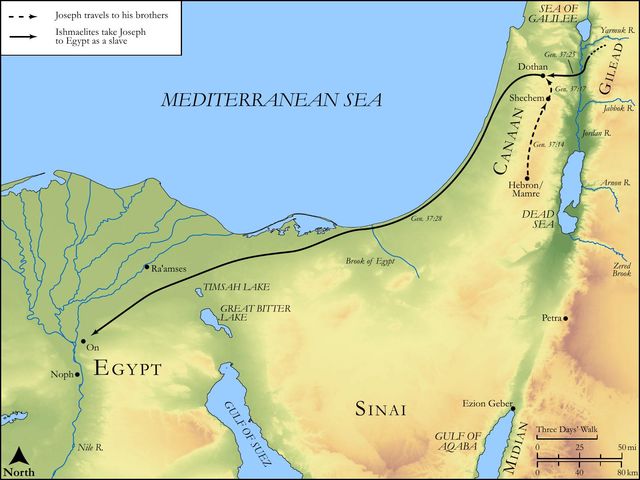
Here is, I. The kind visit which Joseph, in obedience to his father's command, made to his brethren, who were feeding the flock at Shechem, many miles off. Some suggest that they went thither on purpose, expecting that Joseph would be sent to see them, and that then they should have an opportunity to do him a mischief. However, Joseph and his father had both of them more of the innocence of the dove than of the wisdom of the serpent, else he had never come thus into the hands of those that hated him: but God designed it all for good. See in Joseph an instance, 1. Of dutifulness to his father. Though he was his father's darling, yet he was made, and was willing to be, his father's servant. How readily does he wait his father's orders! Here I am, Gen 37:13. Note, Those children that are best beloved by their parents should be most obedient to their parents; and then their love is well-bestowed and well-returned. 2. Of kindness to his brethren. Though he knew they hated him and envied him, yet he made no objections against his father's commands, either from the distance of the place or the danger of the journey, but cheerfully embraced the opportunity of showing his respect to his brethren. Note, It is a very good lesson, though it is learnt with difficulty and rarely practised, to love those that hate us; if our relations do not their duty to us, yet we must not be wanting in our duty to them. This is thank-worthy. Joseph was sent by his father to Shechem, to see whether his brethren were well there, and whether the country had not risen upon them and destroyed them, in revenge of their barbarous murder of the Shechemites some years before. But Joseph, not finding them there, went to Dothan, which showed that he undertook this journey, not only in obedience to his father (for then he might have returned when he missed them at Shechem, having done what his father told him), but out of love to his brethren, and therefore he sought diligently till he found them. Thus, let brotherly love continue, and let us give proofs of it.
II.The bloody and malicious plot of his brethren against him, who rendered good for evil, and, for his love, were his adversaries. Observe,
1.How deliberate they were in the contrivance of this mischief: when they saw him afar off, they conspired against him, Gen 37:18. It was not in a heat, or upon a sudden provocation, that they thought to slay him, but from malice prepense, and in cold blood. Note, Whosoever hateth his brother is a murderer; for he will be one if he have an opportunity, Jo1 3:15. Malice is a most mischievous thing, and is in danger of making bloody work where it is harboured and indulged. The more there is of a project and contrivance in a sin the worse it is; it is bad to do evil, but worse to devise it.
2.How cruel they were in their design; nothing less than his blood would satisfy them: Come, and let us slay him, Gen 37:20. Note, The old enmity hunts for the precious life. It is the blood-thirsty that hate the upright (Pro 29:10), and it is the blood of the saints that the harlot is drunk with.
3.How scornfully they reproached him for his dreams (Gen 37:19): This dreamer cometh; and (Gen 37:20), We shall see what will become of his dreams. This shows what it was that fretted and enraged them. They could not endure to think of doing homage to him; this was what they were plotting to prevent by the murder of him. Note, Men that fret and rage at God's counsels are impiously aiming to defeat them; but they imagine a vain thing, Psa 2:1-3. God's counsels will stand.
4.How they agreed to keep one another's counsel, and to cover the murder with a lie: We will say, Some evil beast hath devoured him; whereas in thus consulting to devour him they proved themselves worse than the most evil beasts; for evil beasts prey not on those of their own kind, but they were tearing a piece of themselves.
III.Reuben's project to deliver him, Gen 37:21, Gen 37:22.
Note, God can raise up friends for his people, even among their enemies; for he has all hearts in his hands. Reuben, of all the brothers, had most reason to be jealous of Joseph, for he was the first-born, and so entitled to those distinguishing favours which Jacob was conferring on Joseph; yet he proves his best friend. Reuben's temper seems to have been soft and effeminate, which had betrayed him to the sin of uncleanness; while the temper of the next two brothers, Simeon and Levi, was fierce, which betrayed them to the sin of murder, a sin which Reuben startled at the thought of. Note, Our natural constitution should be guarded against those sins to which it is most inclinable, and improved (as Reuben's here) against those sins to which it is most averse. Reuben made a proposal which they thought would effectually answer their intention of destroying Joseph, and yet which he designed should answer his intention of rescuing Joseph out of their hands and restoring him to his father, probably hoping thereby to recover his father's favour, which he had lately lost; but God overruled all to serve his own purpose of making Joseph an instrument to save much people alive. Joseph was here a type of Christ. Though he was the beloved Son of his Father, and hated by a wicked world, yet the Father sent him out of his bosom to visit us in great humility and love. He came from heaven to earth, to seek and save us; yet then malicious plots were laid against him. He came to his own, and his own not only received him not, but consulted against him: This is the heir, come let us kill him; Crucify him, crucify him. This he submitted to, in pursuance of his design to redeem and save us.
Historical interpretation
Three Centuries of Reception
2 surviving comments on this verse. Each one is dated, so this reads as a timeline rather than a list.
Select a marker to jump to its quote. Markers stagger vertically where authors wrote within a few decades of each other.
Every kind of honour and happiness was bestowed upon you, and then was fulfilled that which is written, "My beloved ate and drank, and was enlarged and became fat, and kicked." [Deuteronomy 32:15] Hence flowed emulation and envy, strife and sedition, persecution and disorder, war and captivity. So the worthless rose up against the honoured, those of no reputation against such as were renowned, the foolish against the wise, the young against those advanced in years. For this reason righteousness and peace are now far departed from you, inasmuch as every one abandons the fear of God, and has become blind in His faith, neither walks in the ordinances of His appointment, nor acts a part becoming a Christian, but walks after his own wicked lusts, resuming the practice of an unrighteous and ungodly envy, by which death itself entered into the world. [Wisdom 2:24]
For thus it is written: "And it came to pass after certain days, that Cain brought of the fruits of the earth a sacrifice unto God; and Abel also brought of the firstlings of his sheep, and of the fat thereof. And God had respect to Abel and to his offerings, but Cain and his sacrifices He did not regard. And Cain was deeply grieved, and his countenance fell. And God said to Cain, Why are you grieved, and why is your countenance fallen? If you offer rightly, but do not divide rightly, have you not sinned? Be at peace: your offering returns to yourself, and you shall again possess it. And Cain said to Abel his brother, Let us go into the field. And it came to pass, while they were in the field, that Cain rose up against Abel his brother, and slew him." [Genesis 4:3-8] You see, brethren, how envy and jealousy led to the murder of a brother. Through envy, also, our father Jacob fled from the face of Esau his brother [Genesis 27:41-45]. Envy made Joseph be persecuted unto death, and to come into bondage. [Genesis 37:18-28] Envy compelled Moses to flee from the face of Pharaoh king of Egypt, when he heard these words from his fellow-countryman, "Who made you a judge or a ruler over us? Will you kill me, as you killed the Egyptian yesterday?" [Exodus 2:14] On account of envy, Aaron and Miriam had to make their abode without the camp. [Numbers 12:14-15] Envy brought down Dathan and Abiram alive to Hades, through the sedition which they excited against God's servant Moses. [Numbers 16:33] Through envy, David not only underwent the hatred of foreigners, but was also persecuted by Saul king of Israel. [1 Samuel 21:10-15]
Indeed, Reuben and Judah observed the holy bonds of brotherhood and desired to free Joseph from their hands. Judah receives the preference by his father’s blessing, and rightly so, when it is said to him, “The sons of your father shall bow down to you. A lion’s whelp is Judah, and he is the expectation of nations.” Surely this is appropriate to Christ alone, for whom it was in store that he should be worshiped by his brothers and awaited by the nations and that he should wash his tunic in wine by the passion of his own body, because he did not stain his flesh with any spot of sin.…Conferring together against that counsel, the brothers abused him in whom “the blessing prevailed over the blessings of the enduring mountains and was stronger than the desires of the everlasting hills.” Who did Joseph understand was being prefigured in himself? Only he who surpasses the merits of all people and possesses the summit of limitless power beyond the desires of all the saints, he whom no one matches in prayer. And so, in the case of the patriarchs, enmity is repaid through grace, for they are excused from their guilt and made holy by the gift of revelation. For it is not so much a matter of blame in having said what refers to the people as it is a matter of happiness in having seen what refers to Christ. The people assumed the character of a sinner to receive the grace of their Lord and Redeemer. Assuredly grace destroyed guilt; guilt did not diminish grace.
Continue studying Genesis 37:21 across the web’s major study libraries — every link below opens this exact verse, chapter, or book on the destination site.
Read & Compare
 BibleGatewayThis verse in more than 200 translations and 70 languages.
 Bible.comThe YouVersion reader — hundreds of translations, reading plans, and highlights.
 ESV.orgCrossway's official English Standard Version reader.
 NET BibleThe NET translation with 60,000+ translators' notes on every rendering decision.
 STEP BibleTyndale House's free study tool — original text, vocabulary, and scholarly resources.
 BibliaLogos Bible Software's free web reader.
 USCCBThe New American Bible (Revised Edition) with the U.S. bishops' study notes.
Commentaries
 BibleHub CommentariesDozens of classic commentaries on this verse, gathered on one page.
 StudyLightMore than 100 commentary sets — the largest collection on the web.
 BibleRefPlain-English commentary on what this verse means, verse by verse.
 Enduring WordDavid Guzik's free commentary on this chapter, widely used by Bible teachers.
 Bible Study ToolsVerse commentary alongside Greek and Hebrew study aids.
Original Language & Research
- BibleHub InterlinearThe verse word by word — original language, transliteration, and English.
- BibleHub LexiconEvery word's original-language definition and Strong's entry.
 Blue Letter BibleDeep-study tools — Strong's numbers, concordance, and word studies.
 SefariaThe Hebrew text with Rashi and centuries of Jewish commentary.
Sermons, Hymns & Audio


TrulyRandomVerse is not affiliated with these sites and doesn’t control their content. They’re linked because they’re genuinely useful.
Summary
Genesis 37:21 marks a pivotal turn in the unfolding drama of Joseph and his brothers, highlighting Reuben's crucial intervention that prevented outright fratricide. Amidst the brothers' profound jealousy and murderous intent, Reuben stepped in to rescue Joseph from immediate death, subtly redirecting the course of events and setting the stage for God's sovereign and redemptive plan to unfold, ultimately preserving the nascent nation of Israel.
Context
ShowHideLiterary Context
This verse is situated at a critical juncture in the narrative of Joseph, immediately following the climax of his brothers' intense hatred. Driven by deep-seated envy over Jacob's evident favoritism and Joseph's provocative dreams (Genesis 37:5, Genesis 37:9), the brothers had initially conspired to murder him, declaring, "Come now therefore, and let us slay him" (Genesis 37:19-20). Their sinister plan was to dispose of Joseph and fabricate a story for their father, Jacob. It is precisely at this dark moment, on the precipice of a heinous act, that Reuben, the eldest son, intervenes, introducing a flicker of conscience and a strategic counter-proposal amidst their destructive intentions.
Historical & Cultural Context
In ancient Near Eastern patriarchal societies, the eldest son, like Reuben, held significant responsibility and authority, often acting as a mediator or protector within the family unit. Fratricide, while tragically present in early biblical narratives (e.g., Cain and Abel), was an abhorrent crime that would bring immense shame and divine judgment upon a family. Reuben's position as firstborn would have burdened him with the responsibility for the family's honor and the well-being of his siblings, even those he might resent. Furthermore, the nomadic lifestyle of Jacob's family meant that such a crime could be easily concealed in the wilderness, yet the moral implications remained severe, impacting the family's standing and their relationship with God. Reuben's intervention, therefore, can be seen as an attempt to uphold a semblance of moral order and prevent a sin of immense gravity within the family.
Key Themes
ShowHideGenesis 37:21 contributes significantly to several overarching themes within the book of Genesis and biblical theology. Firstly, it powerfully illustrates the theme of Divine Providence, demonstrating how God can orchestrate His purposes even through human sin and imperfect actions. Reuben's flawed intervention, though not fully preventing Joseph's suffering, was a crucial link in God's plan to bring Joseph to Egypt, ultimately preserving the family of Israel from famine (Genesis 50:20). Secondly, the verse highlights the Destructive Power of Envy and Sibling Rivalry, a recurring motif in Genesis, from Cain and Abel to Jacob and Esau. The brothers' hatred for Joseph, fueled by jealousy, reveals the corrupting nature of sin. Lastly, it touches upon the theme of Conscience and Moral Responsibility, as Reuben, despite his own moral failings (as seen in Genesis 35:22), still possesses enough moral compass to recoil from outright murder, underscoring the innate human awareness of right and wrong.
Exposition and Analysis
ShowHideKey Word Analysis
ShowHideThis term (H3027) refers to the "hand," often signifying power, authority, or means. In this context, "out of their hands" implies being rescued from their grasp, control, or the destructive power they intended to wield. It emphasizes Reuben's act of extracting Joseph from the immediate physical threat posed by his brothers' murderous intentions. The phrase vividly portrays the brothers' readiness to inflict harm and Reuben's decisive action to counteract that power.
The verb (H5337) means "to snatch away," "to rescue," or "to preserve." It denotes an active, forceful removal from danger or from the possession of another. Reuben's action was not passive; he actively "snatched" Joseph from the clutches of his brothers' murderous plot. While his deliverance was not absolute (Joseph was still sold), this word highlights the immediate and critical rescue from death that Reuben accomplished.
This verb (H5221) means "to strike," often with the implication of inflicting a fatal blow, leading to "slaughter" or "slaying." Coupled with the implied object "him" (referring to Joseph's nephesh or life/soul, H5315), it underscores the ultimate and irreversible act of murder that Reuben sought to prevent. His plea, "Let us not kill him," directly addresses the most heinous aspect of their conspiracy, aiming to avert the shedding of his brother's blood.
Verse Breakdown
ShowHide"And Reuben heard [it]"
This clause signifies Reuben's awareness of his brothers' murderous plot, indicating that he was either present for the conspiracy or overheard their intentions. As the eldest, his hearing carried significant weight, implying a responsibility to respond. His immediate reaction suggests a moral awakening or a strategic calculation upon learning of their extreme plan.
"and he delivered him out of their hands"
This is the core action of the verse. Reuben actively intervened, not merely by speaking, but by initiating a process of rescue. The phrase "out of their hands" emphasizes Joseph's immediate peril and Reuben's success in removing him from the direct threat of physical violence or death at the hands of his brothers. This act of "delivering" sets him apart from the others' malevolent intent.
"and said"
This simple phrase introduces Reuben's verbal intervention, indicating that his deliverance was not silent but accompanied by an explicit command or plea. It transitions from his physical action of separating Joseph from the immediate threat to his verbal persuasion of his brothers.
"Let us not kill him"
This is Reuben's direct and urgent appeal, revealing his primary objective: to prevent fratricide. While he did not advocate for Joseph's complete freedom or safety, his immediate concern was to avert the ultimate sin of murder. This statement serves as a crucial turning point, mitigating the brothers' initial, more extreme intent and setting the stage for a less severe, yet still cruel, alternative.
Literary Devices
ShowHideGenesis 37:21 employs several literary devices that enrich its meaning and dramatic impact. Characterization is evident in Reuben's portrayal. As the eldest, his intervention reveals a complex, morally ambiguous character. While he prevents murder, his actions are not fully righteous, as he later allows Joseph to be sold into slavery, perhaps hoping to retrieve him later (Genesis 37:22). This highlights his flawed but still conscience-driven nature. The narrative also employs Dramatic Irony, as the brothers believe they are eliminating Joseph and thwarting his dreams, yet Reuben's intervention, though imperfect, is a crucial step in God's sovereign plan to exalt Joseph and save their family. The reader is aware of God's larger purposes, while the characters remain largely oblivious to the ultimate outcome of their actions. Furthermore, the scene presents a Turning Point in the narrative, shifting the trajectory from certain death to a prolonged period of suffering and eventual exaltation for Joseph, demonstrating how a single act of intervention can profoundly alter destiny.
Theological and Thematic Connections
ShowHideGenesis 37:21 profoundly illustrates the intricate interplay between human agency and divine providence. While the brothers' actions are driven by sinful envy and hatred, Reuben's intervention, though imperfect and motivated by a mix of conscience and perhaps self-preservation, becomes a crucial link in God's overarching plan. This moment demonstrates God's ability to redeem even the darkest human intentions and turn them towards His redemptive purposes. The prevention of fratricide, while leading to Joseph's enslavement, ultimately sets the stage for his rise to power in Egypt, his preservation of his family during famine, and the eventual fulfillment of God's covenant promises to Abraham, Isaac, and Jacob. This narrative powerfully underscores that God remains sovereign, weaving together human choices—both good and evil—to accomplish His ultimate will, transforming what was intended for evil into good (Genesis 50:20).
Reflection and Application
ShowHideGenesis 37:21 offers several pertinent lessons for believers today. Reuben's act, however flawed, reminds us of the importance of speaking up against injustice and evil, even when it is unpopular or difficult. His intervention, though not a complete rescue, prevented the ultimate sin of murder and significantly altered the trajectory of Joseph's life, and by extension, the future of Israel. This underscores the potential power of one dissenting voice to mitigate destructive paths and stand against the tide of collective wrongdoing. We are called to be courageous, to act on our conscience, and to be agents of restraint and mercy in a world often consumed by malice. Ultimately, this narrative powerfully illustrates that God remains sovereign and in control, orchestrating events to fulfill His ultimate plan for His people, even through moments of great sin, betrayal, and imperfect human responses. It encourages us to trust in God's overarching plan, even when circumstances seem chaotic or unjust.
Questions for Reflection
ShowHideFAQ
ShowHideWhy did Reuben intervene to save Joseph's life?
ShowHideReuben, as the eldest son, likely felt a profound sense of responsibility and a flicker of conscience. His primary motivation, as revealed in Genesis 37:22, was to prevent the heinous act of fratricide within the family. He intended to later return Joseph to their father, Jacob, thereby avoiding the ultimate sin of murder and potentially preserving his own standing and the family's honor.
Was Reuben's intervention a truly righteous act?
ShowHideReuben's act was complex and ultimately incomplete. While he successfully prevented the immediate murder of Joseph, he did not fully protect him from his brothers' cruelty, allowing him to be sold into slavery. Therefore, it was not a perfectly righteous act, but it was a crucial step that mitigated a greater evil and demonstrated a conscience, serving as a vital link in God's providential plan. His later regret in Genesis 42:22 shows his awareness of his partial failure.
How does this event demonstrate God's sovereignty?
ShowHideThis event powerfully illustrates God's sovereignty by showing how He can use even the wicked intentions of humans (the brothers' hatred and betrayal) and imperfect human actions (Reuben's flawed intervention) to accomplish His divine purposes. Joseph's journey to Egypt, initiated by this betrayal, was ultimately God's means to preserve the nascent nation of Israel during a severe famine and fulfill His covenant promises to Abraham, Isaac, and Jacob, demonstrating His ability to turn evil for good (Genesis 50:20).
Christ-Centered Fulfillment
ShowHideReuben's imperfect intervention, which saved Joseph from immediate death but not from suffering and betrayal, powerfully foreshadows the greater divine plan of salvation orchestrated through Jesus Christ. Joseph, though innocent, suffered immensely at the hands of his own brethren, was sold for a price (twenty shekels of silver, Genesis 37:28), and descended into a foreign land, yet was ultimately exalted to a position of power to save his family and countless others from famine. This narrative parallels Christ, who, though utterly innocent, was betrayed by His own people (John 1:11), sold for a price (Matthew 26:15), suffered death on the cross (Philippians 2:8), and was resurrected and exalted to the right hand of God (Acts 2:33). Just as Joseph's suffering brought about the physical preservation of his family, Christ's suffering and sacrifice brought about the eternal salvation and spiritual preservation of all who believe (Romans 5:8), demonstrating God's ultimate ability to turn the darkest human evils—betrayal, hatred, and murder—into the greatest redemptive good for humanity (1 Peter 2:24).