


Genesis 42:14
Bible text: King James Version (1769 Blayney text) · Public domain
Bible text: Berean Standard Bible · Public domain
Bible text: American Standard Version (1901) · Public domain
Bible text: World English Bible, Messianic edition · Public domain
Bible text: Geneva Bible (1599) · Public domain
Bible text: Young's Literal Translation · Public domain
- וַיֹּאמֶרvai·Yo·merand he saidH559Conj-w ¦ V-Qal-ConsecImperf-3msVerb Qal Consecutive Imperfect 3rd Singular Masculineוַandיֹּאמֶרhe said
- אֲלֵהֶם'a·le·Hemto themH413Prep ¦ 3mpPreposition Definiteאֲלֵtoהֶםthem
- יוֹסֵףyo·SefJosephH3130N-proper-mNoun Proper Masculine
- הוּאHu'itH1931Pro-3msPronoun Personal 3rd Singular Masculine
- אֲשֶׁר'a·Sher[is that] whichH834RelParticle Relative
- דִּבַּרְתִּיdi·Bar·tiI saidH1696V-Piel-Perf-1csVerb Piel Perfect 1st Singular common gender
- אֲלֵכֶם'a·le·Khemto youH413Prep ¦ 2mpPreposition Definiteאֲלֵtoכֶםyou
- לֵאמֹרle·Mor<to> sayingH559Prep-l ¦ V-Qal-InfVerb Qal Infinitive Constructלֵ<to>אמֹרsaying
- מְרַגְּלִיםme·ra·ge·Lim[are] spiesH7270V-Piel-Prtcpl-mpVerb Piel Participle Plural Masculine Absolute
- אַתֶּם'a·TemyouH859Pro-2mpPronoun Personal 2nd Plural Masculine
English is a literal word-by-word gloss of the Hebrew, not the KJV's wording. Why?
This is the original text the KJV's translators worked from — each Hebrew word with its own literal English meaning in this verse, prepared by scholars at Tyndale House, Cambridge. The KJV translates whole sentences, not word by word, so its wording differs: one Hebrew word can become several English words, and the KJV may choose “the LORD” where the gloss reads “Yahweh”. Both are faithful — they answer different questions. For the KJV's own rendering, switch to the KJV text.
Details
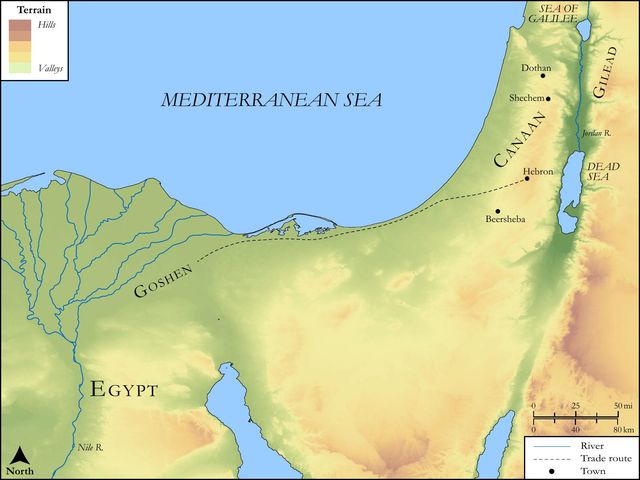
See on the biblical-era maps


Study this verse
Public-domain commentary
Matthew Henry
From his Commentary on the Whole Bible. Henry comments on passages, not single verses — this entry covers Genesis 42:7–20. His two-level outline is real structure in the source text, so it is rendered as structure.
We may well wonder that Joseph, during the twenty years that he had now been in Egypt, especially during the last seven years that he had been in power there, never sent to his father to acquaint him with his circumstances; nay, it is strange that he who so often went throughout all the land of Egypt (Gen 41:45, Gen 41:46) never made an excursion to Canaan, to visit his aged father, when he was in the borders of Egypt, that lay next to Canaan. Perhaps it would not have been above three or four days' journey for him in his chariot. It is a probable conjecture that his whole management of himself in this affair was by special direction from Heaven, that the purpose of God concerning Jacob and his family might be accomplished. When Joseph's brethren came, he knew them by many a satisfactory token, but they knew not him, little thinking to find him there, Gen 42:8. He remembered the dreams (Gen 42:9), but they had forgotten them. The laying up of God's oracles in our hearts will be of excellent use to us in all our conduct. Joseph had an eye to his dreams, which he knew to be divine, in his carriage towards his brethren, and aimed at the accomplishment of them and the bringing of his brethren to repentance for their former sins; and both these points were gained.
I.He showed himself very rigorous and harsh with them.
The very manner of his speaking, considering the post he was in, was enough to frighten them; for he spoke roughly to them, Gen 42:7. He charged them with bad designs against the government (Gen 42:9), treated them as dangerous persons, saying, You are spies, and protesting by the life of Pharaoh that they were so, Gen 42:16. Some make this an oath, others make it no more than a vehement asseveration, like that, as thy soul liveth; however it was more than yea, yea, and nay, nay, and therefore came of evil. Note, Bad words are soon learned by converse with those that use them, but not so soon unlearned. Joseph, by being much at court, got the courtier's oath, By the life of Pharaoh, perhaps designing hereby to confirm his brethren in their belief that he was an Egyptian, and not an Israelite. They knew this was not the language of a son of Abraham. When Peter would prove himself no disciple of Christ, he cursed and swore. Now why was Joseph thus hard upon his brethren? We may be sure it was not from a spirit of revenge, that he might now trample upon those who had formerly trampled upon him; he was not a man of that temper. But,
1.It was to enrich his own dreams, and complete the accomplishment of them.
2.It was to bring them to repentance.
3.It was to get out of them an account of the state of their family, which he longed to know: they would have discovered him if he had asked as a friend, therefore he asks as a judge. Not seeing his brother Benjamin with them, perhaps he began to suspect that they had made away with him too, and therefore gives them occasion to speak of their father and brother. Note, God in his providence sometimes seems harsh with those he loves, and speaks roughly to those for whom yet he has great mercy in store.
II.They, hereupon, were very submissive.
They spoke to him with all the respect imaginable: Nay, my lord (Gen 42:10) - a great change since they said, Behold, this dreamer comes. They very modestly deny the charge: We are no spies. They tell him their business, that they came to buy food, a justifiable errand, and the same that many strangers came to Egypt upon at this time. They undertake to give a particular account of themselves and their family (Gen 42:13), and this was what they wanted.
III.He clapped them all up in prison for three days, Gen 42:17.
Thus God deals with the souls he designs for special comfort and honour; he first humbles them, and terrifies them, and brings them under a spirit of bondage, and then binds up their wounds by the Spirit of adoption.
IV.He concluded with them, at last, that one of them should be left as a hostage, and the rest should go home and fetch Benjamin.
It was a very encouraging word he said to them (Gen 42:18): I fear God; as if he had said, "You may assure yourselves I will do you no wrong; I dare not, for I know that, high as I am, there is one higher than I." Note, With those that fear God we have reason to expect fair dealing. The fear of God will be a check upon those that are in power, to restrain them from abusing their power to oppression and tyranny. Those that have no one else to stand in awe of ought to stand in awe of their own consciences. See Neh 5:15, So did not I, because of the fear of God.
Continue studying Genesis 42:14 across the web’s major study libraries — every link below opens this exact verse, chapter, or book on the destination site.
Read & Compare
 BibleGatewayThis verse in more than 200 translations and 70 languages.
 Bible.comThe YouVersion reader — hundreds of translations, reading plans, and highlights.
 ESV.orgCrossway's official English Standard Version reader.
 NET BibleThe NET translation with 60,000+ translators' notes on every rendering decision.
 STEP BibleTyndale House's free study tool — original text, vocabulary, and scholarly resources.
 BibliaLogos Bible Software's free web reader.
 USCCBThe New American Bible (Revised Edition) with the U.S. bishops' study notes.
Commentaries
 BibleHub CommentariesDozens of classic commentaries on this verse, gathered on one page.
 StudyLightMore than 100 commentary sets — the largest collection on the web.
 BibleRefPlain-English commentary on what this verse means, verse by verse.
 Enduring WordDavid Guzik's free commentary on this chapter, widely used by Bible teachers.
 Bible Study ToolsVerse commentary alongside Greek and Hebrew study aids.
Original Language & Research
- BibleHub InterlinearThe verse word by word — original language, transliteration, and English.
- BibleHub LexiconEvery word's original-language definition and Strong's entry.
 Blue Letter BibleDeep-study tools — Strong's numbers, concordance, and word studies.
 SefariaThe Hebrew text with Rashi and centuries of Jewish commentary.
Sermons, Hymns & Audio


TrulyRandomVerse is not affiliated with these sites and doesn’t control their content. They’re linked because they’re genuinely useful.
Summary
In Joseph, now the powerful vizier of Egypt, confronts his unsuspecting brothers who have traveled from Canaan to purchase grain during a severe regional famine. He delivers a calculated and definitive accusation, declaring, "That is it that I spake unto you, saying, Ye are spies." This strategic pronouncement is not merely an act of suspicion but a deliberate maneuver designed to test their character, gather crucial information about his family's welfare, and initiate a complex series of events that will ultimately lead to their profound repentance, reconciliation, and the divinely ordained preservation of the nascent Israelite family.
Context
ShowHideLiterary Context
This verse is a pivotal moment within the larger narrative of Joseph's life, specifically following his recognition of his brothers (who do not recognize him) and his initial, somewhat veiled, questioning of them in Genesis 42:7-13. Joseph's declaration in Genesis 42:14 solidifies his accusation, setting the stage for the trials he will impose upon them, including the imprisonment of Simeon and the demand for Benjamin to be brought to Egypt. This accusation serves as the catalyst for the brothers' internal reflection and eventual confession of guilt regarding their past treatment of Joseph, as seen in Genesis 42:21. It is a crucial step in Joseph's intricate plan to test their integrity and bring about a redemptive familial reunion.
Historical & Cultural Context
The setting is ancient Egypt during a period of severe famine that extended beyond its borders, as detailed in Genesis 41:56-57. Egypt, with its advanced agricultural system sustained by the Nile, was the only region prepared for such a prolonged crisis, making it the sole source of grain for surrounding nations. This made visitors from foreign lands, especially those arriving in groups, immediate subjects of suspicion, as they could indeed be scouts for invading armies or spies seeking to exploit vulnerabilities. Joseph, as the governor responsible for Egypt's security and food supply, was acting within a believable cultural and political framework by questioning foreign visitors. His position of immense power, combined with his Egyptian attire and language (requiring an interpreter, as noted in Genesis 42:23), made him completely unrecognizable to his brothers, who would have assumed him to be a native Egyptian official.
Key Themes
ShowHideGenesis 42:14 powerfully contributes to several overarching themes within the book of Genesis. The theme of Divine Sovereignty and Providence is paramount, illustrating how God orchestrates human events, even sinful ones like Joseph's betrayal, to fulfill His ultimate purposes, preserving His chosen family (Genesis 45:5-8). It also highlights the theme of Testing and Discernment, as Joseph's accusation serves as a divinely-guided trial to reveal the true character of his brothers and their capacity for repentance and transformation, mirroring God's own methods of refining His people. Furthermore, the narrative explores Consequences and Repentance, showing how the brothers' past sin indirectly leads to their present distress and eventually to a profound realization of their guilt, paving the way for spiritual and relational restoration.
Exposition and Analysis
ShowHideKey Word Analysis
ShowHideAs per H3130, this name means "let him add" or "adding." Here, it signifies the central figure of this narrative arc. Joseph, having been elevated to a position of immense power in Egypt, is now strategically "adding" a new, challenging chapter to his brothers' lives, testing them and orchestrating events that will add to the family's story of preservation and reconciliation. His identity, though concealed, is the driving force behind the entire interaction.
This primitive root means "to arrange" or, figuratively, "to speak." Joseph's use of "spake" here emphasizes that his accusation was not a spontaneous outburst but a pre-meditated, arranged statement. He had already laid the groundwork for this charge in earlier interactions, and now he is confirming and solidifying his "arranged" accusation, setting the terms for the ensuing test.
Derived from H7270, this word means "to walk along," but specifically in applications like "to reconnoiter" or "to spy out." It carries a strong connotation of hostile reconnaissance, implying individuals who are gathering intelligence for nefarious purposes, potentially for invasion or sabotage. Joseph's deliberate use of this severe term was a calculated move to exert maximum pressure on his brothers, accusing them of a capital offense and forcing them to reveal more about their true intentions and family situation.
Verse Breakdown
ShowHide"And Joseph said unto them,"
This opening clause establishes Joseph's authority and initiative in the conversation. As the powerful Egyptian governor, his words carry immense weight and legal consequence. This is not a casual remark but a formal declaration from a position of power.
"That is it that I spake unto you, saying,"
This phrase emphasizes the deliberate and pre-meditated nature of Joseph's accusation. He is reiterating a charge he had already made or strongly implied (Genesis 42:9), confirming his earlier suspicion and making it explicit. It serves to underscore the seriousness of the situation and Joseph's unwavering stance.
"Ye are spies:"
This is the direct and unambiguous accusation. By labeling them "spies," Joseph places his brothers in a perilous position, accusing them of a crime that could carry the death penalty. This accusation is the core of his strategy, designed to provoke a strong reaction, force them to defend themselves, and compel them to reveal information about their family, particularly Benjamin and their father Jacob.
Literary Devices
ShowHideThe verse employs several significant literary devices. Irony is prominent, as the accuser, Joseph, is the very person his brothers betrayed and sold into slavery, and he is now accusing them of a crime they did not commit, while they are unknowingly facing the consequences of a past, real betrayal. This creates a powerful sense of dramatic tension. There is also Foreshadowing, as Joseph's calculated accusation and the subsequent trials hint at the deeper, redemptive purpose that will unfold, ultimately leading to reconciliation and the preservation of his family. Furthermore, the narrative uses Dramatic Tension by placing the brothers in a life-threatening situation, forcing them to confront their past and revealing their true character under duress.
Theological and Thematic Connections
ShowHideJoseph's accusation in Genesis 42:14 is a profound testament to God's sovereign hand working through complex human interactions. It demonstrates that even through painful and seemingly unjust circumstances, God can orchestrate events to bring about His perfect will, leading to restoration and the fulfillment of His covenant promises. Joseph's actions, though initially harsh, were not driven by malice but by a divinely inspired purpose to test, refine, and ultimately reconcile his family, ensuring the lineage through which the Messiah would eventually come. This narrative underscores the theme of divine providence, where God uses even human sin and suffering as instruments for His redemptive plan, revealing His faithfulness in preserving His people.
Reflection and Application
ShowHideJoseph's calculated accusation in Genesis 42:14 provides a rich tapestry for reflection on God's mysterious ways and our response to challenging circumstances. It reminds us that God often works through difficult, even painful, processes to bring about His ultimate good. Just as Joseph's brothers were brought to a place of self-examination and repentance through a divinely orchestrated trial, we too can expect God to use various tests and adversities to refine our character, expose hidden sins, and draw us closer to Him. This narrative encourages us to trust in God's overarching plan, even when we don't understand the immediate circumstances or feel unjustly accused. It prompts us to consider how we respond to pressure, how we seek reconciliation, and how we might participate in God's redemptive work, even when it requires difficult conversations or painful self-reflection. Ultimately, it offers hope that even the deepest family wounds can be healed through repentance, forgiveness, and God's sovereign grace.
Questions for Reflection
ShowHideFAQ
ShowHideWhy did Joseph accuse his brothers of being spies?
ShowHideJoseph accused his brothers of being spies as a deliberate and strategic maneuver, not because he genuinely believed they were. His primary objectives were multifaceted: to test their character and moral transformation since they had sold him into slavery, to gather vital information about his father Jacob and his youngest brother Benjamin, and to orchestrate a series of trials that would ultimately lead to their repentance, a profound reconciliation, and the divinely ordained preservation of his family. This accusation was the first step in a complex plan to bring about a redemptive outcome for all involved.
Did Joseph enjoy seeing his brothers suffer?
ShowHideWhile Joseph's actions undoubtedly caused his brothers distress and fear, the biblical text strongly indicates his motivation was not malicious enjoyment or retribution. Joseph's deep emotional turmoil is evident in his frequent weeping throughout this narrative arc (e.g., Genesis 42:24, Genesis 43:30, Genesis 45:1-2). His strategy was a difficult but necessary means to a redemptive end, aimed at spiritual transformation and genuine reconciliation rather than mere punishment. His tears reveal a heart burdened by the past and yearning for true restoration.
What is the significance of Joseph's concealed identity in this chapter?
ShowHideJoseph's decision to conceal his identity is crucial for the unfolding narrative and its theological implications. By remaining unrecognized, he could objectively observe and test his brothers' character without their pretense. This concealment allowed him to orchestrate the trials necessary to bring them to a place of repentance and self-awareness regarding their past sin against him. Furthermore, his hidden identity and eventual revelation foreshadow a recurring biblical theme where God's purposes are initially veiled, only to be revealed in His perfect timing and through unexpected means, often leading to greater glory and understanding.
Christ-Centered Fulfillment
ShowHideJoseph's veiled identity and deliberate accusation in Genesis 42:14, which initiates a process of testing and eventual reconciliation, powerfully prefigures the work of Christ. Like Joseph, who was rejected by his own brothers and seemingly abandoned to suffering, yet rose to a position of ultimate power to save them, Christ was rejected by His own people and suffered death on a cross, yet through His resurrection, He ascended to ultimate authority, becoming the savior of the world (Philippians 2:6-11). He, too, tests the hearts of humanity, not with suspicion, but with a perfect knowledge of our sin and a divine desire for our repentance and transformation (John 2:24-25). Unrecognized by many in His first coming, He brings about a profound reconciliation, offering salvation and restoration to all who acknowledge their spiritual poverty and turn to Him in faith, just as Joseph's brothers were brought to a place of confession and forgiveness (2 Corinthians 5:18-19). His suffering, veiled glory, and subsequent exaltation are the ultimate means by which God preserves His people and brings them into an eternal, reconciled relationship with Himself.