


Genesis 49:22
Bible text: King James Version (1769 Blayney text) · Public domain
Bible text: Berean Standard Bible · Public domain
Bible text: American Standard Version (1901) · Public domain
Bible text: World English Bible, Messianic edition · Public domain
Bible text: Geneva Bible (1599) · Public domain
Bible text: Young's Literal Translation · Public domain
- בֵּןben[is] a son ofH1121N-mscNoun Singular Masculine Construct
- פֹּרָתpo·Rata fruit-bearerH6509V-Qal-Prtcpl-fsVerb Qal Participle Singular Feminine Absolute
- יוֹסֵףyo·SefJosephH3130N-proper-mNoun Proper Masculine
- בֵּןbena son ofH1121N-mscNoun Singular Masculine Construct
- פֹּרָתpo·Rata fruit-bearerH6509V-Qal-Prtcpl-fsVerb Qal Participle Singular Feminine Absolute
- עֲלֵי'a·leiatH5921PrepPreposition
- עָיִן'A·yina springH5869N-fsNoun Singular Feminine Absolute
- בָּנוֹתba·NotdaughtersH1323N-fpNoun Plural Feminine Absolute
- צָעֲדָהtza·'a·Dahshe will climbH6805V-Qal-Perf-3fsVerb Qal Perfect 3rd Singular Feminine
- עֲלֵי'a·leioverH5921PrepPreposition
- שׁוּרShura wallH7791N-msNoun Singular Masculine Absolute
English is a literal word-by-word gloss of the Hebrew, not the KJV's wording. Why?
This is the original text the KJV's translators worked from — each Hebrew word with its own literal English meaning in this verse, prepared by scholars at Tyndale House, Cambridge. The KJV translates whole sentences, not word by word, so its wording differs: one Hebrew word can become several English words, and the KJV may choose “the LORD” where the gloss reads “Yahweh”. Both are faithful — they answer different questions. For the KJV's own rendering, switch to the KJV text.
Details
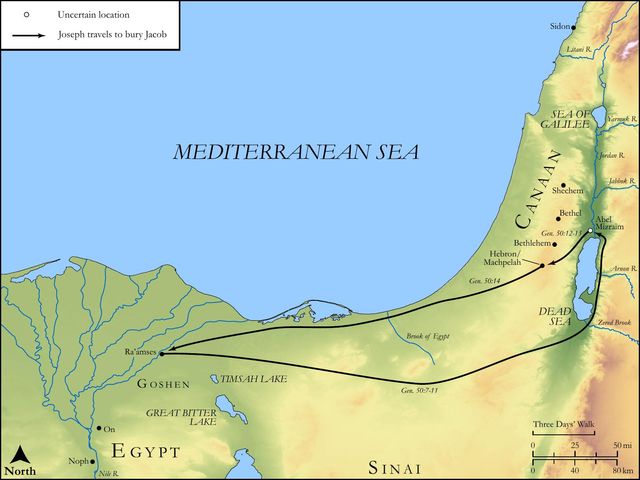
See on the biblical-era maps


Study this verse
Public-domain commentary
Matthew Henry
From his Commentary on the Whole Bible. Henry comments on passages, not single verses — this entry covers Genesis 49:22–27. His four-level outline is real structure in the source text, so it is rendered as structure.
He closes with the blessings of his best beloved sons, Joseph and Benjamin; with these he will breathe his last.
I.The blessing of Joseph, which is very large and full.
He is compared (Gen 49:22) to a fruitful bouth, or young tree; for God had made him fruitful in the land of his affliction; he owned it. Gen 41:52. His two sons were as branches of a vine, or other spreading plant, running over the wall. Note, God can make those fruitful, great comforts to themselves and others, who have been looked upon as dry and withered. More is recorded in the history concerning Joseph than concerning any other of Jacob's sons; and therefore what Jacob says of him is historical as well as prophetical. Observe,
1.The providences of God concerning Joseph, Gen 49:23, Gen 49:24. These are mentioned to the glory of God, and for the encouragement of Jacob's faith and hope, that God had blessings in store for his seed. Here observe (1.) Joseph's straits and troubles, Gen 49:23. Though he now lived at ease and in honour, Jacob reminds him of the difficulties he had formerly waded through. He had had many enemies, here called archers, being skilful to do mischief, masters of their art of persecution. They hated him: there persecution begins. They shot their poisonous darts at him, and thus they sorely grieved him. His brethren, in his father's house, were very spiteful towards him, mocked him, stripped him, threatened him, sold him, thought they had been the death of him. His mistress, in the house of Potiphar, sorely grieved him, and shot at him, when she impudently assaulted his chastity (temptations are fiery darts, thorns in the flesh, sorely grievous to gracious souls); when she prevailed not in this, she hated him, and shot at him by her false accusations, arrows against which there is little fence but the hold God has in the consciences of the worst of men. Doubtless he had enemies in the court of Pharaoh, that envied his preferment, and sought to undermine him. (2.) Joseph's strength and support under all these troubles (Gen 49:24): His bow abode in strength, that is, his faith did not fail, but he kept his ground, and came off a conqueror. The arms of his hands were made strong, that is, his other graces did their part, his wisdom, courage, and patience, which are better than weapons of war. In short, he maintained both his integrity and his comfort through all his trials; he bore all his burdens with an invincible resolution, and did not sink under them, nor do any thing unbecoming him. (3.) The spring and fountain of this strength; it was by the hands of the mighty God, who was therefore able to strengthen him, and the God of Jacob, a God in covenant with him, and therefore engaged to help him. All our strength for the resisting of temptations, and the bearing of afflictions, comes from God: his grace is sufficient, and his strength is perfected in our weakness. (4.) The state of honour and usefulness to which he was subsequently advanced: Thence (from this strange method of providence) he became the shepherd and stone, the feeder and supporter, of God's Israel, Jacob and his family. Herein Joseph was a type, [1.] Of Christ; he was shot at and hated, but borne up under his sufferings (Isa 50:7-9), and was afterwards advanced to be the shepherd and stone. [2.] Of the church in general, and particular believers; hell shoots its arrows against the saints, but Heaven protects and strengthens them, and will crown them.
2.The promises of God to Joseph. See how these are connected with the former: Even by the God of thy father Jacob, who shall help thee, Gen 49:25. Note, Our experiences of God's power and goodness in strengthening us hitherto are our encouragements still to hope for help from him; he that has helped us will help: we may build much upon our Eben-ezers. See what Joseph may expect from the Almighty, even the God of his father.
(1.)He shall help thee in difficulties and dangers which may yet be before thee, help thy seed in their wars. Joshua came from him, who commanded in chief in the wars of Canaan.
(2.)He shall bless thee; and he only blesses indeed. Jacob prays for a blessing upon Joseph, but the God of Jacob commands the blessing. Observe the blessings conferred on Joseph.
[1.]Various and abundant blessings: Blessings of heaven above (rain in its season, and fair weather in its season, and the benign influences of the heavenly bodies); blessings of the deep that lieth under this earth, which, compared with the upper world, is but a great deep, with subterraneous mines and springs. Spiritual blessings are blessings of heaven above, which we ought to desire and seek for in the first place, and to which we must give the preference; while temporal blessings, those of this earth, must lie under in our account and esteem. Blessings of the womb and the breasts are given when children are safely born and comfortably nursed. In the word of God, by which we are born again, and nourished up (Pe1 1:23; Pe1 2:2), there are to the new man blessings both of the womb and the breasts.
[2.]Eminent and transcendent blessings, which prevail above the blessings of my progenitors, Gen 49:26. His father Isaac had but one blessing, and, when he had given that to Jacob, he was at a loss for a blessing to bestow upon Esau; but Jacob had a blessing for each of his twelve sons, and now, at the latter end, a copious one for Joseph. The great blessing entailed upon that family was increase, which did not so immediately and so signally follow the blessings which Abraham and Isaac gave to their sons as it followed the blessing which Jacob gave to his; for, soon after his death, they multiplied exceedingly.
[3.]Durable and extensive blessings: Unto the utmost bounds of the everlasting hills, including all the productions of the most fruitful hills, and lasting as long as they last, Isa 54:10. Note, the blessings of the everlasting God include the riches of the everlasting hills, and much more. Well, of these blessings it is here said, They shall be, so it is a promise, or, Let them be, so it is a prayer, on the head of Joseph, to which let them be as a crown to adorn it and a helmet to protect it. Joseph was separated from his brethren (so we read it) for a time; yet, as others read it, he was a Nazarite among his brethren, better and more excellent than they. Note, It is no new thing for the best men to meet with the worst usage, for Nazarites among their brethren to be cast out and separated from their brethren; but the blessing of God will make it up to them.
II.The blessing of Benjamin (Gen 49:27):
He shall raven as a wolf; it is plain by this that Jacob was guided in what he said by a spirit of prophecy, and not by natural affection; else he would have spoken with more tenderness of his beloved son Benjamin, concerning whom he only foresees and foretels this, that his posterity should be a warlike tribe, strong and daring, and that they should enrich themselves with the spoils of their enemies - that they should be active and busy in the world, and a tribe as much feared by their neighbours as any other: In the morning, he shall devour the prey, which he seized and divided over night. Or, in the first times of Israel, they shall be noted for activity, though many of them left-handed, Jdg 3:15; Jdg 20:16. Ehud the second judge, and Saul the first king, were of this tribe; and so also in the last times Esther and Mordecai, by whom the enemies of the Jews were destroyed, were of this tribe. The Benjamites ravened like wolves when they desperately espoused the cause of the men of Gibeah, those men of Belial, Jdg 20:14. Blessed Paul was of this tribe (Rom 11:1; Phi 3:5); and he did, in the morning of his day, devour the prey as a persecutor, but, in the evening, divided the spoil as a preacher. Note, God can serve his own purposes by the different tempers of men; the deceived and the deceiver are his.
Historical interpretation
Two Centuries of Reception
6 surviving comments on this verse. Each one is dated, so this reads as a timeline rather than a list.
Select a marker to jump to its quote. Markers stagger vertically where authors wrote within a few decades of each other.
The prophet has blessed Joseph more than all his brothers, because he contemplated the mysteries which, having been prefigured in him, would be fulfilled in Christ. Therefore Jacob did not praise Joseph but the one who was symbolized by Joseph. In fact, he says to him, “My son is increased, Joseph,” because thanks to his kingly and perfect name the grace of Christ has increased and has become abundant in the world.
Just as Jacob depended on Joseph instead of Reuben the firstborn, so also instead of Adam, the firstborn and rebellious one, the world had one Son of old age, in the latter days of the world, so that the whole world might stand and lean on him as if on a pillar. “Rise up, O spring, O building supported” by brothers and sons. Through the power of our Lord the world is supported on the prophets and on the apostles. Joseph became a wall of plenty to his brothers in the time of famine, and our Lord became the wall of knowledge to the world in the time of error.
My son, he said, is younger. Indeed, he is the youngest, who was almost the last born. Finally, Scripture also says: Jacob loved him, because he was the son of his old age. This also refers to Christ. For the Son of God, shining forth to the aged and already setting world, came late through the birth of the Virgin Mary, as if receiving a body as the son of old age according to the mystery, who always was with the Father before the ages.
And the Father says to him: Return to me, calling him from the earth to heaven, whom he had sent for our salvation. Therefore, raising up his only-begotten Son, he frustrated the plan of the slanderers. Hence, Isaiah also says: The futile plan of your spirit. And the one who had been accusing and directing arrows like a hunter, has disarmed everything: he has crushed the power of those who relied on their own strength and not on God. Then, he said, Israel prevailed from the God of your father, and my God helped you. Who is it that strengthened Israel and helped his son, if not the only Father God, who said: Jacob, my servant, I will uphold him; Israel, my chosen one, my soul will uphold him.
What was the reason that, above all his sons, the father pursued Joseph more abundantly as his son, if not because he already saw in him the mysteries of Christ prefigured? Therefore, blessing him more who was expected than him who was seen, he said: Joseph, my son, is to be multiplied. Who is to be multiplied, if not Christ, whose grace is always increased, and whose glory has no end? Concerning whom also John says: He must increase, but I must decrease; for through his name, which is salvation and perfection, grace has been multiplied and abounded in this world. My son is to be enlarged; and therefore, because his brothers saw him growing, they began to envy. But Joseph understood and zeal entered into those whom he favored the most. Finally, he said: I came not but for the lost sheep of the house of Israel. And they said: We do not know where he is from. He cared for them, and they denied him.
What is the significance of the fact that only Joseph among all the brothers is called son three times? In accordance with the limits of my point of view, I understand that the first time Joseph was born [to his father] as a son, because he was born of Rachel when his father did not hope any longer to obtain an offspring. But then Joseph was, in a sense, born to his father a second time as a son, because it was announced to Jacob that he was alive, when he was by now convinced of his death. And finally he becomes his son for the third time when, by instructing [Joseph] and educating him with doctrine and erudition and all the virtues through which he was able to see God, he had begotten him also in the spirit. On the other hand, it would not be correct for Jacob to call Joseph the youngest son, since he is older than Benjamin, unless we must understand that he is the youngest in the teaching of his father.
(Verse 22 and following) The son of Joseph grew up, the son of Joseph grown tall above the fountain of the daughter, walking with a composed stride on the wall. And they provoked him, and contended with him, and were angry against him, having arrows. He sat in the strength of his bow, and the chains of his hands were broken, from the hands of the mighty Jacob. From there will come the shepherd, the stone of Israel from the God of your father: and the rest. Because the Seventy Interpreters disagree in many places, we have expressed their interpretation as it is in Hebrew. And the meaning of the chapter is this: O Joseph, who is called thus because God has increased you for me, or because you will become greater among your brothers (for indeed Ephraim was the strongest of the tribe, as we read in the Books of Kings and Chronicles); O, I say, my son Joseph, who is so handsome that a crowd of Egyptian girls watches you from the walls, towers, and windows, your brothers envied you and provoked you to anger, wounded by arrows of envy and spears of jealousy. But you have set your bow and weapons of war in God, who is a mighty warrior; and your chains, with which your brothers bound you, have been loosed and broken by him, so that from your seed may be born Ephraim, strong and steadfast, like an unconquerable and unyielding stone, ruling over the ten tribes of Israel.
Continue studying Genesis 49:22 across the web’s major study libraries — every link below opens this exact verse, chapter, or book on the destination site.
Read & Compare
 BibleGatewayThis verse in more than 200 translations and 70 languages.
 Bible.comThe YouVersion reader — hundreds of translations, reading plans, and highlights.
 ESV.orgCrossway's official English Standard Version reader.
 NET BibleThe NET translation with 60,000+ translators' notes on every rendering decision.
 STEP BibleTyndale House's free study tool — original text, vocabulary, and scholarly resources.
 BibliaLogos Bible Software's free web reader.
 USCCBThe New American Bible (Revised Edition) with the U.S. bishops' study notes.
Commentaries
 BibleHub CommentariesDozens of classic commentaries on this verse, gathered on one page.
 StudyLightMore than 100 commentary sets — the largest collection on the web.
 BibleRefPlain-English commentary on what this verse means, verse by verse.
 Enduring WordDavid Guzik's free commentary on this chapter, widely used by Bible teachers.
 Bible Study ToolsVerse commentary alongside Greek and Hebrew study aids.
Original Language & Research
- BibleHub InterlinearThe verse word by word — original language, transliteration, and English.
- BibleHub LexiconEvery word's original-language definition and Strong's entry.
 Blue Letter BibleDeep-study tools — Strong's numbers, concordance, and word studies.
 SefariaThe Hebrew text with Rashi and centuries of Jewish commentary.
Sermons, Hymns & Audio


TrulyRandomVerse is not affiliated with these sites and doesn’t control their content. They’re linked because they’re genuinely useful.
Summary
Genesis 49:22, a profound prophetic blessing from Jacob to his son Joseph, portrays him as an exceedingly fruitful bough, perpetually sustained by an abundant source, whose expansive branches transcend all conventional boundaries. This vivid imagery encapsulates the remarkable prosperity, divine provision, and far-reaching influence destined for Joseph's descendants, particularly the tribes of Ephraim and Manasseh, highlighting God's faithfulness in transforming profound adversity into extraordinary blessing and widespread impact.
Context
ShowHideLiterary Context
Genesis 49 records the final, divinely inspired pronouncements and blessings of Jacob upon each of his twelve sons, serving as a prophetic roadmap for the future character and destiny of their respective tribal lineages. Positioned near the conclusion of the book of Genesis, these blessings transition the narrative focus from the individual patriarchs to the emerging nation of Israel. Joseph, having endured immense suffering—from betrayal and slavery to false accusation and imprisonment—yet rising to a position of unparalleled power to save his family and Egypt from famine, occupies a uniquely favored position among his brothers. This specific verse, therefore, is not merely a personal commendation of Joseph's character but a potent prophetic declaration concerning the future abundance, resilience, and widespread impact of his descendants, particularly through his two sons, Ephraim and Manasseh, whom Jacob adopted and granted a double portion of the inheritance, elevating them to the status of full tribes within Israel (see Genesis 48:5). The entire chapter provides a comprehensive overview of Israel's future, setting the stage for the Exodus and the nation's formation, as seen in the broader scope of Jacob's blessings.
Historical & Cultural Context
Among the patriarchs, blessings were highly significant, carrying legal, social, and spiritual weight, often determining inheritance, status, and future destiny. Jacob's blessings, however, transcend typical familial pronouncements, imbued with divine foresight concerning the tribal characteristics and geographical allocations that would manifest centuries later in the land of Canaan. The imagery of a "fruitful bough" and "well" would have resonated deeply with a people whose existence was inextricably linked to agricultural prosperity and reliable water sources in an often arid climate. Wells and springs were vital for survival, symbolizing life, sustenance, and blessing. The concept of "branches running over the wall" would convey an extraordinary, almost miraculous, abundance that defied typical limitations, signifying a tribe whose influence and population would extend beyond its expected borders. Joseph's life story, culminating in his role as vizier of Egypt, would have been a powerful testament to divine favor and resilience against all odds, a narrative that would shape the identity and expectations of his descendants.
Key Themes
ShowHideGenesis 49:22 contributes significantly to several overarching themes within the book of Genesis and the broader biblical narrative. Firstly, it underscores the theme of Divine Sovereignty and Providence, demonstrating God's ability to orchestrate events, even human evil, for His redemptive purposes, as Joseph himself articulated in Genesis 50:20. Joseph's fruitfulness was not merely a result of his own efforts but a direct outcome of God's hand upon his life, turning suffering into salvation. Secondly, it highlights Covenant Faithfulness, affirming God's unwavering commitment to His promises made to Abraham, Isaac, and Jacob, particularly the promise of numerous descendants and a great nation (e.g., Genesis 12:2). The prosperity and expansion of Joseph's lineage serve as tangible evidence of God keeping His word. Thirdly, the verse exemplifies the theme of Blessing Through Adversity, showcasing how God uses trials and betrayal as catalysts for greater blessing and fruitfulness, not only for the individual but for an entire family and nation. Finally, it speaks to Generational Blessing and Expansion, where God's favor extends through families, resulting in numerical growth and widespread influence, contributing to the ultimate fulfillment of the promise of a great nation that would be a blessing to all peoples, a concept foundational to the entire biblical narrative, as seen in the call of Abraham.
Exposition and Analysis
ShowHideGenesis 49:22 paints a vivid picture of Joseph's character and the destiny of his lineage through three powerful images: "a fruitful bough," "by a well," and "whose branches run over the wall." These phrases collectively describe a life and legacy marked by extraordinary divine favor, resilience, and expansive influence.
Key Word Analysis
ShowHideMeaning "let him add" or "adding." This name itself is prophetic, reflecting the increase and addition that characterized Joseph's life and the future of his descendants. Despite being sold into slavery and experiencing immense loss, God continually added to him—wisdom, favor, prosperity, and ultimately, a vast family, embodying the very meaning of his name.
A primitive root meaning "to bear fruit (literally or figuratively); to bring forth (fruit), (be, cause to be, make) fruitful, grow, increase." The repetition of "fruitful bough" emphasizes an extraordinary, almost supernatural, degree of productivity and increase. This speaks to Joseph's personal prosperity, the growth of his family, and prophetically, the immense numerical strength and productivity of the tribes of Ephraim and Manasseh, who would become dominant forces in Israel.
Meaning "an eye (literally or figuratively); by analogy, a fountain (as the eye of the landscape)." While "eye" is a primary meaning, in this context, it clearly denotes a spring or fountain—a constant, life-giving source of water. This imagery signifies that Joseph's fruitfulness was not self-generated or dependent on fleeting circumstances, but was deeply rooted in and perpetually sustained by God's unfailing provision and blessing, ensuring continuous vitality and growth even in challenging environments.
Verse Breakdown
ShowHide"Joseph [is] a fruitful bough, [even] a fruitful bough"
This opening clause establishes the central metaphor. The Hebrew phrase ben porath (בֵּן פֹּרָת) literally translates to "son of a fruitful tree" or "a fruitful son." The immediate repetition, "a fruitful bough, even a fruitful bough," serves as an emphatic declaration, highlighting the extraordinary and abundant nature of Joseph's fruitfulness. This refers not only to Joseph's personal prosperity, his numerous descendants, and his ability to thrive in adversity but also prophetically to the immense numerical strength, productivity, and blessing that would characterize the tribes of Ephraim and Manasseh, who would become two of the largest and most influential tribes in Israel.
"by a well;"
This phrase provides the crucial source of Joseph's sustained fruitfulness. The "well" (or spring/fountain) represents a constant, unfailing, and abundant supply of water, essential for life and growth in an arid land. This imagery signifies that Joseph's prosperity and fruitfulness were not self-generated or dependent on his own strength or favorable circumstances, but were deeply rooted in and perpetually sustained by God's unfailing provision, presence, and blessing. It speaks to a divine connection that ensures continuous vitality and growth, regardless of external conditions.
"[whose] branches run over the wall:"
This powerful image portrays an overflowing abundance that cannot be contained within normal boundaries. It suggests a vine or tree so prolific and vigorous in its growth that its branches extend beyond its designated space, spilling over a confining wall. Prophetically, this points to the future expansion, widespread influence, and numerical superiority of Joseph's descendants, particularly Ephraim, who would become a dominant force among the northern tribes of Israel. Their impact and reach would extend beyond the geographical borders of their allotted territory, signifying a blessing that overflows and touches many beyond their immediate confines.
Literary Devices
ShowHideGenesis 49:22 is rich in Imagery and Metaphor, painting a vivid picture of Joseph's character and destiny. The central Metaphor of Joseph as a "fruitful bough" immediately evokes images of vitality, growth, and productivity. This is further enhanced by the Symbolism of the "well," representing a constant, life-giving source—an obvious Symbol for divine sustenance and blessing. The "branches running over the wall" is a powerful Hyperbole and Metaphor for overflowing abundance and expansive influence that transcends normal limitations, suggesting a blessing so great it cannot be contained. The Repetition of "a fruitful bough, even a fruitful bough" serves to emphasize and intensify the degree of Joseph's fruitfulness, underscoring its extraordinary nature and prophetic significance. Together, these devices create a memorable and impactful prophetic declaration.
Theological and Thematic Connections
ShowHideJoseph's blessing in Genesis 49:22 serves as a powerful theological statement about God's character and His interaction with humanity. It profoundly illustrates God's sovereign ability to bring forth life, abundance, and widespread influence even from the most challenging circumstances, echoing the broader biblical theme of God's redemptive work. Joseph's life, marked by betrayal, suffering, and unjust imprisonment, yet culminating in his role as a savior for his family and nations, stands as a testament to divine providence and the principle that God's blessings are not contingent on human merit alone but flow from His covenant faithfulness. The imagery of being rooted "by a well" underscores that true fruitfulness is always dependent on a divine source, emphasizing God as the ultimate provider and sustainer. The "branches running over the wall" foreshadows the expansive nature of God's kingdom and the way His blessings are intended to overflow, impacting others beyond the immediate recipient. This verse, therefore, is not just a historical prophecy but a timeless theological truth about the source and purpose of divine blessing.
Reflection and Application
ShowHideJoseph's blessing in Genesis 49:22 offers profound insights for contemporary believers, serving as a powerful reminder that genuine fruitfulness, whether spiritual, relational, or vocational, originates from our deep and abiding connection to God, the ultimate source of all life and sustenance. Like the "fruitful bough by a well," our capacity to thrive, endure adversity, and impact the world around us is directly proportional to our rootedness in divine provision and presence. This verse encourages us to cultivate a profound reliance on God, trusting that even in seasons of profound challenge, betrayal, or apparent barrenness, He possesses the sovereign power to bring forth abundant fruit from our lives. Furthermore, the striking image of "branches running over the wall" challenges us to live lives of overflowing generosity, influence, and impact. God blesses us not merely for our own comfort or benefit, but so that His goodness, truth, and love might extend beyond our immediate circles, breaking through societal, cultural, or personal barriers, and impacting our communities and the world for His glory. It calls us to be channels of His blessing, allowing His life within us to spill out and nourish others.
Questions for Reflection
ShowHideFAQ
ShowHideWhy is Joseph singled out for such a unique blessing?
ShowHideJoseph's unique blessing reflects his extraordinary faithfulness, integrity, and suffering, which God sovereignly used to preserve the entire family of Jacob and, indeed, many nations. Despite immense betrayal by his brothers, false accusations, and unjust imprisonment, Joseph remained steadfast in his character and trust in God, demonstrating wisdom and administrative genius. His life became a powerful testament to God's redemptive power, turning evil into good. This made him a fitting recipient of a blessing that emphasized abundance, divine sustenance, and expansive influence, which would be vividly evident in the powerful and numerous tribes of Ephraim and Manasseh, who descended from him.
What is the significance of the "well" and "wall" imagery?
ShowHideThe "well" (or spring/fountain) signifies a constant, unfailing source of nourishment and life. In an arid land, a well was indispensable for survival and prosperity. Its presence emphasizes that Joseph's fruitfulness was divinely sustained and not dependent on fleeting circumstances or his own limited resources. It points to God as the ultimate, inexhaustible provider. The "wall" represents boundaries, limitations, or even obstacles. The "branches running over the wall" symbolize an overflowing abundance of blessing, growth, and influence that cannot be contained within typical confines. This imagery speaks to the widespread impact, numerical strength, and expansive reach of Joseph's descendants, extending beyond their expected geographical or social borders.
Does this blessing apply to believers today?
ShowHideWhile the specific prophetic blessing was for Joseph's lineage and had a literal fulfillment in the tribes of Ephraim and Manasseh, the underlying spiritual principles are universally applicable to believers in Christ. We are called to be spiritually fruitful, bearing the "fruit of the Spirit" (Galatians 5:22-23). Our spiritual life is sustained by the "living water" that Jesus offers (John 7:38). Furthermore, God blesses us abundantly, not just for our own benefit, but so that His grace and influence might overflow through us to impact others (2 Corinthians 9:8). Our fruitfulness is likewise dependent on our abiding connection to Christ, and our influence should extend beyond our immediate sphere to the world.
Christ-Centered Fulfillment
ShowHideJoseph, as a beloved son who suffered greatly at the hands of his brothers yet rose to a position of power to save them and many nations, serves as a profound type of Christ. Just as Joseph was the "fruitful bough" who brought life, provision, and sustenance to his family and the world, Christ is the true "vine" (John 15:1-5) from whom all spiritual fruitfulness flows for those who abide in Him. His suffering on the cross, though intended for evil by humanity, was divinely purposed for the salvation of all who believe, demonstrating God's ultimate plan to turn the deepest evil into the greatest good, echoing Joseph's declaration in Genesis 50:20. The imagery of Joseph being sustained "by a well" finds its ultimate fulfillment in Christ as the source of "living water" (John 4:10-14) that eternally satisfies the soul. Finally, the "branches running over the wall" finds its ultimate and global fulfillment in the expansive mission of the Church, empowered by the Holy Spirit, carrying the life-giving message of the Gospel to the ends of the earth (Acts 1:8), breaking through all cultural, geographical, and spiritual barriers to bring salvation and blessing to every nation, tribe, and tongue (Revelation 7:9-10). In Christ, the promise of overflowing fruitfulness and boundless influence is fully realized for all who are united with Him.