


Genesis 35:24
- בְּנֵיbe·Nei[the] sons ofH1121N-mpcNoun Plural Masculine Construct
- רָחֵלra·ChelRachelH7354N-proper-fNoun Proper Feminine
- יוֹסֵףyo·SefJosephH3130N-proper-mNoun Proper Masculine
- וּבִנְיָמִןu·vin·ya·Minand BenjaminH1144Conj-w ¦ N-proper-mNoun Proper MasculineוּandבִנְיָמִןBenjamin
English is a literal word-by-word gloss of the Hebrew, not the KJV's wording. Why?
This is the original text the KJV's translators worked from — each Hebrew word with its own literal English meaning in this verse, prepared by scholars at Tyndale House, Cambridge. The KJV translates whole sentences, not word by word, so its wording differs: one Hebrew word can become several English words, and the KJV may choose “the LORD” where the gloss reads “Yahweh”. Both are faithful — they answer different questions. For the KJV's own rendering, switch to the KJV text.
Details
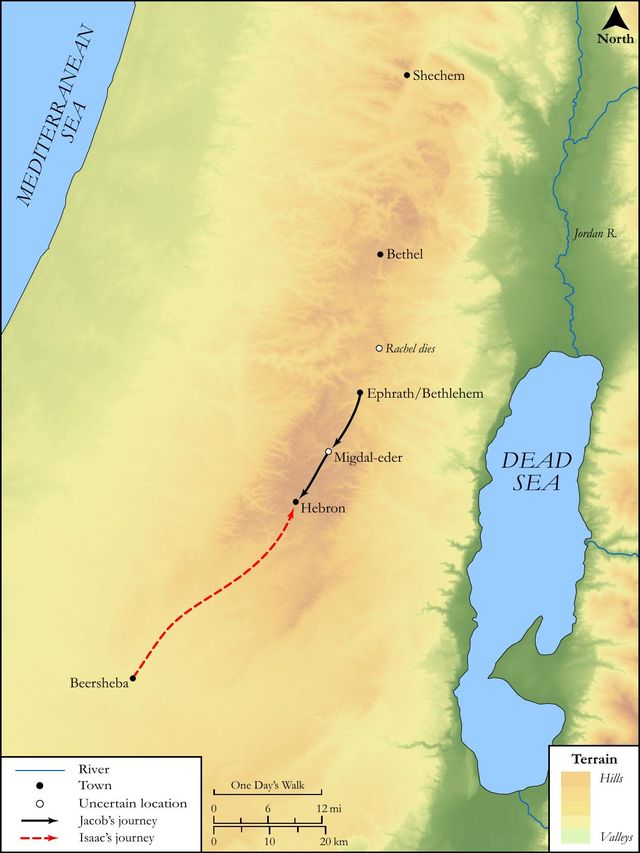
See on the biblical-era map


Study this verse
Public-domain commentary
Matthew Henry
From his Commentary on the Whole Bible. Henry comments on passages, not single verses — this entry covers Genesis 35:21–29.
Here is, 1. Jacob's removal, Gen 35:21. He also, as his fathers, sojourned in the land of promise as in a strange country, and was not long in a place. Immediately after the story of Rachel's death he is here called Israel (Gen 35:21, Gen 35:22), and not often so afterwards: the Jews say, "The historian does him this honour here because he bore that affliction with such admirable patience and submission to Providence." Note, Those are Israel's indeed, princes with God, that support the government of their own passions. He that has this rule over his own spirit is better than the mighty. Israel, a prince with God, yet dwells in tents; the city is reserved for him in the other world. 2. The sin of Reuben. A piece of abominable wickedness it was that he was guilty of (Gen 35:22), that very sin which the apostle says (Co1 5:1) is not so much as named among the Gentiles, that one should have his father's wife. It is said to have been when Israel dwelt in that land; as if he were then absent from his family, which might be the unhappy occasion of these disorders. Though perhaps Bilhah was the greater criminal, and it is probable was abandoned by Jacob for it, yet Reuben's crime was so provoking that, for it, he lost his birthright and blessing, Gen 49:4. The first-born is not always the best, nor the most promising. This was Reuben's sin, but it was Jacob's affliction; and what a sore affliction it was is intimated in a little compass, and Israel heard it. No more is said - that is enough; he heard it with the utmost grief and shame, horror and displeasure. Reuben thought to conceal it, that his father should never hear of it; but those that promise themselves secresy in sin are generally disappointed; a bird of the air carries the voice. 3. A complete list of the sons of Jacob, now that Benjamin the youngest was born. This is the first time we have the names of these heads of the twelve tribes together; afterwards we find them very often spoken of and enumerated, even to the end of the Bible, Rev 7:4; Rev 21:12. 4. The visit which Jacob made to his father Isaac at Hebron. We may suppose he had visited him before since his return, for he sorely longed after his father's house; but never, till now, brought his family to settle with him, or near him, Gen 35:27. Probably he did this now upon the death of Rebekah, by which Isaac was left solitary, and not disposed to marry again. 5. The age and death of Isaac are here recorded, though it appears, by computation, that he died not till many years after Joseph was sold into Egypt, and much about the time that he was preferred there. Isaac, a mild quiet man, lived the longest of all the patriarches, for he was 180 years old; Abraham was but 175. Isaac lived about forty years after he had made his will, Gen 27:2. We shall not die an hour the sooner, but abundantly the better, for our timely setting our heart and house in order. Particular notice is taken of the amicable agreement of Esau and Jacob, in solemnizing their father's funeral (Gen 35:29), to show how wonderfully God had changed Esau's mind since he vowed his brother's murder immediately after his father's death, Gen 27:41. Note, God has many ways of preventing bad men from doing the mischief they intended; he can either tie their hands or turn their hearts.
Continue studying Genesis 35:24 across the web’s major study libraries — every link below opens this exact verse, chapter, or book on the destination site.
Read & Compare
 BibleGatewayThis verse in more than 200 translations and 70 languages.
 Bible.comThe YouVersion reader — hundreds of translations, reading plans, and highlights.
 ESV.orgCrossway's official English Standard Version reader.
 NET BibleThe NET translation with 60,000+ translators' notes on every rendering decision.
 STEP BibleTyndale House's free study tool — original text, vocabulary, and scholarly resources.
 BibliaLogos Bible Software's free web reader.
 USCCBThe New American Bible (Revised Edition) with the U.S. bishops' study notes.
Commentaries
 BibleHub CommentariesDozens of classic commentaries on this verse, gathered on one page.
 StudyLightMore than 100 commentary sets — the largest collection on the web.
 BibleRefPlain-English commentary on what this verse means, verse by verse.
 Enduring WordDavid Guzik's free commentary on this chapter, widely used by Bible teachers.
 Bible Study ToolsVerse commentary alongside Greek and Hebrew study aids.
Original Language & Research
- BibleHub InterlinearThe verse word by word — original language, transliteration, and English.
- BibleHub LexiconEvery word's original-language definition and Strong's entry.
 Blue Letter BibleDeep-study tools — Strong's numbers, concordance, and word studies.
 SefariaThe Hebrew text with Rashi and centuries of Jewish commentary.
Sermons, Hymns & Audio


TrulyRandomVerse is not affiliated with these sites and doesn’t control their content. They’re linked because they’re genuinely useful.
Summary
Genesis 35:24 concisely identifies Joseph and Benjamin as the two sons born to Jacob through his beloved wife, Rachel. This brief genealogical entry is part of a larger record detailing the twelve sons who would become the patriarchs of the tribes of Israel, highlighting God's meticulous faithfulness in preserving and multiplying the covenant lineage as His divine plan for salvation unfolds.
Context
ShowHideLiterary Context
This verse is situated within Genesis 35, a pivotal chapter marking a significant turning point in Jacob's life and the narrative of the patriarchs. It immediately follows the account of Jacob's return to Bethel, where God reaffirms the covenant promises made to Abraham and Isaac, promising to make Jacob fruitful and to establish a nation and a company of nations from him, as well as kings, and to give the land of Canaan to his descendants (Genesis 35:9-12). The listing of Jacob's sons, beginning in Genesis 35:23, serves as a fulfillment of these promises, meticulously detailing the foundational members of the nascent nation of Israel. Critically, Genesis 35:24 follows the poignant and tragic account of Rachel's death during Benjamin's birth (Genesis 35:16-18), making the mention of her sons here a tender and significant detail within the broader family record.
Historical & Cultural Context
In the ancient Near East, lineage and genealogy were of paramount importance, serving not merely as historical records but as affirmations of identity, inheritance, and covenant standing. The patriarchal period, characterized by nomadic or semi-nomadic life, placed a high value on male offspring for the continuation of the family name, the preservation of property, and the fulfillment of divine promises related to progeny. The specific mention of sons by their mothers, as seen in the broader list of Genesis 35:23-26, reflects the social structure where a wife's status and her contribution to the family were often tied to the sons she bore. Rachel's unique status as Jacob's beloved wife, for whom he labored fourteen years, imbues the mention of her sons with particular emotional and narrative weight. The renaming of Benjamin by Jacob, from "Ben-oni" (son of my sorrow) to "Benjamin" (son of the right hand), also reflects the cultural practice of names carrying prophetic or aspirational significance.
Key Themes
ShowHideGenesis 35:24 contributes to several overarching themes in Genesis. Firstly, it underscores the theme of Covenant Fulfillment, as God's promise to multiply Jacob's descendants (Genesis 35:11) begins to visibly take shape through the enumeration of his twelve sons, who will form the tribes of Israel. Secondly, the verse highlights Divine Providence, demonstrating God's sovereign hand guiding the lineage despite human sorrow and struggle, as exemplified by Rachel's death during Benjamin's birth. Thirdly, it emphasizes the theme of Family and Lineage as the Foundation of Israel, meticulously tracing the origins of the nation through its patriarchal figures. Finally, the narrative surrounding Joseph and Benjamin, particularly Joseph's later story, introduces the theme of Sovereignty and Redemption, where God uses human suffering and betrayal for a greater redemptive purpose, ultimately preserving the covenant family and foreshadowing future salvation.
Exposition and Analysis
ShowHideGenesis 35:24, "The sons of Rachel; Joseph, and Benjamin:", is a concise yet profoundly significant statement within the genealogical record of Jacob's family. It serves to highlight two pivotal figures in the unfolding narrative of Israel.
Key Word Analysis
ShowHideFrom the root meaning "to build," this word signifies a male offspring, but also carries the broader connotation of one who builds or continues the family name and lineage. In this context, it emphasizes Joseph and Benjamin's role in constructing the future nation of Israel.
Meaning "let him add" or "adding," this name reflects Rachel's prayer for another son after Joseph's birth, as recorded in Genesis 30:24. Joseph's life indeed added immensely to the preservation and growth of Jacob's family, as he became a powerful ruler in Egypt and saved his family from famine.
Meaning "son of (the) right hand," this name was given by Jacob to his youngest son, contrasting with Rachel's dying name "Ben-oni" ("son of my sorrow"). Jacob's renaming signifies a hope for strength, favor, and blessing, indicating a turning point from grief to a future of divine favor for this son.
Verse Breakdown
ShowHide"The sons of Rachel;"
This clause immediately draws attention to Rachel, Jacob's most beloved wife, whose long struggle with barrenness and eventual joy in childbirth are central to the Genesis narrative. Her two sons, Joseph and Benjamin, hold a special place in Jacob's affection and in the biblical story, distinct from the sons born to Leah, Bilhah, and Zilpah. This highlights the emotional and spiritual significance of Rachel's progeny.
"Joseph, and Benjamin:"
This direct enumeration names the two individuals who would become immensely significant. Joseph, Rachel's firstborn, is the protagonist of a major portion of Genesis, his life a testament to God's sovereign plan to preserve His people. Benjamin, the youngest of all Jacob's sons, born tragically as Rachel died, represents both sorrow and the promise of future strength and favor, as indicated by Jacob's renaming of him. Their inclusion here marks them as foundational pillars of the twelve tribes, each destined to lead a significant branch of the future nation.
Literary Devices
ShowHideThe verse employs several literary devices. Genealogy is the primary device, serving to meticulously record the lineage through which God's covenant promises are fulfilled. The specific mention of "Rachel" highlights Emphasis or Highlighting, drawing particular attention to her sons due to her beloved status and the dramatic circumstances of Benjamin's birth. There is also an element of Foreshadowing, as the naming of Joseph and Benjamin, particularly Joseph, subtly hints at their future prominence and the critical roles they will play in the preservation of Jacob's family and the establishment of Israel. Furthermore, the implicit Contrast between Rachel's sorrowful naming of Ben-oni and Jacob's hopeful renaming of Benjamin underscores the theme of God's ability to bring blessing and strength out of profound loss.
Theological and Thematic Connections
ShowHideGenesis 35:24, though a simple genealogical entry, deeply connects to the overarching theological themes of God's unwavering covenant faithfulness, His meticulous providence, and the foundational role of family in His redemptive plan. The enumeration of Jacob's sons, particularly Joseph and Benjamin, underscores God's commitment to multiply Abraham's descendants into a great nation, ensuring the lineage through which His promises would be fulfilled. Even in the midst of sorrow and loss, such as Rachel's death, God's purpose for His chosen people remains steadfast, demonstrating His ability to weave human tragedy into His divine tapestry of salvation. This verse reminds us that every individual, every family, and every generation is part of God's grand design, contributing to the unfolding of His eternal purposes.
Reflection and Application
ShowHideGenesis 35:24, a seemingly simple record, invites us to reflect on the profound truth that God is intimately involved in the details of our lives, even the seemingly mundane or painful ones. Just as Joseph and Benjamin were integral to God's grand plan for Israel, so too are our individual lives, our families, and our unique circumstances woven into His sovereign design. This verse encourages us to trust in God's faithfulness, even when faced with sorrow or uncertainty, knowing that He can bring forth strength and purpose from our deepest pains, just as Jacob renamed "Ben-oni" to "Benjamin." It challenges us to see our own lineage, our relationships, and our place in the broader community of faith as part of God's ongoing story, reminding us that every life has significance in His eyes and contributes to His unfolding kingdom.
Questions for Reflection
ShowHideFAQ
ShowHideWhy are Joseph and Benjamin specifically highlighted as Rachel's sons, given that Jacob had other children?
ShowHideThis verse is part of a comprehensive genealogical summary in Genesis 35:23-26, which meticulously lists all twelve of Jacob's sons by their mothers. Joseph and Benjamin are specifically highlighted as Rachel's sons because Rachel was Jacob's most beloved wife, and her long struggle with barrenness made the birth of her two sons particularly significant and miraculous. Furthermore, Joseph, her firstborn, played an exceptionally pivotal role in the preservation of the nascent nation of Israel, becoming a type of Christ in his suffering, exaltation, and saving work. Benjamin, her last-born, was born in the land of Canaan and at the cost of Rachel's life, adding a layer of poignant significance to his entry into the world. Their unique narrative importance within the book of Genesis warrants their specific mention.
Christ-Centered Fulfillment
ShowHideThe enumeration of Jacob's sons, particularly Joseph and Benjamin, forms the essential genealogical backbone for the nation of Israel, the very people through whom God's redemptive plan would unfold, ultimately culminating in the advent of the Messiah. Joseph, Rachel's firstborn, stands out as a profound type of Christ. Like Jesus, Joseph was deeply loved by his father (Genesis 37:3), yet rejected and betrayed by his own brothers (Genesis 37:28). He suffered unjustly, was imprisoned, but was ultimately exalted to a position of immense power and authority (Genesis 41:40-41). From this position, Joseph, through his wisdom and God-given foresight, saved his family and many nations from death by famine, prefiguring Christ's suffering, His exaltation to the right hand of God (Philippians 2:9-11), and His ultimate role as the Savior of humanity, providing spiritual sustenance and eternal life (John 6:35). The preservation of this specific lineage, despite trials and tragedies like Rachel's death and Joseph's suffering, demonstrates God's unwavering commitment to His covenant promises, ensuring the unbroken line from which the Christ, the true "Son of the Right Hand" and the ultimate "adder" of blessing, would ultimately come to redeem His people (Matthew 1:1-17).