


Genesis 38:30
- וְאַחַרve·'a·Charand afterH310Conj-w ¦ Adj-msAdjective Numerical Singular Masculine Absoluteוְandאַחַרafter
- יָצָאya·Tza'he came outH3318V-Qal-Perf-3msVerb Qal Perfect 3rd Singular Masculine
- אָחִיו'a·Chivhis brotherH251N-msc ¦ 3msNoun Singular Masculine Constructאָחִיbrotherוhis
- אֲשֶׁר'a·SherwhomH834RelParticle Relative
- עַל'al[was] onH5921PrepPreposition
- יָדוֹya·Dohis handH3027N-csc ¦ 3msNoun Singular common gender Constructיָדhandוֹhis
- הַשָּׁנִיha·sha·Nithe scarlet threadH8144Art ¦ N-msNoun Singular Masculine Absoluteהַtheשָּׁנִיscarlet thread
- וַיִּקְרָאvai·yik·Ra'and someone calledH7121Conj-w ¦ V-Qal-ConsecImperf-3msVerb Qal Consecutive Imperfect 3rd Singular Masculineוַandיִּקְרָאsomeone called
- שְׁמוֹshe·Mohis nameH8034N-msc ¦ 3msNoun Singular Masculine Constructשְׁמnameוֹhis
- זָרַחZa·rachZerahH2226N-proper-mNoun Proper Masculine
English is a literal word-by-word gloss of the Hebrew, not the KJV's wording. Why?
This is the original text the KJV's translators worked from — each Hebrew word with its own literal English meaning in this verse, prepared by scholars at Tyndale House, Cambridge. The KJV translates whole sentences, not word by word, so its wording differs: one Hebrew word can become several English words, and the KJV may choose “the LORD” where the gloss reads “Yahweh”. Both are faithful — they answer different questions. For the KJV's own rendering, switch to the KJV text.
Details
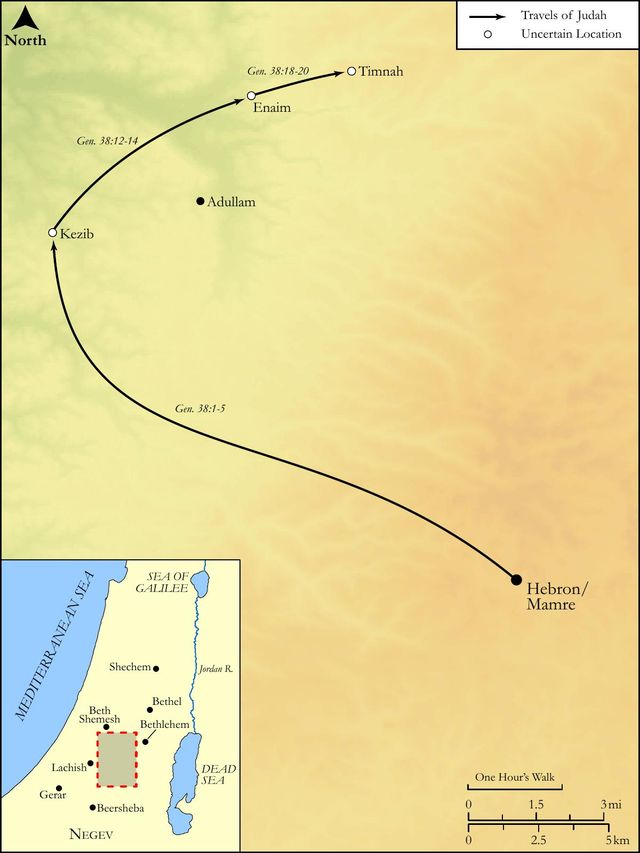
See on the biblical-era map


Study this verse
Public-domain commentary
Matthew Henry
From his Commentary on the Whole Bible. Henry comments on passages, not single verses — this entry covers Genesis 38:24–30. His two-level outline is real structure in the source text, so it is rendered as structure.
Here is, I. Judah's rigour against Tamar, when he heard she was an adulteress. She was, in the eye of the law, Shelah's wife, and therefore her being with child by another was looked upon as an injury and reproach to Judah's family: Bring her forth therefore, says Judah, the master of the family, and let her be burnt; not burnt to death, but burnt in the cheek or forehead, stigmatized for a harlot. This seems probable, Gen 38:24. Note, it is a common thing for men to be severe against those very sins in others in which yet they allow themselves; and so, in judging others, they condemn themselves, Rom 2:1; Rom 14:22. If he designed that she should be burnt to death, perhaps, under pretence of zeal against the sin, he was contriving how to get rid of his daughter-in-law, being loath to marry Shelah to her. Note, It is a common thing, but a very bad thing, to cover malice against men's persons with a show of zeal against their vices.
II.Judah's shame, when it was made to appear that he was the adulterer.
She produced the ring and the bracelets in court, which justified the fathering of the child upon Judah, Gen 38:25, Gen 38:26. Note, The wickedness that has been most secretly committed, and most industriously concealed, yet sometimes is strangely brought to light, to the shame and confusion of those who have said, No eye sees. A bird of the air may carry the voice; however, there is a destroying day coming, when all will be laid open. Some of the Jewish writers observe that as Judah had said to his father, See, is this thy son's coat? (Gen 37:32) so it was now said to him, "See, are these thy signet and bracelets?" Judah, being convicted by his own conscience,
1.Confesses his sin: She has been more righteous than I. He owns that a perpetual mark of infamy should be fastened rather upon him, who had been so much accessory to it. Note, Those offenders ought to be treated with the greatest tenderness to whom we have any way given occasion of offending. If servants purloin, and their masters, by withholding from them what is due, tempt them to it, they ought to forgive them.
2.He never returned to it again: He knew her again no more. Note, Those do not truly repent of their sins that do not forsake them.
III.The building up of Judah's family hereby, notwithstanding, in the birth of Pharez and Zarah, from whom descended the most considerable families of the illustrious tribe of Judah. It should seem, the birth was hard to the mother, by which she was corrected for her sin. The children also, like Jacob and Esau, struggled for the birthright, and Pharez obtained it, who is ever named first, and from him Christ descended. He had his name from his breaking forth before his brother: This breach be upon thee, which is applicable to those that sow discord, and create distance, between brethren. The Jews, as Zarah, bade fair for the birthright, and were marked with a scarlet thread, as those that came out first; but the Gentiles, like Pharez, as a son of violence, got the start of them, by that violence which the kingdom of heaven suffers, and attained to the righteousness of which the Jews came short. Yet, when the fulness of time is come, all Israel shall be saved. Both these sons are named in the genealogy of our Saviour (Mat 1:3), to perpetuate the story, as an instance of the humiliation of our Lord Jesus. Some observe that the four eldest sons of Jacob fell under very foul guilt, Reuben and Judah under the guilt of incest, Simeon and Levi under that of murder; yet they were patriarchs, and from Levi descended the priests, from Judah the kings and Messiah. Thus they became examples of repentance, and monuments of pardoning mercy.
Historical interpretation
Historical reception
1 surviving comment on this verse from the historical church.
(Verse 30.) After this, his brother came out, who had the scarlet thread in his hand, and his name was called Zara. This name means 'east'. Therefore, either because he appeared first, or because many righteous people were born from him, as it is written in the book of Chronicles (1 Chronicles 2 and following), he was called Zara, that is, 'east'.
Continue studying Genesis 38:30 across the web’s major study libraries — every link below opens this exact verse, chapter, or book on the destination site.
Read & Compare
 BibleGatewayThis verse in more than 200 translations and 70 languages.
 Bible.comThe YouVersion reader — hundreds of translations, reading plans, and highlights.
 ESV.orgCrossway's official English Standard Version reader.
 NET BibleThe NET translation with 60,000+ translators' notes on every rendering decision.
 STEP BibleTyndale House's free study tool — original text, vocabulary, and scholarly resources.
 BibliaLogos Bible Software's free web reader.
 USCCBThe New American Bible (Revised Edition) with the U.S. bishops' study notes.
Commentaries
 BibleHub CommentariesDozens of classic commentaries on this verse, gathered on one page.
 StudyLightMore than 100 commentary sets — the largest collection on the web.
 BibleRefPlain-English commentary on what this verse means, verse by verse.
 Enduring WordDavid Guzik's free commentary on this chapter, widely used by Bible teachers.
 Bible Study ToolsVerse commentary alongside Greek and Hebrew study aids.
Original Language & Research
- BibleHub InterlinearThe verse word by word — original language, transliteration, and English.
- BibleHub LexiconEvery word's original-language definition and Strong's entry.
 Blue Letter BibleDeep-study tools — Strong's numbers, concordance, and word studies.
 SefariaThe Hebrew text with Rashi and centuries of Jewish commentary.
Sermons, Hymns & Audio


TrulyRandomVerse is not affiliated with these sites and doesn’t control their content. They’re linked because they’re genuinely useful.
Summary
Genesis 38:30 concludes the dramatic birth narrative of Judah's twin sons, Perez and Zarah, recording the emergence of Zarah, who was initially marked as the firstborn but ultimately born second. This verse underscores God's sovereign control over human events and lineage, often defying human expectations and interventions, thereby setting the stage for the continuation of the messianic line through the unexpected son, Perez.
Context
ShowHideLiterary Context
Genesis chapter 38 serves as a pivotal narrative interlude, strategically placed within the broader Joseph saga. This chapter abruptly shifts the focus from Joseph's enslavement and ascent in Egypt to the complex and morally ambiguous life of his brother Judah. The preceding verses, Genesis 38:27-29, detail the intense and unusual birth of Tamar's twins. The midwife, observing Zarah's hand emerge first, ties a scarlet thread around it, signifying him as the firstborn. However, in a surprising turn, his brother Perez "breaks through" first, establishing a divinely ordained reversal of birth order. Verse 30 formally records Zarah's subsequent birth and names him, bringing this dramatic scene to its conclusion and solidifying the unexpected lineage.
Historical & Cultural Context
In ancient Israelite society, the status of the firstborn son (primogeniture) was of immense importance, carrying significant rights, blessings, and a double portion of the inheritance. The midwife's action of marking Zarah's hand with a scarlet thread was a practical and culturally understood method to identify the firstborn in a twin birth, ensuring proper lineage and inheritance claims. The events of this chapter, including Judah's moral failings and Tamar's desperate, unconventional actions, highlight the societal pressures and customs surrounding family lineage, levirate marriage, and the preservation of the family name. Despite these human complexities and imperfections, the narrative demonstrates God's consistent work within and through human culture to achieve His purposes.
Key Themes
ShowHideGenesis 38:30 contributes significantly to several overarching themes within the book of Genesis and the broader biblical narrative. Foremost among these is the theme of Divine Sovereignty, where God's plan unfolds irrespective of, and often in opposition to, human expectations or interventions. The reversal of birth order, where the one marked as first is born second, echoes other instances in Genesis where God chooses the younger over the elder, such as Jacob chosen over Esau and Ephraim chosen over Manasseh. This narrative also emphasizes the Preservation of the Covenant Lineage, demonstrating God's faithfulness to His promises even when human agents are deeply flawed or circumstances are highly unconventional. Finally, the Symbolism of the Scarlet Thread subtly introduces a motif that will reappear in later biblical narratives, hinting at themes of identification, protection, and redemption.
Exposition and Analysis
ShowHideGenesis 38:30 concludes the extraordinary birth of Judah's twin sons, stating, "And afterward came out his brother, that had the scarlet thread upon his hand: and his name was called Zarah." This verse, seemingly a simple record of birth, carries profound implications for understanding God's sovereign hand in human history and the unfolding of His redemptive plan.
Key Word Analysis
ShowHideThis word signifies a sequence in time, meaning "after," "behind," or "subsequently." In this context, it emphasizes that Zarah's birth occurred after Perez's, despite Zarah's hand having emerged first. This temporal marker highlights the unexpected reversal of birth order, underscoring the divine intervention that defied human expectation.
A primitive root meaning "to go out" or "to come forth." Here, it directly describes the act of birth. The use of this verb for Zarah, following the description of Perez "breaking forth" (פֶּרֶץ - peretz) in the previous verse, accentuates the distinct manner of their births and the dramatic sequence.
This proper name means "brightness," "dawning," or "rising." The ironic nature of his name, implying a "first light" or "rising sun," stands in stark contrast to his actual birth order as the second twin. This naming further emphasizes the divine subversion of what appeared to be the natural course of events.
Verse Breakdown
ShowHide"And afterward came out his brother,"
This clause immediately follows the description of Perez's birth in Genesis 38:29. The term "afterward" (H310, ʼachar') is crucial, as it firmly establishes Zarah's position as the second-born, despite his initial appearance. The phrase "his brother" refers to Perez, confirming their fraternal relationship and the completion of the twin birth.
"that had the scarlet thread upon his hand:"
This detail directly references the midwife's action in Genesis 38:28. The scarlet thread (H8144, shânîy) was tied around Zarah's hand as a marker, a clear identifier of the presumed firstborn. Its presence on Zarah's hand in this verse serves as a powerful reminder of the dramatic reversal that just occurred, where the marked "first" became "second."
"and his name was called Zarah."
This final clause formally names the second twin. The name "Zarah" (H2226, Zerach') means "brightness" or "dawning." This name, ironically, points to a "first" or "beginning," yet he is the second to emerge. The naming solidifies his identity within the narrative, even as his initial claim to primogeniture is overturned.
Literary Devices
ShowHideThe narrative of Genesis 38:30, in conjunction with the preceding verses, employs several significant literary devices. Irony is prominent, as Zarah, whose name means "brightness" or "dawning" and who was marked as the firstborn, ultimately emerges second. This reversal highlights God's sovereign choice over human expectation and intervention. The Symbolism of the scarlet thread is also profound; initially a marker of birth order, it later emerges in biblical narrative as a powerful symbol of salvation and covenant, most notably with Rahab in Jericho (Joshua 2:18). This creates a subtle Foreshadowing of God's redemptive work, often accomplished through unexpected means and individuals. The entire episode serves as a Type or pattern, illustrating God's consistent method of choosing the unexpected or the "second" to fulfill His divine purposes, a theme seen repeatedly in Scripture.
Theological and Thematic Connections
ShowHideGenesis 38:30 profoundly illustrates God's absolute sovereignty, demonstrating His capacity to orchestrate events and lineage in ways that defy human logic, expectation, and even direct intervention. The narrative underscores that God's purposes are not constrained by human customs like primogeniture or by human attempts to control outcomes. Instead, He consistently chooses the unexpected, the "breacher" (Perez), to fulfill His divine plan, ensuring the preservation of the covenant lineage despite moral failures and complex family dynamics. This highlights God's grace working through imperfect people and unconventional circumstances to achieve His perfect will.
Reflection and Application
ShowHideGenesis 38:30 offers a powerful spiritual lesson: God's plans are often realized through unexpected paths and unconventional means, frequently overturning our human expectations or logical predictions. This narrative encourages us to cultivate a deep trust in God's sovereign wisdom, even when circumstances appear chaotic, contradictory, or contrary to what we deem "normal" or "first-choice." It reminds us that setbacks, reversals, or being overlooked in human systems do not negate God's ability to use us or our situations for His greater purposes. Instead, we are called to embrace humility, recognizing that God's ways are higher than our ways, and His redemptive plan will always prevail, often through the very people or events we might least expect. This should inspire patience, faith, and a willingness to surrender our own agendas to His perfect, though sometimes mysterious, will.
Questions for Reflection
ShowHideFAQ
ShowHideWhy was Zarah initially marked with a scarlet thread?
ShowHideZarah was marked with a scarlet thread by the midwife because his hand emerged first from the womb. In ancient Israelite culture, the firstborn held significant rights and privileges, so the midwife used the thread as a clear identifier to mark him as the presumed firstborn, ensuring his claim to primogeniture.
What is the significance of Perez being born first despite Zarah being marked?
ShowHideThe reversal of birth order, with Perez "breaking through" first, is profoundly significant. It powerfully demonstrates God's sovereignty over human expectations, predictions, and even interventions. Despite the midwife's attempt to identify the firstborn, God orchestrated Perez's unexpected emergence. This act highlights that God's chosen path often defies conventional logic and human attempts to control outcomes. Perez's unexpected birth as the actual firstborn was crucial, as he became a direct ancestor of King David and, ultimately, of Jesus Christ, as recorded in Matthew 1:3.
Does the scarlet thread have any other symbolic meaning in the Bible?
ShowHideYes, while in Genesis 38:30 the scarlet thread primarily serves as a marker of birth order, a scarlet cord later appears as a powerful symbol of salvation and covenant in biblical history. Most notably, Rahab, the prostitute of Jericho, used a scarlet cord to mark her house, signifying her deliverance from destruction by the invading Israelites, as recounted in Joshua 2:18. This later usage suggests a deeper, redemptive resonance for the color scarlet, often associated with blood and atonement, foreshadowing themes of divine protection and salvation.
Christ-Centered Fulfillment
ShowHideGenesis 38:30, by establishing Perez as the true firstborn of Judah's twins despite the initial marking of Zarah, plays a crucial role in tracing the messianic lineage directly to Christ. Perez, whose name means "breach" or "breakthrough," becomes a pivotal ancestor of King David and, consequently, is listed in the genealogies of Jesus Christ in Matthew 1:3 and Luke 3:33. This narrative powerfully foreshadows the coming of Jesus, the ultimate "breacher" who broke through the barriers of sin and death to bring salvation to humanity. Just as God sovereignly orchestrated Perez's unexpected emergence to preserve the covenant line through unconventional means, He orchestrated the miraculous and unexpected birth of Jesus, who, though appearing in humility, is the true Firstborn over all creation (Colossians 1:15) and the "firstborn among many brethren" (Romans 8:29). The scarlet thread, though initially a marker of birth order, subtly points to the redemptive blood of Christ, which provides the ultimate mark of salvation and covenant for all who believe (Hebrews 9:12).