


Joshua 2:18
Bible text: King James Version (1769 Blayney text) · Public domain
Bible text: King James Version with Strong's numbers · Public domain
Bible text: Berean Standard Bible · Public domain
Bible text: American Standard Version (1901) · Public domain
Bible text: World English Bible, Messianic edition · Public domain
Bible text: Geneva Bible (1599) · Public domain
Bible text: Young's Literal Translation · Public domain
- הִנֵּהhi·Nehhere!H2009PrtParticle Interjection
- אֲנַחְנוּ'a·Nach·nuweH587Pro-1cpPronoun Personal 1st Plural common gender
- בָאִיםva·'Im[are] about to comeH935V-Qal-Prtcpl-mpVerb Qal Participle Plural Masculine Absolute
- בָּאָרֶץba·'A·retzin the landH776Prep-b ¦ N-fsNoun Singular Feminine Absoluteבָּin theאָרֶץland
- אֶת'et<obj.>H853DirObjMParticle Object Indicator
- תִּקְוַתtik·Vat[the] cord ofH8615N-fscNoun Singular Feminine Construct
- חוּטchut[the] thread ofH2339N-mscNoun Singular Masculine Construct
- הַשָּׁנִיha·sha·Nithe scarletH8144Art ¦ N-msNoun Singular Masculine Absoluteהַtheשָּׁנִיscarlet
- הַזֶּהha·Zeh<the> thisH2088Art ¦ PrtParticle Demonstrativeהַ<the>זֶּהthis
- תִּקְשְׁרִיtik·she·Riyou will bindH7194V-Qal-Imperf-2fsVerb Qal Imperfect 2nd Singular Feminine
- בַּחַלּוֹןba·cha·lOnin the windowH2474Prep-b ¦ N-msNoun Singular Masculine Absoluteבַּin theחַלּוֹןwindow
- אֲשֶׁר'a·SherwhichH834RelParticle Relative
- הוֹרַדְתֵּנוּho·rad·Te·nuyou let down usH3381V-Hiphil-Perf-2fs ¦ 1cpVerb Hiphil Perfect 2nd Singular Feminineהוֹרַדְתֵּyou let downנוּus
- בוֹvoin <the> itPrep-b ¦ 3msSuffix Personal 3rd Singular Masculineבin <the>וֹit
- וְאֶתve·'Etand <obj.>H853Conj-w ¦ DirObjMParticle Object Indicatorוְandאֶת<obj.>
- אָבִיךְ'a·Vikhyour fatherH1N-msc ¦ 2fsNoun Singular Masculine Constructאָבִיfatherךְyour
- וְאֶתve·'Etand <obj.>H853Conj-w ¦ DirObjMParticle Object Indicatorוְandאֶת<obj.>
- אִמֵּךְ'i·Mekhyour motherH517N-fsc ¦ 2fsNoun Singular Feminine Constructאִמֵּmotherךְyour
- וְאֶתve·'Etand <obj.>H853Conj-w ¦ DirObjMParticle Object Indicatorוְandאֶת<obj.>
- אַחַיִךְ'a·Cha·yikhyour brothersH251N-mpc ¦ 2fsNoun Plural Masculine Constructאַחַיִbrothersךְyour
- וְאֵתve·'Etand <obj.>H853Conj-w ¦ DirObjMParticle Object Indicatorוְandאֵת<obj.>
- כָּלkolallH3605N-mscNoun Singular Masculine Construct
- בֵּיתbeit[the] household ofH1004N-mscNoun Singular Masculine Construct
- אָבִיךְ'a·Vikhyour fatherH1N-msc ¦ 2fsNoun Singular Masculine Constructאָבִיfatherךְyour
- תַּאַסְפִיta·'as·Fiyou will gatherH622V-Qal-Imperf-2fsVerb Qal Imperfect 2nd Singular Feminine
- אֵלַיִךְ'e·La·yikhto youH413Prep ¦ 2fsPreposition Definiteאֵלַיִtoךְyou
- הַבָּיְתָהha·Ba·ye·tahthe house towardsH1004Art ¦ N-ms ¦ SfxNoun Singular Masculine Absoluteהַtheבָּיְתָhouseהtowards
English is a literal word-by-word gloss of the Hebrew, not the KJV's wording. Why?
This is the original text the KJV's translators worked from — each Hebrew word with its own literal English meaning in this verse, prepared by scholars at Tyndale House, Cambridge. The KJV translates whole sentences, not word by word, so its wording differs: one Hebrew word can become several English words, and the KJV may choose “the LORD” where the gloss reads “Yahweh”. Both are faithful — they answer different questions. For the KJV's own rendering, switch to the KJV text.
Details
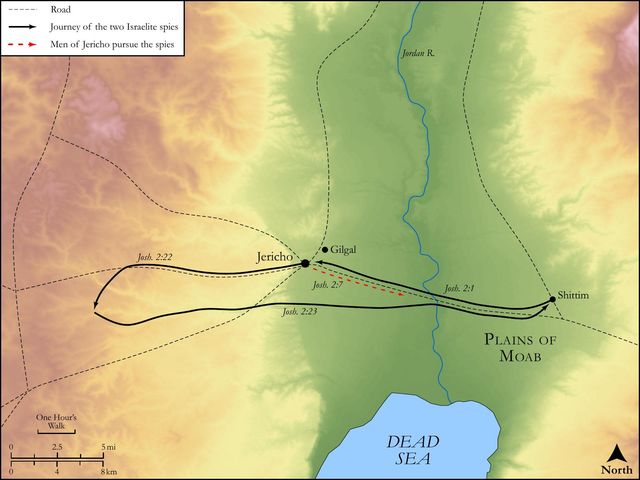
See on the biblical-era map
Study this verse
Public-domain commentary
Matthew Henry
From his Commentary on the Whole Bible. Henry comments on passages, not single verses — this entry covers Joshua 2:8–21. His two-level outline is real structure in the source text, so it is rendered as structure.
The matter is here settled between Rahab and the spies respecting the service she was now to do for them, and the favour they were afterwards to show to her. She secures them on condition that they should secure her.
I.She gives them, and by them sends to Joshua and Israel, all the encouragement that could be desired to make their intended descent upon Canaan. this was what they came for, and it was worth coming for. Having got clear of the officers, she comes up to them to the roof of the house where they lay hid, finds them perhaps somewhat dismayed at the peril they apprehended themselves in from the officers, and scarcely recovered from the fright, but has that to say to them which will give them abundant satisfaction.
1.She lets them know that the report of the great things God had done for them had come to Jericho (v. 10), not only that they had an account of their late victories obtained over the Amorites in the neighbouring country, on the other side of the river, but that their miraculous deliverance out of Egypt, and passage through the Red Sea, a great way off, and forty years ago, were remembered and talked of afresh in Jericho, to the amazement of every body. Thus this Joshua and his fellows were men wondered at, Zac 3:8. See how God makes his wonderful works to be remembered (Psa 111:4), so that men shall speak of the might of his terrible acts, Psa 145:6.
2.She tells them what impressions the tidings of these things had made upon the Canaanites: Your terror has fallen upon us (Jos 2:9); our hearts did melt, Jos 2:11. If she kept a public house, this would give her an opportunity of understanding the sense of various companies and of travellers from other parts of the country, so that they could not know this any way better than by her information; and it would be of great use to Joshua and Israel to know it; it would put courage into the most cowardly Israelite to hear how their enemies were dispirited, and it was easy to conclude that those who now fainted before them would infallibly fall before them, especially because it was the accomplishment of a promise God had made them, that he would lay the fear and dread of them upon all this land (Deu 11:25), and so it would be an earnest of the accomplishment of all the other promises God had made to them. Let not the stout man glory in his courage, any more than the strong man in his strength; for God can weaken both mind and body. Let not God's Israel be afraid of their most powerful enemies; for their God can, when he pleases, make their most powerful enemies afraid of them. Let none think to harden their hearts against God and prosper; for he that made man's soul can at any time make the sword of his terrors approach to it.
3.She hereupon makes profession of her faith in God and his promise; and perhaps there was not found so great faith (all things considered), no, not in Israel, as in this woman of Canaan. (1.) who believes God's power and dominion over all the world (v. 11): "Jehovah your God, whom you worship and call upon, is so far above all gods that he is the only true God; for he is God in heaven above and in earth beneath, and is served by all the hosts of both." A vast distance there is between heaven and earth, yet both are equally under the inspection and government of the great Jehovah. Heaven is not above his power, nor is earth below his cognizance. (2.) She believes his promise to his people Israel (v. 9): I know that the Lord hath given you the land. The king of Jericho had heard as much as she had of the great things God had done for Israel, yet he cannot infer thence that the Lord had given them this land, but resolves to hold it out against them to the last extremity; for the most powerful means of conviction will not of themselves attain the end without divine grace, and by that grace Rahab the harlot, who had only heard of the wonders God had wrought, speaks with more assurance of the truth of the promise made to the fathers than all the elders of Israel had done who were eye-witnesses of those wonders, many of whom perished through unbelief of this promise. Blessed are those that have not seen, and yet have believed; so Rahab did. O woman, great is thy faith!
II.She engaged them to take her and her relations under their protection, that they might not perish in the destruction of Jericho, v.
12, 13. Now, 1. It was an evidence of the sincerity and strength of her faith concerning the approaching revolution in her country that she was so solicitous to make an interest for herself with the Israelites, and courted their kindness. She foresaw the conquest of her country, and in the belief of that bespoke in time the favour of the conquerors. Thus Noah, being moved with fear, prepared an ark to the saving of his house, and the condemning of the world, Heb 11:7. Those who truly believe the divine revelation concerning the ruin of sinners, and the grant of the heavenly land to God's Israel, will give diligence to flee from the wrath to come, and to lay hold of eternal life, by joining themselves to God and to his people. 2. The provision she made for the safety of her relations, as well as for her own, is a laudable instance of natural affection, and an intimation to us in like manner to do all we can for the salvation of the souls of those that are dear to us, and, with ourselves, to bring them, if possible, into the bond of the covenant. No mention is made of her husband and children, but only her parents, and brothers, and sisters, for whom, though she was herself a housekeeper, she retained a due concern. 3. Her request that they would swear unto her by Jehovah is an instance of her acquaintance with the only true God, and her faith in him and devotion towards him, one act of which is religiously to swear by his name. 4. Her petition is very just and reasonable, that, since she had protected them, they should protect her, and since her kindness to them extended to their people, for whom they were now negotiating, their kindness to her should take in all hers. It was the least they could do for one that had saved their lives with the hazard of her own. Note, Those that show mercy may expect to find mercy. Observe, She does not demand any preferment by way of reward for her kindness to them, though they lay so much at her mercy that she might have made her own terms, but only indents for her Life, which in a general destruction would be a singular favour. Thus God promised Ebed-Melech, in recompence for his kindness to Jeremiah, that in the worst of times he should have his life for a prey, Jer 39:18. Yet this Rahab was afterwards advanced to be a princess in Israel, the wife of Salmon, and one of the ancestors of Christ, Mat 1:5. Those that faithfully serve Christ and suffer for him he will not only protect, but prefer, and will do for them more than they are able to ask or think.
III.They solemnly engaged for her preservation in the common destruction (Jos 2:14):
"Our life for yours. We will take as much care of your lives as of our own, and would as soon hurt ourselves as any of you." Nay, they imprecate God's judgments on themselves if they should violate their promise to her. She had pawned her life for theirs, and now they in requital pawn their lives for hers, and (as public persons) with them they pawn the public faith and the credit of their nation, for they plainly interest all Israel in the engagement in those words, When the Lord has given us the land, meaning not themselves only, but the people whose agents they were. No doubt they knew themselves sufficiently authorized to treat with Rahab concerning this matter, and were confident that Joshua would ratify what they did, else they had not dealt honestly; the general law that they should make no covenant with the Canaanites (Deu 7:2) did not forbid them to take under their protection a particular person, that had heartily come into their interests and had done them real kindnesses. The law of gratitude is one of the laws of nature. Now observe here, 1. The promises they made her. In general, "We will deal kindly and truly with thee, v. 14. We will not only be kind in promising now, but true in performing what we promise; and not only true in performing just what we promise, but kind in out-doing thy demands and expectations." The goodness of God is often expressed by his kindness and truth (Psa 117:2), and in both these we must be followers of him. In particular, "If a hand be upon any in the house with thee, his blood shall be on our head," v. 19. If hurt come through our carelessness to those whom we are obliged to protect, we thereby contract guilt, and blood will be found a heavy load. 2. The provisos and limitations of their promises. Though they were in haste, and it may be in some confusion, yet we find them very cautious in settling this agreement and the terms of it, not to bind themselves to more than was fit for them to perform. Note, Covenants must be made with care, and we must swear in judgment, lest we find ourselves perplexed and entangled when it is too late after vows to make enquiry. Those that will be conscientious in keeping their promises will be cautious in making them, and perhaps may insert conditions which others may think frivolous. Their promise is here accompanied with three provisos, and they were necessary ones. They will protect Rahab, and all her relations always, provided, (1.) That she tie the scarlet cord with which she was now about to let them down in the window of her house, v. 18. This was to be a mark upon the house, which the spies would take care to give notice of to the camp of Israel, that no soldier, how hot and eager soever he was in military executions, might offer any violence to the house that was thus distinguished. This was like the blood sprinkled upon the door-post, which secured the first-born from the destroying angel, and, being of the same colour, some allude to this also to represent the safety of believers under the protection of the blood of Christ sprinkled on the conscience. The same cord that she made use of for the preservation of these Israelites was to be made use of for her preservation. What we serve and honour God with we may expect he will bless and make comfortable to us. (2.) That she should have all those whose safety she had desired in the house with her and keep them there, and that, at the time of taking the town, none of them should dare to stir out of doors, v. 18, 19. This was a necessary proviso, for Rahab's kindred could not be distinguished any other way than by being in her distinguished house; should they mingle with their neighbours, there was no remedy, but the sword would devour one as well as another. It was a reasonable proviso that, since they were saved purely for Rahab's sake, her house should have the honour of being their castle, and that, if they would not perish with those that believed not, they should thus far believe the certainty and severity of the ruin coming upon their city as to retire into a place made safe by promise, as Noah into the ark and Lot into Zoar, and should save themselves from this untoward generation, by separating from them. It was likewise a significant proviso, intimating to us that those who are added to the church that they may be saved must keep close to the society of the faithful, and, having escaped the corruption that is in the world through lust, must take heed of being again entangled therein. (3.) That she should keep counsel (v. 14, 20): If thou utter this our business, that is, "If thou betray us when we are gone, or if thou make this agreement public, so as that others tie scarlet lines in their windows and so confound us, then we will be clear of thy oath." Those are unworthy of the secret of the Lord that know now how to keep it to themselves when there is occasion.
IV.She then took effectual care to secure her new friends, and sent them out another way, Jam 2:25.
Having fully understood the bargain they made with her, and consented to it (Jos 2:21), she then let them down by a cord over the city wall (Jos 2:15), the situation of her house befriending them herein: thus Paul made his escape out of Damascus, Co2 11:33. She also directed them which way to go for their own safety, being better acquainted with the country than they were, Jos 2:16. she directs them to leave the high road, and abscond in the mountains till the pursuers returned, for till then they could not safely venture over Jordan. those that are in the way of God and their duty may expect that Providence will protect them, but this will not excuse them from taking all prudent methods for their own safety. God will keep us, but then we must not wilfully expose ourselves. Providence must be trusted, but not tempted. Calvin thinks that their charge to Rahab to keep this matter secret, and not to utter it, was intended for her safety, lest she, boasting of her security from the sword of Israel, should, before they came to protect her, fall into the hands of the king of Jericho and be put to death for treason: thus do they prudently advise her for her safety, as she advised them for theirs. And it is good advice, which we should at any time be thankful for, to take heed to ourselves.
Historical interpretation
Two Centuries of Reception
3 surviving comments on this verse. Each one is dated, so this reads as a timeline rather than a list.
Select a marker to jump to its quote. Markers stagger vertically where authors wrote within a few decades of each other.
On account of her faith and hospitality, Rahab the harlot was saved. For when spies were sent by Joshua, the son of Nun, to Jericho, the king of the country ascertained that they had come to spy out their land, and sent men to seize them, in order that, when taken, they might be put to death. But the hospitable Rahab receiving them, concealed them on the roof of her house under some stalks of flax. And when the men sent by the king arrived and said, "There came men unto you who are to spy out our land; bring them forth, for so the king commands," she answered them, "The two men whom you seek came unto me, but quickly departed again and are gone," thus not discovering the spies to them. Then she said to the men, "I know assuredly that the Lord your God has given you this city, for the fear and dread of you have fallen on its inhabitants. When therefore you shall have taken it, keep ye me and the house of my father in safety." And they said to her, "It shall be as you have spoken to us. As soon, therefore, as you know that we are at hand, you shall gather all your family under your roof, and they shall be preserved, but all that are found outside of your dwelling shall perish." Moreover, they gave her a sign to this effect, that she should hang forth from her house a scarlet thread. And thus they made it manifest that redemption should flow through the blood of the Lord to all them that believe and hope in God. You see, beloved, that there was not only faith, but prophecy, in this woman.
Also this commandment is given to the person who was once a prostitute: “All,” it says, “who will be found in your house will be saved. But concerning those who go out from the house, we ourselves are free of them by your oath.” Therefore, if anyone wants to be saved, let him come into the house of this one who was once a prostitute. Even if anyone from that people wants to be saved, let him come in order to be able to attain salvation. Let him come to this house in which the blood of Christ is the sign of redemption. For among those who said, “His blood be upon us and upon our children,” the blood of Christ is for condemnation. For Jesus had been appointed “for the ruin and the resurrection of many.” Therefore, for those refuting his sign, his blood effects punishment; for those who believe, salvation.Let no one persuade himself, let no one deceive himself. Outside this house, that is, outside the church, no one is saved. If anyone goes outside, he is responsible for his own death. This is the significance of the blood, for this is also the purification that is manifest through the blood.
For the faith of the sacred Scripture sets forth that the Church is not without, nor can be separated nor divided against itself, but maintains the unity of an inseparable and undivided house; since it is written of the sacrament of the passover, and of the lamb, which Lamb designated Christ: "In one house shall it be eaten: ye shall not carry forth the flesh abroad out of the house." Which also we see expressed concerning Rahab, who herself also bore a type of the Church, who received the command which said, "Thou shalt bring thy father, and thy mother, and thy brethren, and all thy father's household unto thee into thine house; and whosoever shall go out of the doors of thine house into the street, his blood shall be upon him." In which mystery is declared, that they who will live, and escape from the destruction of the world, must be gathered together into one house alone, that is, into the Church; but whosoever of those thus collected together shall go out abroad, that is, if any one, although he may have obtained grace in the Church, shall depart and go out of the Church, that his blood shall be upon him; that is, that he himself must charge it upon himself that he perishes; which the Apostle Paul explains, teaching and enjoining that a heretic must be avoided, as perverse, and a sinner, and as condemned of himself. For that man will be guilty of his own ruin, who, not being cast out by the bishop, but of his own accord deserting from the Church is by heretical presumption condemned of himself.
Continue studying Joshua 2:18 across the web’s major study libraries — every link below opens this exact verse, chapter, or book on the destination site.
Read & Compare
 BibleGatewayThis verse in more than 200 translations and 70 languages.
 Bible.comThe YouVersion reader — hundreds of translations, reading plans, and highlights.
 ESV.orgCrossway's official English Standard Version reader.
 NET BibleThe NET translation with 60,000+ translators' notes on every rendering decision.
 STEP BibleTyndale House's free study tool — original text, vocabulary, and scholarly resources.
 BibliaLogos Bible Software's free web reader.
 USCCBThe New American Bible (Revised Edition) with the U.S. bishops' study notes.
Commentaries
 BibleHub CommentariesDozens of classic commentaries on this verse, gathered on one page.
 StudyLightMore than 100 commentary sets — the largest collection on the web.
 BibleRefPlain-English commentary on what this verse means, verse by verse.
 Enduring WordDavid Guzik's free commentary on this chapter, widely used by Bible teachers.
 Bible Study ToolsVerse commentary alongside Greek and Hebrew study aids.
Original Language & Research
- BibleHub InterlinearThe verse word by word — original language, transliteration, and English.
- BibleHub LexiconEvery word's original-language definition and Strong's entry.
 Blue Letter BibleDeep-study tools — Strong's numbers, concordance, and word studies.
 SefariaThe Hebrew text with Rashi and centuries of Jewish commentary.
Sermons, Hymns & Audio


TrulyRandomVerse is not affiliated with these sites and doesn’t control their content. They’re linked because they’re genuinely useful.
Summary
Joshua 2:18 meticulously outlines the crucial instructions given by the Israelite spies to Rahab, the harlot of Jericho, detailing the precise conditions for her and her household's deliverance from the impending destruction of the city. As a fulfillment of the solemn covenant established in exchange for her courageous protection of them, Rahab was commanded to affix a distinct scarlet thread in her window and diligently gather her entire extended family within the safety of her home. This specific act of obedience and the visible sign would unequivocally mark her dwelling for divine preservation, powerfully underscoring God's unwavering faithfulness to those who respond in genuine faith and demonstrating the expansive reach of His sovereign grace.
Context
ShowHideLiterary Context
Joshua 2:18 is strategically positioned within the foundational narrative of Israel's conquest of Canaan, specifically preceding the dramatic fall of Jericho. The preceding verses (Joshua 2:1-17) recount Joshua's dispatch of two spies to Jericho, their providential encounter with Rahab, her courageous and risky act of concealing them from the king's search parties, and the solemn oath she extracts from them for her and her family's safety. Verse 18, along with the subsequent verses (Joshua 2:19-20), provides the precise, non-negotiable conditions for this promised deliverance, emphasizing the visible sign of the scarlet thread and the absolute necessity of her family remaining within her house. This immediate context meticulously sets the stage for the dramatic and divinely orchestrated fulfillment in Joshua 6, where Rahab and her household are indeed miraculously spared amidst the city's catastrophic collapse.
Historical & Cultural Context
The historical backdrop for Joshua 2:18 is the pivotal moment of Israel's entry into the Promised Land, a period characterized by divine judgment against the deeply entrenched idolatry and wickedness of the Canaanite nations. Jericho, a heavily fortified and strategically vital city, represented the formidable initial challenge for the invading Israelites. Culturally, while the term "harlot" (Hebrew: zonah) generally denotes a prostitute, some scholars suggest it could occasionally refer to an innkeeper, though her profession undeniably placed her among the outcasts of respectable society. Regardless, Rahab's act of sheltering foreign spies was an extraordinary and treasonous betrayal of her own people, motivated not by political allegiance but by a profound, divinely-inspired fear and respect for the God of Israel, whose mighty and miraculous deeds she had heard of (Joshua 2:9-11). The practice of making solemn oaths, often accompanied by a tangible, visible sign, was a common and binding custom, as in the heap of witness between Jacob and Laban, serving to secure trust and ensure compliance between parties.
Key Themes
ShowHideThis verse powerfully contributes to several overarching and profound themes woven throughout the Book of Joshua and the broader biblical narrative. It prominently highlights the theme of covenant and divine promise, demonstrating God's unwavering faithfulness to His word, even when delivered through human agents, and His willingness to extend mercy beyond the conventional boundaries. Rahab's actions exemplify salvation by faith, as her belief in the God of Israel, despite her background and societal standing, directly leads to her and her family's deliverance, a theme profoundly echoed and affirmed in the New Testament (Hebrews 11:31). The "scarlet thread" introduces the potent theme of a visible sign of redemption, bearing striking resemblance to the blood applied to the doorposts during the Passover in Egypt, serving as a marker of divine protection from judgment. Furthermore, the explicit instruction to gather her entire "father's household" underscores the theme of corporate salvation and the expansive extension of God's grace to families, illustrating how one individual's genuine faith can bring blessing and deliverance to many. It also subtly but significantly introduces the theme of the inclusion of outsiders, as a Canaanite woman becomes an integral part of God's redemptive plan and, remarkably, the lineage of the Messiah.
Exposition and Analysis
ShowHideKey Word Analysis
ShowHideThis word (H1004) primarily denotes a house or dwelling, but in a broader sense, it encompasses the family unit residing within, including parents, children, servants, and extended relatives. In Israel, the "household" (often "father's house") was the fundamental social and economic unit. The command for Rahab to gather her entire bayith underscores the communal and familial aspect of salvation presented in this narrative, highlighting that God's grace can extend beyond the individual to encompass their entire kin.
While literally referring to a cord or rope in this context (H8615), this Hebrew word carries a profound secondary meaning of "hope" or "expectation" in various other biblical passages (e.g., Job 11:18). This linguistic nuance imbues the physical scarlet thread with deeper spiritual significance, suggesting it was not merely a practical marker but also a tangible symbol of Rahab's profound hope for deliverance, a hope firmly rooted in the promise of God's agents.
This term (H8144) refers to a vibrant, deep red dye, typically derived from the kermes insect. In the Old Testament, "scarlet" is frequently associated with sacred objects and rituals, such as the Tabernacle's curtains, priestly garments, and purification rites (e.g., Exodus 25:4 or Leviticus 14:4). Its rich color often symbolizes life, blood, and atonement, making its appearance here deeply significant as a visible sign of life and protection amidst impending judgment and death.
Verse Breakdown
ShowHide"Behold, [when] we come into the land"
This opening clause establishes the critical condition and the imminent timing for the fulfillment of the spies' solemn promise. It unequivocally signifies the approaching invasion and conquest of Jericho by the Israelite army, acting under divine command, thereby setting the dramatic stage for the unfolding events. The "we" refers to the collective force of Israel, representing God's instrument of judgment and salvation.
"thou shalt bind this line of scarlet thread in the window which thou didst let us down by"
This is the central and most specific instruction given to Rahab, forming her crucial part in the established covenant. The "scarlet thread" is designated as a distinct, visible, and unmistakable sign, serving as a divine marker for protection. Its precise placement in the very window from which the spies made their escape powerfully reinforces the direct connection between Rahab's prior act of faith and courageous assistance (saving the spies) and her subsequent promised salvation. This public display necessitates her active obedience and unwavering trust.
"and thou shalt bring thy father, and thy mother, and thy brethren, and all thy father's household, home unto thee"
This command meticulously outlines the expansive scope of the promised salvation and Rahab's direct responsibility in securing it. She is not merely promised individual deliverance but becomes the vital instrument through whom her entire extended family can find refuge and safety. The explicit emphasis on gathering them "home unto thee" profoundly underscores the absolute necessity of remaining within the designated place of safety—under Rahab's marked roof—to avoid the impending destruction.
Literary Devices
ShowHideJoshua 2:18 is rich with profound literary devices that amplify its theological significance. Symbolism is paramount, with the "line of scarlet thread" serving as a potent and multifaceted symbol of salvation, protection, and hope. Its color, scarlet, is deeply resonant with potential associations throughout biblical narratives, often linked to blood, life, and redemption. The thread itself also functions as a type or foreshadowing, pointing forward to the ultimate means of salvation. The narrative structure employs a clear conditional promise, where Rahab's deliverance is explicitly contingent upon her active and obedient response to specific divine instructions, thereby creating narrative tension and profoundly emphasizing the critical importance of human faith and response to divine initiatives. The spies' solemn oath and Rahab's subsequent actions also powerfully demonstrate covenant language and the binding, sacred nature of agreements, reflecting and reinforcing God's own unwavering covenant faithfulness.
Theological and Thematic Connections
ShowHideJoshua 2:18 stands as a remarkable and profound testament to God's inclusive grace and His sovereign, expansive plan of salvation, extending His mercy even to those outside the conventional covenant community of Israel. Rahab, a Canaanite and a harlot, is chosen as both an instrument of God's unfolding plan and a direct recipient of His boundless mercy, not based on her moral standing, social status, or ethnicity, but solely on her demonstrated, active faith in the God of Israel. Her diligent obedience in displaying the scarlet thread and carefully gathering her family within her home serves as a powerful illustration that genuine salvation requires both a profound belief and a corresponding, visible, and active response. The scarlet thread itself becomes a deeply profound theological symbol, marking a household for deliverance from imminent judgment, much like the blood on the doorposts in Egypt, and powerfully pointing forward to the ultimate, perfect sacrifice that would secure eternal salvation for all who believe.
Reflection and Application
ShowHideThe timeless narrative of Rahab and the scarlet thread in Joshua 2:18 offers profound and enduring lessons for believers across all generations. It powerfully reminds us that God's boundless grace transcends all human-imposed boundaries, societal categories, and moral failings, reaching out with redemptive power to those whom society might deem unworthy, overlooked, or beyond hope. Rahab's faith, though perhaps nascent and imperfect, was undeniably genuine and actively expressed, compelling her to obey the specific and seemingly simple instructions given for her and her family's salvation. This challenges us to deeply examine whether our own faith is merely intellectual assent or if it translates into tangible, demonstrable acts of obedience, trust, and reliance upon God's infallible promises. Furthermore, Rahab's profound concern for her entire family underscores the biblical emphasis on corporate salvation and the immense privilege and responsibility we have to share the transformative good news of Christ with our loved ones, actively seeking their inclusion in God's eternal kingdom. Just as the scarlet thread was a visible and unmistakable sign of divine protection, our lives, having been marked by the precious blood of Christ, should visibly declare our unwavering allegiance to Him and serve as beacons of hope, grace, and redemption to a world desperately in need of spiritual deliverance.
Questions for Reflection
ShowHideFAQ
ShowHideWhy was a scarlet thread chosen specifically, and what is its significance?
ShowHideThe choice of a "scarlet thread" is profoundly significant and rich with theological meaning. The color scarlet (Hebrew: shânîy) is frequently associated with blood in the Old Testament, particularly in contexts of sacrifice, atonement, and purification rituals (e.g., the cleansing of a leper in Leviticus 14). In Rahab's case, it served as a visible, unmistakable sign that marked her house for protection from the impending destruction, much like the blood on the doorposts in Exodus 12:13 marked the Israelite homes for deliverance during the Passover. The thread itself, called tiqvâh (H8615) in Hebrew, also carries the powerful nuance of "hope" or "expectation," making it a tangible symbol of Rahab's hope for salvation based on the spies' promise and, ultimately, God's faithfulness. Theologically, it powerfully foreshadows the ultimate redemptive power of blood, pointing forward to the atoning sacrifice of Jesus Christ.
Was Rahab's faith truly genuine, given her profession as a harlot?
ShowHideThe biblical text unequivocally presents Rahab's faith as genuine, active, and exemplary. While her profession as a harlot is explicitly stated, the narrative's focus is squarely on her actions of faith and obedience, which are presented as commendable. She risked her own life to protect the Israelite spies, declaring her profound belief in the God of Israel as the true and sovereign God, "God in heaven above and on earth beneath" (Joshua 2:11). Her faith is later affirmed and celebrated in the New Testament, notably in Hebrews 11:31, where she is listed among the heroes of faith, and in James 2:25, which highlights her faith demonstrated by her works. Her story is a powerful and inspiring testament to God's boundless grace, which extends to all who believe, regardless of their past, social standing, or perceived unworthiness.
What happened to Rahab and her family after the fall of Jericho?
ShowHideAs precisely promised in Joshua 2:18, Rahab and her entire household were miraculously spared during the catastrophic destruction of Jericho. Joshua 6:25 explicitly states that "Joshua spared Rahab the harlot, her family and all who belonged to her, because she hid the messengers whom Joshua sent to spy out Jericho." They were safely brought out of the city and fully integrated into the community of Israel. Remarkably, Rahab was not merely saved but was fully assimilated and became a significant figure within Israelite society. She later married Salmon, an Israelite from the tribe of Judah, and became the mother of Boaz, who was the father of Obed, the father of Jesse, who was the father of King David. This extraordinary lineage is recorded in Matthew 1:5, making Rahab one of only four women specifically mentioned in the direct genealogy of Jesus Christ, a profound and beautiful testament to God's redemptive plan and His ability to transform lives and include outsiders in His divine lineage.
Christ-Centered Fulfillment
ShowHideJoshua 2:18, with its vivid and poignant imagery of the scarlet thread, serves as a powerful and divinely orchestrated Old Testament type pointing directly and unmistakably to the person and redemptive work of Jesus Christ. Just as the scarlet thread precisely marked Rahab's house for salvation from physical destruction, the precious, shed blood of Jesus Christ marks believers for eternal salvation from the righteous judgment for sin. The color scarlet, deeply associated with blood in the Old Testament sacrificial system, finds its ultimate and perfect fulfillment in the precious, atoning blood of the Lamb of God, which cleanses from all sin and purifies us from all unrighteousness (1 John 1:7). Rahab, a Gentile and an outcast from the covenant community, was saved by genuine faith and active obedience to a visible sign, profoundly foreshadowing the New Covenant reality where salvation is graciously offered to all, both Jew and Gentile alike, solely through faith in Christ's finished, perfect work on the cross (Romans 3:22). Her remarkable inclusion in the sacred lineage of Jesus Christ (Matthew 1:5) dramatically illustrates that God's redemptive plan was always expansive and inclusive, culminating in Christ, who sovereignly breaks down all dividing walls of hostility and brings those who were once far off near by His own precious blood (Ephesians 2:13). The scarlet thread, therefore, stands as a beautiful and prophetic prefigurement of the cross, where Christ's blood secures ultimate hope, deliverance, and eternal life for all who, like Rahab, place their complete trust in God's promised and perfectly fulfilled salvation.