


Genesis 37:36
Bible text: King James Version (1769 Blayney text) · Public domain
Bible text: Berean Standard Bible · Public domain
Bible text: American Standard Version (1901) · Public domain
Bible text: World English Bible, Messianic edition · Public domain
Bible text: Geneva Bible (1599) · Public domain
Bible text: Young's Literal Translation · Public domain
- וְהַמְּדָנִיםve·Ha·me·da·Nimand the MedanitesH4092Conj-w ¦ Art ¦ N-mpNoun Gentilic Plural Masculine AbsoluteוְandהַtheמְּדָנִיםMedanites
- מָכְרוּma·khe·Ruthey soldH4376V-Qal-Perf-3cpVerb Qal Perfect 3rd Plural common gender
- אֹתוֹ'o·To<obj.> himH853DirObjM ¦ 3msParticle Object Indicatorאֹת<obj.>וֹhim
- אֶל'elintoH413PrepPreposition
- מִצְרָיִםmitz·Ra·yimEgyptH4714N-properNoun Proper Location
- לְפוֹטִיפַרle·fo·ti·Farto PotipharH6318Prep-l ¦ N-proper-mNoun Proper MasculineלְtoפוֹטִיפַרPotiphar
- סְרִיסse·Risan official ofH5631N-mscNoun Singular Masculine Construct
- פַּרְעֹהpar·'OhPharaohH6547N-msNoun Title Singular Masculine Absolute
- שַׂרsar[the] commander ofH8269N-mscNoun Singular Masculine Construct
- הַטַּבָּחִיםha·ta·ba·Chimthe bodyguardsH2876Art ¦ N-mpNoun Plural Masculine Absoluteהַtheטַּבָּחִיםbodyguards
English is a literal word-by-word gloss of the Hebrew, not the KJV's wording. Why?
This is the original text the KJV's translators worked from — each Hebrew word with its own literal English meaning in this verse, prepared by scholars at Tyndale House, Cambridge. The KJV translates whole sentences, not word by word, so its wording differs: one Hebrew word can become several English words, and the KJV may choose “the LORD” where the gloss reads “Yahweh”. Both are faithful — they answer different questions. For the KJV's own rendering, switch to the KJV text.
Details
See on the biblical-era maps


Study this verse
Public-domain commentary
Matthew Henry
From his Commentary on the Whole Bible. Henry comments on passages, not single verses — this entry covers Genesis 37:31–36. His four-level outline is real structure in the source text, so it is rendered as structure.
I.Joseph would soon be missed, great enquiry would be made for him, and therefore his brethren have a further design, to make the world believe that Joseph was torn in pieces by a wild beast; and this they did,
1.To clear themselves, that they might not be suspected to have done him any mischief. Note, We have all learned of Adam to cover our transgression, Job 31:33. When the devil has taught men to commit one sin, he then teaches them to conceal it with another, theft and murder with lying and perjury; but he that covers his sin shall not prosper long. Joseph's brethren kept their own and one another's counsel for some time, but their villany came to light at last, and it is here published to the world, and the remembrance of it transmitted to every age.
2.To grieve their good father. It seems designed by them on purpose to be revenged upon him for his distinguishing love of Joseph. It was contrived on purpose to create the utmost vexation to him. They sent him Joseph's coat of many colours, with one colour more than it had had, a bloody colour, Gen 37:32. They pretended they had found it in the fields, and Jacob himself must be scornfully asked, Is this thy son's coat? Now the badge of his honour is the discovery of his fate; and it is rashly inferred from the bloody coat that Joseph, without doubt, is rent in pieces. Love is always apt to fear the worst concerning the person beloved; there is a love that casteth out fear, but that is a perfect love. Now let those that know the heart of a parent suppose the agonies of poor Jacob, and put their souls into his soul's stead. How strongly does he represent to himself the direful idea of Joseph's misery! Sleeping or waking, he imagines he sees the wild beast setting upon Joseph, thinks he hears his piteous shrieks when the lion roared against him, makes himself tremble and grow chill, many a time, when he fancies how the beast sucked his blood, tore him limb from limb, and left no remains of him, but the coat of many colours, to carry the tidings. And no doubt it added no little to the grief that he had exposed him, by sending him, and sending him all alone, on this dangerous journey, which proved so fatal to him. This cuts him to the heart, and he is ready to look upon himself as an accessory to the death of his son. Now,
(1.)Endeavours were used to comfort him. His sons basely pretended to do it (Gen 37:35); but miserable hypocritical comforters were they all. Had they really desired to comfort him, they might easily have done it, by telling him the truth, "Joseph is alive, he is indeed sold into Egypt, but it will be an easy thing to send thither and ransom him." This would have loosened his sackcloth, and girded him with gladness presently. I wonder their countenances did not betray their guilt, and with what face they could pretend to condole with Jacob on the death of Joseph, when they knew he was alive. Note, The heart is strangely hardened by the deceitfulness of sin. But,
(2.)It was all in vain: Jacob refused to be comforted, Gen 37:35. He was an obstinate mourner, resolved to go down to the grave mourning. It was not a sudden transport of passion, like that of David, Would God I had died for thee, my son, my son! But, like Job, he hardened himself in sorrow. Note,
[1.]Great affection to any creature does not prepare for so much the greater affliction, when it is either removed from us or embittered to us. Inordinate love commonly ends in immoderate grief; as much as the sway of the pendulum throws one way, so much it will throw the other way.
[2.]Those consult neither the comfort of their souls nor the credit of their religion that are determined in their sorrow upon any occasion whatsoever. We must never say, "We will go to our grave mourning," because we know not what joyful days Providence may yet reserve for us, and it is our wisdom and duty to accommodate ourselves to Providence.
[3.]We often perplex ourselves with imaginary troubles. We fancy things worse than they are, and then afflict ourselves more than we need. Sometimes there needs no more to comfort us than to undeceive us: it is good to hope the best.
II.The Ishmaelites and Midianites having bought Joseph only to make their market of him, here we have him sold again (with gain enough to the merchants, no doubt) to Potiphar, Gen 37:36. Jacob was lamenting the loss of his life; had he known all he would have lamented, though not so passionately, the loss of liberty. Shall Jacob's freeborn son exchange the best robe of his family for the livery of an Egyptian lord, and all the marks of servitude? How soon was the land of Egypt made a house of bondage to the seed of Jacob! Note, It is the wisdom of parents not to bring up their children too delicately, because they know not to what hardships and mortifications Providence may reduce them before they die. Jacob little thought that ever his beloved Joseph would be thus bought and sold for a servant.
Historical interpretation
Historical reception
4 surviving comments on this verse. Each one is dated, so this reads as a timeline rather than a list.
Select a marker to jump to its quote. Markers stagger vertically where authors wrote within a few decades of each other.
Then Jacob sent Joseph to the flock that he might bring back to him a report on his brothers. But the brothers, by means of the cloak that was bespattered with blood, sent Jacob a report on Joseph. With no mercy they cast him into a pit in the desert, but they wept over Joseph with tears in the house. They sold him naked to the Arabs but wept over him and wailed in the presence of the Canaanites. They put irons on his hands and feet and sent him on his way but composed lamentations over him in the village. Joseph went down to Egypt and was sold; within a few days he had changed owners twice.
But as for what pertains to the moral interpretation, because our God wishes all people to be saved, through Joseph he also gave consolation to those who are in slavery, and he gave them instruction. Even in the lowliest status, people should learn that their character can be superior and that no state of life is devoid of virtue if the soul of the individual knows itself. The flesh is subject to slavery, not the spirit, and many humble servants are more free than their masters, if in their condition of slavery they consider that they should abstain from the works of a slave. Every sin is slavish, while blamelessness is free. On this account the Lord also says, “Everyone who commits sin is a slave of sin.” Indeed, how is each greedy person not a slave, seeing that he auctions himself off for a very tiny sum of money? The person who has piled up what he is not going to use is afraid that he may lose all that he has piled up; the more numerous his acquisitions, the greater the risk he will run in keeping them.…Moreover, how is that person who is subject to lust not also a slave? First, he blazes with his own fires, and he is burned up by the torches within his own breast. To such people the prophet rightly says, “Walk in the light of your own fire and in the flame that you have kindled.” Fear takes hold of them all and lies in wait for each one when he is asleep; so that he may gain control over one object of desire, a person becomes the slave of them all. The one who makes his own masters is the slave to a wretched slavery indeed, for he wishes to have masters that he may fear; indeed, nothing is so characteristic of slavery as the constant fear. But that one, whatever his servile status, will always be free who is not seduced by love or held by the chains of greed or bound by fear of reproach, who looks to the present with tranquility and is not afraid of the future. Doesn’t it seem to you that a person of the latter kind is the master even in slavery, while one of the former kind is a slave even in liberty? Joseph was a slave, Pharaoh a ruler; the slavery of the one was happier than the sovereignty of the other. Indeed, all Egypt would have collapsed from famine unless Pharaoh had made his sovereignty subject to the counsel of a mere servant.
I think this was a further blow to those men: they saw that Jacob gave evidence of such ardent love for the one who was not present, nay rather was considered taken by wild beasts, and they were even more racked with envy. But whereas they would merit no excuse for being so cruel to their brother and their father, even the Midianites … serve the divine plan further by handing Joseph over to Potiphar, Pharaoh’s chief steward. Do you see how things proceed gradually and systematically, and how in every circumstance Joseph shows his characteristic virtue and endurance so that, just as an athlete who has nobly contended will be crowned with the kingdom’s garland, likewise the fulfillment of the dreams would … teach those who sold him that no advantage accrued to them from their awful ruse? Virtue, you see, has such power that even when under attack it emerges even more conspicuous. Nothing, after all, is stronger than virtue, nothing more powerful … not because it has such power of itself but because the one who acquires it also enjoys grace from on high. By enjoying grace from on high and being accorded assistance from there, virtue would be more powerful than anything, invincible and proof against not only the wiles of human beings but also the snares of the demons.
(Verse 36.) Now the Midianites sold Joseph in Egypt to Potiphar, an eunuch of Pharaoh and the chief of the royal executioners. In many places the Scriptures mention the chief of the executioners as the chief of the cooks, for μαγειρεύειν in Greek means to cook. Therefore, Joseph was sold to the chief of the army and the warriors, not to Potiphar, as it is written in Latin, but to Potiphar the eunuch. The question arises, how he is later said to have a wife. The Hebrews report that Joseph was bought by this person because of his excessive beauty for a disgraceful service, and after the Lord's men were dried up, he was later chosen according to the custom of the Hierophants as the high priest of Heliopolis; and his daughter was Aseneth, whom Joseph later took as his wife.
Continue studying Genesis 37:36 across the web’s major study libraries — every link below opens this exact verse, chapter, or book on the destination site.
Read & Compare
 BibleGatewayThis verse in more than 200 translations and 70 languages.
 Bible.comThe YouVersion reader — hundreds of translations, reading plans, and highlights.
 ESV.orgCrossway's official English Standard Version reader.
 NET BibleThe NET translation with 60,000+ translators' notes on every rendering decision.
 STEP BibleTyndale House's free study tool — original text, vocabulary, and scholarly resources.
 BibliaLogos Bible Software's free web reader.
 USCCBThe New American Bible (Revised Edition) with the U.S. bishops' study notes.
Commentaries
 BibleHub CommentariesDozens of classic commentaries on this verse, gathered on one page.
 StudyLightMore than 100 commentary sets — the largest collection on the web.
 BibleRefPlain-English commentary on what this verse means, verse by verse.
 Enduring WordDavid Guzik's free commentary on this chapter, widely used by Bible teachers.
 Bible Study ToolsVerse commentary alongside Greek and Hebrew study aids.
Original Language & Research
- BibleHub InterlinearThe verse word by word — original language, transliteration, and English.
- BibleHub LexiconEvery word's original-language definition and Strong's entry.
 Blue Letter BibleDeep-study tools — Strong's numbers, concordance, and word studies.
 SefariaThe Hebrew text with Rashi and centuries of Jewish commentary.
Sermons, Hymns & Audio


TrulyRandomVerse is not affiliated with these sites and doesn’t control their content. They’re linked because they’re genuinely useful.
Summary
Genesis 37:36 marks a profound turning point in Joseph's life, detailing his sale by the Midianites into Egypt to Potiphar, a high-ranking officer of Pharaoh and the captain of the guard. This seemingly tragic and unjust act of human trafficking, born of profound familial jealousy, was, in fact, a divinely orchestrated step in God's sovereign plan. It strategically positioned Joseph for future leadership and the eventual preservation of his family and countless others from a devastating famine, initiating a crucial period of testing, preparation, and spiritual growth under divine providence.
Context
ShowHideLiterary Context
This verse serves as the immediate culmination of a dramatic narrative arc initiated by Joseph's brothers' intense jealousy and hatred. Following Joseph's prophetic dreams and Jacob's favoritism, his brothers conspire against him, first intending to kill him, then casting him into a pit. The narrative in Genesis 37:25-28 describes his sale by his brothers to a caravan of Ishmaelites/Midianites. Verse 36 then closes this initial segment of Joseph's journey, explicitly stating the final transaction of his sale into Egypt. It directly precedes the account of Joseph's service in Potiphar's house in Genesis 39, setting the stage for his subsequent trials and eventual rise to power. The mention of the Midianites here, following the Ishmaelites, emphasizes the fluidity of tribal designations among nomadic traders of that day, both groups being descendants of Abraham who engaged in similar commercial activities.
Historical & Cultural Context
The patriarchal period was characterized by extensive trade routes connecting Mesopotamia, Canaan, and Egypt. Caravans of merchants, often dealing in commodities like spices, balm, and myrrh, also participated in the slave trade, which was a common, albeit abhorrent, practice. Egypt, a powerful and highly organized civilization, was a significant destination for such trade. The mention of "Pharaoh" (a title for the Egyptian king) and "officer" and "captain of the guard" highlights the sophisticated bureaucratic and military structure of Egyptian society. The "captain of the guard" was a highly trusted and influential position, responsible for the king's personal security and often the state prison, indicating that Joseph was sold into a prominent household rather than a common one, which would prove significant for his future.
Key Themes
ShowHideGenesis 37:36 profoundly contributes to several overarching themes within the book of Genesis and the broader biblical narrative. Firstly, it underscores the theme of Divine Sovereignty working through human sin, demonstrating how God orchestrates even wicked acts for His ultimate redemptive purposes, a concept powerfully articulated by Joseph himself in Genesis 50:20. Secondly, it introduces the theme of Suffering as Preparation, as Joseph's descent into slavery marks the beginning of a period of severe trials and character development that would forge him into the leader necessary for God's plan. Thirdly, it initiates the Descent into Egypt, a critical narrative arc that foreshadows the later migration of Jacob's entire family and the subsequent formation of Israel as a nation, ultimately leading to their enslavement and miraculous exodus, themes foundational to the book of Exodus.
Exposition and Analysis
ShowHideGenesis 37:36 succinctly describes the culmination of Joseph's involuntary journey from the pastoral lands of Canaan to the sophisticated civilization of Egypt, a transition fraught with human sin but undeniably guided by divine purpose. The verse states: "And the Midianites sold him into Egypt unto Potiphar, an officer of Pharaoh's, [and] captain of the guard."
Key Word Analysis
ShowHideThis primitive root (H4376) signifies the act of selling, encompassing various forms from merchandise to a daughter in marriage or, as in this case, into slavery. Its use here highlights the dehumanizing reality of Joseph's situation, reducing him from a beloved son to a mere commodity. Yet, paradoxically, this "sale" is the very mechanism God employs to move Joseph into his destined role.
This term (H5631), often translated as "eunuch," broadly refers to a court official or minister of state. While eunuchs often held positions of trust in ancient courts, the term evolved to denote a high-ranking official regardless of physical castration. Potiphar's designation as an "officer of Pharaoh's" immediately establishes his significant status and proximity to the highest authority in Egypt, indicating that Joseph was placed in a household of considerable influence and power.
Derived from a root meaning "to butcher" (H2876), this word literally means "butcher" or "executioner." In the context of a royal court, it refers to a "lifeguardsman" or a member of the royal bodyguard. Thus, the "captain of the guard" (Hebrew: sar haṭṭabbâchîm) was the chief of the royal executioners and the king's personal security detail, a position of immense trust, authority, and responsibility for the king's safety and the custody of state prisoners. This detail underscores the strategic importance of Joseph's placement.
Verse Breakdown
ShowHide"And the Midianites sold him"
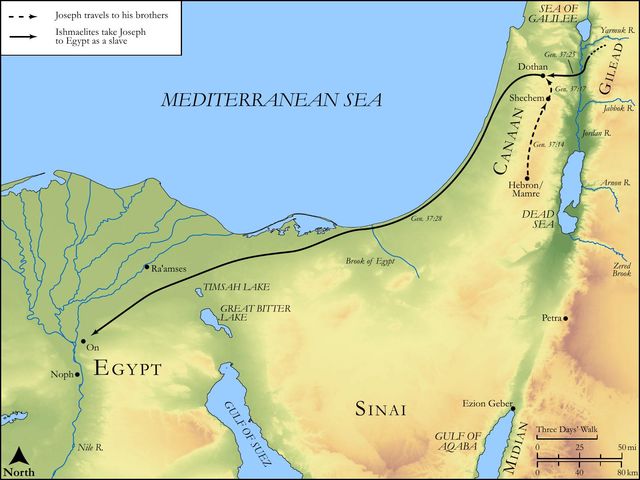
This phrase identifies the agents of Joseph's final transaction. While Genesis 37:28 mentions Ishmaelites, the interchangeable use of "Midianites" here suggests either a mixed caravan of traders or a general term for nomadic groups involved in the slave trade from the Arabian Desert. Their act of selling Joseph, though driven by commercial interest, becomes the divinely appointed means of his relocation.
"into Egypt unto Potiphar"
This signifies Joseph's forced relocation from Canaan to Egypt, a major political and economic power of that day. The destination, "Egypt," is crucial to God's larger plan for the Abrahamic covenant, as it would eventually become the place where Jacob's descendants would multiply into a nation. "Potiphar" is identified as Joseph's new owner, an Egyptian official whose name (likely meaning "he whom Ra has given") reflects the polytheistic religious environment Joseph was about to enter.
"an officer of Pharaoh's, [and] captain of the guard"
This clause provides specific details about Potiphar's high status and influential position within the Egyptian court. As an "officer of Pharaoh's," he held a position of trust and authority directly under the king. His role as "captain of the guard" (literally "chief of the executioners/slaughterers") implies he was the head of Pharaoh's personal security force, responsible for the royal bodyguard and state prisoners. This placement was not random; it ensured Joseph's proximity to power and set the stage for his future ascent within the Egyptian hierarchy, as detailed in Genesis 39:1-6.
Literary Devices
ShowHideThe narrative of Genesis 37:36 employs several significant literary devices. Irony is powerfully present, as the human act of selling Joseph into slavery, intended by his brothers for evil and by the traders for profit, is paradoxically the very means by which God begins to fulfill His redemptive purposes. This serves as a profound theological statement on divine sovereignty. Furthermore, the verse functions as a crucial point of Foreshadowing. Joseph's individual descent into Egypt as a slave directly anticipates the later, larger national descent of the entire family of Jacob into Egypt, which would also lead to their eventual enslavement and subsequent miraculous deliverance, a foundational narrative for the nation of Israel. The detailed description of Potiphar's high office also serves as Setup, preparing the reader for Joseph's eventual rise to power by establishing his initial placement within an influential and critical part of the Egyptian administration.
Theological and Thematic Connections
ShowHideGenesis 37:36 is a pivotal verse that profoundly illustrates the overarching theme of divine sovereignty working through human sin and suffering. Despite the grave injustice of Joseph's sale into slavery, an act born of his brothers' jealousy and the Midianites' commercial exploitation, the biblical narrative consistently presents this event as a crucial, divinely orchestrated step in God's larger redemptive plan. This verse demonstrates that God is not limited by human wickedness but can meticulously weave even the darkest threads of human depravity into the tapestry of His glorious purposes, transforming what was intended for evil into good for the salvation of many. Joseph's journey from favored son to enslaved servant initiates a period of profound testing and character development, preparing him for the immense responsibilities he would later bear.
Reflection and Application
ShowHideGenesis 37:36 offers a profound and enduring lesson for believers today: the reality of God's sovereign hand at work, even amidst the most painful and unjust circumstances of life. Joseph's experience of betrayal, abandonment, and forced enslavement represents a complete loss of control and dignity, yet this very event became the necessary pathway to his elevation and the eventual salvation of his family and countless others. For us, this verse serves as a powerful reminder that our current difficulties, betrayals, or setbacks are not necessarily endpoints but can be integral, divinely appointed steps in God's larger, redemptive plan for our lives. It encourages us to cultivate resilience, maintain faithfulness, and adopt a long-term, eternal perspective, trusting that God can transform the worst human intentions and the deepest personal suffering into opportunities for His glory and our ultimate good, working all things together for those who love Him and are called according to His purpose.
Questions for Reflection
ShowHideFAQ
ShowHideWhy are both "Ishmaelites" and "Midianites" mentioned in relation to Joseph's sale?
ShowHideThe biblical text uses both "Ishmaelites" in Genesis 37:27-28 and "Midianites" in Genesis 37:36 to describe the traders who bought Joseph from his brothers. This is generally understood in a few ways: they may have been a mixed caravan composed of members from both groups, or the terms might have been used somewhat interchangeably in that period to refer to nomadic, trading peoples from the Arabian desert region. Both groups were descendants of Abraham through different lines (Ishmael from Hagar, Midian from Keturah), and their close association in trade routes could lead to such a fluid use of names, indicating a common identity as desert merchants.
What was the exact role of "Potiphar, captain of the guard"?
ShowHidePotiphar held a very significant and powerful position within Pharaoh's court. The Hebrew phrase sar haṭṭabbâḥîm literally translates to "chief of the slaughterers" or "chief of the executioners." This indicates he was not merely a military officer but the head of Pharaoh's personal security detail. His responsibilities would have included commanding the royal bodyguard, overseeing executions, and managing the state prison. This role implies immense trust from Pharaoh and considerable authority, placing Joseph in a highly influential household where he would gain exposure to the inner workings of the Egyptian government, a crucial step in his preparation for future leadership as detailed in Genesis 39:1-6.
Was Joseph's sale into slavery part of God's plan, or just a tragic accident?
ShowHideWhile the human actions involved in Joseph's sale were undoubtedly sinful and motivated by evil (his brothers' jealousy and the traders' exploitation), the biblical narrative consistently presents this event as an integral part of God's overarching, sovereign plan. Joseph himself articulates this profound theological truth later in his life, stating to his brothers in Genesis 50:20, "But as for you, ye thought evil against me; but God meant it unto good, to bring to pass, as it is this day, to save much people alive." This demonstrates that God can use even wicked human intentions and the suffering they inflict to accomplish His righteous and redemptive purposes, ultimately working all things for the good of those who love Him (Romans 8:28).
Christ-Centered Fulfillment
ShowHideJoseph's unjust sale into slavery in Genesis 37:36 serves as a profound and compelling prefigurement of the person and work of Jesus Christ. Like Joseph, who was betrayed by his own brothers and sold for a price, Jesus was betrayed by one of His closest disciples, Judas, for thirty pieces of silver (Matthew 26:14-16). Both endured immense suffering, humiliation, and unjust condemnation, being delivered into the hands of foreign powers – Joseph to Egypt, and Jesus to the Roman authorities (John 18:28-32). Yet, through their respective sufferings, both became instruments of salvation for many. Joseph, through his period of enslavement and imprisonment, was ultimately elevated to a position of power, saving his family and entire nations from physical famine (Genesis 41:56-57). Similarly, Christ, through His ultimate sacrifice on the cross, was exalted by God (Philippians 2:8-11), reigning as Lord and Savior, thereby accomplishing the spiritual salvation of humanity from sin and eternal death (Romans 5:8-10). Thus, Joseph's journey from the pit to the palace, initiated by his sale, powerfully illustrates God's redemptive plan unfolding through suffering, betrayal, and ultimate triumph in Christ.