


Genesis 26:28
- וַיֹּאמְרוּvai·yo·me·Ruand they saidH559Conj-w ¦ V-Qal-ConsecImperf-3mpVerb Qal Consecutive Imperfect 3rd Plural Masculineוַandיֹּאמְרוּthey said
- רָאוֹra·'Ocertainly <to see>H7200V-Qal-InfAbsVerb Qal Infinitive Absolute
- רָאִינוּra·'i·Nuwe have seenH7200V-Qal-Perf-1cpVerb Qal Perfect 1st Plural common gender
- כִּיkithatH3588PrtParticle Conditional
- הָיָהha·Yahhe has beenH1961V-Qal-Perf-3msVerb Qal Perfect 3rd Singular Masculine
- יְהוָהYah·wehYahwehH3068N-properNoun Proper Title
- עִמָּךְ'i·moKhwith youH5973Prep ¦ 2msPreposition Definiteעִמָּwithךְyou
- וַנֹּאמֶרva·No·merand we saidH559Conj-w ¦ V-Qal-ConsecImperf-1cpVerb Qal Consecutive Imperfect 1st Plural common genderוַandנֹּאמֶרwe said
- תְּהִיte·Hilet it beH1961V-Qal-Imperf-3fsVerb Qal Imperfect 3rd Singular Feminine
- נָאna'pleaseH4994PrtParticle Interjection
- אָלָה'a·Lahan oathH423N-fsNoun Singular Feminine Absolute
- בֵּינוֹתֵינוּbei·no·Tei·nubetween usH996Adj-fpc ¦ 1cpAdjective Numerical Plural Feminine Constructבֵּינוֹתֵיbetweenנוּus
- בֵּינֵינוּbei·Nei·nubetween usH996Adj-mpc ¦ 1cpAdjective Numerical Plural Masculine Constructבֵּינֵיbetweenנוּus
- וּבֵינֶךָu·vei·Ne·khaand between youH996Conj-w ¦ Adj-msc ¦ 2msAdjective Numerical Singular Masculine Constructוּandבֵינֶbetweenךָyou
- וְנִכְרְתָהve·nikh·re·Tahand let us makeH3772Conj-w ¦ V-Qal-Imperf-1cpVerb Qal Imperfect 1st Plural common genderוְandנִכְרְתָהlet us make
- בְרִיתve·Rita covenantH1285N-fsNoun Singular Feminine Absolute
- עִמָּךְ'i·Makhwith youH5973Prep ¦ 2msPreposition Definiteעִמָּwithךְyou
English is a literal word-by-word gloss of the Hebrew, not the KJV's wording. Why?
This is the original text the KJV's translators worked from — each Hebrew word with its own literal English meaning in this verse, prepared by scholars at Tyndale House, Cambridge. The KJV translates whole sentences, not word by word, so its wording differs: one Hebrew word can become several English words, and the KJV may choose “the LORD” where the gloss reads “Yahweh”. Both are faithful — they answer different questions. For the KJV's own rendering, switch to the KJV text.
Details
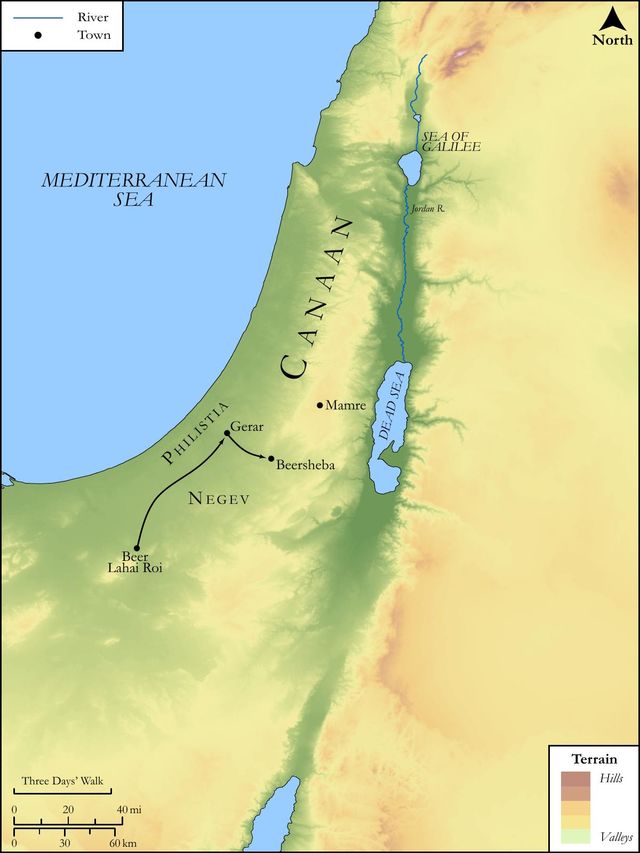
See on the biblical-era maps


Study this verse
Public-domain commentary
Matthew Henry
From his Commentary on the Whole Bible. Henry comments on passages, not single verses — this entry covers Genesis 26:26–33. His two-level outline is real structure in the source text, so it is rendered as structure.
We have here the contests that had been between Isaac and the Philistines issuing in a happy peace and reconciliation.
I.Abimelech pays a friendly visit to Isaac, in token of the respect he had for him, Gen 26:26.
Note, When a man's ways please the Lord he makes even his enemies to be at peace with him, Pro 16:7. King's hearts are in his hands, and when he pleases he can turn them to favour his people.
II.Isaac prudently and cautiously questions his sincerity in this visit, Gen 26:27.
Note, In settling friendships and correspondences, there is need of the wisdom of the serpent, as well as the innocence of the dove; nor is it any transgression of the law of meekness and love plainly to signify our strong perception of injuries received, and to stand upon our guard in dealing with those that have acted unfairly.
III.Abimelech professes his sincerity, in this address to Isaac, and earnestly courts his friendship, Gen 26:28, Gen 26:29.
Some suggest that Abimelech pressed for this league with him because he feared lest Isaac, growing rich, should, some time or other, avenge himself upon them for the injuries he had received. However, he professes to do it rather from a principle of love.
1.He makes the best of their behaviour towards him. Isaac complained they had hated him, and sent him away. No, said Abimelech, we sent thee away in peace. They turned him off from the land he held of them; but they suffered him to take away his stock, and all his effects, with him. Note, The lessening of injuries is necessary to the preserving of friendship; for the aggravating of them exasperates and widens breaches. The unkindness done to us might have been worse.
2.He acknowledges the token of God's favour to him, and makes this the ground of their desire to be in league with him: The Lord is with thee, and thou art the blessed of the Lord. As if he had said, "Be persuaded to overlook and pass by the injuries offered thee; for God had abundantly made up to thee the damage thou receivedst." Note, Those whom God blesses and favours have reason enough to forgive those who hate them, since the worst enemy they have cannot do them any real hurt. Or, "For this reason we desire thy friendship, because God is with thee." Note, It is good to be in covenant and communion with those who are in covenant and communion with God, Jo1 1:3; present address to him was the result of mature deliberation: We said, Let there be an oath between us. Whatever some of his peevish envious subjects might mean otherwise, he and his prime-ministers of state, whom he had now brought with him, designed no other than a cordial friendship. Perhaps Abimelech had received, by tradition, the warning God gave to his predecessor not to hurt Abraham (Gen 20:7), and this made him stand in such awe of Isaac, who appeared to be as much the favourite of Heaven as Abraham was.
IV.Isaac entertains him and his company, and enters into a league of friendship with him, Gen 26:30, Gen 26:31.
Here see how generous the good man was, 1. In giving: He made them a feast, and bade them welcome. (2.) In forgiving. He did not insist upon the unkindnesses they had done him, but freely entered into a covenant of friendship with them, and bound himself never to do them any injury. Note, Religion teaches us to be neighbourly, and, as much as in us lies, to live peaceably with all men.
V.Providence smiled upon what Isaac did; for the same day that he made this covenant with Abimelech his servants brought him the tidings of a well of water they had found, Gen 26:32, Gen 26:33. He did not insist upon the restitution of the wells which the Philistines had unjustly taken from him, lest this should break off the treaty, but sat down silent under the injury; and, to recompense him for this, immediately he is enriched with a new well, which, because it suited so well to the occurrence of the day, he called by an old name, Beer-sheba, The well of the oath.
Continue studying Genesis 26:28 across the web’s major study libraries — every link below opens this exact verse, chapter, or book on the destination site.
Read & Compare
 BibleGatewayThis verse in more than 200 translations and 70 languages.
 Bible.comThe YouVersion reader — hundreds of translations, reading plans, and highlights.
 ESV.orgCrossway's official English Standard Version reader.
 NET BibleThe NET translation with 60,000+ translators' notes on every rendering decision.
 STEP BibleTyndale House's free study tool — original text, vocabulary, and scholarly resources.
 BibliaLogos Bible Software's free web reader.
 USCCBThe New American Bible (Revised Edition) with the U.S. bishops' study notes.
Commentaries
 BibleHub CommentariesDozens of classic commentaries on this verse, gathered on one page.
 StudyLightMore than 100 commentary sets — the largest collection on the web.
 BibleRefPlain-English commentary on what this verse means, verse by verse.
 Enduring WordDavid Guzik's free commentary on this chapter, widely used by Bible teachers.
 Bible Study ToolsVerse commentary alongside Greek and Hebrew study aids.
Original Language & Research
- BibleHub InterlinearThe verse word by word — original language, transliteration, and English.
- BibleHub LexiconEvery word's original-language definition and Strong's entry.
 Blue Letter BibleDeep-study tools — Strong's numbers, concordance, and word studies.
 SefariaThe Hebrew text with Rashi and centuries of Jewish commentary.
Sermons, Hymns & Audio


TrulyRandomVerse is not affiliated with these sites and doesn’t control their content. They’re linked because they’re genuinely useful.
Summary
Genesis 26:28 captures a pivotal moment of reconciliation where Abimelech, the Philistine king, along with his officials, openly acknowledged the undeniable presence and blessing of the Lord upon Isaac. This profound recognition led them to propose a formal, binding oath and covenant of peace, marking a significant transition from a period of conflict and suspicion to one of mutual respect and agreement, driven by the visible evidence of divine favor on Isaac's life.
Context
ShowHideLiterary Context
This verse is situated within a narrative arc detailing Isaac's experiences in Gerar and his subsequent interactions with the Philistines. Following a famine, Isaac had sojourned in Gerar, where he was blessed by God, leading to immense prosperity that aroused the envy of the Philistines (Genesis 26:12-14). This envy escalated into open conflict, with the Philistines filling in Abraham's wells and disputing Isaac's claims to newly dug wells, forcing Isaac to move from place to place (Genesis 26:15-22). Isaac eventually settled in Beersheba, where the Lord appeared to him, reaffirming the Abrahamic covenant promises and assuring Isaac of His presence and blessing (Genesis 26:23-24). Immediately after this divine encounter and Isaac's response of building an altar, Abimelech, accompanied by his chief captain Phichol and his friend Ahuzzath, unexpectedly came to Isaac. Their visit, initiated by them despite their prior antagonism, sets the stage for the surprising admission and covenant proposal found in this verse, signifying a dramatic shift from hostility to a desire for peace.
Historical & Cultural Context
In the ancient Near East, access to water was paramount for survival and prosperity, making control over wells a frequent source of conflict, as seen in Isaac's disputes with the Philistines. The Philistines were a powerful seafaring people who had settled in the coastal plain of Canaan, often coming into contact and conflict with the nomadic patriarchs. Covenants (Hebrew: bᵉrîyth) were foundational to social, political, and religious life, serving as solemn, binding agreements between individuals, tribes, or nations. These agreements often involved oaths, rituals (like cutting animals and passing between the pieces, symbolizing the fate of the party who breaks the covenant), and the invocation of deities as witnesses, ensuring their gravity and enforceability. For a powerful king like Abimelech to seek a covenant with a nomadic patriarch like Isaac, it speaks volumes about the perceived power and favor of Isaac's God. It was a pragmatic move to secure peace and prevent future conflicts, acknowledging a superior, unseen force at work.
Key Themes
ShowHideGenesis 26:28 powerfully illustrates several key themes prevalent in the book of Genesis and the broader biblical narrative. The most prominent is the visible manifestation of God's blessing and presence. Isaac's prosperity, resilience, and success in finding water, even in the face of Philistine opposition, served as undeniable evidence of God's favor, so much so that even a foreign king could "see" it. This underscores the theme of God's faithfulness to His covenant promises, specifically those made to Abraham and reaffirmed to Isaac in Genesis 26:3-4. Furthermore, the verse highlights the theme of divine sovereignty and providence, where God orchestrates circumstances, even turning adversaries into witnesses of His power and instruments for the establishment of peace. The Philistines' initiative to make a covenant also reflects the biblical emphasis on seeking and establishing peace (Hebrew: shalom), even with former antagonists, demonstrating the transformative power of God's work in human relationships.
Exposition and Analysis
ShowHideThis verse captures a pivotal moment of recognition and reconciliation, where the Philistine leadership, despite their prior hostility, openly acknowledges God's undeniable favor on Isaac.
Key Word Analysis
ShowHideThis is the personal, covenantal name of God, often transliterated as Yahweh. It signifies "the self-Existent or Eternal," emphasizing God's unchanging nature and His active presence in the lives of His people. Abimelech's use of this specific name, rather than a generic term for deity, indicates a recognition of Isaac's God as distinct and powerful, the one who truly "was with" Isaac. This is a profound acknowledgment from a foreign king.
This primitive root means "to see, literally or figuratively," and encompasses various applications from simple observation to discerning, perceiving, or having experience. The repetition ("saw certainly" or "seeing, we saw") emphasizes the undeniable, empirical nature of their observation. It wasn't a mere rumor or guess, but a clear, repeated, and undeniable perception of God's active blessing and presence in Isaac's life, evident in his prosperity and resilience despite opposition.
Derived from a root meaning "to cut," signifying a compact made by passing between pieces of flesh. It denotes a solemn, binding agreement, a confederacy, or a league. The act of "making" a covenant (Hebrew: kârath, H3772, "to cut") reinforces the ancient practice of cutting animals and passing between the pieces to solemnize the agreement, symbolizing the severe consequences for breaking the compact. This term signifies a deep, enduring bond with mutual obligations, far more significant than a simple treaty or truce.
Verse Breakdown
ShowHide"And they said, We saw certainly that the LORD was with thee:"
This opening clause reveals the Philistine delegation's astonishing confession. Abimelech and his officials explicitly state that they had observed undeniable evidence of God's active presence and blessing upon Isaac. The emphatic Hebrew construction ("seeing, we saw") underscores the certainty and clarity of their perception. This admission is remarkable, coming from those who had previously harassed Isaac, and it highlights the visible, tangible impact of God's favor on Isaac's life, which even outsiders could not deny.
"and we said, Let there be now an oath betwixt us, even betwixt us and thee,"
Following their confession, the Philistines initiate the proposal for a formal agreement. The mention of an "oath" (Hebrew: ʼâlâh, H423) emphasizes the solemnity and binding nature of the proposed agreement. An oath in the ancient world invoked divine witness and judgment, making the commitment extremely serious and legally binding. This indicates their desire for a permanent cessation of hostilities and the establishment of a trustworthy relationship, secured by a divine sanction.
"and let us make a covenant with thee;"
This final phrase specifies the ultimate goal: to establish a formal "covenant" (Hebrew: bᵉrîyth). This is not merely a handshake agreement but a foundational pact that would define their future relationship. The Philistines, having witnessed God's favor on Isaac, recognized the need to align themselves with someone so clearly blessed by a powerful deity, seeking peace and stability through a formal, religiously sanctioned agreement.
Literary Devices
ShowHideThe passage employs several potent literary devices. Irony is evident in the fact that Abimelech, who previously expelled Isaac from Gerar and whose people disputed Isaac's wells, now comes seeking a covenant of peace. This reversal of roles underscores the profound impact of God's visible blessing on Isaac. The narrative also demonstrates Divine Providence, as God orchestrates circumstances to fulfill His promises to Isaac, turning the hearts of his adversaries and compelling them to acknowledge His presence. Isaac's life serves as a powerful Testimony, a living witness to God's faithfulness and power, which is so undeniable that even those outside the covenant community are forced to acknowledge it. This theme of Visible Blessing acts as a persuasive force, transforming conflict into an opportunity for reconciliation.
Theological and Thematic Connections
ShowHideGenesis 26:28 provides a profound theological insight into the nature of God's covenant faithfulness and the power of His manifest presence. It demonstrates that God's blessings upon His people are not merely internal spiritual experiences but can be so tangible and evident that even those outside the community of faith are compelled to acknowledge them. This visible favor serves as a powerful testimony to God's active involvement in human affairs, demonstrating His sovereignty over all people and circumstances, even turning the hearts of adversaries. The Philistines' initiative to make a covenant with Isaac, driven by their observation of God's presence, underscores the biblical principle that genuine peace and lasting relationships are often established on the recognition of God's truth and power. It highlights that God's faithfulness to His promises (as seen in Genesis 26:24) leads to a security and favor that transcends human conflict.
Reflection and Application
ShowHideGenesis 26:28 offers profound encouragement and practical application for believers today. It reminds us that our lives, when lived in faithful obedience and alignment with God's will, can become a visible testament to His presence and goodness, even to those who may be indifferent or adversarial. Just as Isaac's consistent conduct and God's evident blessing inclined Abimelech's heart towards peace, our lives can be a powerful witness to the transforming power of Christ. God's unwavering favor can indeed transform challenging circumstances, turning conflict into opportunities for reconciliation and respect. This narrative challenges us to consider how our own lives reflect God's presence—do others "see certainly that the LORD is with" us? It encourages us to pursue peace, even with those who have wronged us, trusting that God's active presence and blessing are the ultimate source of security and favor. Ultimately, this passage calls us to live in such a way that God's glory is clearly manifested, enabling us to navigate human conflict and uncertainty with divine assurance, and to be instruments of His peace in the world.
Questions for Reflection
ShowHideFAQ
ShowHideHow did Abimelech "see" that the LORD was with Isaac?
ShowHideAbimelech and his officials likely observed the tangible and undeniable results of God's blessing on Isaac's life. This would have included Isaac's remarkable prosperity in flocks and herds, his ability to consistently find and secure water in an arid land despite opposition, and his general success and resilience even when driven from one place to another. His flourishing, despite Philistine attempts to hinder him, would have been clear indicators of a supernatural favor beyond mere human effort or luck. This "seeing" was not necessarily a spiritual revelation in the prophetic sense but an empirical and undeniable observation of divine favor and its profound effects, compelling a rational conclusion that the God of Isaac was indeed powerful and active on his behalf.
Why was an "oath" and "covenant" necessary if God's presence was so clear?
ShowHideWhile God's presence with Isaac was undeniably evident, human relationships, especially between potentially antagonistic parties, often require formal agreements to establish trust, ensure lasting peace, and provide a framework for future interactions. An oath, by invoking a divine witness (in this case, Isaac's God, whom Abimelech now acknowledged), added a layer of solemnity and accountability, making the covenant truly binding and difficult to violate without perceived divine repercussions. It served as a public declaration of commitment, moving beyond mere observation of God's favor to a mutual, legally and religiously sanctioned agreement that would govern future interactions and prevent further conflict. This demonstrates the practical outworking of peace and the human responsibility in maintaining it, even when God's favor is clearly manifest.
Christ-Centered Fulfillment
ShowHideThe visible presence of the Lord with Isaac, leading to a covenant of peace initiated by former adversaries, powerfully foreshadows the ultimate divine presence and the new covenant established in Jesus Christ. In Christ, God Himself tabernacled among humanity, making His presence undeniably manifest, as John 1:14 declares, "The Word became flesh and dwelt among us." Jesus is the ultimate embodiment of God's favor and the initiator of a new, eternal covenant, sealed not with animal sacrifices but with His own blood (Luke 22:20). This covenant brings not merely a temporary truce, but a lasting peace between God and humanity, and among people, breaking down dividing walls of hostility (Ephesians 2:14-16). Through His sacrifice and the indwelling of the Holy Spirit, Christ enables believers to experience God's abiding presence and to be instruments of reconciliation, reflecting His peace and the undeniable reality of God's work to a conflicted world, just as Isaac's life became a testament to God's favor that even his enemies could not deny.