


Genesis 21:32
- וַיִּכְרְתוּvai·yikh·re·Tuand they madeH3772Conj-w ¦ V-Qal-ConsecImperf-3mpVerb Qal Consecutive Imperfect 3rd Plural Masculineוַandיִּכְרְתוּthey made
- בְרִיתve·Rita covenantH1285N-fsNoun Singular Feminine Absolute
- בִּבְאֵרbiv·'Erat BeerH884Prep-b ¦ N-properNoun Proper LocationבִּatבְאֵרBeer
- שָׁבַעSha·va'ShebaH884N-properNoun Proper Location
- וַיָּקָםvai·Ya·komand he aroseH6965Conj-w ¦ V-Qal-ConsecImperf-3msVerb Qal Consecutive Imperfect 3rd Singular Masculineוַandיָּקָםhe arose
- אֲבִימֶלֶךְ'a·vi·Me·lekhAbimelechH40N-proper-mNoun Proper Masculine
- וּפִיכֹלu·fi·Kholand PhicolH6369Conj-w ¦ N-proper-mNoun Proper MasculineוּandפִיכֹלPhicol
- שַׂרsar[the] commander ofH8269N-mscNoun Singular Masculine Construct
- צְבָאוֹtze·va·'Ohis armyH6635N-msc ¦ 3msNoun Singular Masculine Constructצְבָאarmyוֹhis
- וַיָּשֻׁבוּvai·ya·Shu·vuand they returnedH7725Conj-w ¦ V-Qal-ConsecImperf-3mpVerb Qal Consecutive Imperfect 3rd Plural Masculineוַandיָּשֻׁבוּthey returned
- אֶל'eltoH413PrepPreposition
- אֶרֶץ'E·retz[the] land ofH776N-fscNoun Singular Feminine Construct
- פְּלִשְׁתִּיםpe·lish·Tim[the] PhilistinesH6430N-mpNoun Gentilic Plural Masculine Absolute
English is a literal word-by-word gloss of the Hebrew, not the KJV's wording. Why?
This is the original text the KJV's translators worked from — each Hebrew word with its own literal English meaning in this verse, prepared by scholars at Tyndale House, Cambridge. The KJV translates whole sentences, not word by word, so its wording differs: one Hebrew word can become several English words, and the KJV may choose “the LORD” where the gloss reads “Yahweh”. Both are faithful — they answer different questions. For the KJV's own rendering, switch to the KJV text.
Details
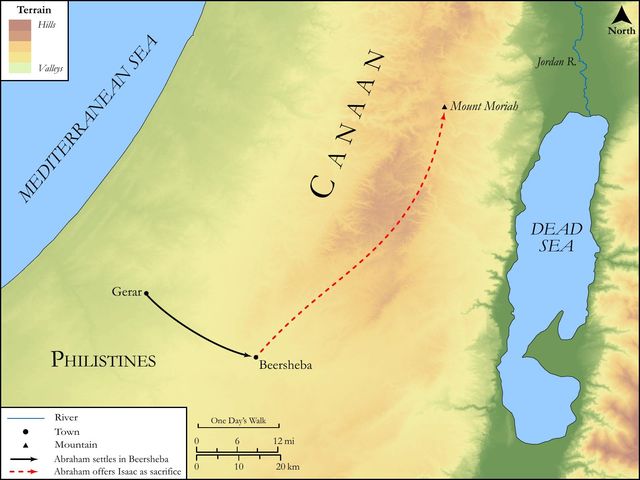
See on the biblical-era maps


Study this verse
Public-domain commentary
Matthew Henry
From his Commentary on the Whole Bible. Henry comments on passages, not single verses — this entry covers Genesis 21:22–32. His three-level outline is real structure in the source text, so it is rendered as structure.
We have here an account of the treaty between Abimelech and Abraham, in which appears the accomplishment of that promise (Gen 12:2) that God would make his name great. His friendship is valued, is courted, though a stranger, though a tenant at will to the Canaanites and Perizzites.
I.The league is proposed by Abimelech, and Phichol his prime-minister of state and general of his army.
1.The inducement to it was God's favour to Abraham (Gen 21:22): "God is with thee in all that thou doest, and we cannot but take notice of it." Note,
(1.)God in his providence sometimes shows his people such tokens for good that their neighbours cannot but take notice of it, Psa 86:17. Their affairs do so visibly prosper, and they have such remarkable success in their undertakings, that a confession is extorted from all about them of God's presence with them.
(2.)It is good being in favour with those that are in favour with God, and having an interest in those that have an interest in heaven, Zac 8:23. We will go with you, for we have heard that God is with you. We do well for ourselves if we have fellowship with those that have fellowship with God, Jo1 1:3.
2.The tenour of it was, in general, that there should be a firm and constant friendship between the two families, which should not upon any account be violated. This bond of friendship must be strengthened by the bond of an oath, in which the true God was appealed to, both as a witness of their sincerity and an avenger in case either side were treacherous, Gen 21:23. Observe,
(1.)He desires the entail of this league upon his posterity and the extension of it to his people. He would have his son, and his son's son, and his land likewise, to have the benefit of it. Good men should secure an alliance and communion with the favourites of Heaven, not for themselves only, but for theirs also.
(2.)He reminds Abraham of the fair treatment he had found among them: According to the kindness I have done unto thee. As those that have received kindness must return it, so those that have shown kindness may expect it.
II.It is consented to by Abraham, with a particular clause inserted about a well. In Abraham's part of this transaction observe,
1.He was ready to enter into this league with Abimelech, finding him to be a man of honour and conscience, and that had the fear of God before his eyes: I will swear, Gen 21:24. Note,
(1.)Religion does not make men morose and unconversable; I am sure it ought not. We must not, under colour of shunning bad company, be sour to all company, and jealous of every body.
(2.)An honest mind does not startle at giving assurances: if Abraham say that he will be true to Abimelech, he is not afraid to swear it; an oath is for confirmation.
2.He prudently settled the matter concerning a well, about which Abimelech's servants had quarrelled with him. Wells of water, it seems, were choice goods in that country: thanks be to God, that they are not so scarce in ours.
(1.)Abraham mildly told Abimelech of it, Gen 21:25. Note, If our brother trespass against us, we must, with the meekness of wisdom, tell him his fault, that the matter may be fairly accommodated and an end made of it, Mat 18:15.
(2.)He acquiesced in Abimelech's justification of himself in this matter: I wot not who has done this thing, Gen 21:26. Many are suspected of injustice and unkindness that are perfectly innocent, and we ought to be glad when they clear themselves. The faults of servants must not be imputed to their masters, unless they know of them and justify them; and no more can be expected from an honest man than that he be ready to do right as soon as he knows that he has done wrong.
(3.)He took care to have his title to the well cleared and confirmed, to prevent any disputes or quarrels for the future, Gen 21:30. It is justice, as well as wisdom, to do thus, in perptuam rei memoriam - that the circumstance may be perpetually remembered.
3.He made a very handsome present to Abimelech, Gen 21:27. It was not any thing curious or fine that he presented to him, but that which was valuable and useful - sheep and oxen, in gratitude for Abimelech's kindness to him, and in token of hearty friendship between them. The interchanging of kind offices is the improving of love: that which is mine is my friend's.
4.He ratified the covenant by an oath, and registered it by giving a new name to the place (Gen 21:31), Beer-sheba, the well of the oath, in remembrance of the covenant they swore to, that they might be ever mindful of it; or the well of seven, in remembrance of the seven lambs given to Abimelech, as a consideration for his confirming Abraham's title to that well. Note, Bargains made must be remembered, that we may make them good, and may not break our word through oversight.
Continue studying Genesis 21:32 across the web’s major study libraries — every link below opens this exact verse, chapter, or book on the destination site.
Read & Compare
 BibleGatewayThis verse in more than 200 translations and 70 languages.
 Bible.comThe YouVersion reader — hundreds of translations, reading plans, and highlights.
 ESV.orgCrossway's official English Standard Version reader.
 NET BibleThe NET translation with 60,000+ translators' notes on every rendering decision.
 STEP BibleTyndale House's free study tool — original text, vocabulary, and scholarly resources.
 BibliaLogos Bible Software's free web reader.
 USCCBThe New American Bible (Revised Edition) with the U.S. bishops' study notes.
Commentaries
 BibleHub CommentariesDozens of classic commentaries on this verse, gathered on one page.
 StudyLightMore than 100 commentary sets — the largest collection on the web.
 BibleRefPlain-English commentary on what this verse means, verse by verse.
 Enduring WordDavid Guzik's free commentary on this chapter, widely used by Bible teachers.
 Bible Study ToolsVerse commentary alongside Greek and Hebrew study aids.
Original Language & Research
- BibleHub InterlinearThe verse word by word — original language, transliteration, and English.
- BibleHub LexiconEvery word's original-language definition and Strong's entry.
 Blue Letter BibleDeep-study tools — Strong's numbers, concordance, and word studies.
 SefariaThe Hebrew text with Rashi and centuries of Jewish commentary.
Sermons, Hymns & Audio


TrulyRandomVerse is not affiliated with these sites and doesn’t control their content. They’re linked because they’re genuinely useful.
Summary
formally concludes the solemn covenant established at Beersheba between Abraham and Abimelech, the Philistine king of Gerar. This verse succinctly records the ratification of their peace treaty, which secured Abraham's rights to a vital well, and details the subsequent departure of Abimelech and his chief captain, Phichol, back to their territory, signifying a successful and binding resolution to their dispute and the establishment of peaceful coexistence.
Context
ShowHideLiterary Context
This verse serves as the narrative climax and resolution of the immediate preceding passage, Genesis 21:22-31. The story begins with Abimelech, recognizing God's evident blessing upon Abraham, initiating a request for a solemn oath of loyalty and non-aggression. The catalyst for this formal agreement was a dispute over a well that Abraham's servants had dug, but which Abimelech's servants had seized. Abraham's direct complaint about this injustice (Genesis 21:25) leads directly to the formal establishment of a peace treaty, which secured Abraham's rightful claim to the well and ensured a period of peaceful relations between their respective peoples. The verse also marks a significant geographical and thematic anchor, as Beersheba becomes a recurring location in the patriarchal narratives (e.g., Genesis 26:23-33; Genesis 46:1-5).
Historical & Cultural Context
In the ancient Near East, covenants were foundational to political, social, and religious life. They were solemn, binding agreements, often ratified by oaths, sacrifices, and symbolic acts (like passing between cut animals, as implied by the Hebrew root for "covenant"). Access to water sources like wells was paramount for survival in arid regions, making disputes over them common and potentially violent. The act of making a covenant, especially with a foreign ruler like Abimelech, was a significant diplomatic achievement, reflecting Abraham's growing status and the recognition of God's favor upon him. The Philistines, though not fully established in Canaan as a major power until later, were present in the region, and interactions with their kings, like Abimelech of Gerar, were crucial for Abraham's nomadic existence.
Key Themes
ShowHideThis verse contributes to several major themes within Genesis and the broader biblical narrative. It highlights the theme of God's faithfulness to His covenant promises to Abraham, as He orchestrates events to secure Abraham's safety and property in the land. The resolution of the well dispute through diplomacy rather than conflict underscores the theme of seeking peace and justice, even with potential adversaries. Furthermore, Abimelech's recognition of God's blessing upon Abraham ("God is with thee in all that thou doest" in Genesis 21:22) emphasizes the theme of divine favor recognized by outsiders. Finally, Abraham's securing of land rights, even for a single well, serves as a microcosm of the larger promise of the land of Canaan to his descendants, foreshadowing the fulfillment of the land promise found throughout the Pentateuch and beyond.
Exposition and Analysis
ShowHideKey Word Analysis
ShowHideFrom a primitive root meaning "to cut (off, down or asunder)," this word specifically implies "to covenant" or "make an alliance or bargain, originally by cutting flesh and passing between the pieces." This highlights the ancient practice of covenant-making, often involving a ritualistic cutting that symbolized the solemnity and binding nature of the agreement, with dire consequences for breaking it.
Derived from a root meaning "to cut," this term refers to a compact, confederacy, or league. In biblical context, a covenant is a solemn, binding agreement between two parties, often initiated by a superior party, establishing a relationship and outlining mutual obligations and promises. Here, it signifies the formal peace treaty between Abraham and Abimelech.
Meaning "well of an oath" or "well of seven," this place name is etymologically significant. It directly references the solemn oath and covenant made there, as well as the seven ewe lambs Abraham gave to Abimelech as a witness to his ownership of the well (Genesis 21:28-31). The name itself encapsulates the core events of the passage.
Verse Breakdown
ShowHide"Thus they made a covenant at Beersheba:"
This clause signifies the formal and binding conclusion of the agreement between Abraham and Abimelech. The term "covenant" (Hebrew: b'rit) denotes a solemn, unbreakable pact, underscoring the gravity of the agreement. The location, Beersheba, is crucial, as its name ("well of the oath" or "well of seven") memorializes the very act of covenant-making and the associated seven ewe lambs given by Abraham as a witness to his ownership of the well.
"then Abimelech rose up, and Phichol the chief captain of his host,"
This details the immediate action following the covenant's ratification. Abimelech, the Philistine king of Gerar, and his military commander, Phichol, are identified as the key figures on the Philistine side. Their "rising up" indicates their readiness to depart, having completed their diplomatic mission. The presence of Phichol, the "chief captain of his host," emphasizes the official and military backing of Abimelech's agreement.
"and they returned into the land of the Philistines."
This final clause confirms the successful resolution of the dispute and the establishment of peace. The departure of Abimelech and Phichol back to their own territory signifies that the terms of the covenant were accepted and that the immediate threat or tension between Abraham's household and Abimelech's kingdom had been diffused, leading to a period of stability and peaceful coexistence.
Literary Devices
ShowHideThe passage employs Etymological Significance through the naming of Beersheba. The name itself, Be'er Sheva, carries a dual meaning—"well of the oath" and "well of seven"—which directly encapsulates the pivotal events of the narrative: the solemn covenant ratified there and the seven ewe lambs Abraham gave as a witness to his ownership of the well. This linguistic device ensures that the location itself serves as a perpetual reminder of the agreement. Furthermore, the narrative structure demonstrates Narrative Resolution, as the tension over the well is formally and peacefully resolved, leading to the departure of Abimelech and his party, signifying a return to order and stability after a period of dispute.
Theological and Thematic Connections
ShowHideThe covenant at Beersheba powerfully illustrates God's ongoing faithfulness to Abraham, demonstrating how divine providence orchestrates human affairs to secure His chosen one's safety, property, and standing in the promised land. The solemnity of this human covenant reflects the profound biblical understanding of promises and oaths as binding and sacred, mirroring God's own unchangeable covenantal faithfulness to His people. This narrative also provides a practical example of seeking peace and justice, highlighting how diplomacy and integrity can resolve conflict, a principle deeply valued in scripture.
Reflection and Application
ShowHideThe account of the covenant at Beersheba offers timeless lessons for navigating disputes and fostering harmonious relationships in our own lives. It teaches us the profound value of integrity and truthfulness, as Abraham's consistent character and righteous standing ultimately led to a respected and binding agreement, even with a powerful gentile ruler. Rather than allowing conflicts over resources, perceived injustices, or misunderstandings to fester and escalate into destructive conflict, the narrative encourages us to actively pursue reconciliation, engage in honest negotiation, and establish peace, even with those who might seem to be adversaries. This passage reminds us that God's promises of blessing and provision often unfold through our diligent pursuit of peace, justice, and honorable dealings in our human interactions, demonstrating that divine faithfulness is often realized through human responsibility and wisdom. It calls us to be peacemakers in our families, communities, and workplaces, trusting that God honors our efforts to live righteously and resolve conflict constructively.
Questions for Reflection
ShowHideFAQ
ShowHideWhy was the covenant at Beersheba significant for Abraham?
ShowHideThe covenant at Beersheba was profoundly significant for Abraham because it formally secured his rightful claim to a crucial well, a vital resource for survival in the arid region, and established a binding peace treaty with Abimelech, the powerful Philistine king of Gerar. This agreement not only provided immediate security and stability for Abraham's household but also served as a tangible affirmation of his growing influence and the universal recognition of God's favor upon him, even by those outside the covenant community. It represented a concrete step in the divine promise of land possession and peaceful dwelling for Abraham and his descendants in Canaan, ensuring his ability to thrive in the territory God had promised him (see Genesis 12:7).
Christ-Centered Fulfillment
ShowHideWhile Genesis 21:32 describes a specific human covenant for peace and land rights, it subtly points to Christ as the ultimate Peacemaker and Fulfiller of all divine covenants. Abraham's securing of a well and peaceful coexistence with Abimelech foreshadows the spiritual inheritance and eternal peace secured for believers through Christ's atoning work. Just as Abraham's "seed" was promised the land, Christ, the ultimate Seed of Abraham (Galatians 3:16), provides access to the true "living water" (John 4:10-14) and establishes a new and eternal covenant of peace between God and humanity (Hebrews 8:6-13). Through His sacrifice, Jesus mediates a covenant that secures for His people an everlasting inheritance (Hebrews 9:15), far greater than any earthly well or territory, offering reconciliation with God and eternal rest (Ephesians 2:14-18). He is the one who truly causes enemies to be at peace, bringing Jew and Gentile into one body (Ephesians 2:11-22), fulfilling the promise of blessing to all nations through Abraham's greater Son.