


Exodus 13:17
Bible text: King James Version (1769 Blayney text) · Public domain
Bible text: King James Version with Strong's numbers · Public domain
Bible text: Berean Standard Bible · Public domain
Bible text: American Standard Version (1901) · Public domain
Bible text: World English Bible, Messianic edition · Public domain
Bible text: Geneva Bible (1599) · Public domain
Bible text: Young's Literal Translation · Public domain
- וַיְהִיvay·Hiand it wasH1961Conj-w ¦ V-Qal-ConsecImperf-3msVerb Qal Consecutive Imperfect 3rd Singular Masculineוַandיְהִיit was
- בְּשַׁלַּחbe·sha·Lachwhen let goH7971Prep-b ¦ V-Piel-InfVerb Piel Infinitive Constructבְּwhenשַׁלַּחlet go
- פַּרְעֹהpar·'OhPharaohH6547N-msNoun Title Singular Masculine Absolute
- אֶת'et<obj.>H853DirObjMParticle Object Indicator
- הָעָםha·'Amthe peopleH5971Art ¦ N-msNoun Singular Masculine Absoluteהָtheעָםpeople
- וְלֹאve·lo'and notH3808Conj-w ¦ NegParticle Negativeוְandלֹאnot
- נָחָםna·Chamhe led themH5148V-Qal-Perf-3ms ¦ 3mpVerb Qal Perfect 3rd Singular Masculineנָחָhe ledםthem
- אֱלֹהִים'E·lo·HimGodH430N-mpNoun Plural Masculine Absolute
- דֶּרֶךְDe·rekh[the] way ofH1870N-cscNoun Singular common gender Construct
- אֶרֶץ'E·retz[the] land ofH776N-fscNoun Singular Feminine Construct
- פְּלִשְׁתִּיםpe·lish·Tim[the] PhilistinesH6430N-mpNoun Gentilic Plural Masculine Absolute
- כִּיkiforH3588PrtParticle Conditional
- קָרוֹבka·Rov[was] nearH7138Adj-msAdjective Singular Masculine Absolute
- הוּאHu'itH1931Pro-3msPronoun Personal 3rd Singular Masculine
- כִּיkiforH3588PrtParticle Conditional
- אָמַר'a·Marhe saidH559V-Qal-Perf-3msVerb Qal Perfect 3rd Singular Masculine
- אֱלֹהִים'E·lo·HimGodH430N-mpNoun Plural Masculine Absolute
- פֶּןpenlestH6435PrtParticle Conditional
- יִנָּחֵםyi·na·Chemit should regretH5162V-Niphal-Imperf-3msVerb Niphal Imperfect 3rd Singular Masculine
- הָעָםha·'Amthe peopleH5971Art ¦ N-msNoun Singular Masculine Absoluteהָtheעָםpeople
- בִּרְאֹתָםbir·'o·Tamwhen they seeH7200Prep-b ¦ V-Qal-Inf ¦ 3mpVerb Qal Infinitive Constructבִּwhenרְאֹתָseeםthey
- מִלְחָמָהmil·cha·MahbattleH4421N-fsNoun Singular Feminine Absolute
- וְשָׁבוּve·Sha·vuand they will returnH7725Conj-w ¦ V-Qal-ConsecPerf-3cpVerb Qal Consecutive Perfect 3rd Plural common genderוְandשָׁבוּthey will return
- מִצְרָיְמָהmitz·Ra·ye·mahEgypt towardsH4714N-proper ¦ SfxNoun Proper LocationמִצְרָיְמָEgyptהtowards
English is a literal word-by-word gloss of the Hebrew, not the KJV's wording. Why?
This is the original text the KJV's translators worked from — each Hebrew word with its own literal English meaning in this verse, prepared by scholars at Tyndale House, Cambridge. The KJV translates whole sentences, not word by word, so its wording differs: one Hebrew word can become several English words, and the KJV may choose “the LORD” where the gloss reads “Yahweh”. Both are faithful — they answer different questions. For the KJV's own rendering, switch to the KJV text.
Details
See on the biblical-era maps

Study this verse
Public-domain commentary
Matthew Henry
From his Commentary on the Whole Bible. Henry comments on passages, not single verses — this entry covers Exodus 13:17–22. His three-level outline is real structure in the source text, so it is rendered as structure.
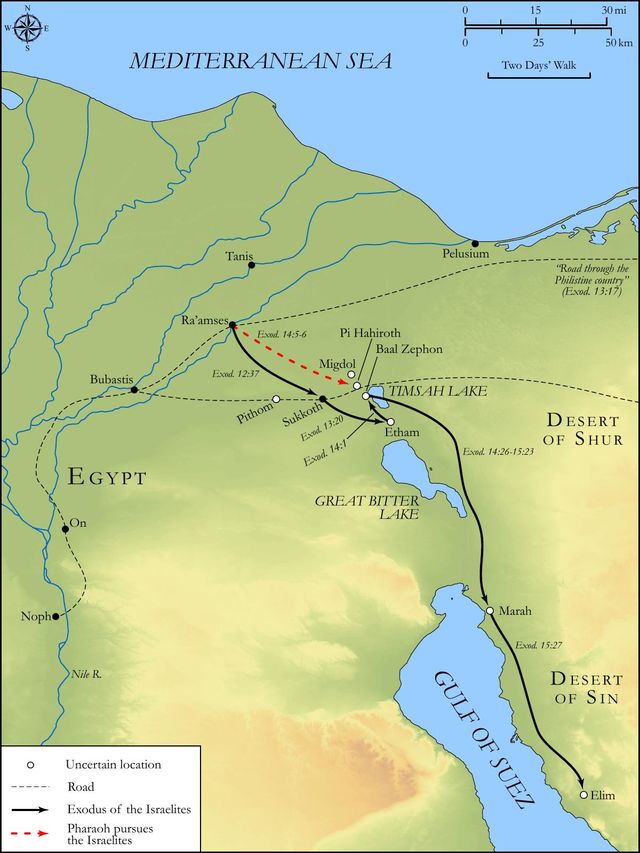
Here is, I. The choice God made of their way, Exo 13:17, Exo 13:18. He was their guide. Moses gave them direction but as he received it from the Lord. Note, The way of man is not in himself, Jer 10:23. He may devise his way, and design it; but, after all, it is God that directs his steps, Pro 16:9. Man proposes, but God disposes, and in his disposal we must acquiesce, and set ourselves to follow providence. There were two ways from Egypt to Canaan. One was a short cut from the north of Egypt to the south of Canaan, perhaps about four or five days' journey; the other was much further about, through the wilderness, and that was the way in which God chose to lead his people Israel, Exo 13:18. 1. There were many reasons why God led them through the way of the wilderness of the Red Sea. The Egyptians were to be drowned in the Red Sea. The Israelites were to be humbled and proved in the wilderness, Deu 8:2. God had given it to Moses for a sign (Exo 3:12), You shall serve God in this mountain. They had again and again told Pharaoh that they must go three days' journey into the wilderness to do sacrifice, and therefore it was requisite that they should bend their march that way, else they would justly have been exclaimed against as notorious dissemblers. Before they entered the lists with their enemies, matters must be settled between them and their God, laws must be given, ordinances instituted, covenants sealed, and the original contract ratified, for the doing of which it was necessary that they should retire into the solitudes of a wilderness, the only closet for such a crowd; the high road would be no proper place for these transactions. It is said (Deu 32:10), He led them about, some hundreds of miles about, and yet (Psa 107:7), He led them forth by the right way. God's way is the right way, though it seem about. If we think he leads not his people the nearest way, yet we may be sure he leads them the best way, and so it will appear when we come to our journey's end. Judge nothing before the time. 2. There was one reason why God did not lead them the nearest way, which would have brought them after a few days' march to the land of the Philistines (for it was that part of Canaan that lay next to Egypt), namely, because they were not as yet fit for war, much less for war with the Philistines, Exo 13:17. Their spirits were broken with slavery; it was not easy for them to turn their hands of a sudden from the trowel to the sword. The Philistines were formidable enemies, too fierce to be encountered by raw recruits; it was more suitable that they should begin with the Amalekites, and be prepared for the wars of Canaan by experiencing the difficulties of the wilderness. Note, God proportions his people's trials to their strength, and will not suffer them to be tempted above what they are able, Co1 10:13. That promise, if compared with the foregoing verses, will seem to refer to this event, as an instance of it. God knows our frame, and considers our weakness and faintheartedness, and by less trials will prepare us for greater. God is said to bring Israel out of Egypt as the eagle brings up her young ones (Deu 32:11), teaching them by degrees to fly. Orders being thus given which way they should go, we are told, (1.) That they went up themselves, not as a confused rout, but in good order, rank and file: they went up harnessed, Exo 13:18. They went up by five in a rank (so some), in five squadrons, so others. They marched like an army with banners, which added much to their strength and honour. (2.) That they took the bones of Joseph along with them (Exo 13:19), and probably the bones of the rest of Jacob's sons, unless (as some think) they had been privately carried to Canaan (Act 7:16), severally as they died. Joseph had particularly appointed that his bones should be carried up when God should visit the (Gen 50:25, Gen 50:26), so that their carrying up his bones was not only a performance of the oath their fathers had sworn to Joseph, but an acknowledgment of the performance of God's promise to them by Joseph that he would visit them and bring them out of the land of Egypt, and an encouragement to their faith and hope that he would fulfil the other part of the promise, which was to bring them to Canaan, in expectation of which they carried these bones with them while they wandered in the desert. They might think, "Joseph's bones must rest at last, and then we shall." Moses is said to take these bones with him. Moses was now a very great man; so had Joseph been in his day, yet he was now but a box full of dry bones; this was all that remained of him in this world, which might serve for a monitor to Moses to remember his mortality. I have said, You are gods; it was said so to Moses expressly (Exo 7:1); but you shall die like men.
II.Here is the guidance they were blessed with in the way:
The Lord went before them in a pillar, Exo 13:21, Exo 13:22. In the first two stages it was enough that God directed Moses whither to march: he knew the country and the road well enough; but now that they had come to the edge of the wilderness (Exo 13:20) they would have occasion for a guide; and a very good guide they had, one that was infinitely wise, kind, and faithful: The Lord went before them, the shechinah (or appearance of the divine Majesty, which was typical of Christ) or a previous manifestation of the eternal Word, which, in the fulness of time, was to be made flesh, and dwell among us. Christ was with the church in the wilderness, Co1 10:9. Now their King passed before them, even the Lord on the head of them, Mic 2:13. Note, Those whom God brings into a wilderness he will not leave nor lose there, but will take care to lead them through it; we may well think it was a very great satisfaction to Moses and the pious Israelites to be sure that they were under divine guidance. Those needed not to fear missing their way who were thus led, nor being lost who were thus directed; those needed not to fear being benighted who were thus illuminated, nor being robbed who were thus protected. Those who make the glory of God their end, and the word of God their rule, the Spirit of God the guide of their affections, and the providence of God the guide of their affairs, may be confident that the Lord goes before them, as truly as he went before Israel in the wilderness, though not so sensibly; we must live by faith.
1.They had sensible evidences of God's going before them. They all saw an appearance from heaven of a pillar, which in the bright day appeared cloudy, and in the dark night appeared fiery. We commonly see that that which is a flame in the night is a smoke in the day; so was this. God gave them this ocular demonstration of his presence, in compassion to the infirmity of their faith, and in compliance with that infant state of the church, which needed to be thus lisped to in their own language; but blessed are those that have not seen and yet have believed God's gracious presence with them, according to his promise.
2.They had sensible effects of God's going before them in this pillar. For,
(1.)It led the way in that vast howling wilderness, in which there was no road, no track, no way-mark, of which they had no maps, through which they had no guides. When they marched, this pillar went before them, at the rate that they could follow, and appointed the place of their encampment, as Infinite Wisdom saw fit, which both eased them from care, and secured them from danger, both in moving and in resting.
(2.)It sheltered them by day from the heat, which, at some times of the year, was extreme.
(3.)It gave them light by night when they had occasion for it, and at all times made their camp pleasant and the wilderness they were in less frightful.
III.These were constant standing miracles (Exo 13:22):
He took not away the pillar of cloud; no, not when they seemed to have less occasion for it, travelling through inhabited countries, no, not when they murmured and were provoking; it never left them, till it brought them to the borders of Canaan. It was a cloud which the wind could not scatter. This favour is acknowledged with thankfulness long afterwards, Neh 9:19; Psa 78:14. There was something spiritual in this pillar of cloud and fire.
1.The children of Israel were baptized unto Moses in this cloud, which, some think, distilled dew upon them, Co1 10:2. By coming under this cloud, they signified their putting themselves under the divine guidance and command by the ministry of Moses. Protection draws allegiance; this cloud was the badge of God's protection, and so became the bond of their allegiance. Thus they were initiated, and admitted under that government, now when they were entering upon the wilderness.
2.Some make this cloud a type f Christ. The cloud of his human nature was a veil to the light and fire of his divine nature; we find him (Rev 10:1) clothed with a cloud, and his feet as pillars of fire. Christ is our way, the light of our way and the guide of it.
3.It signified the special guidance and protection which the church of Christ is under in this world. God himself is the keeper of Israel, and he neither slumbers nor sleeps, Psa 121:4; Isa 27:3. There is a defence created, not only on Sion's assemblies, but on every dwelling-place in Sion. See Isa 4:5, Isa 4:6. Nay, every Israelite indeed is hidden under the shadow of God's wings (Psa 17:8); angels, whose ministry was made use of in this cloud, are employed for their good, and pitch their tents about them. Happy art thou, O Israel! who is like unto thee, O people?
Continue studying Exodus 13:17 across the web’s major study libraries — every link below opens this exact verse, chapter, or book on the destination site.
Read & Compare
 BibleGatewayThis verse in more than 200 translations and 70 languages.
 Bible.comThe YouVersion reader — hundreds of translations, reading plans, and highlights.
 ESV.orgCrossway's official English Standard Version reader.
 NET BibleThe NET translation with 60,000+ translators' notes on every rendering decision.
 STEP BibleTyndale House's free study tool — original text, vocabulary, and scholarly resources.
 BibliaLogos Bible Software's free web reader.
 USCCBThe New American Bible (Revised Edition) with the U.S. bishops' study notes.
Commentaries
 BibleHub CommentariesDozens of classic commentaries on this verse, gathered on one page.
 StudyLightMore than 100 commentary sets — the largest collection on the web.
 BibleRefPlain-English commentary on what this verse means, verse by verse.
 Enduring WordDavid Guzik's free commentary on this chapter, widely used by Bible teachers.
 Bible Study ToolsVerse commentary alongside Greek and Hebrew study aids.
Original Language & Research
- BibleHub InterlinearThe verse word by word — original language, transliteration, and English.
- BibleHub LexiconEvery word's original-language definition and Strong's entry.
 Blue Letter BibleDeep-study tools — Strong's numbers, concordance, and word studies.
 SefariaThe Hebrew text with Rashi and centuries of Jewish commentary.
Sermons, Hymns & Audio


TrulyRandomVerse is not affiliated with these sites and doesn’t control their content. They’re linked because they’re genuinely useful.
Summary
Exodus 13:17 profoundly illustrates God's strategic and compassionate leadership immediately following the Israelites' liberation from Egyptian bondage. Rather than guiding them along the direct, militarily perilous coastal route through Philistine territory, God intentionally led them on a longer, circuitous path through the wilderness. This divine wisdom and foresight prevented the newly freed, psychologically vulnerable people from encountering immediate warfare, which God knew would cause them to regret their freedom, lose heart, and desire to return to the perceived security of Egypt, thereby safeguarding their nascent faith and commitment to Him.
Context
ShowHideLiterary Context
This pivotal verse marks the transition from the climactic events of the Passover and the final plague—the death of the firstborn, which compelled Pharaoh to release Israel (Exodus 12:29-33)—to the commencement of their journey toward the Promised Land. The narrative immediately preceding this verse details the hurried departure from Rameses and the institution of the Feast of Unleavened Bread, emphasizing the urgency and divine mandate of their exodus. Following Exodus 13:17, the subsequent verses in Exodus 13:18-22 describe the specific route God chose, leading them by the way of the wilderness toward the Red Sea, and establishing the miraculous pillar of cloud by day and fire by night as His constant, visible presence and guide. This sequence underscores God's active, moment-by-moment involvement in the lives of His people.
Historical & Cultural Context
The "way of the land of the Philistines" refers to the Via Maris, or "Way of the Sea," a well-established ancient trade and military route that hugged the Mediterranean coast, connecting Egypt with Canaan and Mesopotamia. While geographically the shortest path to Canaan, this route was strategically significant and heavily fortified. At this time, it was dotted with Egyptian garrisons and inhabited by various Canaanite peoples, including the Philistines, who were known for their formidable military capabilities and iron weaponry. For a multitude of former slaves—unarmed, untrained, and psychologically fragile after centuries of brutal servitude—a direct confrontation with such well-equipped and experienced forces would have been disastrous. Their cultural memory of oppression was fresh, and the sheer terror of immediate, intense warfare would have been overwhelming, likely leading them to despair and a longing for the familiar, albeit enslaved, life in Egypt. God's decision was a pragmatic act of pastoral care, recognizing their profound vulnerability.
Key Themes
ShowHideExodus 13:17 contributes significantly to several overarching themes in the book of Exodus and the Pentateuch. Foremost is the theme of Divine Providence and Sovereign Guidance, demonstrating God's meticulous planning and active involvement in leading His people, not merely freeing them. It highlights God's Compassion and Understanding of Human Weakness, as He tailors His leadership to the people's fragile state, prioritizing their spiritual and psychological well-being over mere expediency. This verse also introduces the theme of Preparation for Covenant and Conquest, as the wilderness journey, though longer, served as a crucible for developing Israel's faith, unity, and dependence on God, preparing them for the reception of the Law at Sinai (Exodus 19) and the eventual conquest of Canaan (Numbers 13). It underscores that God's ways are often counter-intuitive to human logic but are always perfectly wise and aligned with His benevolent purposes, a truth echoed throughout the biblical narrative, as seen in passages like Isaiah 55:8-9.
Exposition and Analysis
ShowHideKey Word Analysis
ShowHideThis primitive root means "to guide," "to transport," or "to lead forth." In this context, it signifies God's active and intentional direction of the Israelites' journey. It is not a passive observation but a deliberate act of divine leadership, choosing their path for them. This emphasizes God's role as the ultimate guide and shepherd of His people, steering them away from immediate danger.
This word primarily means "to sigh," "to be sorry," or "to regret." While it can refer to theological repentance from sin, here it denotes a profound change of mind or regret concerning their decision to leave Egypt. God foresaw that the sight of war would cause the people to intensely regret their newfound freedom and long for the "comforts" (even in slavery) of Egypt, leading them to turn back. This highlights the psychological fragility of a people recently delivered from generations of bondage.
This term refers to a "battle" or "warfare" in general. Its inclusion here underscores the specific threat that God sought to avert. The Philistines were a formidable military power, and the "way of the land of the Philistines" was a heavily militarized zone. God's decision to avoid this path was a strategic act of protection, recognizing that the Israelites were not yet prepared, either militarily or psychologically, for such a direct and intense confrontation.
Verse Breakdown
ShowHide"And it came to pass, when Pharaoh had let the people go, that God led them not [through] the way of the land of the Philistines, although that [was] near"
This opening clause establishes the immediate context of Israel's liberation and highlights God's sovereign initiative. The phrase "God led them not" (Hebrew: lo nacham Elohim) signifies a deliberate, conscious decision on God's part, not an oversight or a random occurrence. The "way of the land of the Philistines" was indeed the most direct and "near" route to Canaan, appealing to human logic for efficiency and speed. God's choice to bypass this seemingly obvious path immediately signals that His wisdom often transcends and contradicts human expediency, demonstrating His higher purposes and perfect understanding.
"for God said, Lest peradventure the people repent when they see war, and they return to Egypt"
This second clause provides the divine rationale behind God's seemingly circuitous route, revealing His profound understanding of human nature and His compassionate foresight. God's stated reason is a preventative measure: He knew that an immediate encounter with the horrors of war would overwhelm the people with fear and discouragement. The primary concern was that they would "repent" (regret their decision to leave) and "return to Egypt," effectively abandoning their newfound liberty and their commitment to God. This demonstrates God's pastoral care, safeguarding their nascent faith and ensuring their long-term spiritual and physical survival by preparing them gradually for the challenges ahead.
Literary Devices
ShowHideExodus 13:17 employs a clear cause-and-effect structure, where God's specific action (not leading them via the Philistine route) is explicitly linked to His stated reason (to prevent the people from regretting their freedom and returning to Egypt upon seeing war). This direct linkage emphasizes divine intentionality and foresight. There is also an implicit contrast between human logic and divine wisdom: the "near" route represents the human desire for efficiency, while God's chosen longer, wilderness route embodies His superior, compassionate wisdom that prioritizes the people's well-being and spiritual formation over immediate geographical proximity. Furthermore, the verse subtly uses foreshadowing, hinting at the future challenges and potential for Israel's faith to waver, which will become a recurring theme throughout their wilderness journey.
Theological and Thematic Connections
ShowHideExodus 13:17 powerfully illustrates several core theological truths that resonate throughout the biblical narrative and into Christian theology. It underscores God's Divine Providence and Sovereign Guidance, revealing Him as an active, involved leader who meticulously plans the path for His people, knowing the end from the beginning and guiding with perfect wisdom for their ultimate good. This divine care is rooted in God's profound Compassion and Understanding of Human Weakness; He does not push His people beyond what they can bear but leads them gently, providing preparation and protection tailored to their specific needs and vulnerabilities, much like a loving parent. The verse also highlights the crucial Importance of Trust in God's Ways, especially when His path does not align with human logic or desires for expediency. The "near" path might seem most logical, but God's "detours" are often the safest, most formative, and ultimately lead to a deeper dependence on Him and the fulfillment of His promises.
Reflection and Application
ShowHideExodus 13:17 offers timeless and profoundly practical lessons for believers navigating the complexities of life's journey today. We often find ourselves desiring the shortest, most efficient path to our goals, whether in career, relationships, or personal growth. However, this verse serves as a powerful reminder that God frequently leads us on longer, more challenging, or seemingly circuitous routes. These "detours" are not delays or oversights but divine strategies meticulously designed for our protection, preparation, and profound spiritual growth. It calls us to cultivate a deep trust in God's wisdom, even when His path doesn't align with our immediate logic or comfort. Just as God knew the Israelites were not ready for immediate warfare, He intimately understands your current capacity, your weaknesses, and your vulnerabilities. He promises not to give you more than you can handle, and He prepares you for challenges step-by-step, not all at once, building resilience and faith along the way. Furthermore, the temptation to "return to Egypt"—to revert to old habits, perceived comforts, or a life apart from God when faced with difficulty or spiritual warfare—is a persistent danger for every believer. God's leading, even through the wilderness, aims to strengthen our resolve, deepen our commitment, and prevent us from regretting our spiritual journey and turning back from the freedom He has given us.
Questions for Reflection
ShowHideFAQ
ShowHideWhy didn't God just make the Israelites strong enough to fight the Philistines immediately?
ShowHideWhile God possesses infinite power to instantly empower His people for battle, as demonstrated in numerous later biblical accounts, His primary concern in Exodus 13:17 was not merely military victory but the spiritual and psychological well-being of a people just freed from centuries of brutal slavery. They were a traumatized, unorganized, and untrained multitude. They needed time to develop faith, unity, and a national identity distinct from their oppressors. God's wisdom often prioritizes character formation, spiritual maturity, and the building of a trusting relationship over immediate, humanly desired outcomes. He was preparing them for a deeper covenant relationship and a future inheritance, not just a quick conquest, understanding that true liberation involved more than just physical freedom.
Does "repent" in this verse mean they would have sinned by returning to Egypt?
ShowHideThe Hebrew word nâcham (H5162), translated "repent" here, primarily signifies "to be sorry," "to regret," or "to change one's mind." While returning to Egypt would indeed have been an act of profound disobedience and a rejection of God's miraculous deliverance, the emphasis of nâcham in this context is on their emotional and psychological state: a deep regret over having left, leading to a desire to reverse course. It is not primarily about theological repentance from sin in the sense of turning from wickedness, but a practical and emotional turning back from their commitment to God's plan due to fear and discouragement. God understood their fragility and sought to prevent this emotional and practical abandonment of their journey.
Was God afraid of the Philistines or the Egyptian garrisons?
ShowHideAbsolutely not. The God of Israel, who had just demonstrated His overwhelming power over Pharaoh and all the gods of Egypt through the ten devastating plagues, is not limited or threatened by any earthly army or nation. His decision to avoid the Philistine route was not born out of fear for Himself or an inability to overcome the enemy, but out of compassionate foresight for His people. It was a strategic choice to protect their nascent faith and commitment, preventing them from succumbing to fear and despair. This act underscores His wisdom and pastoral care, not a concession to a superior military force, as He is sovereign over all creation and all armies.
Christ-Centered Fulfillment
ShowHideExodus 13:17, with its profound themes of divine guidance, compassionate protection, and strategic preparation, finds its ultimate and most glorious fulfillment in the person and redemptive work of Jesus Christ. Just as God meticulously led Israel through the wilderness, Jesus is the true and ultimate Guide for His people, declaring Himself to be "the way, the truth, and the life" (John 14:6). He is the Good Shepherd who "leads His sheep out" and "goes before them" (John 10:3-4), intimately knowing our weaknesses and leading us in paths of righteousness for His name's sake (Psalm 23:3). He does not lead us into trials we cannot bear, but faithfully promises to provide a way of escape, ensuring we are not tempted beyond our strength (1 Corinthians 10:13). The Israelites were spared immediate physical warfare to prevent spiritual backsliding; in Christ, believers are not spared spiritual warfare but are equipped and empowered to stand firm against the schemes of the devil through the armor of God (Ephesians 6:10-18). Jesus, our High Priest, understands our weaknesses, having been tempted in every way, yet without sin (Hebrews 4:15), and He continually intercedes for us, praying that our faith may not fail (Luke 22:31-32), thereby protecting us from the ultimate "return to Egypt"—a final, eternal turning away from God. The wilderness journey prepared Israel for an earthly Promised Land; Christ leads His followers through the "wilderness" of this fallen world, using trials and "detours" to sanctify and prepare them, not for a temporal inheritance, but for the heavenly and eternal inheritance of God's Kingdom (1 Peter 1:3-5). He Himself is the ultimate fulfillment of the rest and inheritance that God promised, providing eternal life and true freedom from the bondage of sin and death, a liberation far greater than that from Pharaoh.