


Numbers 14:4
Bible text: King James Version (1769 Blayney text) · Public domain
Bible text: Berean Standard Bible · Public domain
Bible text: American Standard Version (1901) · Public domain
Bible text: World English Bible, Messianic edition · Public domain
Bible text: Geneva Bible (1599) · Public domain
Bible text: Young's Literal Translation · Public domain
- וַיֹּאמְרוּvai·yo·me·Ruand they saidH559Conj-w ¦ V-Qal-ConsecImperf-3mpVerb Qal Consecutive Imperfect 3rd Plural Masculineוַandיֹּאמְרוּthey said
- אִישׁ'isheachH376N-msNoun Singular Masculine Absolute
- אֶל'eltoH413PrepPreposition
- אָחִיו'a·Chivhis brotherH251N-msc ¦ 3msNoun Singular Masculine Constructאָחִיbrotherוhis
- נִתְּנָהni·te·Nahlet us appointH5414V-Qal-Imperf-1cpVerb Qal Imperfect 1st Plural common gender
- רֹאשׁrosha leaderH7218N-msNoun Singular Masculine Absolute
- וְנָשׁוּבָהve·na·Shu·vahand let us returnH7725Conj-w ¦ V-Qal-Imperf-1cpVerb Qal Imperfect 1st Plural common genderוְandנָשׁוּבָהlet us return
- מִצְרָיְמָהmitz·Ra·ye·mahEgypt towardsH4714N-proper ¦ SfxNoun Proper LocationמִצְרָיְמָEgyptהtowards
English is a literal word-by-word gloss of the Hebrew, not the KJV's wording. Why?
This is the original text the KJV's translators worked from — each Hebrew word with its own literal English meaning in this verse, prepared by scholars at Tyndale House, Cambridge. The KJV translates whole sentences, not word by word, so its wording differs: one Hebrew word can become several English words, and the KJV may choose “the LORD” where the gloss reads “Yahweh”. Both are faithful — they answer different questions. For the KJV's own rendering, switch to the KJV text.
Details
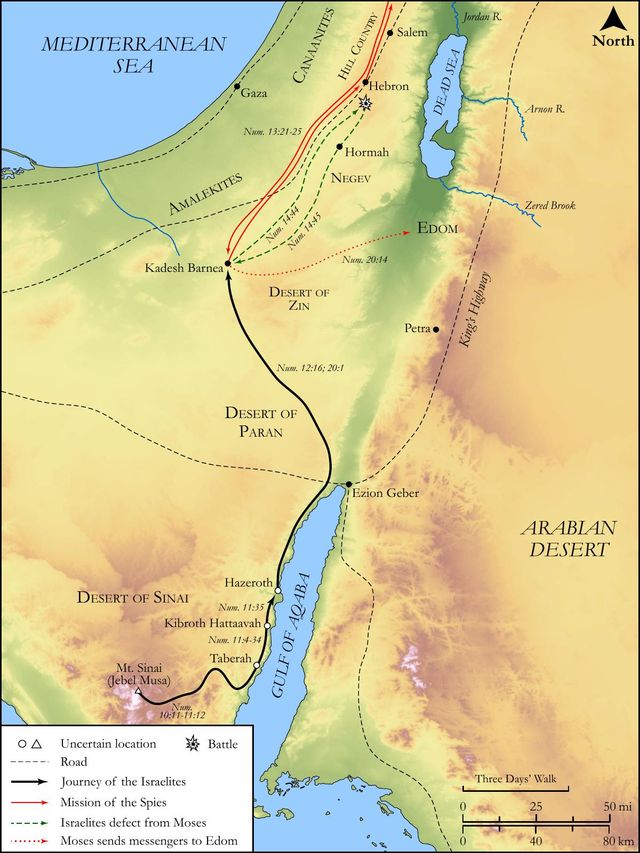
See on the biblical-era map
Study this verse
Public-domain commentary
Matthew Henry
From his Commentary on the Whole Bible. Henry comments on passages, not single verses — this entry covers Numbers 14:1–4. His two-level outline is real structure in the source text, so it is rendered as structure.
Here we see what mischief the evil spies made by their unfair representation. We may suppose that these twelve that were impanelled to enquire concerning Canaan had talked it over among themselves before they brought in their report in public; and Caleb and Joshua, it is likely, had done their utmost to bring the rest over to be of their mind, and if they would but have agreed that Caleb, according to his pose, should have spoken for them all, as their foreman, all had been well; but the evil spies, it should seem, wilfully designed to raise this mutiny, purely in opposition to Moses and Aaron, though they could not propose any advantage to themselves by it, unless they hoped to be captains and commanders of the retreat into Egypt they were now meditating. But what came of it? Here in these verses we find those whom they studied to humour put into a vexation, and, before the end of the chapter, brought to ruin. Observe,
I.How the people fretted themselves:
They lifted up their voices and cried (Num 14:1); giving credit to the report of the spies rather than to the word of God, and imagining their condition desperate, they laid the reins on the neck of their passions, and could keep no manner of temper. Like foolish froward children, they fall a crying, yet know not what they cry for. It would have been time enough to cry out when the enemy had beaten up their quarters, and they had seen the sons of Anak at the gate of their camp; but those that cried when nothing hurt them deserved to have something given them to cry for. And, as if all had been already gone, they sat down and wept that night. Note, Unbelief, or distrust of God, is a sin that is its own punishment. Those that do not trust God are continually vexing themselves. The world's mourners are more than God's, and the sorrow of the world worketh death.
II.How they flew in the face of their governors - murmured against Moses and Aaron, and in them reproached the Lord, Num 14:2, Num 14:3.
The congregation of elders began the discontent (Num 14:1), but the contagion soon spread through the whole camp, for the children of Israel murmured. Jealousies and discontents spread like wildfire among the unthinking multitude, who are easily taught to despise dominions, and to speak evil of dignities.
1.They look back with a causeless discontent. They wish that they had died in Egypt with the first-born that were slain there, or in the wilderness with those that lately died of the plague for lusting. See the prodigious madness of unbridled passions, which make men prodigal even of that which nature accounts most dear, life itself. Never were so many months spent so pleasantly as these which they had spent since they came out of Egypt, loaded with honours, compassed with favours, and continually entertained with something or other that was surprising; and yet, as if all these things had not made it worth their while to live, they wished they had died in Egypt. And such a light opinion they had of God's tremendous judgments executed on their neighbours for their sin that they wished they had shared with them in their plagues, rather than run the hazard of making a descent upon Canaan. They wish rather to die criminals under God's justice than live conquerors in his favour. Some read it, O that we had died in Egypt, or in the wilderness! O that we might die! They wish to die, for fear of dying; and have not sense enough to reason as the poor lepers, when rather than die upon the spot they ventured into an enemy's camp, If they kill us, we shall but die, Kg2 7:4. How base were the spirits of these degenerate Israelites, who, rather than die (if it come to the worst) like soldiers on the bed of honour, with their swords in their hands, desire to die like rotten sheep in the wilderness.
2.They look forward with a groundless despair, taking it for granted (Num 14:3) that if they went on they must fall by the sword, and pretend to lay the cause of their fear upon the great care they had for their wives and children, who, they conclude, will be a prey to the Canaanites. And here is a most wicked blasphemous reflection upon God himself, as if he had brought them hither on purpose that they might fall by the sword, and that their wives and children, those poor innocents, should be a prey. Thus do they, in effect, charge that God who is love itself with the worst of malice, and eternal Truth with the basest hypocrisy, suggesting that all the kind things he had said to them, and done for them, hitherto, were intended only to decoy them into a snare, and to cover a secret design carried on all along to ruin them. Daring impudence! But what will not that tongue speak against heaven that is set on fire of hell? The devil keeps up his interest in the hearts of men by insinuating to them ill thoughts of God, as if he desired the death of sinners, and delighted in the hardships and sufferings of his own servants, whereas he knows his thoughts to us-ward (whether we know them so or no) to be thoughts of good, and not of evil, Jer 29:11.
III.How they came at last to this desperate resolve, that, instead of going forward to Canaan, they would go back again to Egypt.
The motion is first made by way of query only (Num 14:3): Were it not better for us to return into Egypt? But the ferment being high, and the spirits of the people being disposed to entertain any thing that was perverse, it soon ripened to a resolution, without a debate (Num 14:4): Let us make a captain and return to Egypt; and it is lamented long after (Neh 9:17) that in their rebellion they appointed a captain to return to their bondage; for they knew Moses would not be their captain in this retreat. Now,
1.It was the greatest folly in the world to wish themselves in Egypt, or to think that if they were there it would be better with them than it was. If they durst not go forward to Canaan, yet better be as they were than go back to Egypt. What did they want? What had they to complain of? They had plenty, and peace, and rest, were under a good government, had good company, had the tokens of God's presence with them, and enough to make them easy even in the wilderness, if they had but hearts to be content. But whither were they thus eager to go to better themselves? To Egypt! Had they so soon forgotten the sore bondage they were in there? Would they be again under the tyranny of their taskmasters, and at the drudgery of making brick? And, after all the plagues which Egypt had suffered for their sakes, could they expect any better treatment there than they had formerly, and not rather much worse? In how little time (not a year and a half) have they forgotten all the sighs of their bondage, and all the songs of their deliverance! Like brute-beasts, they mind only what is present, and their memories, with the other powers of reason, are sacrificed to their passions. See Psa 106:7. We find it threatened (Deu 28:68), as the completing of their misery, that they should be brought into Egypt again, and yet this is what they here wish for. Sinners are enemies to themselves; and those that walk not in God's counsels consult their own mischief and ruin.
2.It was a most senseless ridiculous thing to talk of returning thither through the wilderness. Could they expect that God's cloud would lead them or his manna attend them? And, if they did not, the thousands of Israel must unavoidably be lost and perish in the wilderness. Suppose the difficulties of conquering Canaan were as great as they imagined, those of returning to Egypt were much greater. In this let us see, (1.) The folly of discontent and impatience under the crosses of our outward condition. We are uneasy at that which is, complain of our place and lot, and we would shift; but is there any place or condition in this world that has not something in it to make us uneasy if we are disposed to be so? The way to better our condition is to get our spirits into a better frame; and instead of asking, "Were it not better to go to Egypt?" ask, "Were it not better to be content, and make the best of that which is?" (2.) The folly of apostasy from the ways of God. Heaven is the Canaan set before us, a land flowing with milk and honey; those that bring up ever so ill a report of it cannot but say that it is indeed a good land, only it is hard to get to it. Strict and serious godliness is looked upon as an impracticable thing, and this deters many who began well from going on; rather than undergo the imaginary hardships of a religious life, they run themselves upon the certain fatal consequences of a sinful course; and so they transcribe the folly of Israel, who, when they were within a step of Canaan, would make a captain, and return to Egypt.
Continue studying Numbers 14:4 across the web’s major study libraries — every link below opens this exact verse, chapter, or book on the destination site.
Read & Compare
 BibleGatewayThis verse in more than 200 translations and 70 languages.
 Bible.comThe YouVersion reader — hundreds of translations, reading plans, and highlights.
 ESV.orgCrossway's official English Standard Version reader.
 NET BibleThe NET translation with 60,000+ translators' notes on every rendering decision.
 STEP BibleTyndale House's free study tool — original text, vocabulary, and scholarly resources.
 BibliaLogos Bible Software's free web reader.
 USCCBThe New American Bible (Revised Edition) with the U.S. bishops' study notes.
Commentaries
 BibleHub CommentariesDozens of classic commentaries on this verse, gathered on one page.
 StudyLightMore than 100 commentary sets — the largest collection on the web.
 BibleRefPlain-English commentary on what this verse means, verse by verse.
 Enduring WordDavid Guzik's free commentary on this chapter, widely used by Bible teachers.
 Bible Study ToolsVerse commentary alongside Greek and Hebrew study aids.
Original Language & Research
- BibleHub InterlinearThe verse word by word — original language, transliteration, and English.
- BibleHub LexiconEvery word's original-language definition and Strong's entry.
 Blue Letter BibleDeep-study tools — Strong's numbers, concordance, and word studies.
 SefariaThe Hebrew text with Rashi and centuries of Jewish commentary.
Sermons, Hymns & Audio


TrulyRandomVerse is not affiliated with these sites and doesn’t control their content. They’re linked because they’re genuinely useful.
Summary
Numbers 14:4 encapsulates a pivotal moment of profound rebellion and catastrophic unbelief among the Israelites, immediately following the disheartening report of ten spies concerning the formidable inhabitants of the Promised Land. Overwhelmed by fear and despair at the prospect of facing seemingly insurmountable obstacles, the people collectively rejected God's divinely appointed leadership under Moses and Aaron. Astonishingly, they proposed to establish their own leader and, in an ultimate act of spiritual regression, abandoned the journey to Canaan entirely, opting instead to return to the perceived "security" of their former bondage in Egypt. This verse starkly illustrates the human tendency to prefer the known, even if it is slavery, over the challenges and uncertainties of trusting God for a promised future.
Context
ShowHideLiterary Context
This verse stands as the climactic expression of the Israelites' immediate and widespread reaction to the spies' report detailed in Numbers 13. Following the majority report, which vividly emphasized the strength of the Canaanites and their fortified cities (Numbers 13:28-29), and despite Caleb's courageous and faithful counter-report (Numbers 13:30), the people succumbed to wailing and murmuring throughout the night (Numbers 14:1-2). Their lament quickly escalated into direct rebellion, first against Moses and Aaron, then implicitly against God Himself, culminating in the explicit proposal to "make a captain, and let us return into Egypt" found in this verse. This corporate defiance directly precipitates God's righteous judgment and the pronouncement of forty years of wilderness wandering for the unfaithful generation (Numbers 14:33-35).
Historical & Cultural Context
The Israelites at this juncture were a newly liberated people, having recently experienced the miraculous deliverance from centuries of Egyptian slavery and the foundational covenant establishment at Mount Sinai. Their journey through the wilderness was intended by God to forge them into a nation wholly dependent on and obedient to Yahweh, preparing them for life in the Promised Land. However, their collective memory of Egyptian bondage, though undeniably harsh, often seemed preferable to the daunting challenges and uncertainties of trusting God in the wilderness. The appointing of leaders was not uncommon in Israel, for Moses had made able men "heads over the people," but in this specific context, it represented a direct usurpation of God's divinely chosen leadership through Moses. Their desire to return to Egypt highlights a profound spiritual regression, a longing for the "fleshpots" of Egypt (Exodus 16:3) over the freedom and promises of God.
Key Themes
ShowHideNumbers 14:4 powerfully encapsulates several overarching themes prevalent throughout the book of Numbers and the broader Pentateuch. Primarily, it underscores the destructive nature of unbelief and fear, demonstrating how these corrosive forces can eclipse faith in God's omnipotence and His unfailing promises (Hebrews 3:12). It also highlights the critical theme of rejection of divine authority, as the people not only spurned Moses and Aaron, God's appointed mediators, but fundamentally rebelled against God's direct leadership and sovereign will for their lives. The verse further emphasizes the human tendency to long for the past (represented by Egypt), preferring the perceived security of known bondage over the challenging yet liberating path of faith towards true freedom. This profound act of rebellion sets the stage for the theme of consequences of disobedience, directly leading to the judgment of the wilderness wandering for an entire generation, as detailed later in Numbers 14.
Exposition and Analysis
ShowHideKey Word Analysis
ShowHideThe Hebrew word רֹאשׁ (rôʼsh), meaning "head" or "chief," is used here in the phrase "make a captain" (literally, "set a head"). This term signifies the intention to establish their own authority, to choose a leader who would align with their rebellious desires rather than submitting to God's chosen leader, Moses. This was a direct challenge to the divinely instituted order and a decisive move towards self-governance apart from God's will. It implies a desire for a leader who would lead them away from God's path, rather than into His promised blessing.
The verb שׁוּב (shûwb), meaning "to turn back," "to return," or "to revert," carries profound spiritual weight in this context. "Return into Egypt" (מִצְרַיְמָה Mitsraymah) is not merely a geographical movement but a profound spiritual and theological regression. It expresses a desire to reverse the miraculous liberation from slavery, to undo God's mighty acts of deliverance, and to revert to a state of servitude that God had specifically rescued them from. This choice highlights a deep-seated spiritual amnesia and a preference for the familiar, even if it meant bondage, over the challenging yet ultimately freeing path of faith towards the Promised Land.
Verse Breakdown
ShowHide"And they said one to another"
This phrase indicates a collective, unanimous, and public declaration of their intent. It was not merely individual grumbling but a corporate decision, a shared sentiment of rebellion that had spread throughout the community. This communal agreement underscores the depth of their widespread unbelief and the gravity of their sin, as the entire assembly actively participated in this defiance against God's plan and His appointed leaders.
"Let us make a captain"
This clause reveals their active decision to replace their divinely appointed leadership with a human, self-chosen authority. By proposing to "make a captain," they were not just rejecting Moses and Aaron, but implicitly rejecting God's direct rule and His covenant with them. They sought a leader who would cater to their fears and desires, rather than one who would faithfully lead them according to God's will, regardless of the challenges or the apparent impossibility of the task.
"and let us return into Egypt"
This final clause articulates the ultimate act of rejection and spiritual regression. It is a desire to abandon God's promise of the land, to negate the miraculous deliverance from slavery, and to revert to a life of bondage. This desire to return to Egypt, a place of oppression and idolatry, demonstrates a profound lack of faith in God's power, goodness, and faithfulness, preferring the perceived "comfort" of slavery over the freedom and challenges of God's covenant path.
Literary Devices
ShowHideNumbers 14:4 employs several potent literary devices to convey its message and underscore the gravity of the Israelites' sin. The most striking is Irony: the very people miraculously delivered from centuries of Egyptian bondage, who witnessed God's power in the plagues and the Red Sea, now desire to return to that very slavery. This highlights the profound spiritual amnesia and the human tendency to forget divine deliverance in the face of adversity. There is also a strong element of Contrast between God's unwavering faithfulness and the Israelites' profound faithlessness and rebellion. The collective "they said one to another" emphasizes Collective Speech, underscoring the communal nature of their sin and the widespread contagion of unbelief. Furthermore, this verse serves as a powerful Foreshadowing of future rebellions and the tragic consequences of disobedience that will plague Israel's history, both in the wilderness and beyond, demonstrating a recurring pattern of human rebellion against divine authority.
Theological and Thematic Connections
ShowHideNumbers 14:4 stands as a stark theological warning against the dangers of unbelief and the human propensity to regress when faced with spiritual challenges. It reveals that true freedom is not merely physical liberation but a spiritual journey of trust and obedience to God. The Israelites' desire to return to Egypt demonstrates a fundamental misunderstanding of God's redemptive work, preferring the known "comfort" of bondage to the unknown path of faith. This act of rebellion against divine authority underscores the seriousness of rejecting God's chosen leadership and His sovereign plan. The passage serves as a timeless reminder that fear, left unchecked, can lead to profound spiritual compromise and a rejection of God's best for His people, ultimately hindering their inheritance of His promises.
Reflection and Application
ShowHideNumbers 14:4 offers a profound mirror for believers today, challenging us to examine our own responses when faced with life's "giants" and "walled cities"—the daunting challenges, fears, or temptations that make God's promises seem impossible. Like the Israelites, we often stand at the threshold of God's blessings, only to allow fear and doubt to overshadow His proven faithfulness. This verse warns us against the subtle yet powerful pull of our "Egypts"—the old habits, sinful patterns, or perceived "comfort zones" that, though ultimately enslaving, offer a false sense of security when the path of faith becomes difficult. True spiritual growth requires us to resist the urge to regress, to cling to God's promises, and to trust His leadership even when the way forward is unclear or fraught with obstacles. Our response to adversity should be one of unwavering faith and courageous obedience, not rebellion and a desire to return to what God has already delivered us from.
Questions for Reflection
ShowHideFAQ
ShowHideWhy did the Israelites want to return to Egypt, a place of slavery?
ShowHideThe Israelites' desire to return to Egypt, despite their miraculous liberation, stemmed primarily from overwhelming fear and a profound lack of faith. Faced with the daunting report of the spies regarding the strong inhabitants and fortified cities of Canaan (Numbers 13:28), their immediate reaction was not to trust God's power, but to succumb to despair. They romanticized their past in Egypt, remembering the "fleshpots" and food (Exodus 16:3) while conveniently forgetting the harsh slavery and oppression. The known, even if it was bondage, seemed less terrifying than the unknown challenges of trusting God for a future they could not see. This highlights a common human tendency to prefer perceived security over the demanding path of faith.
Who was the "captain" they intended to make?
ShowHideThe text does not specify who the Israelites intended to make their "captain." The phrase "Let us make a captain" (שׂים ראשׁ, sim ro'sh) indicates their collective decision to appoint a leader from among themselves who would facilitate their desired return to Egypt. This would have been a leader who agreed with their fearful assessment and was willing to defy God's command to enter the Promised Land. This act was a direct rejection of Moses, God's divinely appointed leader, and ultimately, a profound rejection of God's own leadership over them, seeking instead a leader who would cater to their rebellious desires.
What were the immediate consequences of this rebellion?
ShowHideThe immediate consequences of this rebellion were severe and far-reaching. God's wrath was kindled against them, and He initially threatened to destroy them and make a greater nation from Moses (Numbers 14:11-12). However, through Moses' intercession, God relented from complete destruction but pronounced a judgment: the entire generation of Israelites twenty years old and upward who had rebelled would perish in the wilderness and not enter the Promised Land. Only Joshua and Caleb, who had shown unwavering faith, would be permitted to enter (Numbers 14:29-30). Furthermore, they were condemned to wander in the wilderness for forty years, one year for each day the spies explored the land (Numbers 14:33-34), a period of judgment and purification before the next generation could enter.
Christ-Centered Fulfillment
ShowHideThe Israelites' profound failure in Numbers 14:4, marked by their rejection of God's leadership and their desire to return to the slavery of Egypt, powerfully foreshadows humanity's inherent need for a perfect leader and a greater deliverance. Their inability to enter the earthly Promised Land due to unbelief points to the ultimate "Promised Land" of eternal rest and salvation, which can only be entered through unwavering faith in Christ. Jesus is the true and ultimate "Captain" or "Pioneer" of our salvation (Hebrews 2:10), who perfectly obeyed God where Israel failed. He leads His people not into an earthly territory, but out of the spiritual slavery of sin and death (Romans 6:6-7) into the glorious freedom of the children of God (John 8:34-36). Unlike the generation that perished in the wilderness due to their unbelief, those who trust in Christ are guaranteed entry into God's presence and eternal life, not by their own merit or strength, but by the perfect sacrifice of the Lamb of God who takes away the sin of the world!. He is the faithful leader who never turns back from God's will, ensuring that all who follow Him will inherit the true and heavenly country (Hebrews 11:16), a rest that remains for the people of God (Hebrews 4:9-11).