


Numbers 14:5
Bible text: King James Version (1769 Blayney text) · Public domain
Bible text: Berean Standard Bible · Public domain
Bible text: American Standard Version (1901) · Public domain
Bible text: World English Bible, Messianic edition · Public domain
Bible text: Geneva Bible (1599) · Public domain
Bible text: Young's Literal Translation · Public domain
- וַיִּפֹּלvai·yi·Poland he fellH5307Conj-w ¦ V-Qal-ConsecImperf-3msVerb Qal Consecutive Imperfect 3rd Singular Masculineוַandיִּפֹּלhe fell
- מֹשֶׁהmo·ShehMosesH4872N-proper-mNoun Proper Masculine
- וְאַהֲרֹןve·'a·ha·Ronand AaronH175Conj-w ¦ N-proper-mNoun Proper MasculineוְandאַהֲרֹןAaron
- עַל'alonH5921PrepPreposition
- פְּנֵיהֶםpe·nei·Hemtheir facesH6440N-mpc ¦ 3mpNoun Plural Masculine Constructפְּנֵיfacesהֶםtheir
- לִפְנֵיlif·Nei<to> beforeH6440Prep-l ¦ N-mpcNoun Plural Masculine Constructלִ<to>פְנֵיbefore
- כָּלkolallH3605N-mscNoun Singular Masculine Construct
- קְהַלke·Hal[the] assembly ofH6951N-mscNoun Singular Masculine Construct
- עֲדַת'a·Dat[the] congregation ofH5712N-fscNoun Singular Feminine Construct
- בְּנֵיbe·Nei[the] people ofH1121N-mpcNoun Plural Masculine Construct
- יִשְׂרָאֵלYis·ra·'ElIsraelH3478N-properNoun Proper Location
English is a literal word-by-word gloss of the Hebrew, not the KJV's wording. Why?
This is the original text the KJV's translators worked from — each Hebrew word with its own literal English meaning in this verse, prepared by scholars at Tyndale House, Cambridge. The KJV translates whole sentences, not word by word, so its wording differs: one Hebrew word can become several English words, and the KJV may choose “the LORD” where the gloss reads “Yahweh”. Both are faithful — they answer different questions. For the KJV's own rendering, switch to the KJV text.
Details
See on the biblical-era map
Study this verse
Public-domain commentary
Matthew Henry
From his Commentary on the Whole Bible. Henry comments on passages, not single verses — this entry covers Numbers 14:5–10. His four-level outline is real structure in the source text, so it is rendered as structure.
The friends of Israel here interpose to save them if possible from ruining themselves, but in vain. The physicians of their state would have healed them, but they would not be healed; their watchmen gave them warning, but they would not take warning, and so their blood is upon their own heads.
I.The best endeavours were used to still the tumult, and, if now at last they would have understood the things that belonged to their peace, all the following mischief would have been prevented.
1.Moses and Aaron did their part, Num 14:5. Though it was against them that they murmured (Num 14:2), yet they bravely overlooked the affront and injury done them, and approved themselves faithful friends to those who were outrageous enemies to them. The clamour and noise of the people were so great that Moses and Aaron could not be heard; should they order any of their servants to proclaim silence, the angry multitude would perhaps be the more clamorous; and therefore, to gain audience in the sight of all the assembly, they fell on their faces, thus expressing,
(1.)Their humble prayers to God to still the noise of this sea, the noise of its waves, even the tumult of the people.
(2.)The great trouble and concern of their own spirits. They fell down as men astonished and even thunder-struck, amazed to see a people throw away their own mercies: to see those so ill-humoured who were so well taught. And,
(3.)Their great earnestness with the people to cease their murmurings; they hoped to work upon them by this humble posture, and to prevail with them not to persist in their rebellion; Moses and Aaron beseech them, as though by them God himself did beseech them, to be reconciled unto God. What they said to the people Moses relates in the repetition of this story. Deu 1:29, Deu 1:30, Be not afraid; the Lord your God shall fight for you. Note, Those that are zealous friends to precious souls will stoop to any thing for their salvation. Moses and Aaron, notwithstanding the posts of honour they are in, prostrate themselves to the people to beg of them not to ruin themselves.
2.Caleb and Joshua did their part: they rent their clothes in a holy indignation at the sin of the people, and a holy dread of the wrath of God, which they saw ready to break out against them. it was the greater trouble to these good men because the tumult was occasioned by those spies with whom they had been joined in commission; and therefore they thought themselves obliged to do what they could to still the storm which their fellows had raised. No reasoning could be more pertinent and pathetic than theirs was (Num 14:7-9), and they spoke as with authority.
(1.)They assured them of the goodness of the land they had surveyed, and that it was really worth venturing for, and not a land that ate up the inhabitants, as the evil spies had represented it. It is an exceedingly good land (Num 14:7); it is very, very good, so the word is; so that they had no reason to despise this pleasant land. Note, If men were but thoroughly convinced of the desirableness of the gains of religion, they would not stick at the services of it.
(2.)They made nothing of the difficulties that seemed to lie in the way of their gaining the possession of it: "Fear not the people of the land, Num 14:9. Whatever formidable ideas have been given you of them, the lion is not so fierce as he is painted. They are bread for us," that is, "they are set before us rather to be fed upon than to be fought with, so easily, so pleasantly, and with so much advantage to ourselves shall we master them." Pharaoh is said to have been given them for meat (Psa 74:14), and the Canaanites will be so too. They show that, whatever was suggested to the contrary, the advantage was clear on Israel's side. For,
[1.]Though the Canaanites dwell in walled cities, they are naked: Their defence has departed from them; that common providence which preserves the rights of nations has abandoned them, and will be no shelter nor protection to them. The other spies took notice of their strength, but these of their wickedness, and thence inferred that God had forsaken them, and therefore their defence had departed. No people can be safe when they have provoked God to leave them.
[2.]Though Israel dwell in tents they are fortified: The Lord is with us, and his name is a strong tower; fear them not. Note, While we have the presence of God with us, we need not fear the most powerful force against us.
(3.)They showed them plainly that all the danger they were in was from their own discontents, and that they would succeed against all their enemies if they did not make God their enemy. On this point alone the cause would turn (Num 14:8): "If the Lord delight in us, as certainly he does, and will if we do not provoke him, he will bring us into this good land; we shall without fail get it in possession by his favour, and the light of his countenance (Psa 44:3), if we do not forfeit his favour and by our own follies turn away our own mercies." It has come to this issue (Num 14:9): Only rebel not you against the Lord. Note, Nothing can ruin sinners but their own rebellion. If God leave them, it is because they drive him from them; and they die because they will die. None are excluded the heavenly Canaan but those that exclude themselves. And, now, could the case have been made more plain? could it have been urged more closely? But what was the effect?
II.It was all to no purpose; they were deaf to this fair reasoning; nay, they were exasperated by it, and grew more outrageous:
All the congregation bade stone them with stones, Num 14:10. The rulers of the congregation, and the great men (so bishop Patrick), ordered the common people to fall upon them, and knock their brains out. Their case was sad indeed when their leaders thus caused them to err. Note, It is common for those whose hearts are fully set in them to do evil to rage at those who give them good counsel. Those who hate to be reformed hate those that would reform them, and count them their enemies because they tell them the truth. Thus early did Israel begin to misuse the prophets, and stone those that were sent to them, and it was this that filled the measure of their sin, Mat 23:37. Stone them with stones! Why, what evil have they done? No crime can be laid to their charge; but the truth is these two witnesses tormented those that were obstinate in their infidelity, Rev 11:10. Caleb and Joshua had but just said, The Lord is with us; fear them not (Num 14:9): and, if Israel will not apply those encouraging words to their own fears, those that uttered them know how to encourage themselves with them against this enraged multitude that spoke of stoning them, as David in a like cause, Sa1 30:6. Those that cannot prevail to edify others with their counsels and comforts should endeavour at least to edify themselves. Caleb and Joshua knew they appeared for God and his glory, and therefore doubted not but God would appear for them and their safety. And they were not disappointed, for immediately the glory of the Lord appeared, to the terror and confusion of those that were for stoning the servants of God. When they reflected upon God (Num 14:3), his glory appeared not to silence their blasphemies; but, when they threatened Caleb and Joshua, they touched the apple of his eye, and his glory appeared immediately. Note, Those who faithfully expose themselves for God are sure to be taken under his special protection, and shall be hidden from the rage of men, either under heaven or in heaven.
Continue studying Numbers 14:5 across the web’s major study libraries — every link below opens this exact verse, chapter, or book on the destination site.
Read & Compare
 BibleGatewayThis verse in more than 200 translations and 70 languages.
 Bible.comThe YouVersion reader — hundreds of translations, reading plans, and highlights.
 ESV.orgCrossway's official English Standard Version reader.
 NET BibleThe NET translation with 60,000+ translators' notes on every rendering decision.
 STEP BibleTyndale House's free study tool — original text, vocabulary, and scholarly resources.
 BibliaLogos Bible Software's free web reader.
 USCCBThe New American Bible (Revised Edition) with the U.S. bishops' study notes.
Commentaries
 BibleHub CommentariesDozens of classic commentaries on this verse, gathered on one page.
 StudyLightMore than 100 commentary sets — the largest collection on the web.
 BibleRefPlain-English commentary on what this verse means, verse by verse.
 Enduring WordDavid Guzik's free commentary on this chapter, widely used by Bible teachers.
 Bible Study ToolsVerse commentary alongside Greek and Hebrew study aids.
Original Language & Research
- BibleHub InterlinearThe verse word by word — original language, transliteration, and English.
- BibleHub LexiconEvery word's original-language definition and Strong's entry.
 Blue Letter BibleDeep-study tools — Strong's numbers, concordance, and word studies.
 SefariaThe Hebrew text with Rashi and centuries of Jewish commentary.
Sermons, Hymns & Audio


TrulyRandomVerse is not affiliated with these sites and doesn’t control their content. They’re linked because they’re genuinely useful.
Summary
Numbers 14:5 captures a pivotal moment of crisis and leadership in the wilderness narrative, immediately following Israel's profound act of rebellion. After the disheartening report from ten of the twelve spies led the congregation to weep, murmur against God and His appointed leaders, and even propose returning to Egypt, Moses and Aaron, as the divinely chosen mediators, prostrated themselves before the entire assembly. This powerful visual demonstration conveyed their deep distress, profound humility, and desperate appeal to God on behalf of a wayward and faithless people, signifying their complete reliance on divine intervention in the face of human defiance.
Context
ShowHideLiterary Context
This verse is deeply embedded within the climactic narrative of Numbers 14:1-4. The preceding verses describe the Israelites' visceral reaction to the negative spy report: a collective wail, bitter lamentation, and open rebellion against Yahweh and His appointed leaders. Their despair quickly escalates into outright mutiny, as they accuse Moses and Aaron, express a wish to have died in Egypt or the wilderness, and even propose appointing a new leader to guide them back to their former bondage. Moses and Aaron's act of falling on their faces is thus a direct, immediate, and desperate response to this profound spiritual apostasy and the imminent threat of a full-blown mutiny. It signifies their complete helplessness in the face of the people's hardened hearts and their turning to God as the only source of authority and intervention. This moment sets the stage for the subsequent divine judgment and the reaffirmation of God's covenant, albeit with severe consequences for the rebellious generation, as detailed in the remainder of Numbers 14.
Historical & Cultural Context
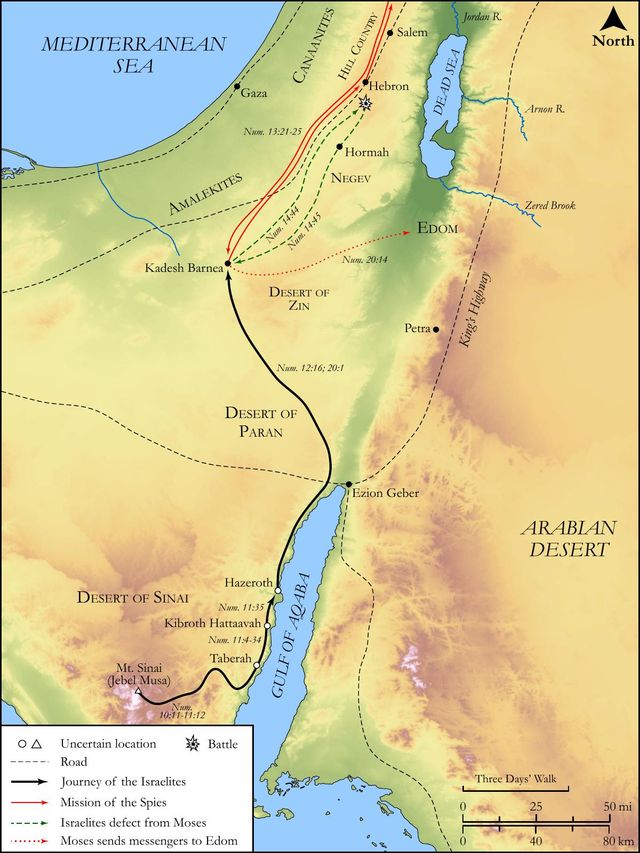
The events of Numbers 14 unfold approximately two years after the Exodus from Egypt, with the nation of Israel positioned at Kadesh-barnea, on the very threshold of the Promised Land. The sending of the twelve spies, one from each tribe, was a strategic move intended to gather intelligence and prepare the people for the conquest, yet it became a crucial test of their faith in God's power and faithfulness to His covenant promises. Prostration—the act of "falling on their faces"—was a common and highly significant gesture in Israel before the LORD, as when all the people saw the fire come out from before Him and "fell on their faces." It conveyed a spectrum of meanings, including deep reverence, submission, supplication, or profound distress. Such a posture was typically adopted in the presence of deity, before a king, or in moments of overwhelming awe, grief, or despair. For Moses and Aaron, as the covenant mediators and the divinely appointed leaders of Israel, performing this act publicly before the rebellious congregation underscored their recognition of God's ultimate sovereignty. It also highlighted their own powerlessness against the collective will of the people, effectively turning their appeal directly from the human realm to the divine, acknowledging that only God could resolve this crisis.
Key Themes
ShowHideNumbers 14:5 powerfully contributes to several overarching themes woven throughout the book of Numbers and the Pentateuch. Firstly, it vividly illustrates the recurring theme of Leadership and Intercession. Moses and Aaron consistently function as mediators between a holy God and a rebellious people. Their prostration here is a profound act of intercession, echoing Moses' earlier pleas for Israel after the golden calf incident in Exodus 32:11-14. Secondly, the verse underscores the severe consequences of Unbelief and Rebellion. The people's refusal to trust God's power and faithfulness, despite His miraculous deliverance and provision, is the direct catalyst for this crisis. This demonstrates how quickly a lack of faith can devolve into open defiance, jeopardizing God's redemptive plan for His people. Finally, it speaks to the theme of Divine Authority and Covenant Faithfulness. Moses and Aaron's action implicitly acknowledges God's ultimate authority and His unwavering commitment to His covenant, even when His people prove faithless. This sets the stage for God's subsequent judgment and the reaffirmation of His promises, albeit with a delay, as seen in Numbers 14:20-35.
Exposition and Analysis
ShowHideKey Word Analysis
ShowHideThis idiomatic Hebrew phrase is composed of the verb H5307 (nâphal, "to fall") and the noun H6440 (pânîym, "faces"). It signifies a posture of extreme humility, submission, reverence, or profound distress. It is a physical act of prostration, indicating a complete surrender to a higher power or an overwhelming sense of helplessness. In this context, it conveys Moses and Aaron's utter despair at the people's rebellion, their recognition of the gravity of the situation, and their turning to God in desperate supplication rather than attempting to reason further with the defiant multitude. It is a non-verbal plea for divine intervention, acknowledging their own inability to control the situation.
This compound phrase employs H6951 (qâhâl, "assemblage") and H5712 (ʻêdâh, "congregation" or "stated assemblage"). Both terms refer to the collective body of the Israelites, specifically those gathered for communal action or decision-making. In the Pentateuch, the qâhâl and ʿēdâ are not merely a random crowd but represent the divinely constituted community of Israel, bound by covenant to Yahweh. The use of both terms emphasizes the widespread and unified nature of the rebellion, underscoring that the entire covenant community was implicated in this act of unbelief. The fact that Moses and Aaron fell before "all the assembly of the congregation" highlights the public and desperate nature of their appeal, directed at a people who had collectively turned away from God.
Verse Breakdown
ShowHide"Then Moses and Aaron"
This clause identifies the two primary leaders of Israel, divinely appointed by God to guide His people through the wilderness. Their joint action underscores their unified leadership and shared burden in the face of this unprecedented crisis. Their names evoke their unique roles as the covenant mediator (Moses) and the high priest (Aaron), emphasizing the spiritual weight and authority behind their response.
"fell on their faces"
This describes their physical posture of prostration. As analyzed above, it is a powerful non-verbal expression of humility, submission, despair, and desperate prayer. It signifies their complete reliance on God's power and their recognition of their own inability to control or persuade the rebellious congregation through human means. This act is a turning away from the people's defiance and a turning towards God in desperate appeal.
"before all the assembly of the congregation of the children of Israel"
This specifies the audience and the scope of the rebellion. The act of prostration was public, performed in full view of the entire covenant community. This highlights the widespread nature of the people's unbelief and the public nature of the leaders' distress and appeal. It emphasizes the collective nature of the crisis and the urgent need for a collective divine response to the entire nation of God's chosen people.
Literary Devices
ShowHideThe verse employs several powerful literary devices to convey its profound message. Symbolism is paramount, as the act of Moses and Aaron falling on their faces serves as a potent visual symbol of profound humility, desperate intercession, and utter dependence on God in the face of overwhelming human rebellion. This posture creates a stark contrast with the people's defiant and faithless murmuring, highlighting the vast chasm between the leaders' trust in God and the congregation's profound unbelief. The scene also utilizes dramatic irony, as the people's rebellion, intended to avoid perceived danger, actually leads them into greater peril and judgment. Furthermore, there is an element of foreshadowing, as this dramatic moment sets the stage for God's subsequent judgment on the rebellious generation, who would wander in the wilderness for forty years, and simultaneously foreshadows Moses' continued role as a faithful intercessor throughout the wilderness journey, a role he would repeatedly fulfill as seen in Numbers 16:45.
Theological and Thematic Connections
ShowHideNumbers 14:5 serves as a profound theological statement on the nature of leadership, the gravity of unbelief, and the necessity of divine intervention. Moses and Aaron's prostration is not merely an act of despair but a profound theological declaration: they acknowledge that only God, in His sovereign power and mercy, can address the deep-seated rebellion and faithlessness of His people. Their action underscores the principle that true spiritual leadership, especially in times of profound crisis, involves not just directing but also interceding, bearing the burden of the people's sin before God. This moment highlights the terrifying power of collective unbelief to derail God's purposes, yet it also implicitly points to God's enduring patience and His willingness to respond to the fervent prayers of His faithful servants, even when judgment is justly deserved. It is a vivid illustration of the spiritual battle fought by leaders on behalf of their flock.
Reflection and Application
ShowHideNumbers 14:5 provides a stark and powerful lesson for believers today, particularly concerning the nature of faith, the responsibilities of leadership, and the devastating consequences of unbelief. In a world often characterized by complaint, distrust, and a desire for immediate gratification, this passage challenges us to examine our own hearts: do we truly trust God's promises even when circumstances seem overwhelming, or do we succumb to fear, murmuring, and a desire to return to a perceived "comfort" of the past? For those in positions of leadership, whether in the church, family, or community, this verse illustrates the immense burden and spiritual responsibility of guiding a community, especially when confronted with widespread spiritual apathy or open rebellion. Moses and Aaron's response teaches us that in moments of profound crisis, true leadership often means humbling ourselves before God, interceding fervently on behalf of others, and acknowledging our complete dependence on divine power rather than relying solely on human strategy or persuasion. It calls us to cultivate a spirit of humility, persistent prayer, and unwavering faith, recognizing that our ultimate hope and solution lie not in our own strength or wisdom, but in God's sovereign hand and His unfailing faithfulness.
Questions for Reflection
ShowHideFAQ
ShowHideWhy did Moses and Aaron fall on their faces instead of trying to reason with the people?
ShowHideMoses and Aaron fell on their faces as a profound act of humility, despair, and desperate intercession because reasoning with the people had proven utterly futile. The congregation was already in a state of open rebellion, weeping, murmuring, and even plotting to appoint a new leader to return to Egypt, as vividly described in Numbers 14:1-4. Their prostration signified their complete reliance on God's intervention, acknowledging that only divine power could address the deep-seated unbelief and avert the impending judgment. It was a strategic turning from human persuasion, which had failed, to divine appeal, a recognition that the situation was beyond their control and required God's direct and sovereign action. This posture also symbolized their identification with the people's plight while simultaneously appealing to God on their behalf, demonstrating their essential role as faithful mediators.
What was the immediate outcome of Moses and Aaron's action and the people's rebellion?
ShowHideImmediately following Moses and Aaron's prostration, Joshua and Caleb, the two faithful spies, tore their clothes and courageously attempted to persuade the people to trust God and enter the land, as recorded in Numbers 14:6-9. However, the assembly responded with escalating defiance, threatening to stone them. It was at this critical juncture that the glory of the Lord suddenly appeared in the tabernacle before all the children of Israel, signaling God's direct and imminent intervention. God then declared His intention to strike the people with pestilence and disinherit them, but Moses again interceded on their behalf, appealing to God's great mercy and His reputation among the nations, as detailed in Numbers 14:11-19. While God relented from immediate destruction, He declared that the rebellious generation, aged twenty and above, would die in the wilderness and not enter the Promised Land, except for Caleb and Joshua, a judgment outlined in Numbers 14:26-35.
Christ-Centered Fulfillment
ShowHideNumbers 14:5, with Moses and Aaron's desperate intercession in the face of Israel's profound unbelief, powerfully foreshadows the ultimate Christ-centered fulfillment of mediation and salvation. Moses, as the faithful leader and intercessor, stands as a prophetic type of Christ, who is the greater prophet and the perfect mediator of a new and better covenant, as profoundly highlighted in Hebrews 3:1-6. While Moses and Aaron could only fall on their faces in despair and plead for a rebellious people, Jesus, the spotless Lamb of God, did not merely intercede; He became the atoning sacrifice for the very sin of unbelief and rebellion that plagued Israel. His profound prostration in Gethsemane (Matthew 26:39) was not a plea for a wayward people to turn, but a perfect submission to the Father's will for their salvation. Jesus fully takes away the sin of the world (John 1:29), providing the ultimate, once-for-all atonement that Moses and Aaron could only anticipate through their priestly and prophetic roles. Through His finished work on the cross, Christ perfectly addresses the root of human rebellion and unbelief, offering not just a temporary reprieve from judgment but eternal life and true spiritual rest to all who believe, ushering them into the heavenly Canaan (Hebrews 4:1-11).