


Exodus 13:16
Bible text: King James Version (1769 Blayney text) · Public domain
Bible text: Berean Standard Bible · Public domain
Bible text: American Standard Version (1901) · Public domain
Bible text: World English Bible, Messianic edition · Public domain
Bible text: Geneva Bible (1599) · Public domain
Bible text: Young's Literal Translation · Public domain
- וְהָיָהve·ha·Yahand it will becomeH1961Conj-w ¦ V-Qal-ConsecPerf-3msVerb Qal Consecutive Perfect 3rd Singular Masculineוְandהָיָהit will become
- לְאוֹתle·'Ot<into> a signH226Prep-l ¦ N-fsNoun Singular Feminine Absoluteלְ<into>אוֹתa sign
- עַל'alonH5921PrepPreposition
- יָדְכָהya·de·Khahyour handH3027N-csc ¦ 2msNoun Singular common gender Constructיָדְhandכָהyour
- וּלְטוֹטָפֹתu·le·to·ta·Fotand <into> marksH2903Conj-w ¦ Prep-l ¦ N-fpNoun Plural Feminine Absoluteוּandלְ<into>טוֹטָפֹתmarks
- בֵּיןbeinbetweenH996Adj-mscAdjective Numerical Singular Masculine Construct
- עֵינֶיךָ'ei·Nei·khayour eyesH5869N-fdc ¦ 2msNoun Dual Feminine Constructעֵינֶיeyesךָyour
- כִּיkiforH3588PrtParticle Conditional
- בְּחֹזֶקbe·Cho·zekwith strength ofH2392Prep-b ¦ N-mscNoun Singular Masculine Constructבְּwithחֹזֶקstrength of
- יָדYadhandH3027N-csNoun Singular common gender Absolute
- הוֹצִיאָנוּho·tzi·'A·nuhe brought out usH3318V-Hiphil-Perf-3ms ¦ 1cpVerb Hiphil Perfect 3rd Singular Masculineהוֹצִיאָhe brought outנוּus
- יְהוָהYah·wehYahwehH3068N-properNoun Proper Title
- מִמִּצְרָיִםmi·mitz·Ra·yimfrom EgyptH4714Prep-m ¦ N-properNoun Proper LocationמִfromמִּצְרָיִםEgypt
English is a literal word-by-word gloss of the Hebrew, not the KJV's wording. Why?
This is the original text the KJV's translators worked from — each Hebrew word with its own literal English meaning in this verse, prepared by scholars at Tyndale House, Cambridge. The KJV translates whole sentences, not word by word, so its wording differs: one Hebrew word can become several English words, and the KJV may choose “the LORD” where the gloss reads “Yahweh”. Both are faithful — they answer different questions. For the KJV's own rendering, switch to the KJV text.
Details
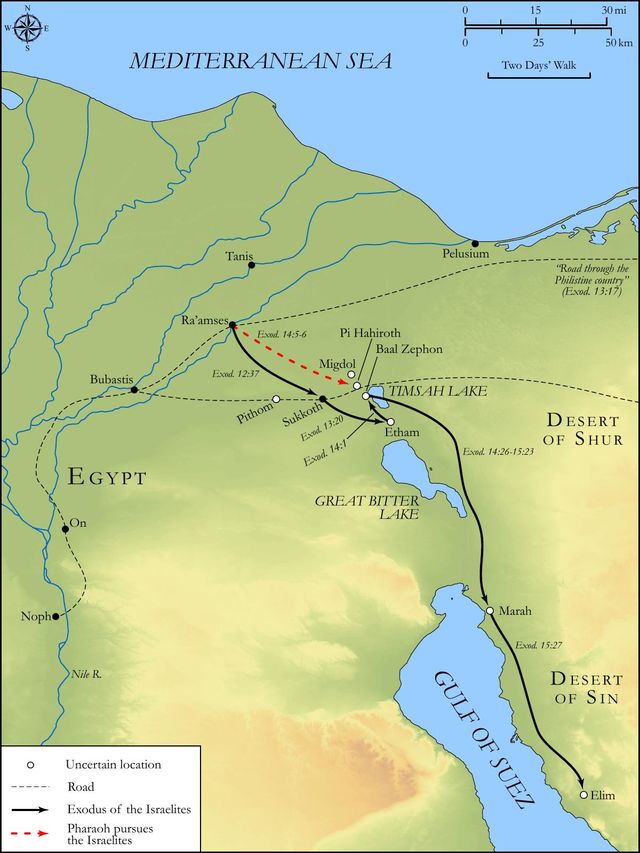
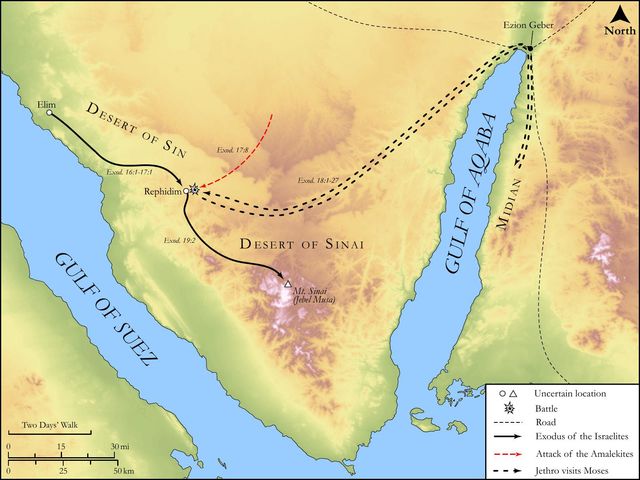
See on the biblical-era maps

Study this verse
Public-domain commentary
Matthew Henry
From his Commentary on the Whole Bible. Henry comments on passages, not single verses — this entry covers Exodus 13:11–16. His two-level outline is real structure in the source text, so it is rendered as structure.
Here we have,
I.Further directions concerning the dedicating of their firstborn to God.
1.The firstlings of their cattle were to be dedicated to God, as part of their possessions. Those of clean beasts - calves, lambs, and kids - if males, were to be sacrificed, Exo 22:30; Num 18:17, Num 18:18. Those of unclean beasts, as colts, were to be redeemed with a lamb, or knocked on the head. For whatsoever is unclean (as we all are by nature), if it be not redeemed, will be destroyed, Exo 13:11, Exo 13:13.
2.The firstborn of their children were to be redeemed, and by no means sacrificed, as the Gentiles sacrificed their children to Moloch. The price of the redemption of the firstborn was fixed by the law (Num 18:16) at five sheckles. We were all obnoxious to the wrath and curse of God; by the blood of Christ we are redeemed, that we may be joined to the church of the firstborn. They were to redeem their children, as well as the firstlings of the unclean beasts, for our children are by nature polluted. Who can bring a clean thing out of an unclean?
II.Further directions concerning the catechising of their children, and all those of the rising generation, from time to time, in this matter.
It is supposed that, when they saw all the firstlings thus devoted, they would ask the meaning of it, and their parents and teachers must tell them (Exo 13:14-16) that God's special propriety in their firstborn, and all their firstlings, was founded in his special preservation of them from the sword of the destroying angel. Being thus delivered, they must serve him. Note,
1.Children should be directed and encouraged to ask their parents questions concerning the things of God, a practice which would be perhaps of all others the most profitable way of catechising; and parents must furnish themselves with useful knowledge, that they may be ready always to give an answer to their enquiries. If ever the knowledge of God cover the earth, as the waters do the sea, the fountains of family-instruction must first be broken up.
2.We should all be able to show cause for what we do in religion. As sacraments are sanctified by the word, so they must be explained and understood by it. God's service is reasonable, and it is then acceptable when we perform it intelligently, knowing what we do and why we do it.
3.It must be observed how often it is said in this chapter that by strength of hand (Exo 13:3, Exo 13:14, Exo 13:16), with a strong hand (Exo 13:9), the Lord brought them out of Egypt. The more opposition is given to the accomplishment of God's purposes the more is his power magnified therein. It is a strong hand that conquers hard hearts. Sometimes God is said to work deliverance not by might nor power (Zac 4:6), not by such visible displays of his power as that recorded here.
4.Their posterity that should be born in Canaan are directed to say, The Lord brought us out of Egypt, Exo 13:14, Exo 13:16. Mercies to our fathers are mercies to us; we reap the benefit of them, and therefore must keep up a grateful remembrance of them. We stand upon the bottom of former deliverances, and were in the loins of our ancestors when they were delivered. Much more reason have we to say that in the death and resurrection of Jesus Christ we were redeemed.
Continue studying Exodus 13:16 across the web’s major study libraries — every link below opens this exact verse, chapter, or book on the destination site.
Read & Compare
 BibleGatewayThis verse in more than 200 translations and 70 languages.
 Bible.comThe YouVersion reader — hundreds of translations, reading plans, and highlights.
 ESV.orgCrossway's official English Standard Version reader.
 NET BibleThe NET translation with 60,000+ translators' notes on every rendering decision.
 STEP BibleTyndale House's free study tool — original text, vocabulary, and scholarly resources.
 BibliaLogos Bible Software's free web reader.
 USCCBThe New American Bible (Revised Edition) with the U.S. bishops' study notes.
Commentaries
 BibleHub CommentariesDozens of classic commentaries on this verse, gathered on one page.
 StudyLightMore than 100 commentary sets — the largest collection on the web.
 BibleRefPlain-English commentary on what this verse means, verse by verse.
 Enduring WordDavid Guzik's free commentary on this chapter, widely used by Bible teachers.
 Bible Study ToolsVerse commentary alongside Greek and Hebrew study aids.
Original Language & Research
- BibleHub InterlinearThe verse word by word — original language, transliteration, and English.
- BibleHub LexiconEvery word's original-language definition and Strong's entry.
 Blue Letter BibleDeep-study tools — Strong's numbers, concordance, and word studies.
 SefariaThe Hebrew text with Rashi and centuries of Jewish commentary.
Sermons, Hymns & Audio


TrulyRandomVerse is not affiliated with these sites and doesn’t control their content. They’re linked because they’re genuinely useful.
Summary
Exodus 13:16 serves as a culminating command, deeply embedding the memory of Israel's miraculous liberation from Egyptian bondage into their national consciousness. It mandates the perpetual remembrance of this defining event through symbolic actions—wearing a "token" on the hand and "frontlets" between the eyes. This verse powerfully underscores that their freedom was not achieved by human might, but solely by the LORD's overwhelming strength, thereby serving as a constant, visible reminder and an educational imperative for all generations to acknowledge God's sovereign and irresistible deliverance.
Context
ShowHideLiterary Context
This verse concludes a pivotal section (beginning in Exodus 13:1) that immediately follows the climactic tenth plague—the death of the firstborn—and Pharaoh's desperate release of Israel (Exodus 12:29-33). Chapters 12 and 13 are foundational, establishing core Israelite practices: the institution of the Passover (Exodus 12:1-28), the Feast of Unleavened Bread (Exodus 12:14-20), and the consecration of the firstborn to the LORD (Exodus 13:1-2). The commands in Exodus 13:9 and Exodus 13:16 are part of a broader divine strategy to embed the memory of the Exodus deep within the national identity, ensuring that this pivotal event shapes Israel's future and their understanding of God.
Historical & Cultural Context
In Scripture, visible signs, memorials, and symbolic gestures were common ways to signify allegiance, ownership, or to commemorate significant events. Treaties, for instance, often involved physical tokens or monuments to seal agreements. The command to wear signs "upon thine hand" and "between thine eyes" was likely understood by the Israelites as a call for a holistic, pervasive remembrance. The "hand" symbolized action, labor, and deeds, representing outward conduct and practical life. "Between the eyes" (the forehead) represented thought, perception, and inner reflection, pointing to the mind and intellect. This was not merely about external display but about internalizing the truth of God's deliverance so deeply that it influenced both their conduct and their cognition. The Exodus was the defining moment of Israel's birth as a nation, establishing their unique covenant relationship with Yahweh, their deliverer and covenant partner. Therefore, its remembrance was paramount for their survival, identity, and ongoing faithfulness.
Key Themes
ShowHideExodus 13:16 contributes significantly to several major themes present throughout the book of Exodus and the Pentateuch. Foremost is the theme of Divine Deliverance and Redemption, highlighting God's absolute power and initiative in rescuing His people from bondage. This verse reinforces the idea that Israel's freedom is a direct result of God's "strength of hand," not human effort. Closely related is the theme of Remembrance and Memorial, emphasizing the imperative for Israel to perpetually recall God's mighty acts. This remembrance is not passive nostalgia but an active, shaping force for their identity and obedience, serving as a basis for the Covenant Relationship between God and Israel. The verse also underscores the Educational Imperative, as these visible signs were meant to prompt questions from future generations, providing crucial opportunities for parents to recount God's faithfulness (Exodus 13:8). Finally, it touches on Holistic Devotion, implying that the memory of the Exodus should permeate every aspect of life, influencing both actions and thoughts, as seen in the later commands to bind God's words on their hearts and minds (Deuteronomy 6:8 and Deuteronomy 11:18).
Exposition and Analysis
ShowHideExodus 13:16 serves as a powerful concluding statement to the divine instructions concerning the perpetual remembrance of the Exodus, reinforcing the command given earlier in Exodus 13:9.
Key Word Analysis
ShowHideThis Hebrew word (H226) signifies a "sign," "mark," "pledge," or "omen." It refers to a visible symbol that points to a deeper reality or a divine act. Throughout the Old Testament, ʼôwth is used for signs of covenants (e.g., the rainbow as a sign of God's covenant with Noah in Genesis 9:12), miracles (e.g., signs performed by Moses in Exodus 4:8), or a visible reminder of God's presence and power. Here, the "token" is a constant, tangible reminder of God's deliverance, intended to provoke recollection and instruction.
This rare Hebrew word (H2903) appears only in Exodus 13:9, Deuteronomy 6:8, and Deuteronomy 11:18. While its precise etymology is debated, it generally refers to something bound or worn on the forehead. Its rarity emphasizes its specific, symbolic function in this context, pointing to the mind and intellect as the seat of memory, understanding, and personal conviction, ensuring that the Exodus narrative is always before their eyes.
This vivid Hebrew idiom, combining chôzeq (H2392, "power; strength") and yâd (H3027, "hand"), powerfully conveys irresistible, overwhelming might and authority. It is a common biblical metaphor for divine intervention, emphasizing that Israel's liberation was not achieved through human effort or military prowess, but solely through God's absolute, decisive power. This phrase underscores the LORD's sovereignty and His active, forceful role in their salvation, leaving no room for human boasting.
Verse Breakdown
ShowHide"And it shall be for a token upon thine hand,"
This clause emphasizes that the memory of the Exodus should influence and be evident in all of Israel's actions, work, and deeds. The "hand" represents practical activity, labor, and outward conduct. The "token" here suggests a visible sign, perhaps a physical object, but more profoundly, a way of living that constantly bears witness to God's saving act, ensuring that their daily lives are shaped by this foundational truth.
"and for frontlets between thine eyes:"
This complements the previous clause by focusing on the internal realm. The "frontlets" on the forehead symbolize the mind, thoughts, perceptions, and intentions. The command implies that the Exodus event should not only dictate their actions but also permeate their innermost thoughts and worldview. It's about a constant, conscious awareness of God's deliverance, ensuring that their intellectual and spiritual understanding is always centered on this historical reality.
"for by strength of hand the LORD brought us forth out of Egypt."
This final clause provides the foundational reason and motivation for these commands. The "strength of hand" of the LORD is the ultimate cause of their freedom. It's a declaration of divine sovereignty and power, reminding Israel that their existence as a free people is entirely due to God's mighty, irresistible intervention, not their own merit or strength. This phrase serves as a theological anchor, grounding the commands in God's saving history and His unparalleled might.
Literary Devices
ShowHideExodus 13:16 employs several potent literary devices to convey its message. The verse utilizes metaphor by using "hand" and "eyes" to represent the totality of human experience—actions, labor, thoughts, and perceptions, encompassing both external conduct and internal reflection. The phrase "strength of hand" is a powerful anthropomorphic metaphor for God's irresistible power, attributing a human characteristic (a strong hand) to God to make His omnipotence comprehensible and relatable. The parallelism between "upon thine hand" and "between thine eyes" highlights the comprehensive nature of the command, demanding both practical and intellectual remembrance. Furthermore, the repetition of the theme of remembrance and the "strength of hand" throughout Exodus 13 serves as a rhetorical emphasis, underscoring the vital importance of never forgetting God's decisive deliverance and the source of their freedom.
Theological and Thematic Connections
ShowHideExodus 13:16 articulates several profound theological truths that resonate throughout biblical theology:
God's Sovereign Power in Salvation: The declaration "for by strength of hand the LORD brought us forth" is a foundational statement of God's absolute sovereignty and irresistible power in delivering His people. Israel's freedom was not earned or achieved by human might, but was a direct, forceful act of divine intervention. This truth establishes God as the sole source of salvation and liberation, a pattern that recurs throughout redemptive history.
The Imperative of Remembrance and Education: The command to wear "tokens" and "frontlets" underscores the critical importance of remembering God's mighty acts. This remembrance is not merely nostalgic recollection but an active, shaping force for identity and obedience. It also carries an educational imperative, as these visible signs were meant to prompt questions from future generations, providing opportunities for parents to recount God's faithfulness (Exodus 13:8).
Holistic Devotion: The "hand" (representing actions) and "eyes" (representing thoughts/perceptions) signify that remembrance of God's deliverance must permeate every aspect of life—both outward conduct and inner consciousness. It calls for an integrated faith where one's deeds and one's mind are wholly devoted to God and shaped by His saving history, reflecting a comprehensive commitment.
This verse connects to the broader biblical narrative by establishing the Exodus as the defining redemptive event of the Old Testament, setting the pattern for God's future interventions. It foreshadows the call for Israel to "love the LORD your God with all your heart and with all your soul and with all your might" (Deuteronomy 6:5), and to bind His words as signs and frontlets (Deuteronomy 6:8) and (Deuteronomy 11:18). The theme of remembering God's works and teaching them to future generations is echoed throughout the Psalms, particularly in Psalm 78:1-7, and remains central to the covenant relationship.
Reflection and Application
ShowHideFor believers today, Exodus 13:16 serves as a profound call to intentional, holistic remembrance of God's saving acts in our own lives and in the grand narrative of redemptive history. While we do not literally wear physical tokens, the underlying spiritual principle remains: our entire being—our thoughts, intentions, actions, and daily lives—should be permeated by the reality of God's deliverance. This verse challenges us to live a life that constantly bears witness to God's power and faithfulness, both inwardly and outwardly.
Questions for Reflection
ShowHideFAQ
ShowHideWere these commands meant to be literal or purely symbolic?
ShowHideThe commands in Exodus 13:16, as well as Exodus 13:9, Deuteronomy 6:8, and Deuteronomy 11:18, were understood by later Jewish tradition to be literal, leading to the practice of wearing tefillin (phylacteries). However, the underlying intent is deeply symbolic: to ensure that God's word and His mighty acts are always present in one's thoughts (between the eyes) and actions (on the hand). While the literal practice developed, the primary theological emphasis is on a constant, internalized remembrance that impacts every aspect of life, fostering a pervasive awareness of God's deliverance.
How did this command lead to the Jewish practice of wearing phylacteries (tefillin)?
ShowHideOver time, the interpretation of these verses by Jewish sages led to the development of tefillin. These are small leather boxes containing scrolls with specific biblical passages (including Exodus 13:1-10 and Exodus 13:11-16, along with Deuteronomy 6:4-9 and Deuteronomy 11:13-21). These boxes are traditionally bound with leather straps onto the arm (representing the hand) and the head (representing "between the eyes") during weekday morning prayers. This practice serves as a tangible fulfillment of the command to keep God's word and His deliverance constantly before one's mind and in one's actions, ensuring that the Exodus narrative remains central to their daily devotion.
What does "strength of hand" really mean in this context?
ShowHide"Strength of hand" is a powerful Hebrew idiom signifying overwhelming, irresistible power and authority. It emphasizes that Israel's liberation from Egypt was not a result of their own efforts, military might, or negotiation, but solely a direct, forceful, and decisive act of God. It highlights God's absolute sovereignty and His ability to accomplish His purposes against all opposition, demonstrating that His will cannot be thwarted. It's a profound declaration that their freedom was a divine gift, a testament to God's unparalleled might, rather than a human achievement.
Christ-Centered Fulfillment
ShowHideExodus 13:16, with its profound emphasis on remembering God's mighty act of deliverance, finds its ultimate fulfillment and reinterpretation in the person and work of Jesus Christ. The Old Testament Exodus served as a powerful type, foreshadowing the greater spiritual liberation accomplished through the Messiah. The Greater Exodus refers to Jesus's life, sacrificial death, and glorious resurrection, which constitute a "greater Exodus" (Luke 9:31)—a deliverance from the far more pervasive bondage of sin and death. Just as God's "strength of hand" brought Israel out of Egypt, it was God's mighty power, supremely demonstrated through Christ's resurrection, that secured salvation and new life for all who believe (Romans 1:16). This leads to New Covenant Remembrance: the Old Covenant commands for physical tokens and frontlets pointed to the need for constant, tangible remembrance. In the New Covenant, this remembrance is internalized and spiritualized, centered on Christ. Jesus Himself instituted the Lord's Supper (Communion) as the new "token" for His followers, commanding them to "do this in remembrance of me" (Luke 22:19). This sacred act of remembrance focuses on His body broken and blood shed for the forgiveness of sins, the ultimate act of divine deliverance that inaugurated the new covenant. Finally, there is The Spirit Writing on Hearts: while the Old Testament command involved external signs and visible reminders, the New Covenant promises a deeper, internal transformation. God's law and His saving acts are no longer primarily bound to external symbols, but are written on the hearts and minds of believers through the indwelling Holy Spirit (Jeremiah 31:33 and Hebrews 8:10). This signifies a profound, internal reality where the remembrance of Christ's saving work permeates one's very being, influencing both thoughts and actions from within, fulfilling the spirit of the command in Exodus 13:16 in a profound, personal, and transformative way.