


Genesis 21:33
Bible text: King James Version (1769 Blayney text) · Public domain
Bible text: Berean Standard Bible · Public domain
Bible text: American Standard Version (1901) · Public domain
Bible text: World English Bible, Messianic edition · Public domain
Bible text: Geneva Bible (1599) · Public domain
Bible text: Young's Literal Translation · Public domain
- וַיִּטַּעvai·yi·Ta'and he plantedH5193Conj-w ¦ V-Qal-ConsecImperf-3msVerb Qal Consecutive Imperfect 3rd Singular Masculineוַandיִּטַּעhe planted
- אֶשֶׁל'E·shela tamarisk treeH815N-msNoun Singular Masculine Absolute
- בִּבְאֵרbiv·'Erin BeerH884Prep-b ¦ N-properNoun Proper LocationבִּinבְאֵרBeer
- שָׁבַעSha·va'ShebaH884N-properNoun Proper Location
- וַיִּקְרָאvai·Yik·ra'and he calledH7121Conj-w ¦ V-Qal-ConsecImperf-3msVerb Qal Consecutive Imperfect 3rd Singular Masculineוַandיִּקְרָאhe called
- שָׁםShamthereH8033AdvAdverb
- בְּשֵׁםbe·Shemon [the] name ofH8034Prep-b ¦ N-mscNoun Singular Masculine Constructבְּonשֵׁם[the] name of
- יְהוָהYah·wehYahwehH3068N-properNoun Proper Title
- אֵל'el[the] God ofH410N-mscNoun Singular Masculine Construct
- עוֹלָםo·LamperpetuityH5769N-msNoun Singular Masculine Absolute
English is a literal word-by-word gloss of the Hebrew, not the KJV's wording. Why?
This is the original text the KJV's translators worked from — each Hebrew word with its own literal English meaning in this verse, prepared by scholars at Tyndale House, Cambridge. The KJV translates whole sentences, not word by word, so its wording differs: one Hebrew word can become several English words, and the KJV may choose “the LORD” where the gloss reads “Yahweh”. Both are faithful — they answer different questions. For the KJV's own rendering, switch to the KJV text.
Details
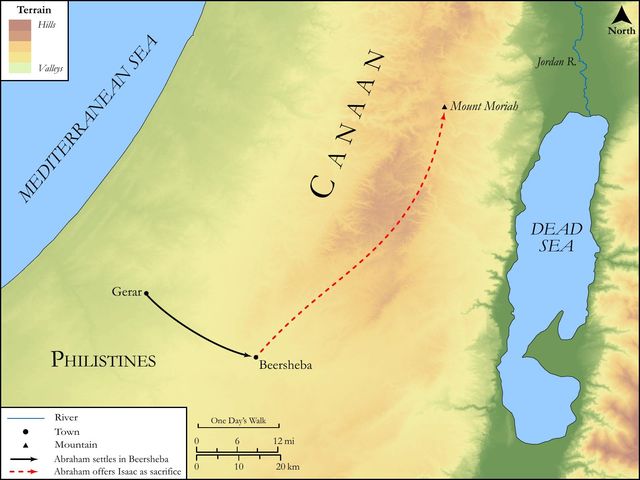
See on the biblical-era maps


Study this verse
Public-domain commentary
Matthew Henry
From his Commentary on the Whole Bible. Henry comments on passages, not single verses — this entry covers Genesis 21:33–34.
Observe, 1. Abraham, having got into a good neighbourhood, knew when he was well off, and continued a great while there. There he planted a grove for a shade to his tent, or perhaps an orchard of fruit-trees; and there, though we cannot say he settled, for God would have him, while he lived, to be a stranger and a pilgrim, yet he sojourned many days, as many as would consist with his character, as Abraham the Hebrew, or passenger. 2. There he made, not only a constant practice, but an open profession, of his religion: There he called on the name of the Lord, the everlasting God, probably in the grove he planted, which was his oratory or house of prayer. Christ prayed in a garden, on a mountain. (1.) Abraham kept up public worship, to which, probably, his neighbours resorted, that they might join with him. Note, Good men should not only retain their goodness wherever they go, but do all they can to propagate it, and make others good. (2.) In calling on the Lord, we must eye him as the everlasting God, the God of the world, so some. Though God had made himself known to Abraham as his God in particular, and in covenant with him, yet he forgets not to give glory to him as the Lord of all: The everlasting God, who was, before all worlds, and will be, when time and days shall be no more. See Isa 40:28.
Continue studying Genesis 21:33 across the web’s major study libraries — every link below opens this exact verse, chapter, or book on the destination site.
Read & Compare
 BibleGatewayThis verse in more than 200 translations and 70 languages.
 Bible.comThe YouVersion reader — hundreds of translations, reading plans, and highlights.
 ESV.orgCrossway's official English Standard Version reader.
 NET BibleThe NET translation with 60,000+ translators' notes on every rendering decision.
 STEP BibleTyndale House's free study tool — original text, vocabulary, and scholarly resources.
 BibliaLogos Bible Software's free web reader.
 USCCBThe New American Bible (Revised Edition) with the U.S. bishops' study notes.
Commentaries
 BibleHub CommentariesDozens of classic commentaries on this verse, gathered on one page.
 StudyLightMore than 100 commentary sets — the largest collection on the web.
 BibleRefPlain-English commentary on what this verse means, verse by verse.
 Enduring WordDavid Guzik's free commentary on this chapter, widely used by Bible teachers.
 Bible Study ToolsVerse commentary alongside Greek and Hebrew study aids.
Original Language & Research
- BibleHub InterlinearThe verse word by word — original language, transliteration, and English.
- BibleHub LexiconEvery word's original-language definition and Strong's entry.
 Blue Letter BibleDeep-study tools — Strong's numbers, concordance, and word studies.
 SefariaThe Hebrew text with Rashi and centuries of Jewish commentary.
Sermons, Hymns & Audio


TrulyRandomVerse is not affiliated with these sites and doesn’t control their content. They’re linked because they’re genuinely useful.
Summary
Following the peaceful resolution of a land dispute with Abimelech, Genesis 21:33 records Abraham's profound act of worship in Beersheba. By planting a grove and publicly invoking the name of "the LORD, the everlasting God," Abraham not only marked the location but also affirmed his deep, enduring faith in God's eternal nature and His unwavering covenant fidelity, establishing a lasting memorial to divine sovereignty and provision.
Context
ShowHideLiterary Context
This verse stands near the close of a significant narrative arc in Genesis 21. It immediately follows the account of Isaac's birth, Hagar and Ishmael's expulsion, and, most directly, the covenant established between Abraham and Abimelech concerning a well at Beersheba. The naming of Beersheba, meaning "well of the oath" or "well of seven," is detailed in Genesis 21:31, highlighting the resolution of conflict and the establishment of peace through an oath. Abraham's subsequent act of worship in verse 33 serves as a capstone to this period of settling and securing his place in the land, transitioning from conflict resolution to spiritual consecration. It demonstrates his consistent practice of building altars and calling upon the Lord, as seen earlier in his journey (e.g., Genesis 12:7-8).
Historical & Cultural Context
Among the patriarchs, the planting of trees, particularly long-lived varieties like the tamarisk (often identified as the "grove" or eshel here), was a common practice to mark significant locations, provide shade, and serve as a meeting place or a memorial. Such an act by Abraham in Beersheba would signify his settled presence and claim to the land, reinforcing the agreement made with Abimelech. Furthermore, "calling on the name of the LORD" was a public act of worship and invocation, often associated with covenant-making or significant divine encounters. It was a declaration of allegiance and reliance upon the deity, a practice deeply embedded in the religious life of the patriarchs. The recognition of God as "the everlasting God" (El Olam) reflects a profound theological understanding emerging within a polytheistic environment, contrasting the transient nature of human affairs with the eternal steadfastness of the one true God.
Key Themes
ShowHideGenesis 21:33 contributes to several overarching themes within Genesis and the broader Pentateuch. It reinforces the theme of covenant faithfulness, both God's unwavering commitment to Abraham and Abraham's consistent response of faith and worship. The establishment of a dedicated place for worship underscores the theme of sacred space and the importance of specific locations for encountering God, a concept that will evolve into the tabernacle and temple. The declaration of God as "the everlasting God" introduces the theme of God's eternal nature and immutability, a foundational theological truth that provides stability amidst human transience and uncertainty. This concept of God's unchanging character is vital for understanding the reliability of His promises throughout salvation history, as highlighted in passages like Psalm 90:2. Finally, the verse subtly touches upon the theme of peace and resolution, as Abraham's act of worship follows the successful resolution of a dispute over resources, suggesting that true peace is found in acknowledging God's ultimate sovereignty.
Exposition and Analysis
ShowHideKey Word Analysis
ShowHideA primitive root meaning "to strike in, i.e. fix; specifically, to plant (literally or figuratively); fastened, plant(-er)." This word signifies a deliberate, permanent action. Abraham wasn't just passing through; he was establishing a fixed presence, both physically in the land and spiritually through an act of dedication. The planting of the eshel (tamarisk tree) was a long-term investment, symbolizing stability and a lasting memorial.
A primitive root meaning "to call out to (i.e. properly, address by name, but used in a wide variety of applications); bewray (self), that are bidden, call (for, forth, self, upon), cry (unto), (be) famous, guest, invite, mention, (give) name, preach, (make) proclaim(-ation), pronounce, publish, read, renowned, say." In this context, it denotes a public, solemn invocation, an act of worship, prayer, and declaration of allegiance to God. It implies a personal and communal acknowledgment of God's sovereignty.
(the) self-Existent or Eternal; Jehovah, Jewish national name of God; Jehovah, the Lord. This is God's covenant name, Yahweh, emphasizing His personal, relational, and self-existent nature. By calling upon "the LORD," Abraham invoked the God who had entered into a covenant relationship with him, revealing His character and making promises.
Properly, concealed, i.e. the vanishing point; generally, time out of mind (past or future), i.e. (practically) eternity; frequentatively, adverbial (especially with prepositional prefix) always; alway(-s), ancient (time), any more, continuance, eternal, (for, (n-)) ever(-lasting, -more, of old), lasting, long (time), (of) old (time), perpetual, at any time, (beginning of the) world ([phrase] without end). This term, when combined with "God" (El), forms El Olam, signifying God's timelessness, His existence from eternity past to eternity future, and His unchanging character and promises. It provides a profound theological anchor for Abraham's faith.
Verse Breakdown
ShowHide"And Abraham planted a grove in Beersheba,"
This clause describes Abraham's physical action of establishing a permanent marker in the newly secured territory of Beersheba. The "grove" (Hebrew eshel) was likely a tamarisk tree, known for its longevity and deep roots, symbolizing stability and a lasting presence. This act signifies not just a practical land claim but also the creation of a dedicated space.
"and called there on the name of the LORD,"
This phrase highlights Abraham's spiritual action. "Calling on the name of the LORD" is a recurring motif in Genesis, signifying a public act of worship, prayer, and invocation of God's covenant name, Yahweh. It demonstrates Abraham's intimate relationship with God and his public declaration of allegiance and dependence. This act transforms the physical space into a sacred one, consecrated to God.
"the everlasting God."
This final phrase reveals the profound theological understanding Abraham had of the God he worshipped. By addressing God as El Olam, "the everlasting God," Abraham acknowledged God's eternal nature, His existence beyond the constraints of time, and His unchanging faithfulness. This title provides a powerful contrast to the temporary nature of human agreements and life itself, grounding Abraham's faith in an immutable divine reality.
Literary Devices
ShowHideThe verse employs several significant literary devices. Symbolism is prominent, with the planting of the "grove" (likely a tamarisk tree) symbolizing permanence, stability, and a lasting memorial. Its deep roots and longevity reflect the enduring nature of God and His covenant. The act of "calling on the name of the LORD" is a form of invocation and public declaration, serving to consecrate the space and publicly affirm Abraham's faith. The specific title, "the everlasting God," is an example of theological naming, revealing a deeper understanding of God's attributes. This epithet emphasizes God's eternal nature, providing a stark contrast to the transient human experience and the temporary nature of earthly agreements. The entire verse functions as a culmination of the preceding narrative, providing a spiritual resolution to the physical and relational conflicts, cementing Abraham's identity as a worshipper of the one true, eternal God.
Theological and Thematic Connections
ShowHideGenesis 21:33 stands as a pivotal declaration of God's eternal nature and Abraham's enduring faith. Abraham's act of planting a long-lived tree and publicly calling upon "the LORD, the everlasting God," underscores a profound theological truth: God's existence transcends time, and His character and promises are immutable. This recognition provides a stable foundation for faith, assuring believers that divine covenants are not subject to the vicissitudes of human history or the limitations of mortality. It highlights that true worship flows from a deep understanding of God's timeless sovereignty and His unwavering commitment to His people, fostering a sense of security and trust in His unfailing love.
Reflection and Application
ShowHideAbraham's actions in Genesis 21:33 offer a powerful blueprint for contemporary faith. In a world characterized by constant flux, uncertainty, and fleeting trends, the recognition of God as El Olam—the everlasting God—provides an unshakeable anchor for our souls. This truth invites us to root our lives not in temporary circumstances or human promises, but in the immutable character and eternal promises of God. Just as Abraham planted a lasting memorial and publicly called upon the Lord, we are called to cultivate intentional spaces and times for worship, both individually and communally. Our faith should be a public testimony, demonstrating our reliance on a God who is always present, always faithful, and always sovereign. This verse challenges us to consider how our lives, our actions, and our declarations reflect the eternal nature of the God we serve, inviting others to encounter the one true source of lasting hope and stability.
Questions for Reflection
ShowHideFAQ
ShowHideWhat is the significance of Abraham planting a "grove"?
ShowHideThe Hebrew word eshel (H815), translated as "grove" in the KJV, more accurately refers to a tamarisk tree. Planting such a tree was a customary act among the patriarchs to mark a significant place, provide shade, and serve as a memorial or a dedicated spot for worship and assembly. It signified Abraham's settled presence in the land and his act of consecration, turning a practical marker into a sacred space for calling upon the Lord. The choice of a tamarisk, known for its longevity and deep roots, also symbolized the permanence of Abraham's commitment and the enduring nature of his covenant with God.
What does "the everlasting God" (El Olam) mean?
ShowHide"The everlasting God" translates the Hebrew El Olam (H410 for El and H5769 for Olam). El is a general term for God, denoting power and deity, while Olam conveys the idea of eternity, perpetuity, or a very long duration, extending into both the past and the future. This title emphasizes God's timelessness, His unchanging nature, and His enduring faithfulness. It signifies that God exists outside of time, is not subject to change, and His covenant promises are eternal and reliable. This attribute provides immense comfort, as seen in passages like Psalm 90:2, which declares God's existence from "everlasting to everlasting."
Why does Abraham "call on the name of the LORD"?
ShowHide"Calling on the name of the LORD" (H7121 qârâʼ and H3068 Yᵉhôvâh) is a recurring phrase in Genesis (e.g., Genesis 12:8), signifying an act of public worship, prayer, and invocation of God's presence and power. It implies a deep personal relationship and a declaration of allegiance. For Abraham, it was a way to publicly acknowledge God's sovereignty, express his faith, and dedicate himself and the land to the God who had made an everlasting covenant with him. This act was a profound expression of his covenant relationship, a public testimony to God's identity and his own reliance upon Him.
Christ-Centered Fulfillment
ShowHideAbraham's worship of El Olam, the everlasting God, finds its ultimate and most profound fulfillment in the person of Jesus Christ. Christ is not merely a manifestation of the eternal God, but He is Himself eternal, co-existent with the Father from before all time, as declared in John 1:1 and John 8:58. He is the very embodiment of God's unchanging nature and faithful promises, for in Him "all the promises of God are yes and in Him Amen" (2 Corinthians 1:20). Through His atoning work on the cross, Christ, the perfect mediator, enables all believers to truly "call on the name of the LORD" and gain access to the eternal Father (Ephesians 2:18). He establishes a new and everlasting covenant through His blood (Hebrews 13:20), offering eternal life and an unshakeable hope to all who believe. Thus, the eternal God whom Abraham worshipped is fully revealed and made accessible in Jesus Christ, the Alpha and the Omega, who is the same yesterday, today, and forever (Hebrews 13:8).