


Genesis 21:34
Bible text: King James Version (1769 Blayney text) · Public domain
Bible text: Berean Standard Bible · Public domain
Bible text: American Standard Version (1901) · Public domain
Bible text: World English Bible, Messianic edition · Public domain
Bible text: Geneva Bible (1599) · Public domain
Bible text: Young's Literal Translation · Public domain
- וַיָּגָרvai·Ya·gorand he sojournedH1481Conj-w ¦ V-Qal-ConsecImperf-3msVerb Qal Consecutive Imperfect 3rd Singular Masculineוַandיָּגָרhe sojourned
- אַבְרָהָם'av·ra·HamAbrahamH85N-proper-mNoun Proper Masculine
- בְּאֶרֶץbe·'E·retzin [the] land ofH776Prep-b ¦ N-fscNoun Singular Feminine Constructבְּinאֶרֶץ[the] land of
- פְּלִשְׁתִּיםpe·lish·Tim[the] PhilistinesH6430N-mpNoun Gentilic Plural Masculine Absolute
- יָמִיםya·MimdaysH3117N-mpNoun Plural Masculine Absolute
- רַבִּיםra·BimmanyH7227Adj-mpAdjective Plural Masculine Absolute
English is a literal word-by-word gloss of the Hebrew, not the KJV's wording. Why?
This is the original text the KJV's translators worked from — each Hebrew word with its own literal English meaning in this verse, prepared by scholars at Tyndale House, Cambridge. The KJV translates whole sentences, not word by word, so its wording differs: one Hebrew word can become several English words, and the KJV may choose “the LORD” where the gloss reads “Yahweh”. Both are faithful — they answer different questions. For the KJV's own rendering, switch to the KJV text.
Details
See on the biblical-era maps


Study this verse
Public-domain commentary
Matthew Henry
From his Commentary on the Whole Bible. Henry comments on passages, not single verses — this entry covers Genesis 21:33–34.
Observe, 1. Abraham, having got into a good neighbourhood, knew when he was well off, and continued a great while there. There he planted a grove for a shade to his tent, or perhaps an orchard of fruit-trees; and there, though we cannot say he settled, for God would have him, while he lived, to be a stranger and a pilgrim, yet he sojourned many days, as many as would consist with his character, as Abraham the Hebrew, or passenger. 2. There he made, not only a constant practice, but an open profession, of his religion: There he called on the name of the Lord, the everlasting God, probably in the grove he planted, which was his oratory or house of prayer. Christ prayed in a garden, on a mountain. (1.) Abraham kept up public worship, to which, probably, his neighbours resorted, that they might join with him. Note, Good men should not only retain their goodness wherever they go, but do all they can to propagate it, and make others good. (2.) In calling on the Lord, we must eye him as the everlasting God, the God of the world, so some. Though God had made himself known to Abraham as his God in particular, and in covenant with him, yet he forgets not to give glory to him as the Lord of all: The everlasting God, who was, before all worlds, and will be, when time and days shall be no more. See Isa 40:28.
Continue studying Genesis 21:34 across the web’s major study libraries — every link below opens this exact verse, chapter, or book on the destination site.
Read & Compare
 BibleGatewayThis verse in more than 200 translations and 70 languages.
 Bible.comThe YouVersion reader — hundreds of translations, reading plans, and highlights.
 ESV.orgCrossway's official English Standard Version reader.
 NET BibleThe NET translation with 60,000+ translators' notes on every rendering decision.
 STEP BibleTyndale House's free study tool — original text, vocabulary, and scholarly resources.
 BibliaLogos Bible Software's free web reader.
 USCCBThe New American Bible (Revised Edition) with the U.S. bishops' study notes.
Commentaries
 BibleHub CommentariesDozens of classic commentaries on this verse, gathered on one page.
 StudyLightMore than 100 commentary sets — the largest collection on the web.
 BibleRefPlain-English commentary on what this verse means, verse by verse.
 Enduring WordDavid Guzik's free commentary on this chapter, widely used by Bible teachers.
 Bible Study ToolsVerse commentary alongside Greek and Hebrew study aids.
Original Language & Research
- BibleHub InterlinearThe verse word by word — original language, transliteration, and English.
- BibleHub LexiconEvery word's original-language definition and Strong's entry.
 Blue Letter BibleDeep-study tools — Strong's numbers, concordance, and word studies.
 SefariaThe Hebrew text with Rashi and centuries of Jewish commentary.
Sermons, Hymns & Audio


TrulyRandomVerse is not affiliated with these sites and doesn’t control their content. They’re linked because they’re genuinely useful.
Summary
Genesis 21:34 succinctly records Abraham's extended residence in the land of the Philistines, marking a period of sustained peace and continued pilgrimage. This verse underscores Abraham's unique status as a temporary resident in the very land promised to his descendants, highlighting his enduring faith and God's faithful provision as he awaited the full realization of the divine covenant.
Context
ShowHideLiterary Context
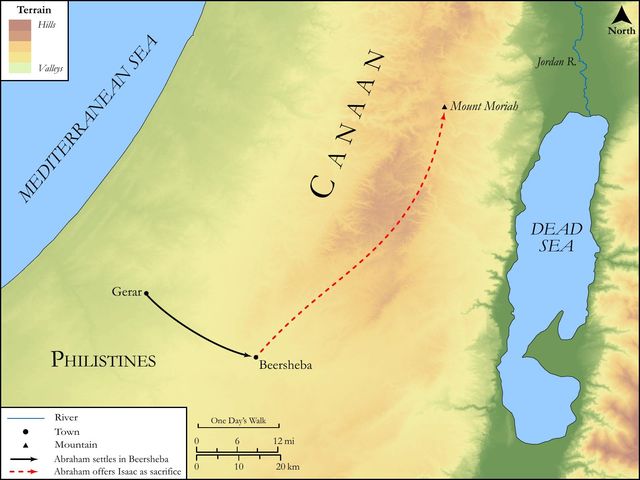
This verse serves as the concluding statement to the narrative arc initiated by the covenant between Abraham and Abimelech, the Philistine king of Gerar, at Beer-sheba. The preceding verses detail the dispute over a well and the subsequent oath and treaty that secured Abraham's rights to the well and his presence in the region (Genesis 21:22-32). The naming of Beer-sheba in Genesis 21:31 directly precedes this verse, solidifying the location of Abraham's extended stay. This period of stability follows the momentous events of Isaac's birth (Genesis 21:1-7) and the challenging expulsion of Hagar and Ishmael (Genesis 21:8-21), setting the stage for the ultimate test of Abraham's faith in the following chapter, the binding of Isaac (Genesis 22).
Historical & Cultural Context
Abraham's "sojourning" reflects the common semi-nomadic lifestyle of the patriarchs, where tribal groups moved with their flocks in search of pasture and water. The "Philistines' land" refers specifically to the region around Gerar, a significant city-state in the Negev. While the major Philistine migrations and establishment of their powerful pentapolis (Gaza, Ashkelon, Ashdod, Gath, Ekron) occurred much later (in the days of the judges), the biblical text here likely refers to a pre-Philistine or proto-Philistine group inhabiting the region, or it is an anachronistic use of the term by the later biblical author to identify the geographical area. Treaties, like the one between Abraham and Abimelech, were crucial for securing peace, water rights, and safe passage for sojourners in a land not yet fully possessed.
Key Themes
ShowHideGenesis 21:34 contributes to several overarching themes in the Abrahamic narrative. Firstly, it highlights God's covenant faithfulness, demonstrating His continued protection and provision for Abraham even in a foreign land, ensuring the patriarch's safety as the promises regarding his descendants begin to unfold. Secondly, it reinforces the theme of pilgrimage and temporary dwelling, underscoring Abraham's identity as a stranger and alien in the land God promised him, living by faith in a future inheritance. This is a recurring motif for Abraham, as seen in his earlier wanderings (e.g., Genesis 12:1-9). Lastly, the phrase "many days" emphasizes patience and waiting for God's timing, as the full realization of the land promise would not occur in Abraham's lifetime, requiring enduring faith.
Exposition and Analysis
ShowHideGenesis 21:34, "And Abraham sojourned in the Philistines' land many days," concisely describes a prolonged period of Abraham's life in the region of Gerar. The verse underscores Abraham's status as a temporary resident, not a permanent possessor, in the very land God had promised to him, while also indicating a time of relative stability and peace secured by the recent covenant with Abimelech.
Key Word Analysis
ShowHideThis primitive root (H1481) properly means "to turn aside from the road (for a lodging or any other purpose), i.e. sojourn (as a guest)." It also carries connotations of shrinking or fearing (as in a strange place) or gathering for hostility. In this context, it emphasizes Abraham's status as a temporary resident or foreigner, highlighting that he did not yet possess the land as his own, but rather lived as a transient guest.
This patrial term (H6430) refers to "a Pelishtite or inhabitant of Pelesheth." While the major Philistine presence in Canaan came later, the use of this term here identifies the geographical region where Abraham resided, specifically the area around Gerar, indicating his interaction with the non-Israelite inhabitants of that coastal plain.
This word (H7227), derived from a root meaning "to abound," signifies "abundant (in quantity, size, age, number, rank, quality)." Here, it emphasizes the significant duration of Abraham's stay.
This term (H3117) refers to "a day (as the warm hours), whether literal (from sunrise to sunset, or from one sunset to the next), or figurative (a space of time defined by an associated term)." Paired with "many," it underscores the extended period of time Abraham spent in this region, implying a sustained era of peace and stability.
Verse Breakdown
ShowHide"And Abraham sojourned"
This phrase immediately establishes Abraham's ongoing status as a temporary resident. Despite God's promise of the land, Abraham lives as a foreigner, emphasizing his life of faith and dependence on God's future fulfillment rather than immediate possession. His life is a continuous journey, a pilgrimage.
"in the Philistines' land"
This specifies the geographical location of Abraham's extended stay, the region around Gerar. It highlights that Abraham's life of faith was lived out in interaction with foreign peoples, not in isolation, and that God's providence extended even to securing his peace and safety among them through the covenant with Abimelech.
"many days"
This concluding phrase signifies a considerable duration, indicating a prolonged period of stability and peace for Abraham. It underscores the patience required in the life of faith, as God's promises unfold over extended timeframes, and it marks a settled phase in Abraham's nomadic life before the next significant divine test.
Literary Devices
ShowHideThe verse employs several subtle literary devices. Irony is present in Abraham's status as a "sojourner" in the very land promised to him and his descendants; he is a temporary resident awaiting an inheritance that will not be fully realized in his lifetime. This highlights the nature of faith as trust in unseen realities. The phrase "many days" serves as a form of hyperbole or emphasis, underscoring the significant length of his stay and the stability he experienced. Furthermore, Abraham's continued sojourning serves as foreshadowing for the future experience of his descendants, who would also sojourn in a foreign land (Egypt) before eventually inheriting Canaan, and ultimately for the Christian understanding of believers as spiritual pilgrims on earth.
Theological and Thematic Connections
ShowHideAbraham's extended sojourn in the Philistines' land profoundly illustrates the nature of God's promises and the life of faith. It teaches that divine promises, while certain, often unfold over extended periods, requiring persistent faith, patience, and unwavering trust in God's timing rather than immediate, full possession. This period of stability, secured through a covenant with a pagan king, also demonstrates God's sovereign control over all human interactions and His ability to provide for and protect His people in any circumstance, even among foreign nations. Abraham's life as a sojourner establishes a foundational biblical motif, portraying believers as temporary residents on earth, looking forward to a heavenly city and a permanent inheritance not of this world.
Reflection and Application
ShowHideAbraham's extended sojourn in the Philistines' land offers a profound and enduring lesson for believers today. Like Abraham, we are called to live as spiritual sojourners in this world, understanding that our ultimate home and inheritance are not earthly but heavenly. This perspective encourages us to live with a healthy detachment from worldly possessions and ambitions, recognizing their temporary nature, while simultaneously engaging actively and peacefully in the societies around us, just as Abraham forged a covenant with Abimelech. It reminds us to cultivate patience and unwavering faith, trusting God's timing for the full realization of His promises, even when our present circumstances feel uncertain or transient. Our security is found not in our earthly dwelling, but solely in God's faithful presence and unfailing provision, enabling us to live as pilgrims with purpose and peace.
Questions for Reflection
ShowHideFAQ
ShowHideWhy did Abraham sojourn in the Philistines' land for "many days"?
ShowHideAbraham's extended stay in the Philistines' land, specifically Gerar, was a period of relative peace and stability following his covenant with King Abimelech (Genesis 21:22-32). This treaty secured his rights to water and pasture, allowing him to live without constant conflict. This duration highlights God's provision and protection for Abraham even among foreign peoples, and it underscores Abraham's continued status as a temporary resident, patiently awaiting the full inheritance of the promised land.
What is the significance of Abraham being a "sojourner"?
ShowHideThe term "sojourner" (Hebrew: gûwr) emphasizes Abraham's status as a temporary resident or foreigner in the land God had promised to his descendants. It underscores that he did not yet possess the land fully, living by faith in God's future fulfillment. This concept is foundational to understanding the biblical theme of pilgrimage, where believers are seen as temporary residents on earth, looking forward to a heavenly home and an eternal inheritance (Hebrews 11:9-10).
Does Abraham's presence in "the Philistines' land" imply the Philistines were already established there in Genesis?
ShowHideWhile the term "Philistines" is used in Genesis 21 and 26, it's important to note that the major Philistine migration and establishment of their pentapolis (Gaza, Ashkelon, Ashdod, Gath, Ekron) occurred much later, in the days of the judges, after the time of Abraham. Scholars suggest that the use of "Philistines" here might be an anachronism by the biblical author, using a familiar term for the region's inhabitants at the time of writing, or it refers to an earlier, proto-Philistine group or a general term for the inhabitants of that coastal plain. The people Abraham encountered were likely a group of non-Israelite inhabitants of Gerar.
Christ-Centered Fulfillment
ShowHideAbraham's life as a sojourner, patiently awaiting the full inheritance of the promised land, finds its ultimate and profound fulfillment in Jesus Christ. While Abraham looked forward to a physical land, Christ is the true "Promised Land" and the ultimate inheritance for all believers, the very "Seed" through whom all God's promises are realized (Galatians 3:16). Through His atoning work on the cross and His resurrection, Christ secures for us an eternal inheritance in the heavenly city, a dwelling far more permanent and glorious than any earthly possession Abraham could have imagined (Hebrews 11:10). Believers, united with Christ through faith, become true heirs of God's promises, no longer merely sojourners awaiting a physical land, but citizens of heaven whose ultimate home is with God Himself (Philippians 3:20). We have entered into the true Sabbath rest that Abraham only anticipated, a rest found in Christ, who is our peace and our permanent dwelling place (Hebrews 4:9-10).