


Genesis 26:26
- וַאֲבִימֶלֶךְva·'a·vi·Me·lekhand AbimelechH40Conj-w ¦ N-proper-mNoun Proper MasculineוַandאֲבִימֶלֶךְAbimelech
- הָלַךְha·Lakhhe cameH1980V-Qal-Perf-3msVerb Qal Perfect 3rd Singular Masculine
- אֵלָיו'e·Lavto himH413Prep ¦ 3msPreposition Definiteאֵלָיtoוhim
- מִגְּרָרmi·ge·Rarfrom GerarH1642Prep-m ¦ N-properNoun Proper LocationמִfromגְּרָרGerar
- וַאֲחֻזַּתva·'a·chu·Zatand AhuzzahH276Conj-w ¦ N-proper-mNoun Proper MasculineוַandאֲחֻזַּתAhuzzah
- מֵרֵעֵהוּme·re·'E·huhis close friendH4828N-msc ¦ 3msNoun Singular Masculine Constructמֵרֵעֵclose friendהוּhis
- וּפִיכֹלu·fi·Kholand PhicolH6369Conj-w ¦ N-proper-mNoun Proper MasculineוּandפִיכֹלPhicol
- שַׂרsar[the] commander ofH8269N-mscNoun Singular Masculine Construct
- צְבָאוֹtze·va·'Ohis armyH6635N-msc ¦ 3msNoun Singular Masculine Constructצְבָאarmyוֹhis
English is a literal word-by-word gloss of the Hebrew, not the KJV's wording. Why?
This is the original text the KJV's translators worked from — each Hebrew word with its own literal English meaning in this verse, prepared by scholars at Tyndale House, Cambridge. The KJV translates whole sentences, not word by word, so its wording differs: one Hebrew word can become several English words, and the KJV may choose “the LORD” where the gloss reads “Yahweh”. Both are faithful — they answer different questions. For the KJV's own rendering, switch to the KJV text.
Details
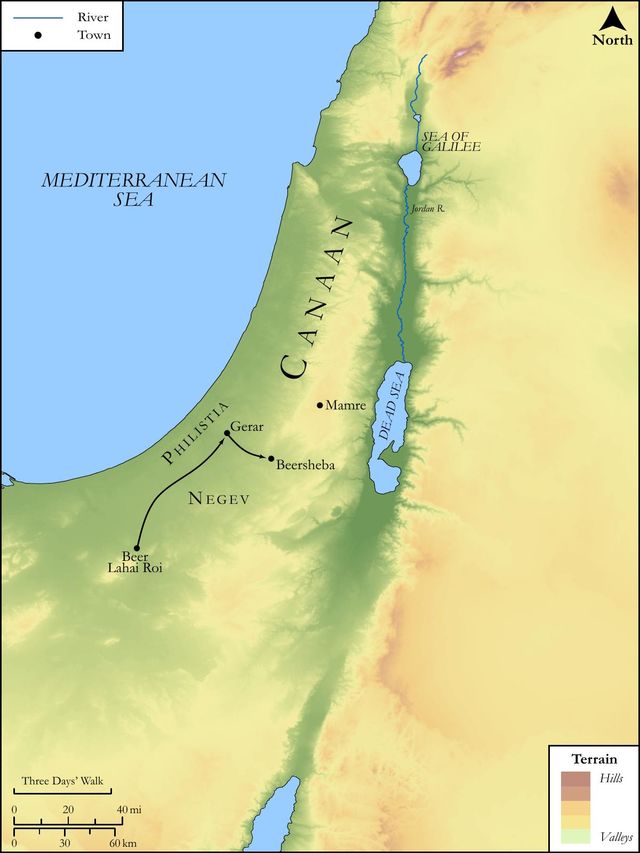
See on the biblical-era maps


Study this verse
Public-domain commentary
Matthew Henry
From his Commentary on the Whole Bible. Henry comments on passages, not single verses — this entry covers Genesis 26:26–33. His two-level outline is real structure in the source text, so it is rendered as structure.
We have here the contests that had been between Isaac and the Philistines issuing in a happy peace and reconciliation.
I.Abimelech pays a friendly visit to Isaac, in token of the respect he had for him, Gen 26:26.
Note, When a man's ways please the Lord he makes even his enemies to be at peace with him, Pro 16:7. King's hearts are in his hands, and when he pleases he can turn them to favour his people.
II.Isaac prudently and cautiously questions his sincerity in this visit, Gen 26:27.
Note, In settling friendships and correspondences, there is need of the wisdom of the serpent, as well as the innocence of the dove; nor is it any transgression of the law of meekness and love plainly to signify our strong perception of injuries received, and to stand upon our guard in dealing with those that have acted unfairly.
III.Abimelech professes his sincerity, in this address to Isaac, and earnestly courts his friendship, Gen 26:28, Gen 26:29.
Some suggest that Abimelech pressed for this league with him because he feared lest Isaac, growing rich, should, some time or other, avenge himself upon them for the injuries he had received. However, he professes to do it rather from a principle of love.
1.He makes the best of their behaviour towards him. Isaac complained they had hated him, and sent him away. No, said Abimelech, we sent thee away in peace. They turned him off from the land he held of them; but they suffered him to take away his stock, and all his effects, with him. Note, The lessening of injuries is necessary to the preserving of friendship; for the aggravating of them exasperates and widens breaches. The unkindness done to us might have been worse.
2.He acknowledges the token of God's favour to him, and makes this the ground of their desire to be in league with him: The Lord is with thee, and thou art the blessed of the Lord. As if he had said, "Be persuaded to overlook and pass by the injuries offered thee; for God had abundantly made up to thee the damage thou receivedst." Note, Those whom God blesses and favours have reason enough to forgive those who hate them, since the worst enemy they have cannot do them any real hurt. Or, "For this reason we desire thy friendship, because God is with thee." Note, It is good to be in covenant and communion with those who are in covenant and communion with God, Jo1 1:3; present address to him was the result of mature deliberation: We said, Let there be an oath between us. Whatever some of his peevish envious subjects might mean otherwise, he and his prime-ministers of state, whom he had now brought with him, designed no other than a cordial friendship. Perhaps Abimelech had received, by tradition, the warning God gave to his predecessor not to hurt Abraham (Gen 20:7), and this made him stand in such awe of Isaac, who appeared to be as much the favourite of Heaven as Abraham was.
IV.Isaac entertains him and his company, and enters into a league of friendship with him, Gen 26:30, Gen 26:31.
Here see how generous the good man was, 1. In giving: He made them a feast, and bade them welcome. (2.) In forgiving. He did not insist upon the unkindnesses they had done him, but freely entered into a covenant of friendship with them, and bound himself never to do them any injury. Note, Religion teaches us to be neighbourly, and, as much as in us lies, to live peaceably with all men.
V.Providence smiled upon what Isaac did; for the same day that he made this covenant with Abimelech his servants brought him the tidings of a well of water they had found, Gen 26:32, Gen 26:33. He did not insist upon the restitution of the wells which the Philistines had unjustly taken from him, lest this should break off the treaty, but sat down silent under the injury; and, to recompense him for this, immediately he is enriched with a new well, which, because it suited so well to the occurrence of the day, he called by an old name, Beer-sheba, The well of the oath.
Historical interpretation
Two Centuries of Reception
3 surviving comments on this verse. Each one is dated, so this reads as a timeline rather than a list.
Select a marker to jump to its quote. Markers stagger vertically where authors wrote within a few decades of each other.
This Abimelech, as I see it, does not always have peace with Isaac, but sometimes he disagrees, at other times he seeks peace. If you remember how, in what precedes, we said of Abimelech that he represents the learned and wise of the world who have comprehended many things even of the truth through the learning of philosophy, you can understand how he can be neither always in dissension nor always at peace with Isaac, who represents the Word of God in the law. For philosophy is neither opposed to everything in the law of God nor in harmony with everything.For many of the philosophers write that there is one God who has created all things. In this they agree with the law of God. Some also have added this, that God made and rules all things by his Word and it is the Word of God by which all things are directed. In this they write in harmony not only with the law but also with the Gospels. Indeed, almost the total philosophy that is called moral and natural holds the same views we do. But it disagrees with us when it says matter is coeternal with God. It disagrees when it denies that God is concerned about mortal things but that his providence is confined beyond the spaces of the lunar sphere. They disagree with us when they appraise the lives of those being born by the courses of the stars. They disagree when they say this world is permanent and is to have no end. But there are also many other things in which they either disagree with us or are in harmony. And therefore in accordance with this figure, Abimelech is sometimes described as being at peace with Isaac and sometimes as disagreeing.
But also I do not think that this was of idle concern to the Holy Spirit, who writes these things, to relate that two others “came with Abimelech, that is, “Ahuzzath his kinsman and Phicol the leader of his army.”Now Ahuzzath means “containing” and Phicol “the mouth of all,” but Abimelech himself means “my father is king.” These three, in my opinion, figuratively represent all philosophy, which is divided into three parts among them: logic, physics, ethics, that is, rational, natural, moral. The rational is that which acknowledges God to be Father of all, that is, Abimelech. The natural is that which is fixed and contains all things, as depending on the forces of nature itself, which Ahuzzath, which means “containing,” professes to be. The moral is that which is in the mouth of all and pertains to all and is situated in the mouth of all because of the likeness of the common precepts. Phicol, which means “the mouth of all,” signifies this.
All these therefore come to the law of God in the learning of instructions of this kind and say, “We certainly saw that the Lord is with you, and we said, ‘Let there be an oath between us and you and let us establish a covenant with you, lest you do evil with us, but as we have not cursed you, so also you are blessed by the Lord.’ ”
Those three, who seek peace from the Word of God and desire to anticipate his fellowship with a covenant, can indeed represent the magi who come from parts of the East learned in the books of their fathers and in the instruction of their ancestors and say, “We certainly saw” “the one born king,” “and we have seen that God is with him,” “and we have come to worship him.”6
But also if there is anyone who has been instructed in learning of this kind, seeing that “God was in Christ reconciling the world to himself” and who has admired the majesty of his works, let him say, “We certainly saw that the Lord is with you, and we said, ‘Let there be an oath between us.’ ” For approaching the law of God he says necessarily, “I have sworn and am determined that I shall keep your commandments.”
(Verse 26.) And Abimelech went to him from Gerar, and Ahuzzath his counselor, and Phicol the commander of his army. Regarding Ahuzzath his counselor, in Hebrew it means his group of friends: it signifies not so much a single person as a crowd of friends who came with the king, among whom was also Phicol the commander of his army.
Continue studying Genesis 26:26 across the web’s major study libraries — every link below opens this exact verse, chapter, or book on the destination site.
Read & Compare
 BibleGatewayThis verse in more than 200 translations and 70 languages.
 Bible.comThe YouVersion reader — hundreds of translations, reading plans, and highlights.
 ESV.orgCrossway's official English Standard Version reader.
 NET BibleThe NET translation with 60,000+ translators' notes on every rendering decision.
 STEP BibleTyndale House's free study tool — original text, vocabulary, and scholarly resources.
 BibliaLogos Bible Software's free web reader.
 USCCBThe New American Bible (Revised Edition) with the U.S. bishops' study notes.
Commentaries
 BibleHub CommentariesDozens of classic commentaries on this verse, gathered on one page.
 StudyLightMore than 100 commentary sets — the largest collection on the web.
 BibleRefPlain-English commentary on what this verse means, verse by verse.
 Enduring WordDavid Guzik's free commentary on this chapter, widely used by Bible teachers.
 Bible Study ToolsVerse commentary alongside Greek and Hebrew study aids.
Original Language & Research
- BibleHub InterlinearThe verse word by word — original language, transliteration, and English.
- BibleHub LexiconEvery word's original-language definition and Strong's entry.
 Blue Letter BibleDeep-study tools — Strong's numbers, concordance, and word studies.
 SefariaThe Hebrew text with Rashi and centuries of Jewish commentary.
Sermons, Hymns & Audio


TrulyRandomVerse is not affiliated with these sites and doesn’t control their content. They’re linked because they’re genuinely useful.
Summary
The verse captures a pivotal moment of diplomatic engagement, as Abimelech, the Philistine king of Gerar, accompanied by his trusted advisor Ahuzzath and his chief military commander Phichol, travels to meet Isaac. This formal delegation signifies a remarkable shift in their relationship, moving from past conflict and envy to an overture for reconciliation, compelled by the undeniable and visible evidence of God's abundant blessing and favor upon Isaac.
Context
ShowHideLiterary Context
This verse immediately follows a period of significant tension and conflict between Isaac and the Philistines. After a famine, Isaac sojourned in Gerar, where his remarkable prosperity provoked the envy of the Philistines, culminating in Abimelech's demand for Isaac to depart, acknowledging, "Thou art much mightier than we" (Genesis 26:16). Isaac then relocated to the valley of Gerar, where persistent disputes over water wells forced him to move again, before finally settling in Beersheba. There, the Lord appeared to him, reaffirming the Abrahamic covenant and promising His continued presence and blessing (Genesis 26:24). It is against this backdrop of Isaac's divinely granted favor and burgeoning influence, now in a new location, that Abimelech, accompanied by his key advisors, undertakes this significant and unexpected journey to meet him.
Historical & Cultural Context
In the ancient Near East, land and water resources were paramount, often leading to conflict between nomadic peoples, like Isaac's clan, and settled communities, like the Philistines of Gerar. Kings, such as Abimelech, wielded significant authority, and diplomatic overtures were formalized through high-level delegations. The presence of a "chief captain of his army" (Phichol) alongside a trusted "friend" (Ahuzzath) underscores the gravity and strategic intent of this visit. Such a high-level delegation from a powerful city-state to a nomadic patriarch, whom they had previously expelled, highlights the Philistines' recognition of Isaac's growing influence and the strategic necessity of securing peace. The recurrence of the names Abimelech and Phichol from Abraham's time suggests either dynastic titles or common names for high-ranking officials within the Philistine administration, indicating a continuity of power and protocol.
Key Themes
ShowHideThis verse significantly contributes to several overarching themes within Genesis 26 and the broader patriarchal narratives. It powerfully illustrates the theme of Divine Blessing and Prosperity, as Isaac's overwhelming success, despite Philistine opposition and displacement, compels Abimelech to seek him out. This demonstrates God's faithfulness to His covenant promises, making Isaac "much mightier" than his adversaries (Genesis 26:16). Furthermore, the visit highlights God's Vindication of His Servants, showing how Isaac's patient endurance and trust in the Lord lead to his exaltation and the recognition of his divine favor by those who previously opposed him. Finally, it underscores the theme of Reconciliation and Peace, as the Philistine king's journey initiates a process of mending strained relations and establishing a covenant, demonstrating God's capacity to turn the hearts of enemies.
Exposition and Analysis
ShowHideKey Word Analysis
ShowHideThis verb, often translated as "walk" or "go," carries a broad semantic range, encompassing movement, departure, and even a manner of life or conduct. Here, it denotes a deliberate journey, emphasizing that Abimelech and his retinue actively "went" to Isaac, signifying a purposeful and formal diplomatic initiative rather than a casual encounter or summons.
Derived from a root suggesting companionship, this term refers to a close associate or confidant. Ahuzzath's designation as "one of his friends" indicates a position of trust and intimacy with Abimelech, suggesting that the king brought advisors whose counsel he valued and whose presence would lend credibility and sincerity to his overture for peace.
This word denotes a "head person" or "ruler" of any rank, often a military commander or high official. Phichol's title, "chief captain of his army," highlights his significant military authority, underscoring the strategic importance of this delegation. His inclusion signals a desire to secure peace and prevent future conflict, acknowledging Isaac's strength and the Philistines' recognition of his divinely-backed power.
Verse Breakdown
ShowHide"Then Abimelech went to him from Gerar"
This opening clause establishes the unexpected initiative taken by Abimelech, the Philistine king. His act of "going" to Isaac, rather than summoning him, signifies a reversal of power dynamics and an acknowledgment of Isaac's elevated status. The journey "from Gerar" emphasizes the distance and deliberate nature of this diplomatic mission, underscoring its formal and serious intent.
"and Ahuzzath one of his friends"
The inclusion of Ahuzzath, identified as a trusted "friend" or confidant, indicates that Abimelech's delegation was not merely official but also comprised individuals whose counsel he valued and who could facilitate a genuine and personal dialogue. Ahuzzath likely served as a close advisor, lending weight and sincerity to the king's overture.
"and Phichol the chief captain of his army"
Phichol's presence as the highest-ranking military official signifies the strategic importance of this visit. His inclusion suggests that the Philistines sought not only personal reconciliation but also a formal military and political peace, acknowledging Isaac's growing strength and the potential for future conflict if relations remained unresolved. This highlights the comprehensive nature of Abimelech's desire for a lasting accord.
Literary Devices
ShowHideGenesis 26:26 employs several literary devices to convey its profound message. The very act of Abimelech, the king of Gerar, traveling to Isaac, whom he had previously expelled, creates a powerful Juxtaposition between past hostility and a present desire for reconciliation. This reversal highlights the dramatic shift in power dynamics, underscoring Isaac's divinely-granted ascendancy. The composition of the delegation itself—comprising royal authority (Abimelech), trusted counsel (Ahuzzath), and military might (Phichol)—serves as Symbolism, representing a comprehensive recognition by the Philistine leadership of Isaac's undeniable prosperity and the strategic necessity of establishing peace. Furthermore, the verse acts as a subtle Foreshadowing of the covenant that will be formally established in the subsequent verses, setting the stage for a period of peace and mutual respect between Isaac and the Philistines, a peace initiated by those who once sought to diminish him.
Theological and Thematic Connections
ShowHideThe arrival of Abimelech's delegation in Genesis 26:26 serves as a powerful testament to the tangible reality of God's covenant faithfulness and His manifest blessing upon Isaac. This unsolicited visit, initiated by those who had previously shown hostility, underscores the theological truth that divine favor is not only transformative for the individual but also visibly impactful in the world, compelling even adversaries to acknowledge God's hand. Isaac's patient endurance and unwavering trust, even when displaced and challenged, ultimately led to his vindication and elevation to a position of such undeniable strength and respect that his former antagonists sought his favor. This narrative beautifully illustrates God's sovereign power to turn the hearts of enemies, demonstrating that true security and influence stem from being in right relationship with Him, allowing His presence to bring about reconciliation and peace in unexpected ways.
Reflection and Application
ShowHideThe narrative of Genesis 26:26 offers profound insights for believers today, reminding us that a life lived in faithful obedience to God often results in His manifest blessing, so undeniably evident that it can transform even adversarial relationships. Isaac's journey, marked by displacement and conflict over essential resources, culminates in a moment where his former oppressor seeks peace, not out of Isaac's cunning or might, but because "the LORD was with" him. This calls us to cultivate a deep reliance on God's presence and provision, trusting that His favor can soften hardened hearts, open doors previously closed, and turn enemies into allies. It encourages us to persevere in righteousness, knowing that our vindication and peace ultimately come from God, demonstrating His power to bring reconciliation and honor to those who walk in His ways.
Questions for Reflection
ShowHideFAQ
ShowHideWho was Abimelech in Genesis 26:26?
ShowHideAbimelech was the Philistine king of Gerar. His name, possibly a dynastic title rather than a personal name, suggests a lineage or succession from the Abimelech who interacted with Abraham generations earlier (Genesis 21:22). His journey to Isaac signifies a recognition of Isaac's immense prosperity and God's undeniable blessing upon him, compelling a diplomatic overture.
Why did Abimelech, Ahuzzath, and Phichol visit Isaac?
ShowHideThey visited Isaac to establish a formal covenant of peace. Despite previous conflicts over water rights and their earlier expulsion of Isaac due to his immense prosperity, they recognized that "the LORD was with thee" (Genesis 26:28). Their visit was a strategic move to secure their relationship with a man so clearly blessed by God, ensuring future stability and preventing further conflict.
What is the significance of the names Ahuzzath and Phichol?
ShowHideAhuzzath is described as "one of his friends," indicating a trusted confidant or close advisor to King Abimelech, highlighting the personal and intimate nature of the delegation. Phichol, identified as "the chief captain of his army," represents the military authority, suggesting a strategic move to secure peace and prevent future conflict. The recurrence of these names (or titles) from Abraham's time (Genesis 21:22) suggests continuity in Philistine leadership roles and underscores the formal and comprehensive nature of this diplomatic mission.
Christ-Centered Fulfillment
ShowHideThe narrative of Isaac's vindication and the unsolicited visit from his former adversaries, acknowledging God's manifest blessing upon him, serves as a powerful prefigurement of Christ. Just as Isaac, the son of promise, experienced divine favor that compelled recognition even from his enemies, so too does Christ, the ultimate Son of God, receive universal homage. His ultimate triumph over sin and death, and the establishment of His eternal kingdom, will compel every knee to bow and every tongue to confess His Lordship, whether in heaven or on earth (Philippians 2:10-11). The peace sought by Abimelech from Isaac foreshadows the true and lasting peace that Christ alone offers, reconciling humanity not just with each other, but supremely with God through His atoning work on the cross (Colossians 1:19-20). In Christ, the hostility between God and humanity is overcome, and a new covenant of peace is established, far surpassing any earthly treaty Isaac could forge (Ephesians 2:14-16).