


2 Samuel 4:3
Bible text: King James Version (1769 Blayney text) · Public domain
Bible text: King James Version with Strong's numbers · Public domain
Bible text: Berean Standard Bible · Public domain
Bible text: American Standard Version (1901) · Public domain
Bible text: World English Bible, Messianic edition · Public domain
Bible text: Geneva Bible (1599) · Public domain
Bible text: Young's Literal Translation · Public domain
- וַיִּבְרְחוּvai·yiv·re·Chuand they fledH1272Conj-w ¦ V-Qal-ConsecImperf-3mpVerb Qal Consecutive Imperfect 3rd Plural Masculineוַandיִּבְרְחוּthey fled
- הַבְּאֵרֹתִיםha·be·'e·ro·Timthe BeerothitesH886Art ¦ N-mpNoun Gentilic Plural Masculine AbsoluteהַtheבְּאֵרֹתִיםBeerothites
- גִּתָּיְמָהgi·Ta·ye·mahGittaim towardsH1664N-proper ¦ SfxNoun Proper LocationגִּתָּיְמָGittaimהtowards
- וַיִּהְיוּvai·yih·yuand they have beenH1961Conj-w ¦ V-Qal-ConsecImperf-3mpVerb Qal Consecutive Imperfect 3rd Plural Masculineוַandיִּהְיוּthey have been
- שָׁםshamthereH8033AdvAdverb
- גָּרִיםga·RimsojournersH1481V-Qal-Prtcpl-mpVerb Qal Participle Plural Masculine Absolute
- עַד'aduntilH5704PrepPreposition
- הַיּוֹםhai·Yomthe dayH3117Art ¦ N-msNoun Singular Masculine Absoluteהַtheיּוֹםday
- הַזֶּהha·Zeh<the> thisH2088Art ¦ PrtParticle Demonstrativeהַ<the>זֶּהthis
English is a literal word-by-word gloss of the Hebrew, not the KJV's wording. Why?
This is the original text the KJV's translators worked from — each Hebrew word with its own literal English meaning in this verse, prepared by scholars at Tyndale House, Cambridge. The KJV translates whole sentences, not word by word, so its wording differs: one Hebrew word can become several English words, and the KJV may choose “the LORD” where the gloss reads “Yahweh”. Both are faithful — they answer different questions. For the KJV's own rendering, switch to the KJV text.
Details
See on the biblical-era maps
Study this verse
Public-domain commentary
Matthew Henry
From his Commentary on the Whole Bible. Henry comments on passages, not single verses — this entry covers 2 Samuel 4:1–8. His three-level outline is real structure in the source text, so it is rendered as structure.
Here is, I. The weakness of Saul's house. Still it grew weaker and weaker. 1. As for Ishbosheth, who was in possession of the throne, his hands were feeble, Sa2 4:1. All the strength they ever had was from Abner's support, and now that he was dead he had no spirit left in him. Though Abner had, in a passion, deserted his interest, yet he hoped, by his means, to make good terms with David; but now even this hope fails him, and he sees himself forsaken by his friends and at the mercy of his enemies. All the Israelites that adhered to him were troubled and at a loss what to do, whether to proceed in their treaty with David or no. 2. As for Mephibosheth, who in the right of his father Jonathan had a prior title, his feet were lame, and he was unfit for any service, Sa2 4:4. He was but five years old when his father and grandfather were killed. His nurse, hearing of the Philistines' victory, was apprehensive that, in pursuit of it, they would immediately send a party to Saul's house, to cut off all that pertained to it, and would especially aim at her young master, who was now next heir to the crown. Under the apprehension of this, she fled with the child in her arms, to secure it either in some secret place where he could not be found, or in some strong place where he could not be got at; and, making more haste than good speed, she fell with the child, and by the fall some bone was broken or put out, and not well set, so that he was lame of it as long as he lived, and unfit either for court or camp. See what sad accidents children are liable to in their infancy, the effect of which may be felt by them, to their great uneasiness, all their days. Even the children of princes and great men, the children of good men, for such a one Jonathan was, children that are well tended, and have nurses of their own to take care of them, yet are not always safe. What reason have we to be thankful to God for the preservation of our limbs and senses to us, through the many perils of the weak and helpless state of infancy, and to own his goodness in giving his angels a charge concerning us, to bear us up in their arms, out of which there is no danger of falling, Psa 91:12.
II.The murder of Saul's son. We are here told,
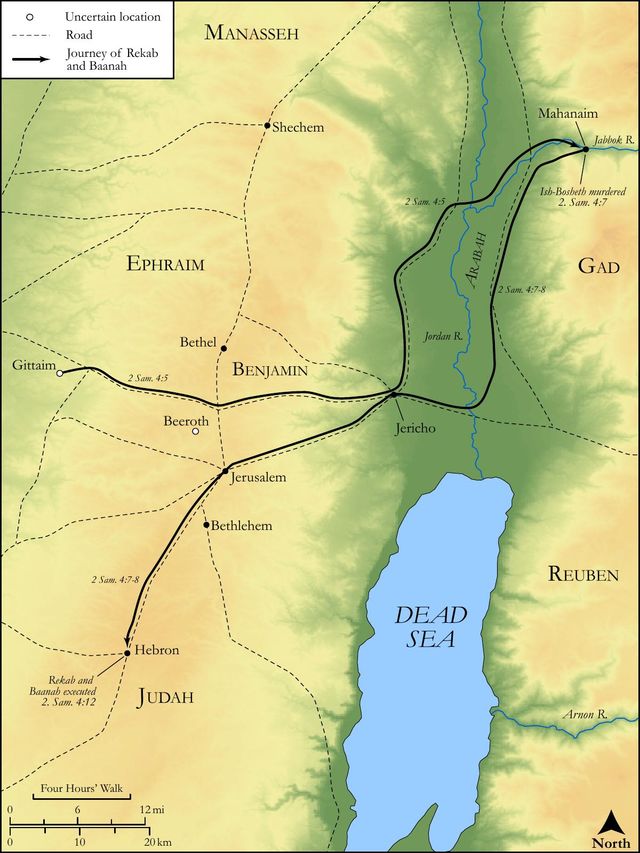
1.Who were the murderers: Baanah and Rechab, Sa2 4:2, Sa2 4:3. They were own brothers, as Simeon and Levi, and partners in iniquity. They were or had been Ish-bosheth's own servants, employed under him, so much the more base and treacherous was it in them to do him a mischief. They were Benjamites, of his own tribe. They were of the city of Beeroth; for some reason which we cannot now account for care is here taken to let us know (in a parenthesis) that that city belonged to the lot of Benjamin, so we find (Jos 18:25), but that the inhabitants, upon some occasion or other, perhaps upon the death of Saul, retired to Gittaim, another city which lay not far off in the same tribe, and was better fortified by nature, being situate (if we may depend upon Mr. Fuller's map) between the two rocks Bozez and Seneh. There the Beerothites were when this was written, and probably took root there, and never returned to Beeroth again, which made Beeroth, that had been one of the cities of the Gibeonites (Jos 9:17), to be forgotten, and Gittaim to be famous long after, as we find, Neh 11:33.
2.How the murder was committed, Sa2 4:5-7. See here,
(1.)The slothfulness of Ish-bosheth. He lay upon his bed at noon. It does not appear that the country was at any time of the year so hot as to oblige the inhabitants to retire at noon, as we are told they do in Spain in the heat of summer; but Ishbosheth was a sluggish man, loved his ease and hated business: and when he should have been, at this critical juncture, at the head of his forces in the field, or at the head of his counsels in a treaty with David, he was lying upon his bed and sleeping, for his hands were feeble (Sa2 4:1), and so were his head and heart. When those difficulties dispirit us which should rather invigorate us and sharpen our endeavours we betray both our crowns and lives. Love not sleep, lest thou come to poverty and ruin. The idle soul is an easy prey to the destroyer.
(2.)The treachery of Baanah and Rechab. They came into the house, under pretence of fetching wheat for the victualling of their regiments; and such was the plainness of those times that the king's corn-chamber and his bed-chamber lay near together, which gave them an opportunity, when they were fetching wheat, to murder him as he lay on the bed. We know not when and where death will meet us. When we lie down to sleep we are not sure but that we may sleep the sleep of death before we awake; nor do we know from what unsuspected hand a fatal stroke may come. Ish-bosheth's own men, who should have protected his life, took it away.
3.The murderers triumphed in what they had done. As if they had performed some very glorious action, and the doing of it for David's advantage was enough not only to justify it, but to sanctify it, they made a present of Ish-bosheth's head to David (Sa2 4:8): Behold the head of thy enemy, than which they thought nothing could be more acceptable to him; yea, and they made themselves instruments of God's justice, ministers to bear his sword, though they had no commission: The Lord hath avenged thee this day of Saul and of his seed. Not that they had any regard either to God or to David's honour; they aimed at nothing but to make their own fortunes (as we say) and to get preferment in David's court; but, to ingratiate themselves with him, they pretended a concern for his life, a conviction of his title, and a zealous desire to see him in full possession of the throne. Jehu pretended zeal for the Lord of hosts when an ambition to set up himself and his own family was the spring of his actions.
Continue studying 2 Samuel 4:3 across the web’s major study libraries — every link below opens this exact verse, chapter, or book on the destination site.
Read & Compare
 BibleGatewayThis verse in more than 200 translations and 70 languages.
 Bible.comThe YouVersion reader — hundreds of translations, reading plans, and highlights.
 ESV.orgCrossway's official English Standard Version reader.
 NET BibleThe NET translation with 60,000+ translators' notes on every rendering decision.
 STEP BibleTyndale House's free study tool — original text, vocabulary, and scholarly resources.
 BibliaLogos Bible Software's free web reader.
 USCCBThe New American Bible (Revised Edition) with the U.S. bishops' study notes.
Commentaries
 BibleHub CommentariesDozens of classic commentaries on this verse, gathered on one page.
 StudyLightMore than 100 commentary sets — the largest collection on the web.
 BibleRefPlain-English commentary on what this verse means, verse by verse.
 Enduring WordDavid Guzik's free commentary on this chapter, widely used by Bible teachers.
 Bible Study ToolsVerse commentary alongside Greek and Hebrew study aids.
Original Language & Research
- BibleHub InterlinearThe verse word by word — original language, transliteration, and English.
- BibleHub LexiconEvery word's original-language definition and Strong's entry.
 Blue Letter BibleDeep-study tools — Strong's numbers, concordance, and word studies.
 SefariaThe Hebrew text with Rashi and centuries of Jewish commentary.
Sermons, Hymns & Audio


TrulyRandomVerse is not affiliated with these sites and doesn’t control their content. They’re linked because they’re genuinely useful.
Summary
The verse 2 Samuel 4:3 serves as a crucial parenthetical note within the narrative of Ish-bosheth's assassination, providing vital historical context for the state of Beeroth. It explains that the inhabitants of Beeroth, known as Beerothites, had been forced to flee their city and resettle as permanent sojourners in Gittaim, a situation that persisted "until this day." This detail clarifies why Beeroth may have been uninhabited or easily traversable by Ish-bosheth's assassins, Rechab and Baanah, subtly linking the immediate events to the long-term consequences of King Saul's past actions against the Gibeonites.
Context
ShowHideLiterary Context
This brief, parenthetical statement in 2 Samuel 4:3 is strategically placed immediately after the mention of Ish-bosheth's vulnerability and before the detailed account of his assassination by Rechab and Baanah. The preceding verses, 2 Samuel 4:1-2, describe Ish-bosheth's despair and the general disarray in Israel following Abner's death, setting the stage for the collapse of Saul's house. The parenthetical note about Beeroth provides essential background information, explaining a geographical or demographic detail pertinent to the assassins' movements or the general instability of the region. It hints at the desolation of Beeroth, making it plausible for the assassins to pass through or originate from a place where their movements would go unnoticed, thereby contributing to the narrative's verisimilitude and historical accuracy.
Historical & Cultural Context
The Beerothites were one of the four cities of the Gibeonites, a people who had secured a solemn covenant with Joshua and the Israelites during the conquest, as recorded in Joshua 9:15. Centuries later, King Saul, in his misguided zeal for Israel, had attempted to exterminate the Gibeonites, violating this ancient and sacred oath, an act whose repercussions are later detailed in 2 Samuel 21:1-2. The flight of the Beerothites to Gittaim was a direct and tragic consequence of Saul's aggression, illustrating the long-lasting repercussions of a king's sin. Gittaim was a Benjaminite city, likely offering a degree of refuge to these displaced people, who then lived there as "sojourners" (Hebrew: gerim), a status denoting resident aliens with limited rights but a recognized, albeit dependent, place within the community. This situation persisted "until this day," indicating that the displacement was a well-known historical fact at the time the book of Samuel was compiled.
Key Themes
ShowHide2 Samuel 4:3 contributes to several overarching themes in the book of Samuel. Firstly, it underscores the theme of Displacement and Instability, highlighting the human cost of political upheaval and the fragility of life during a period of transition from Saul's fragmented kingdom to David's unified reign. Secondly, it subtly reinforces the theme of the Consequences of Sin, particularly the long-term repercussions of Saul's covenant-breaking actions against the Gibeonites, which continued to affect his house and the land even after his death, as seen later in 2 Samuel 21. Finally, the phrase "until this day" emphasizes the Historical Veracity and enduring impact of these events, serving as an editorial note that authenticates the historical account for the original audience, grounding the narrative in tangible, verifiable facts of their present reality.
Exposition and Analysis
ShowHideKey Word Analysis
ShowHideThis verb (H1272) means "to bolt" or "flee suddenly," often driven by urgency or fear. It highlights the involuntary and immediate nature of the Beerothites' departure, emphasizing that they were forced from their homes due to hostile circumstances, likely King Saul's persecution.
This term (H1481) describes someone who "turns aside from the road" to "sojourn as a guest," implying a resident alien or foreigner living among a native population. Unlike temporary visitors, sojourners had a more permanent, though non-native, status, dependent on the hospitality and laws of their host community. Their status in Gittaim signifies their complete displacement and integration into a new, albeit secondary, societal role, underscoring their vulnerability and lack of ancestral land.
This noun (H3117), part of the phrase "until this day," refers to a literal day or a defined space of time. In this context, it is used adverbially as an editorial marker, indicating that the described situation—the Beerothites residing as sojourners in Gittaim—persisted up to the time the book of Samuel was being written or compiled. It authenticates the historical account for the contemporary audience, emphasizing the enduring impact of past events.
Verse Breakdown
ShowHide"And the Beerothites fled to Gittaim"
This clause reveals the forced relocation of the inhabitants of Beeroth. Their flight was not a voluntary migration but a desperate escape, likely from the persecution initiated by King Saul against the Gibeonites. The destination, Gittaim, a city in Benjamin, suggests they sought refuge within a neighboring tribal territory, possibly due to existing familial or political ties, or simply as the nearest available sanctuary from Saul's wrath. This detail explains the desolation of Beeroth at the time of Ish-bosheth's assassination, making it a plausible setting for the assassins' movements.
"and were sojourners there"
This phrase describes the permanent status of the Beerothites in Gittaim. They did not return to Beeroth but established themselves as resident aliens (gerim) in their new home. This signifies a profound and lasting displacement, indicating that their original city remained uninhabited or sparsely populated by its original inhabitants, a crucial piece of information for understanding the assassins' ease of movement. Their status as "sojourners" also highlights their vulnerability and dependence within the host community, lacking the full rights and security of native-born citizens.
"until this day.)"
This parenthetical note, an editorial comment from the narrator, confirms that the situation described—the Beerothites residing as sojourners in Gittaim—persisted up to the time the book of Samuel was being written or compiled. It serves to authenticate the historical account for the contemporary audience, emphasizing the enduring impact of past events and the long-term consequences of Saul's actions. The closing parenthesis indicates the end of this explanatory insertion, allowing the narrative to resume its main thread.
Literary Devices
ShowHideThe verse 2 Samuel 4:3 primarily employs Parenthesis and acts as an Editorial Gloss or Historical Note. The entire verse is enclosed within a conceptual parenthesis, serving as an interjection that provides crucial background information. It pauses the main narrative flow concerning Ish-bosheth's assassination to offer an explanation for the state of Beeroth, a detail that is implicitly relevant to the assassins' movements. This functions as an Explanatory Device, clarifying a point that might otherwise puzzle the reader or seem incongruous. The phrase "until this day" is a classic example of an Authenticating Formula or Anachronistic Marker, a common biblical idiom that grounds the historical account in the contemporary reality of the narrator's audience, lending credibility and a sense of enduring truth to the events described. This subtle technique allows the narrative to maintain focus while providing necessary context, demonstrating the sophisticated literary craftsmanship of the biblical authors.
Theological and Thematic Connections
ShowHideThe seemingly minor detail in 2 Samuel 4:3 carries significant theological weight, illustrating the far-reaching and often intergenerational consequences of sin, particularly the sin of leadership. Saul's violation of the ancient covenant with the Gibeonites, an act of unrighteous zeal, resulted in the enduring displacement and suffering of the Beerothites. This highlights God's justice, which, though sometimes delayed, ultimately brings about the consequences of broken covenants and unfaithfulness. It also underscores the biblical theme of the plight of the sojourner and the vulnerable, reminding us of God's special concern for those who are displaced and overlooked. The instability and fear depicted in this verse serve as a microcosm of the chaos that ensues when divine commands and sacred oaths are disregarded, ultimately contributing to the downfall of Saul's house.
Reflection and Application
ShowHideThe brief, parenthetical note in 2 Samuel 4:3 offers profound lessons for contemporary reflection. It reminds us that even seemingly small or past actions, especially those of leaders, can have long-lasting and widespread repercussions, affecting generations and entire communities. The displacement of the Beerothites serves as a poignant reminder of the human cost of political instability, injustice, and broken promises. It challenges us to consider our own roles in upholding justice, honoring commitments, and caring for the vulnerable and displaced in our societies, recognizing that our actions, both individual and collective, have ripple effects. Furthermore, the concept of "sojourners" resonates with the Christian understanding of believers as temporary residents in this world, whose ultimate citizenship is in heaven. This perspective encourages us to hold lightly to earthly securities and to invest in eternal realities, recognizing that our true home is not here, but with God.
Questions for Reflection
ShowHideFAQ
ShowHideWhy is this verse included as a parenthetical note in the narrative of Ish-bosheth's assassination?
ShowHideThis verse is included as a parenthetical note to provide crucial background information that clarifies the circumstances surrounding Ish-bosheth's assassination. By explaining that the Beerothites had fled their city and were sojourners in Gittaim, the narrator accounts for the likely desolation or diminished population of Beeroth. This detail helps the reader understand how Rechab and Baanah, Ish-bosheth's assassins, could have approached his residence from Beeroth, or passed through the area, with relative ease and without attracting attention, as implied by the narrative in 2 Samuel 4:5-7. It ensures the historical plausibility of the events described, connecting the immediate narrative to the broader historical consequences of Saul's actions against the Gibeonites.
What was the significance of the Beerothites being "sojourners" in Gittaim?
ShowHideThe term "sojourners" (Hebrew: gerim) indicates that the Beerothites were not merely temporary visitors but had established a permanent, albeit non-native, residence in Gittaim. This status highlights their complete displacement from their ancestral land and their integration into a new community where they likely held a subordinate position, dependent on the hospitality and laws of their hosts. Their status as sojourners underscores the severity and lasting impact of Saul's persecution, demonstrating that they were unable to return to Beeroth. It also subtly reinforces the vulnerability of those without their own land or full citizenship, a theme often addressed in the Old Testament, where God commands Israel to care for the sojourner and alien within their gates, as seen in Deuteronomy 10:18-19.
Christ-Centered Fulfillment
ShowHideWhile 2 Samuel 4:3 describes the tragic displacement of a people due to human sin and broken covenants, it subtly points forward to the ultimate fulfillment found in Christ. The Beerothites' status as "sojourners" resonates deeply with the New Testament understanding of believers as spiritual sojourners and exiles in this world, whose true citizenship is in heaven, as declared in Philippians 3:20 and 1 Peter 2:11. Jesus Himself came as a sojourner, having "nowhere to lay his head," as recorded in Matthew 8:20, identifying with the displaced and overlooked. Unlike the broken covenants of the Old Testament that led to suffering and displacement, Christ established a New Covenant in His blood, offering permanent refuge and an eternal home to all who believe, as detailed in Hebrews 8:6-13. Through Him, those who were once alienated and without hope are brought near and made fellow citizens with the saints, members of God's household, as beautifully articulated in Ephesians 2:19. Believers are no longer sojourners in a spiritual sense, but heirs of an inheritance that is imperishable, undefiled, and unfading, kept in heaven for them, a glorious promise found in 1 Peter 1:3-4.