


2 Samuel 4:2
Bible text: King James Version (1769 Blayney text) · Public domain
Bible text: King James Version with Strong's numbers · Public domain
Bible text: Berean Standard Bible · Public domain
Bible text: American Standard Version (1901) · Public domain
Bible text: World English Bible, Messianic edition · Public domain
Bible text: Geneva Bible (1599) · Public domain
Bible text: Young's Literal Translation · Public domain
- וּשְׁנֵיu·she·Neiand twoH8147Conj-w ¦ N-cdcNoun Dual common gender Constructוּandשְׁנֵיtwo
- אֲנָשִׁים'a·na·ShimmenH582N-mpNoun Plural Masculine Absolute
- שָׂרֵיsa·reicommanders ofH8269N-mpcNoun Plural Masculine Construct
- גְדוּדִיםge·du·Dimmarauding bandsH1416N-mpNoun Plural Masculine Absolute
- הָיוּha·Yuthey wereH1961V-Qal-Perf-3cpVerb Qal Perfect 3rd Plural common gender
- בֶןven[the] son ofH1121N-mscNoun Singular Masculine Construct
- שָׁאוּלsha·'UlSaulH7586N-proper-mNoun Proper Masculine
- שֵׁםshem[the] name ofH8034N-mscNoun Singular Masculine Construct
- הָאֶחָדha·'e·Chadthe oneH259Art ¦ N-fsNoun Singular Feminine Absoluteהָtheאֶחָדone
- בַּעֲנָהba·'a·Nah[was] BaanahH1196N-proper-mNoun Proper Masculine
- וְשֵׁםve·Shemand [the] name ofH8034Conj-w ¦ N-mscNoun Singular Masculine Constructוְandשֵׁם[the] name of
- הַשֵּׁנִיha·she·Nithe secondH8145Art ¦ Adj-msAdjective Numerical Position Singular Masculine Absoluteהַtheשֵּׁנִיsecond
- רֵכָבre·Khav[was] RechabH7394N-proper-mNoun Proper Masculine
- בְּנֵיbe·Nei[the] sons ofH1121N-mpcNoun Plural Masculine Construct
- רִמּוֹןri·MonRimmonH7417N-proper-mNoun Proper Masculine
- הַבְּאֶרֹתִיha·be·'e·ro·Tithe BeerothiteH886Art ¦ N-msNoun Gentilic Singular Masculine AbsoluteהַtheבְּאֶרֹתִיBeerothite
- מִבְּנֵיmi·be·Neifrom [the] descendants ofH1121Prep-m ¦ N-mpcNoun Plural Masculine Constructמִfromבְּנֵי[the] descendants of
- בִנְיָמִןvin·ya·MinBenjaminH1144N-proper-mNoun Proper Masculine
- כִּיkiforH3588PrtParticle Conditional
- גַּםgamalsoH1571AdvAdverb
- בְּאֵרוֹתbe·'e·RotBeerothH881N-properNoun Proper Location
- תֵּחָשֵׁבte·cha·Shevit is reckonedH2803V-Niphal-Imperf-3fsVerb Niphal Imperfect 3rd Singular Feminine
- עַל'altoH5921PrepPreposition
- בִּנְיָמִןbin·ya·MinBenjaminH1144N-proper-mNoun Proper Masculine
English is a literal word-by-word gloss of the Hebrew, not the KJV's wording. Why?
This is the original text the KJV's translators worked from — each Hebrew word with its own literal English meaning in this verse, prepared by scholars at Tyndale House, Cambridge. The KJV translates whole sentences, not word by word, so its wording differs: one Hebrew word can become several English words, and the KJV may choose “the LORD” where the gloss reads “Yahweh”. Both are faithful — they answer different questions. For the KJV's own rendering, switch to the KJV text.
Details
See on the biblical-era maps
Study this verse
Public-domain commentary
Matthew Henry
From his Commentary on the Whole Bible. Henry comments on passages, not single verses — this entry covers 2 Samuel 4:1–8. His three-level outline is real structure in the source text, so it is rendered as structure.
Here is, I. The weakness of Saul's house. Still it grew weaker and weaker. 1. As for Ishbosheth, who was in possession of the throne, his hands were feeble, Sa2 4:1. All the strength they ever had was from Abner's support, and now that he was dead he had no spirit left in him. Though Abner had, in a passion, deserted his interest, yet he hoped, by his means, to make good terms with David; but now even this hope fails him, and he sees himself forsaken by his friends and at the mercy of his enemies. All the Israelites that adhered to him were troubled and at a loss what to do, whether to proceed in their treaty with David or no. 2. As for Mephibosheth, who in the right of his father Jonathan had a prior title, his feet were lame, and he was unfit for any service, Sa2 4:4. He was but five years old when his father and grandfather were killed. His nurse, hearing of the Philistines' victory, was apprehensive that, in pursuit of it, they would immediately send a party to Saul's house, to cut off all that pertained to it, and would especially aim at her young master, who was now next heir to the crown. Under the apprehension of this, she fled with the child in her arms, to secure it either in some secret place where he could not be found, or in some strong place where he could not be got at; and, making more haste than good speed, she fell with the child, and by the fall some bone was broken or put out, and not well set, so that he was lame of it as long as he lived, and unfit either for court or camp. See what sad accidents children are liable to in their infancy, the effect of which may be felt by them, to their great uneasiness, all their days. Even the children of princes and great men, the children of good men, for such a one Jonathan was, children that are well tended, and have nurses of their own to take care of them, yet are not always safe. What reason have we to be thankful to God for the preservation of our limbs and senses to us, through the many perils of the weak and helpless state of infancy, and to own his goodness in giving his angels a charge concerning us, to bear us up in their arms, out of which there is no danger of falling, Psa 91:12.
II.The murder of Saul's son. We are here told,
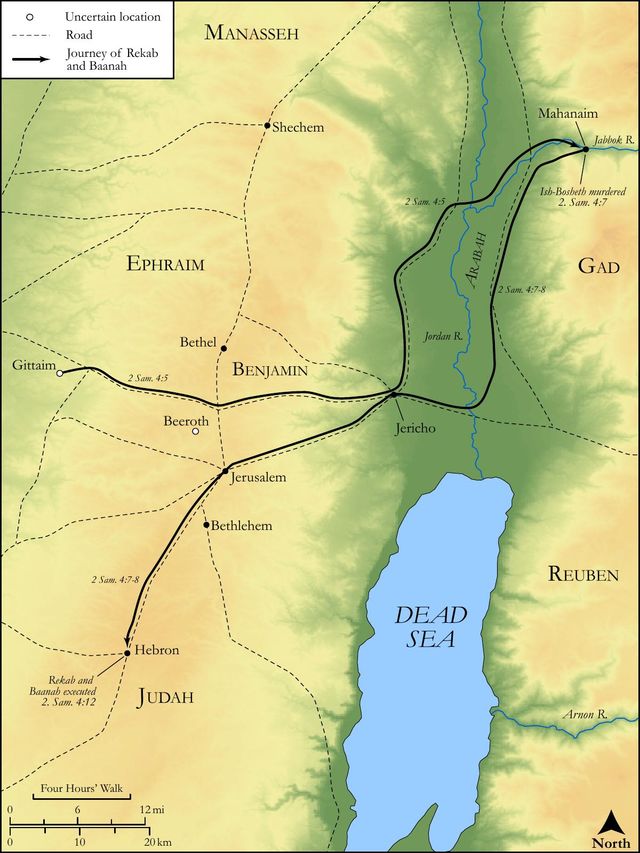
1.Who were the murderers: Baanah and Rechab, Sa2 4:2, Sa2 4:3. They were own brothers, as Simeon and Levi, and partners in iniquity. They were or had been Ish-bosheth's own servants, employed under him, so much the more base and treacherous was it in them to do him a mischief. They were Benjamites, of his own tribe. They were of the city of Beeroth; for some reason which we cannot now account for care is here taken to let us know (in a parenthesis) that that city belonged to the lot of Benjamin, so we find (Jos 18:25), but that the inhabitants, upon some occasion or other, perhaps upon the death of Saul, retired to Gittaim, another city which lay not far off in the same tribe, and was better fortified by nature, being situate (if we may depend upon Mr. Fuller's map) between the two rocks Bozez and Seneh. There the Beerothites were when this was written, and probably took root there, and never returned to Beeroth again, which made Beeroth, that had been one of the cities of the Gibeonites (Jos 9:17), to be forgotten, and Gittaim to be famous long after, as we find, Neh 11:33.
2.How the murder was committed, Sa2 4:5-7. See here,
(1.)The slothfulness of Ish-bosheth. He lay upon his bed at noon. It does not appear that the country was at any time of the year so hot as to oblige the inhabitants to retire at noon, as we are told they do in Spain in the heat of summer; but Ishbosheth was a sluggish man, loved his ease and hated business: and when he should have been, at this critical juncture, at the head of his forces in the field, or at the head of his counsels in a treaty with David, he was lying upon his bed and sleeping, for his hands were feeble (Sa2 4:1), and so were his head and heart. When those difficulties dispirit us which should rather invigorate us and sharpen our endeavours we betray both our crowns and lives. Love not sleep, lest thou come to poverty and ruin. The idle soul is an easy prey to the destroyer.
(2.)The treachery of Baanah and Rechab. They came into the house, under pretence of fetching wheat for the victualling of their regiments; and such was the plainness of those times that the king's corn-chamber and his bed-chamber lay near together, which gave them an opportunity, when they were fetching wheat, to murder him as he lay on the bed. We know not when and where death will meet us. When we lie down to sleep we are not sure but that we may sleep the sleep of death before we awake; nor do we know from what unsuspected hand a fatal stroke may come. Ish-bosheth's own men, who should have protected his life, took it away.
3.The murderers triumphed in what they had done. As if they had performed some very glorious action, and the doing of it for David's advantage was enough not only to justify it, but to sanctify it, they made a present of Ish-bosheth's head to David (Sa2 4:8): Behold the head of thy enemy, than which they thought nothing could be more acceptable to him; yea, and they made themselves instruments of God's justice, ministers to bear his sword, though they had no commission: The Lord hath avenged thee this day of Saul and of his seed. Not that they had any regard either to God or to David's honour; they aimed at nothing but to make their own fortunes (as we say) and to get preferment in David's court; but, to ingratiate themselves with him, they pretended a concern for his life, a conviction of his title, and a zealous desire to see him in full possession of the throne. Jehu pretended zeal for the Lord of hosts when an ambition to set up himself and his own family was the spring of his actions.
Continue studying 2 Samuel 4:2 across the web’s major study libraries — every link below opens this exact verse, chapter, or book on the destination site.
Read & Compare
 BibleGatewayThis verse in more than 200 translations and 70 languages.
 Bible.comThe YouVersion reader — hundreds of translations, reading plans, and highlights.
 ESV.orgCrossway's official English Standard Version reader.
 NET BibleThe NET translation with 60,000+ translators' notes on every rendering decision.
 STEP BibleTyndale House's free study tool — original text, vocabulary, and scholarly resources.
 BibliaLogos Bible Software's free web reader.
 USCCBThe New American Bible (Revised Edition) with the U.S. bishops' study notes.
Commentaries
 BibleHub CommentariesDozens of classic commentaries on this verse, gathered on one page.
 StudyLightMore than 100 commentary sets — the largest collection on the web.
 BibleRefPlain-English commentary on what this verse means, verse by verse.
 Enduring WordDavid Guzik's free commentary on this chapter, widely used by Bible teachers.
 Bible Study ToolsVerse commentary alongside Greek and Hebrew study aids.
Original Language & Research
- BibleHub InterlinearThe verse word by word — original language, transliteration, and English.
- BibleHub LexiconEvery word's original-language definition and Strong's entry.
 Blue Letter BibleDeep-study tools — Strong's numbers, concordance, and word studies.
 SefariaThe Hebrew text with Rashi and centuries of Jewish commentary.
Sermons, Hymns & Audio


TrulyRandomVerse is not affiliated with these sites and doesn’t control their content. They’re linked because they’re genuinely useful.
Summary
This pivotal verse introduces Baanah and Rechab, two brothers holding the significant position of "captains of bands" under Ish-bosheth, Saul's son. The detailed identification of their lineage—as sons of Rimmon, a Beerothite from the tribe of Benjamin—is not merely incidental but serves to establish their close tribal and geographical connection to Saul's house. This seemingly minor background detail is critically important, as these individuals are on the cusp of playing a treacherous and decisive role in the escalating civil conflict between the remnants of Saul's kingdom and the rising house of David, leading directly to the assassination of Ish-bosheth and the subsequent unification of Israel under David.
Context
ShowHideLiterary Context
2 Samuel 4:2 is strategically positioned immediately following the profound shock and destabilization caused by the assassination of Abner, Saul's former commander and the primary pillar of Ish-bosheth's fragile reign. The previous verse, 2 Samuel 4:1, vividly describes Ish-bosheth's profound weakness ("his hands were feeble") and the widespread dismay among "all the Israelites." In this atmosphere of vulnerability and political vacuum, the introduction of Baanah and Rechab in 2 Samuel 4:2 serves as a narrative pivot, setting the stage for the final, tragic act in Ish-bosheth's life. It highlights how the prevailing instability and the absence of strong leadership created an environment ripe for opportunistic betrayal, inexorably moving the narrative towards David's ultimate consolidation of power and the unification of the divided kingdom.
Historical & Cultural Context
The historical backdrop of 2 Samuel is one of intense political fragmentation and civil war following the catastrophic death of King Saul. Israel was effectively divided, with David reigning in Hebron over Judah and Ish-bosheth, a son of Saul, ruling over the northern tribes from Mahanaim. The designation "captains of bands" (Hebrew: rashei gedudim) refers to leaders of smaller, often autonomous or semi-independent military units. Such "bands" frequently engaged in skirmishes, raids, or acted as mercenaries, operating on the fringes of established authority and often shifting allegiances based on perceived advantage or personal gain. The identification of Baanah and Rechab as Beerothites is also culturally significant; Beeroth was one of the Gibeonite cities (Joshua 9:17), whose inhabitants had famously deceived Joshua and were consequently subjected to perpetual servitude (Joshua 9:27). While Beeroth was later "reckoned to Benjamin" (Joshua 18:25), their Gibeonite ancestry might have placed them in a somewhat ambiguous social position within Israelite society, potentially fostering a pragmatic, rather than deeply loyal, approach to the reigning house. This complex background illuminates the intricate web of loyalties and potential for both fidelity and profound betrayal within the tribal structure of ancient Israel.
Key Themes
ShowHideThis verse significantly contributes to several overarching themes woven throughout 2 Samuel. Firstly, it underscores the persistent Political Instability and Succession Crisis that plagued Israel in the wake of Saul's demise, vividly illustrating how the struggle for the throne led to extreme acts of violence, opportunism, and moral decay. Secondly, the emphasis on Tribal Identity and Loyalty is paramount; the explicit mention of Benjamin, Saul's own tribe, highlights the deep-seated tribal divisions and the presumed, yet ultimately shattered, loyalty that should have bound these men to Saul's house. This tribal connection makes their subsequent betrayal all the more poignant. Finally, the verse subtly illustrates the tension between Divine Sovereignty and Human Agency. While God's overarching plan for David to rule all Israel is clear and unyielding, the narrative meticulously records the human actions, motivations, and betrayals—however wicked—that paradoxically serve to advance God's sovereign purposes, demonstrating His ability to work through flawed human choices.
Exposition and Analysis
ShowHideKey Word Analysis
ShowHideThis common Hebrew word, appearing as "Saul's son," "sons of Rimmon," and "children of Benjamin," is fundamental to the verse's meaning. Derived from a root meaning "to build," bên signifies a son as a builder or perpetuator of the family name and lineage. In this context, it emphasizes the familial and tribal connections that should have implied loyalty. Baanah and Rechab are identified by their direct paternal lineage ("sons of Rimmon") and their broader tribal affiliation ("children of Benjamin"), linking them directly to the house of Saul, thereby heightening the impact of their impending betrayal.
This phrase describes Baanah and Rechab's military role. Sar (H8269) denotes a "head person" or "chief," while gedud (H1416) refers to a "crowd" or "troop," often implying a raiding party or a smaller, independent military unit. Unlike commanders of large, organized armies, these "captains of bands" were leaders of mobile, often autonomous detachments. This implies a degree of independent action, a readiness for swift and decisive operations, and perhaps a less formal chain of command, making them precisely the kind of figures capable of executing a clandestine act like regicide.
This designation identifies Baanah and Rechab as originating from Beeroth (H881), a specific place in Palestine. A "Beerothite" (H886) is an inhabitant of Beeroth. The biblical text explicitly notes that Beeroth "was reckoned to Benjamin," linking them tribally to Saul's lineage. However, Beeroth was originally one of the Gibeonite cities, whose inhabitants had a unique, subjugated status within Israel. This dual identity—Gibeonite by origin, Benjaminite by territorial reckoning—might suggest a pragmatic rather than deeply ingrained loyalty, potentially contributing to their willingness to betray Ish-bosheth for personal gain.
Verse Breakdown
ShowHide"And Saul's son had two men [that were] captains of bands:"
This opening clause immediately establishes the direct connection between the two central figures, Baanah and Rechab, and Ish-bosheth, the son of Saul. It highlights their specific military role as "captains of bands," indicating their leadership of smaller, agile units, which is crucial for understanding their capacity for the subsequent assassination. This sets the stage for their involvement as insiders.
"the name of the one [was] Baanah, and the name of the other Rechab,"
This provides the specific names of the two individuals, Baanah (H1196) and Rechab (H7394). By naming them, the narrative lends a sense of historical precision and personal accountability to the unfolding events, emphasizing their individual agency rather than portraying them as anonymous figures in a larger conspiracy.
"the sons of Rimmon a Beerothite, of the children of Benjamin:"
This clause offers vital genealogical and tribal information. Identifying them as "sons of Rimmon" provides their immediate paternal lineage, while "a Beerothite" specifies their hometown. Crucially, "of the children of Benjamin" directly links them to Saul's own tribe, a detail that profoundly underscores the irony and treachery of their impending act against Saul's son, as tribal loyalty would normally be expected.
"(for Beeroth also was reckoned to Benjamin:"
This parenthetical explanation serves as an important clarification, ensuring the reader understands the geographical and tribal link. It explicitly states why inhabitants of Beeroth, despite their Gibeonite origins, are considered "of the children of Benjamin," thereby reinforcing the Benjaminite identity of Baanah and Rechab and making their betrayal of Ish-bosheth even more poignant and scandalous within the context of ancient Israelite tribal loyalties.
Literary Devices
ShowHideThe verse employs several significant literary devices that enrich its meaning and prepare the reader for the unfolding drama. Foreshadowing is prominently utilized, as the meticulous introduction of Baanah and Rechab, complete with their specific military roles and precise tribal affiliations, strongly hints at their future, pivotal importance in the narrative. Their detailed identification serves to prepare the reader for the dramatic and tragic events that are about to unfold, creating a sense of impending doom. Genealogical Detail is also a key feature, characteristic of Old Testament historical narratives. By naming individuals and tracing their lineage and geographical origins, the text lends authenticity and historical grounding to the account, emphasizing the concrete reality of these events and the specific individuals involved. Furthermore, there is a profound underlying Irony in the fact that these men, explicitly identified as "of the children of Benjamin" (Saul's own tribe), are the very ones who ultimately betray and assassinate Ish-bosheth, the last significant vestige of Saul's royal house. This tribal connection, which should have implied unwavering loyalty, instead highlights the depths of opportunism, the breakdown of traditional allegiances, and the moral decay prevalent during this tumultuous period of civil war.
Theological and Thematic Connections
ShowHide2 Samuel 4:2 serves as a stark reminder of the chaotic and morally compromised nature of human power struggles, particularly during a period of transition in leadership. The meticulous identification of Baanah and Rechab, seemingly minor figures, underscores the biblical principle that even the actions of individuals, driven by their own ambitions or perceived advantages, play a significant role in the larger tapestry of God's sovereign plan. While their subsequent act of assassination is a heinous betrayal, it paradoxically clears the path for David's rightful ascension to the throne of all Israel, illustrating how God can use even the wickedness of humanity to achieve His righteous purposes. This verse highlights the fragility of human authority and the pervasive influence of tribal loyalties and personal gain in a fallen world, setting the stage for divine judgment on those who act with treachery.
Reflection and Application
ShowHideThis verse, though brief and seemingly focused on historical detail, offers profound insights for contemporary reflection. It reminds us that every individual, no matter how seemingly minor or historically obscure, holds a place within the unfolding narrative of history and God's overarching plan. Baanah and Rechab's choices, driven by opportunism and a misguided expectation of reward, ultimately led to their demise, demonstrating that actions rooted in treachery and self-interest, even if they appear to align with a larger divine purpose, do not escape divine judgment. For believers, this serves as a powerful call to examine our own loyalties and motives. Are our allegiances primarily to earthly structures, personal gain, or tribal affiliations, or are they first and foremost to God's kingdom and His righteous standards? The narrative underscores the importance of integrity, even when faced with opportunities for advancement through morally questionable means. It challenges us to trust in God's timing and methods, rather than resorting to human cunning or violence to achieve desired outcomes, knowing that true justice, lasting peace, and genuine reward come only from Him.
Questions for Reflection
ShowHideFAQ
ShowHideWho were Baanah and Rechab, and what was their significance?
ShowHideBaanah and Rechab were two brothers, identified as "captains of bands" (leaders of small military units) serving under Ish-bosheth, Saul's son. They were Beerothites from the tribe of Benjamin. Their significance lies in their treacherous act of assassinating Ish-bosheth, hoping to gain favor with David and secure a position in his new kingdom. However, David, a man of integrity and justice, condemned their act as a heinous crime against an innocent man and had them executed, as recorded in 2 Samuel 4:9-12.
Why is their tribal affiliation to Benjamin emphasized?
ShowHideTheir tribal affiliation to Benjamin is emphasized because Benjamin was the tribe of King Saul, Ish-bosheth's father. This connection would naturally imply a presumed loyalty to Saul's royal house and, by extension, to Ish-bosheth. Their act of assassinating Ish-bosheth, therefore, represents a profound betrayal not only of their king but also of their tribal kin. It highlights the deep political divisions, the breakdown of traditional loyalties, and the moral decay prevalent during this tumultuous period of civil war between the house of Saul and the house of David.
What does "captains of bands" mean in this context?
ShowHideThe term "captains of bands" (Hebrew: sarei gedudim) refers to leaders of small, often independent or semi-independent, military detachments or raiding parties. Unlike commanders of large, organized armies, these individuals typically led mobile units involved in skirmishes, border patrols, or opportunistic raids. In the context of 2 Samuel 4:2, it suggests that Baanah and Rechab were figures with a degree of autonomy and a readiness for swift, decisive, and potentially clandestine action, making them suited for the assassination they would carry out.
Christ-Centered Fulfillment
ShowHideThe political instability, tribal betrayals, and violent power struggles depicted in 2 Samuel 4:2 and the subsequent narrative powerfully underscore humanity's desperate need for a true and righteous King, one whose reign is not built on ambition, treachery, or the shifting sands of human loyalty. The house of Saul, marked by internal strife and ultimate collapse, stands in stark contrast to the eternal kingdom promised through the lineage of David, which finds its ultimate and perfect fulfillment in Jesus Christ. Unlike the opportunistic "captains of bands" who sought personal gain through murder, Christ, the true King, laid down His life, not to seize a throne, but to redeem His people (John 10:11). His kingdom is not of this world, nor is it established by human might or political maneuvering (John 18:36), but by divine grace and self-sacrificial love. The chaos surrounding Ish-bosheth's demise points forward to the Prince of Peace (Isaiah 9:6-7), whose reign brings true justice, lasting peace, and an end to all forms of human treachery. He is the ultimate Son of David, whose throne will be established forever (Luke 1:32-33), offering a stability and faithfulness utterly absent in the fragmented kingdom of Saul.