


1 Chronicles 16:5
- אָסָף'a·SafAsaphH623N-proper-mNoun Proper Masculine
- הָרֹאשׁha·Rosh[was] the chiefH7218Art ¦ N-msNoun Singular Masculine Absoluteהָ[was] theרֹאשׁchief
- וּמִשְׁנֵהוּu·mish·Ne·huand [was] his secondH4932Conj-w ¦ N-msc ¦ 3msNoun Singular Masculine Constructוּandמִשְׁנֵ[was] secondהוּhis
- זְכַרְיָהze·khar·YahZechariahH2148N-proper-mNoun Proper Masculine
- יְעִיאֵלye·'i·'ElJeielH3273N-proper-mNoun Proper Masculine
- וּשְׁמִירָמוֹתu·she·mi·ra·Motand ShemiramothH8070Conj-w ¦ N-proper-mNoun Proper MasculineוּandשְׁמִירָמוֹתShemiramoth
- וִיחִיאֵלvi·chi·'Eland JehielH3171Conj-w ¦ N-proper-mNoun Proper MasculineוִandיחִיאֵלJehiel
- וּמַתִּתְיָהu·ma·tit·Yahand MattithiahH4993Conj-w ¦ N-proper-mNoun Proper MasculineוּandמַתִּתְיָהMattithiah
- וֶאֱלִיאָבve·'e·li·'Avand EliabH446Conj-w ¦ N-proper-mNoun Proper MasculineוֶandאֱלִיאָבEliab
- וּבְנָיָהוּu·ve·na·ya·Huand BenaiahH1141Conj-w ¦ N-proper-mNoun Proper MasculineוּandבְנָיָהוּBenaiah
- וְעֹבֵדve·'o·Vedand Obed-H5654Conj-w ¦ N-proper-mNoun Proper MasculineוְandעֹבֵדObed-
- אֱדֹם'e·DomEdomH5654N-proper-mNoun Proper Masculine
- וִיעִיאֵלvi·'i·'Eland JeielH3273Conj-w ¦ N-proper-mNoun Proper MasculineוִandיעִיאֵלJeiel
- בִּכְלֵיbikh·Leiwith instruments ofH3627Prep-b ¦ N-mpcNoun Plural Masculine Constructבִּwithכְלֵיinstruments of
- נְבָלִיםne·va·LimlyresH5035N-mpNoun Plural Masculine Absolute
- וּבְכִנֹּרוֹתu·ve·khi·no·Rotand with harpsH3658Conj-w ¦ Prep-b ¦ N-fpNoun Plural Feminine Absoluteוּandבְwithכִנֹּרוֹתharps
- וְאָסָףve·'a·Safand AsaphH623Conj-w ¦ N-proper-mNoun Proper MasculineוְandאָסָףAsaph
- בַּמְצִלְתַּיִםbam·tzil·Ta·yimwith <the> cymbalsH4700Prep-b ¦ N-fdNoun Dual Feminine Absoluteבַּwith <the>מְצִלְתַּיִםcymbals
- מַשְׁמִיעַmash·Mi·a'[was] sounding aloudH8085V-Hiphil-Prtcpl-msVerb Hiphil Participle Singular Masculine Absolute
English is a literal word-by-word gloss of the Hebrew, not the KJV's wording. Why?
This is the original text the KJV's translators worked from — each Hebrew word with its own literal English meaning in this verse, prepared by scholars at Tyndale House, Cambridge. The KJV translates whole sentences, not word by word, so its wording differs: one Hebrew word can become several English words, and the KJV may choose “the LORD” where the gloss reads “Yahweh”. Both are faithful — they answer different questions. For the KJV's own rendering, switch to the KJV text.
Details
See on the biblical-era map
Study this verse
Public-domain commentary
Matthew Henry
From his Commentary on the Whole Bible. Henry comments on passages, not single verses — this entry covers 1 Chronicles 16:1–6. His two-level outline is real structure in the source text, so it is rendered as structure.
It was a glorious day when the ark of God was safely lodged in the tent David had pitched for it. That good man had his heart much upon it, could not sleep contentedly till it was done, Psa 132:4, Psa 132:5.
I.The circumstances of the ark were now,
1.Better than what they had been. It had been obscure in a country town, in the fields of the wood; now it was removed to a public place, to the royal city, where all might resort to it. It had been neglected, as a despised broken vessel; now it was attended with veneration, and God was enquired of by it. It had borrowed a room in a private house, which it enjoyed by courtesy; now it had a habitation of its own entirely to itself, was set in the midst of it, and not crowded into a corner. Note, Though God's word and ordinances may be clouded and eclipsed for a time, they shall at length shine out of obscurity. Yet,
2.They were much short of what was intended in the next reign, when the temple was to be built. This was but a tent, a poor mean dwelling; yet this was the tabernacle, the temple which David in his psalms often speaks of with so much affection. David, who pitched a tent for the ark and continued steadfast to it, did far better than Solomon, who built a temple for it and yet in his latter end turned his back upon it. The church's poorest times were its purest.
II.Now David was easy in his mind, the ark was fixed, and fixed near him. Now see how he takes care,
1.That God shall have the glory of it. Two ways he gives him honour upon this occasion: - (1.) By sacrifices (Ch1 16:1), burnt-offerings in adoration of his perfections, peace-offerings in acknowledgment of his favours. (2.) By songs: he appointed Levites to record this story in a song for the benefit of others, or to celebrate it themselves by thanking and praising the God of Israel, Ch1 16:4. All our rejoicings must express themselves in thanksgivings to him from whom all our comforts are received.
2.That the people shall have the joy of it. They shall fare the better for this day's solemnity; for he gives them all what is worth coming for, not only a royal treat in honour of the day (Ch1 16:3), in which David showed himself generous to his subjects, as he had found God gracious to him (those whose hearts are enlarged with holy joy should show it by being open-handed); but (which is far better) he gives them also a blessing in the name of the Lord, as a father, as a prophet, Ch1 16:2. He prayed to God for them, and commended them to his grace. In the name of the Word of the Lord (so the Targum), the essential eternal Word, who is Jehovah, and through whom all blessings come to us.
Continue studying 1 Chronicles 16:5 across the web’s major study libraries — every link below opens this exact verse, chapter, or book on the destination site.
Read & Compare
 BibleGatewayThis verse in more than 200 translations and 70 languages.
 Bible.comThe YouVersion reader — hundreds of translations, reading plans, and highlights.
 ESV.orgCrossway's official English Standard Version reader.
 NET BibleThe NET translation with 60,000+ translators' notes on every rendering decision.
 STEP BibleTyndale House's free study tool — original text, vocabulary, and scholarly resources.
 BibliaLogos Bible Software's free web reader.
 USCCBThe New American Bible (Revised Edition) with the U.S. bishops' study notes.
Commentaries
 BibleHub CommentariesDozens of classic commentaries on this verse, gathered on one page.
 StudyLightMore than 100 commentary sets — the largest collection on the web.
 BibleRefPlain-English commentary on what this verse means, verse by verse.
 Enduring WordDavid Guzik's free commentary on this chapter, widely used by Bible teachers.
 Bible Study ToolsVerse commentary alongside Greek and Hebrew study aids.
Original Language & Research
- BibleHub InterlinearThe verse word by word — original language, transliteration, and English.
- BibleHub LexiconEvery word's original-language definition and Strong's entry.
 Blue Letter BibleDeep-study tools — Strong's numbers, concordance, and word studies.
 SefariaThe Hebrew text with Rashi and centuries of Jewish commentary.
Sermons, Hymns & Audio


TrulyRandomVerse is not affiliated with these sites and doesn’t control their content. They’re linked because they’re genuinely useful.
Summary
1 Chronicles 16:5 meticulously details the appointment of specific Levite musicians, led by Asaph, to minister before the Ark of the Covenant in Jerusalem. This verse underscores King David's profound commitment to establishing an organized, continuous, and musically rich system of worship, highlighting the specialized roles and the central importance of instrumental praise in ancient Israelite devotion, thereby setting a foundational precedent for structured liturgical service.
Context
ShowHideLiterary Context
This verse is an integral part of 1 Chronicles 16, which chronicles the pivotal event of King David bringing the Ark of the Covenant to Jerusalem. Following the Ark's triumphant arrival and the offering of sacrifices, David immediately prioritized the establishment of a vibrant and continuous system of worship. Verse 4 details David's initial appointment of Levites "to minister before the ark of the Lord, and to record, and to thank, and to praise the Lord God of Israel." Verse 5 then narrows the focus to specific individuals within this newly organized musical ministry, providing their names and instrumental assignments. This progression from general appointment to specific roles emphasizes the meticulous planning and dedication involved in David's vision for worship, ensuring that the celebration of God's presence was both grand and orderly.
Historical & Cultural Context
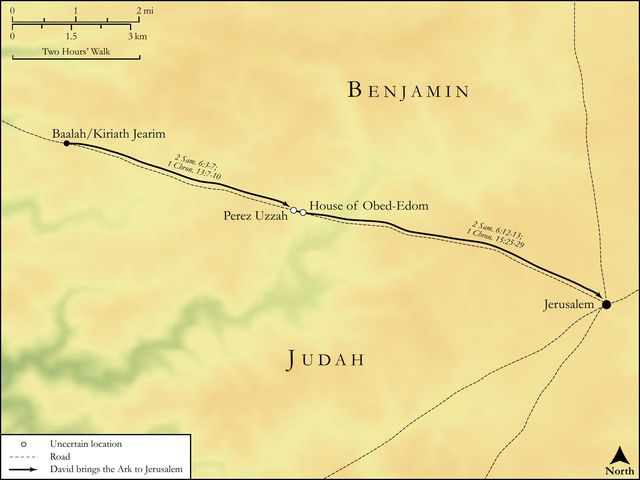
The setting is David's reign, approximately 1000 BC, shortly after he has established Jerusalem as his capital and brought the Ark there from the house of Obed-Edom. The Ark of the Covenant represented God's tangible presence among His people, making its proper veneration paramount. In ancient Israel, the Levites were the designated tribe for sacred service, including temple duties and musical ministry, as outlined in the Mosaic Law. Music played a crucial role in ancient Near Eastern cultures, not just for entertainment but also in religious rituals, royal courts, and public celebrations. David, himself a skilled musician and composer, as evidenced by his playing for Saul in 1 Samuel 16:23 and his authorship of many Psalms, understood the power of music to express devotion and facilitate corporate worship, elevating it to a central component of Israel's national religious life.
Key Themes
ShowHideThis verse contributes significantly to several key themes within 1 Chronicles. Firstly, it highlights the theme of Organized Worship, demonstrating David's meticulous attention to order and structure in approaching God. Worship was not haphazard but a well-thought-out system with designated personnel and roles, reflecting God's own character of order. Secondly, it emphasizes Specialized Roles within the community of faith. The listing of names like Asaph, Zechariah, and others, along with specific instruments, underscores that individuals were appointed to distinct roles based on their skills and calling, with Asaph explicitly named "the chief," indicating a clear leadership position. Thirdly, the verse showcases the Prominence of Music in Israelite worship. The mention of "psalteries," "harps," and "cymbals" indicates that music was not merely an accompaniment but a central element of praise, reflecting a recurring emphasis on musical praise found throughout the Psalms, such as the vibrant call to praise with diverse instruments in Psalm 150:3-5. Finally, it reflects the overarching theme of Devotion and Praise, illustrating the deep national and royal commitment to honoring God's presence, ensuring that the Ark was attended with constant thanksgiving and adoration.
Exposition and Analysis
ShowHideKey Word Analysis
ShowHideFrom a root meaning "collector," Asaph is identified here as "the chief" (H7218, rôʼsh) of the musicians. He was a prominent Levite and the head of one of the three Levitical choirs established by David, alongside Heman and Jeduthun. His role extended beyond mere performance; he was also recognized as a "seer" or prophet (e.g., 2 Chronicles 29:30), indicating his spiritual authority and insight in composing and leading sacred music. Many Psalms (e.g., Psalm 73) are attributed to him or his guild, signifying his profound and lasting influence on Israelite worship music and theology.
This term refers to a stringed instrument, often translated as a lute or a type of harp. Strong's H5035 describes it as a "skin-bag for liquids (from collapsing when empty); hence, a vase (as similar in shape when full); also a lyre (as having a body of like form)." Its inclusion here signifies the melodic and harmonic richness intended for the worship before the Ark, contributing a resonant and often deep sound to the ensemble.
Indicates this is a dual form, "double tinklers," referring to two metal discs struck together to produce a sharp, ringing sound. Asaph, as the chief, is specifically noted for playing the cymbals. This suggests his role in providing a strong rhythmic foundation, marking transitions, or emphasizing key moments in the musical ensemble, perhaps akin to a conductor setting the tempo and accent for the entire musical offering.
Verse Breakdown
ShowHide"Asaph the chief, and next to him Zechariah, Jeiel, and Shemiramoth, and Jehiel, and Mattithiah, and Eliab, and Benaiah, and Obededom:"
This initial clause establishes the leadership and the core group of Levite musicians appointed by David. Asaph's designation as "the chief" (H7218, rôʼsh) immediately highlights his preeminent role, likely overseeing the entire musical ministry and perhaps even composing or arranging the pieces performed. The phrase "next to him" (H4932, mishneh) indicates a clear hierarchy and succession. The naming of each individual underscores the intentionality and personal nature of their selection for this sacred service. The inclusion of Obed-Edom, who previously housed the Ark and was blessed by God for it (1 Chronicles 13:14), suggests that those who had shown faithfulness in relation to the Ark were now being integrated into its formal, continuous service.
"and Jeiel with psalteries and with harps;"
This segment specifies the instrumental assignment for Jeiel, indicating a specialization within the musical team. The pairing of "psalteries" (H5035, nebel) and "harps" (H3658, kinnôwr) suggests a melodic and harmonic role, contributing to the rich tapestry of sound. This detail emphasizes that each musician had a particular skill set and instrument, contributing to a cohesive and comprehensive musical offering, reflecting David's desire for a full and vibrant expression of praise.
"but Asaph made a sound with cymbals;"
This final clause specifically details Asaph's personal instrumental role. While he is "the chief" and likely an overall director, his hands-on involvement with the cymbals (H4700, mᵉtsêleth) is noteworthy. This particular instrument, known for its loud and distinct sound, could have served to punctuate the music, mark rhythmic changes, or lead the entire ensemble, reinforcing Asaph's leadership in setting the pace and intensity of the worship. The verb "made a sound" (H8085, shâmaʻ) implies a deliberate and impactful auditory contribution.
Literary Devices
ShowHideThe primary literary device employed in 1 Chronicles 16:5 is Catalogue or Listing, evident in the detailed enumeration of the Levite musicians by name. This serves to emphasize the meticulous organization and intentionality behind David's establishment of worship. The specific naming of individuals, rather than a general reference, lends historical authenticity and highlights the personal dedication required for this sacred service. Furthermore, there is a clear element of Emphasis placed on Asaph, who is not only named first and designated "the chief" but also singled out for his specific instrumental role with the cymbals. This dual mention underscores his preeminence and central importance within the newly formed musical corps. The differentiation of instruments also creates a sense of Variety within the unified purpose of praise, showcasing a comprehensive and multifaceted approach to worship.
Theological and Thematic Connections
ShowHideThe meticulous organization of worship in 16:5 reveals a profound theological truth: God is a God of order, not chaos. The detailed appointments of Levites and their specific musical roles demonstrate that worship is not to be a haphazard activity but a deliberate, intentional, and excellent offering to a holy God. This commitment to structured and skilled praise reflects the understanding that God deserves the very best of human effort and artistry. The emphasis on music as a central component of worship also highlights its unique capacity to express deep devotion, joy, and reverence, transcending mere words and engaging the whole person. This Old Testament pattern of dedicated and artful worship foreshadows the call for believers to offer their lives as a "living sacrifice" and "spiritual worship" in the New Covenant, as found in Romans 12:1.
Reflection and Application
ShowHideThe detailed account of David's organization of worship in 1 Chronicles 16:5 offers timeless lessons for believers today. It reminds us that our approach to God, whether individually or corporately, should be marked by intentionality and excellence. Just as David ensured skilled musicians were appointed to specific roles, we are called to offer our best talents, time, and resources in service to God, recognizing that all gifts—whether musical, administrative, teaching, serving, or showing hospitality—contribute to the harmonious "sound" of the body of Christ. This verse challenges us to consider how we can be more deliberate in cultivating our spiritual lives, not leaving our faith to chance or convenience, but actively seeking ways to honor God with our whole being. It also encourages us to value the diverse gifts within our communities, understanding that every unique contribution, like the distinct sounds of psalteries, harps, and cymbals, is vital for a rich and comprehensive expression of praise that brings glory to God and edifies His people.
Questions for Reflection
ShowHideFAQ
ShowHideWho was Asaph, and what was his significance beyond this verse?
ShowHideAsaph was a highly significant figure in ancient Israelite worship, a Levite from the clan of Gershon. In 1 Chronicles 16:5, he is identified as "the chief" of the musicians appointed by King David to lead worship before the Ark of the Covenant. His significance extends far beyond this single verse; he was one of the three heads of the Levitical choirs (along with Heman and Jeduthun) established by David, responsible for continuous musical ministry. Asaph was not merely a musician but also recognized as a "seer" or prophet, indicating his spiritual insight and leadership in composing and performing sacred music, as noted in 2 Chronicles 29:30. A substantial portion of the book of Psalms (Psalms 50 and 73-83) is attributed to Asaph or his guild, demonstrating his profound and lasting impact on the liturgical and theological landscape of Israel. His legacy underscores the integral role of inspired music in expressing the heart of God's people and guiding their devotion.
Christ-Centered Fulfillment
ShowHideThe meticulous organization of worship under David, as exemplified in 1 Chronicles 16:5, finds its ultimate fulfillment and perfection in Jesus Christ. David, as king, orchestrated the worship of Israel, pointing forward to Christ, the true King and Head of the Church, who perfectly orchestrates and enables genuine worship for all eternity. The Levite musicians, with their specialized roles and dedicated service before the Ark, foreshadow the ultimate High Priest, Jesus, who entered the heavenly sanctuary not with instruments and animal sacrifices, but with His own precious blood, offering a perfect and eternal sacrifice for sin (Hebrews 9:11-12). Through Christ, the need for a specific tribe or physical temple for worship is transcended, as He enables all believers, through the indwelling Holy Spirit, to become a "royal priesthood" (1 Peter 2:9) who offer spiritual sacrifices of praise and thanksgiving (Hebrews 13:15). The "new song" of redemption sung in heaven by the redeemed multitude (Revelation 5:9-10) is the ultimate expression of the praise initiated by Asaph and his company, now fully realized in the worship of the Lamb who is worthy. Thus, the Old Testament patterns of worship, with their emphasis on order, skill, and heartfelt praise, ultimately point to the One who makes true worship possible "in spirit and truth" for all who believe (John 4:23-24).