


1 Chronicles 16:6
Bible text: King James Version (1769 Blayney text) · Public domain
Bible text: Berean Standard Bible · Public domain
Bible text: American Standard Version (1901) · Public domain
Bible text: World English Bible, Messianic edition · Public domain
Bible text: Geneva Bible (1599) · Public domain
Bible text: Young's Literal Translation · Public domain
- וּבְנָיָהוּu·ve·na·Ya·huand BenaiahH1141Conj-w ¦ N-proper-mNoun Proper MasculineוּandבְנָיָהוּBenaiah
- וְיַחֲזִיאֵלve·ya·cha·zi·'Eland JahazielH3166Conj-w ¦ N-proper-mNoun Proper MasculineוְandיַחֲזִיאֵלJahaziel
- הַכֹּהֲנִיםha·ko·ha·Nimthe priestsH3548Art ¦ N-mpNoun Plural Masculine Absoluteהַtheכֹּהֲנִיםpriests
- בַּחֲצֹצְרוֹתba·cha·tzo·tze·Rotwith trumpetsH2689Prep-b ¦ N-fpNoun Plural Feminine Absoluteבַּwithחֲצֹצְרוֹתtrumpets
- תָּמִידta·MidcontinuallyH8548N-msNoun Singular Masculine Absolute
- לִפְנֵיlif·Nei<to> beforeH6440Prep-l ¦ N-mpcNoun Plural Masculine Constructלִ<to>פְנֵיbefore
- אֲרוֹן'a·Ron[the] ark ofH727N-mscNoun Singular Masculine Construct
- בְּרִיתbe·rit[the] covenant ofH1285N-fscNoun Singular Feminine Construct
- הָאֱלֹהִיםha·'E·lo·Him<the> GodH430Art ¦ N-mpNoun Plural Masculine Absoluteהָ<the>אֱלֹהִיםGod
English is a literal word-by-word gloss of the Hebrew, not the KJV's wording. Why?
This is the original text the KJV's translators worked from — each Hebrew word with its own literal English meaning in this verse, prepared by scholars at Tyndale House, Cambridge. The KJV translates whole sentences, not word by word, so its wording differs: one Hebrew word can become several English words, and the KJV may choose “the LORD” where the gloss reads “Yahweh”. Both are faithful — they answer different questions. For the KJV's own rendering, switch to the KJV text.
Details
See on the biblical-era map
Study this verse
Public-domain commentary
Matthew Henry
From his Commentary on the Whole Bible. Henry comments on passages, not single verses — this entry covers 1 Chronicles 16:1–6. His two-level outline is real structure in the source text, so it is rendered as structure.
It was a glorious day when the ark of God was safely lodged in the tent David had pitched for it. That good man had his heart much upon it, could not sleep contentedly till it was done, Psa 132:4, Psa 132:5.
I.The circumstances of the ark were now,
1.Better than what they had been. It had been obscure in a country town, in the fields of the wood; now it was removed to a public place, to the royal city, where all might resort to it. It had been neglected, as a despised broken vessel; now it was attended with veneration, and God was enquired of by it. It had borrowed a room in a private house, which it enjoyed by courtesy; now it had a habitation of its own entirely to itself, was set in the midst of it, and not crowded into a corner. Note, Though God's word and ordinances may be clouded and eclipsed for a time, they shall at length shine out of obscurity. Yet,
2.They were much short of what was intended in the next reign, when the temple was to be built. This was but a tent, a poor mean dwelling; yet this was the tabernacle, the temple which David in his psalms often speaks of with so much affection. David, who pitched a tent for the ark and continued steadfast to it, did far better than Solomon, who built a temple for it and yet in his latter end turned his back upon it. The church's poorest times were its purest.
II.Now David was easy in his mind, the ark was fixed, and fixed near him. Now see how he takes care,
1.That God shall have the glory of it. Two ways he gives him honour upon this occasion: - (1.) By sacrifices (Ch1 16:1), burnt-offerings in adoration of his perfections, peace-offerings in acknowledgment of his favours. (2.) By songs: he appointed Levites to record this story in a song for the benefit of others, or to celebrate it themselves by thanking and praising the God of Israel, Ch1 16:4. All our rejoicings must express themselves in thanksgivings to him from whom all our comforts are received.
2.That the people shall have the joy of it. They shall fare the better for this day's solemnity; for he gives them all what is worth coming for, not only a royal treat in honour of the day (Ch1 16:3), in which David showed himself generous to his subjects, as he had found God gracious to him (those whose hearts are enlarged with holy joy should show it by being open-handed); but (which is far better) he gives them also a blessing in the name of the Lord, as a father, as a prophet, Ch1 16:2. He prayed to God for them, and commended them to his grace. In the name of the Word of the Lord (so the Targum), the essential eternal Word, who is Jehovah, and through whom all blessings come to us.
Continue studying 1 Chronicles 16:6 across the web’s major study libraries — every link below opens this exact verse, chapter, or book on the destination site.
Read & Compare
 BibleGatewayThis verse in more than 200 translations and 70 languages.
 Bible.comThe YouVersion reader — hundreds of translations, reading plans, and highlights.
 ESV.orgCrossway's official English Standard Version reader.
 NET BibleThe NET translation with 60,000+ translators' notes on every rendering decision.
 STEP BibleTyndale House's free study tool — original text, vocabulary, and scholarly resources.
 BibliaLogos Bible Software's free web reader.
 USCCBThe New American Bible (Revised Edition) with the U.S. bishops' study notes.
Commentaries
 BibleHub CommentariesDozens of classic commentaries on this verse, gathered on one page.
 StudyLightMore than 100 commentary sets — the largest collection on the web.
 BibleRefPlain-English commentary on what this verse means, verse by verse.
 Enduring WordDavid Guzik's free commentary on this chapter, widely used by Bible teachers.
 Bible Study ToolsVerse commentary alongside Greek and Hebrew study aids.
Original Language & Research
- BibleHub InterlinearThe verse word by word — original language, transliteration, and English.
- BibleHub LexiconEvery word's original-language definition and Strong's entry.
 Blue Letter BibleDeep-study tools — Strong's numbers, concordance, and word studies.
 SefariaThe Hebrew text with Rashi and centuries of Jewish commentary.
Sermons, Hymns & Audio


TrulyRandomVerse is not affiliated with these sites and doesn’t control their content. They’re linked because they’re genuinely useful.
Summary
1 Chronicles 16:6 offers a precise detail within the grand celebration of the Ark of the Covenant's arrival in Jerusalem, specifically highlighting Benaiah and Jahaziel, two priests, whose dedicated duty was to sound trumpets continually before the Ark. This verse underscores the meticulous organization of worship under King David, emphasizing the sacred role of the Aaronic priesthood and the vital place of instrumental praise in acknowledging God's abiding presence among His people. It captures a moment of disciplined devotion and joyful adoration at the heart of Israel's spiritual life.
Context
ShowHideLiterary Context
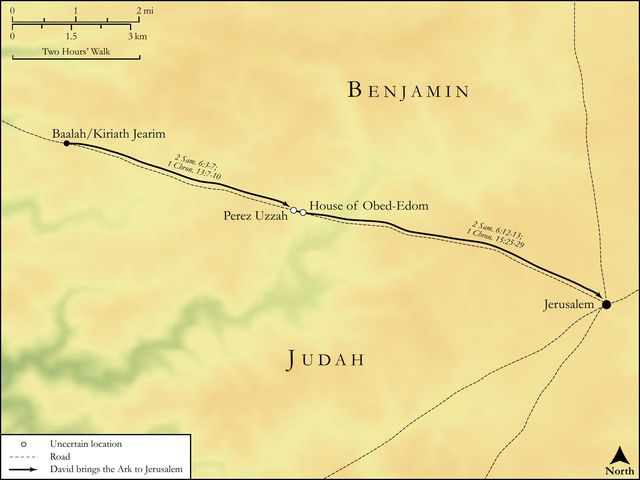
This verse is embedded within 1 Chronicles 15-16, a pivotal section describing King David's successful transfer of the Ark of the Covenant from the house of Obed-Edom to a specially prepared tent in Jerusalem. Following the initial failed attempt (as detailed in 1 Chronicles 13), David meticulously organized the Levites and priests according to Mosaic law, ensuring the Ark was carried properly (1 Chronicles 15:2). Chapter 16 then details the elaborate worship service that ensued, including sacrifices, the distribution of food, and the appointment of specific Levites and priests for continuous praise and service before the Ark. Verse 6 specifically names two priests, Benaiah and Jahaziel, highlighting their unique function within this newly established, highly structured system of worship, immediately preceding David's great psalm of thanksgiving (1 Chronicles 16:7-36).
Historical & Cultural Context
The bringing of the Ark to Jerusalem marked a profound historical and theological moment, establishing the city as both the political and spiritual capital of Israel. Historically, the Ark had been itinerant and often neglected since the time of Eli, suffering capture by the Philistines and residing in various locations (e.g., 1 Samuel 4-7). David's actions signify a deliberate return to covenant faithfulness and a renewed emphasis on the centrality of God's presence. Culturally, trumpets (specifically the chatsotsrah, or silver trumpets) were distinct from shofars; they were priestly instruments used for specific purposes as outlined in Numbers 10, including calling assemblies, signaling war, and, significantly, accompanying sacrifices and feasts as a sound of remembrance and joy before God. Their continual sounding before the Ark underscored the perpetual nature of worship and God's constant availability.
Key Themes
ShowHideThe verse contributes significantly to several overarching themes in Chronicles. Organized Worship is paramount, showcasing David's visionary leadership in establishing a structured, Levitical system of praise that would endure. This was not haphazard but a carefully planned liturgical service, reflecting the divine order. The Role of the Priesthood is also highlighted, as Benaiah and Jahaziel, being priests (descendants of Aaron), had exclusive rights to blow these sacred trumpets (Numbers 10:8). This emphasizes their unique mediatorial and worship-leading function. Music in Worship is a dominant theme throughout Chronicles, with David himself being a skilled musician and composer, and this verse specifically showcases the use of instrumental praise. Finally, the concept of God's Continual Presence is central, symbolized by the Ark and underscored by the "continual" sounding of the trumpets. This perpetual praise acknowledged God's dwelling among His people and His ongoing covenant faithfulness.
Exposition and Analysis
ShowHideKey Word Analysis
ShowHideMeaning "one officiating, a priest." This term specifically identifies Benaiah and Jahaziel as members of the Aaronic lineage, holding the exclusive right to perform certain sacred duties, such as blowing the silver trumpets. Their designation as "priests" underscores the adherence to Mosaic law in David's organization of worship, highlighting the sanctity and divine appointment of their role in mediating between God and Israel.
Describing "a trumpet (from its sundered or quavering note)." This refers specifically to the straight, silver trumpets, distinct from the ram's horn (shofar). These instruments, as commanded in Numbers 10:2, were reserved for priestly use in signaling, calling assemblies, sounding alarms for war, and, as here, accompanying sacrifices and feasts. Their sound was a powerful declaration of God's presence and activity, a sacred call to attention and celebration.
Meaning "continuance (as indefinite extension); constant (or adverbially, constantly)." This adverb denotes regularity, perpetuity, or an ongoing, unbroken service. Its use here emphasizes that the trumpets were not sounded occasionally but as an enduring, consistent act of worship before the Ark. It speaks to an unwavering devotion and a constant awareness of God's presence, signifying a perpetual state of praise and readiness, mirroring the regular offerings and services in the Tabernacle.
Verse Breakdown
ShowHide"Benaiah also and Jahaziel the priests"
This clause precisely identifies two specific individuals by name and their sacred office. Their designation as "the priests" immediately clarifies their Aaronic lineage and their exclusive right to perform certain liturgical functions, setting them apart from the general body of Levites. Their specific mention highlights the detailed organization and assignment of roles within David's worship structure, emphasizing the importance of individual accountability in sacred service.
"with trumpets"
This specifies the instrument used in their service. The plural "trumpets" (Hebrew ḥăṣōṣᵊrōt) indicates at least two, consistent with the instruction in Numbers 10:2 for the use of two silver trumpets. These were not merely musical instruments but sacred tools, whose sound carried profound symbolic and functional significance in Israelite worship and communication, serving as a divine signal and a joyful proclamation.
"continually"
This adverb describes the duration and nature of their trumpet blowing. It implies an unbroken, regular, and perpetual service. This wasn't a one-time blast but an ongoing, rhythmic proclamation, signifying an unceasing act of praise and vigilance before God's presence. It speaks to the commitment and dedication required in the service of the Lord, reflecting a constant state of worship and readiness.
"before the ark of the covenant of God"
This clause defines the sacred location and the object of their continuous service. The Ark of the Covenant was the most sacred artifact in Israel, symbolizing God's throne, His presence, and His covenant relationship with His people. To perform this service "before the ark" meant to be in the immediate presence of the visible symbol of God's dwelling, underscoring the holiness, gravity, and immense privilege of their task.
Literary Devices
ShowHideThe verse employs several literary devices to convey its meaning and impact. Specificity is powerfully evident in the naming of "Benaiah also and Jahaziel," which lends historical credibility and highlights the meticulous organization of David's worship. This attention to detail emphasizes the importance of individual roles within the larger communal worship. Symbolism is profoundly present through the "trumpets" and "the ark of the covenant of God." The trumpets symbolize divine communication, proclamation, and joy, serving as a call to attention and a declaration of God's presence. The Ark, meanwhile, is the preeminent symbol of God's immanent presence, His throne, and His covenant faithfulness with His people. The phrase "continually" functions as a device of Emphasis and Hyperbole, underscoring the unwavering and perpetual nature of the worship and the constant awareness of God's presence. This repetition of sound reinforces the idea of an unbroken connection between God and His people, a constant state of adoration and readiness, reflecting an ideal of ceaseless devotion.
Theological and Thematic Connections
ShowHide1 Chronicles 16:6, while a seemingly small detail, offers profound theological insights into the nature of worship and God's relationship with His people. It reveals God's desire for an ordered, intentional, and continuous acknowledgment of His presence. The "continual" sounding of trumpets before the Ark, the visible symbol of God's dwelling, speaks to the perpetual nature of God's covenant faithfulness and His accessibility. This Old Testament pattern of organized, instrumental worship, led by a dedicated priesthood, foreshadows the New Testament reality of worship in spirit and truth, where every believer is part of a "royal priesthood" (1 Peter 2:9) offering spiritual sacrifices. The emphasis on sound and presence points to the sensory and experiential aspects of encountering the divine, inviting the worshiper into a deeper, ongoing communion with the living God.
Reflection and Application
ShowHideThe scene described in 1 Chronicles 16:6 offers a timeless blueprint for our approach to God. The "continual" sounding of trumpets before the Ark, the very symbol of God's presence, challenges us to cultivate a lifestyle of unceasing awareness and adoration of God. While we no longer worship before a physical Ark, the principles remain: our worship should be intentional, ordered, and utilize our gifts for God's glory. Just as Benaiah and Jahaziel had a specific, dedicated role, so too are believers called to use their unique talents and positions to honor God, whether through music, service, or daily living. This verse encourages us to move beyond sporadic acts of piety to a consistent, joyful, and disciplined pursuit of God's presence, recognizing that He is always with us and worthy of our constant praise. It calls us to make our lives a continuous trumpet blast of worship, announcing His glory in every sphere of our existence, reflecting a heart continually attuned to His majesty.
Questions for Reflection
ShowHideFAQ
ShowHideWhy are Benaiah and Jahaziel specifically mentioned as priests, rather than just Levites?
ShowHideThe specific mention of Benaiah and Jahaziel as "the priests" is crucial because the blowing of the silver trumpets (chatsotsrah) was a duty exclusively reserved for the Aaronic priesthood, as commanded in Numbers 10:8. While Levites were broadly responsible for music and service in the tabernacle, only priests could blow these particular trumpets for signaling, calling assemblies, and accompanying sacrifices and feasts. This detail highlights David's meticulous adherence to Mosaic law in organizing the worship, ensuring that sacred duties were performed by those divinely appointed, underscoring the holiness and order of the service before the Ark.
What is the theological significance of the trumpets being sounded "continually"?
ShowHideThe term "continually" (tamid) signifies an unbroken, perpetual service, emphasizing an unceasing awareness and adoration of God's presence. Theologically, it points to God's constant availability and His enduring covenant faithfulness to His people. It suggests that worship is not merely an occasional event but an ongoing state of being in relationship with God. This continuous praise before the Ark, the symbol of God's dwelling, anticipates the unending worship of God in heaven (Revelation 4:8) and calls believers to cultivate a lifestyle of constant communion and praise, recognizing God's ever-present majesty.
How does the role of trumpets in 1 Chronicles 16:6 relate to other uses of musical instruments in biblical worship?
ShowHideIn 1 Chronicles 16:6, the trumpets are specifically priestly instruments, used for solemn proclamation and joy before the Ark, distinct from the broader range of instruments used by Levites for general praise (e.g., lyres, harps, cymbals mentioned in 1 Chronicles 15:16). While all instruments contributed to the rich tapestry of Israelite worship (as seen in Psalm 150), the priestly trumpets carried a unique liturgical and symbolic weight. They were used for signaling divine commands, announcing God's presence, and accompanying sacred rites, signifying a direct and authoritative call to attention and celebration in the presence of the Lord.
Christ-Centered Fulfillment
ShowHide1 Chronicles 16:6, with its depiction of priests continually sounding trumpets before the Ark, finds its ultimate fulfillment in Jesus Christ. The Ark of the Covenant was the preeminent symbol of God's dwelling presence among His people, a place where heaven touched earth. This foreshadows the incarnation of Jesus, who is Immanuel, "God with us" (Matthew 1:23). As John 1:14 declares, "The Word became flesh and dwelt among us," literally "tabernacled" among us, making God's presence fully and continually accessible in His person. The continuous trumpet blasts before the Ark symbolized an unending acknowledgment of God's presence; in Christ, this presence is not merely symbolized but realized and eternal. Furthermore, the priestly role of Benaiah and Jahaziel, mediating access to God's presence through their sacred duties, points to Jesus, our Great High Priest. He has entered the true heavenly sanctuary, not with the blood of animals, but with His own blood, securing eternal redemption and providing us with direct, continual access to the Father (Hebrews 4:14-16). Through Christ, believers are now part of a "royal priesthood" (1 Peter 2:9), called to offer spiritual sacrifices of praise and service, making our lives a continuous, joyful proclamation of God's glory, far surpassing the sound of ancient trumpets.