


2 Kings 14:17
Bible text: King James Version (1769 Blayney text) · Public domain
Bible text: King James Version with Strong's numbers · Public domain
Bible text: Berean Standard Bible · Public domain
Bible text: American Standard Version (1901) · Public domain
Bible text: World English Bible, Messianic edition · Public domain
Bible text: Geneva Bible (1599) · Public domain
Bible text: Young's Literal Translation · Public domain
- וַיְחִיvay·Chiand he livedH2421Conj-w ¦ V-Qal-ConsecImperf-3msVerb Qal Consecutive Imperfect 3rd Singular Masculineוַandיְחִיhe lived
- אֲמַצְיָהוּ'a·matz·Ya·huAmaziahH558N-proper-mNoun Proper Masculine
- בֶןven[the] son ofH1121N-mscNoun Singular Masculine Construct
- יוֹאָשׁyo·'AshJoashH3101N-proper-mNoun Proper Masculine
- מֶלֶךְMe·lekh[the] king ofH4428N-mscNoun Singular Masculine Construct
- יְהוּדָהye·hu·DahJudahH3063N-properNoun Proper Location
- אַחֲרֵי'a·cha·ReiafterH310Adj-mpcAdjective Numerical Plural Masculine Construct
- מוֹתMot[the] death ofH4194N-mscNoun Singular Masculine Construct
- יְהוֹאָשׁye·ho·'AshJehoashH3060N-proper-mNoun Proper Masculine
- בֶּןben[the] son ofH1121N-mscNoun Singular Masculine Construct
- יְהוֹאָחָזye·ho·'a·ChazJehoahazH3059N-proper-mNoun Proper Masculine
- מֶלֶךְMe·lekh[the] king ofH4428N-mscNoun Singular Masculine Construct
- יִשְׂרָאֵלYis·ra·'ElIsraelH3478N-properNoun Proper Location
- חֲמֵשׁcha·Meshfif-H2568N-cscNoun Singular common gender Construct
- עֶשְׂרֵה'es·RehteenH6240N-csNoun Singular common gender Absolute
- שָׁנָהsha·Nahyear[s]H8141N-fsNoun Singular Feminine Absolute
English is a literal word-by-word gloss of the Hebrew, not the KJV's wording. Why?
This is the original text the KJV's translators worked from — each Hebrew word with its own literal English meaning in this verse, prepared by scholars at Tyndale House, Cambridge. The KJV translates whole sentences, not word by word, so its wording differs: one Hebrew word can become several English words, and the KJV may choose “the LORD” where the gloss reads “Yahweh”. Both are faithful — they answer different questions. For the KJV's own rendering, switch to the KJV text.
Details
See on the biblical-era maps
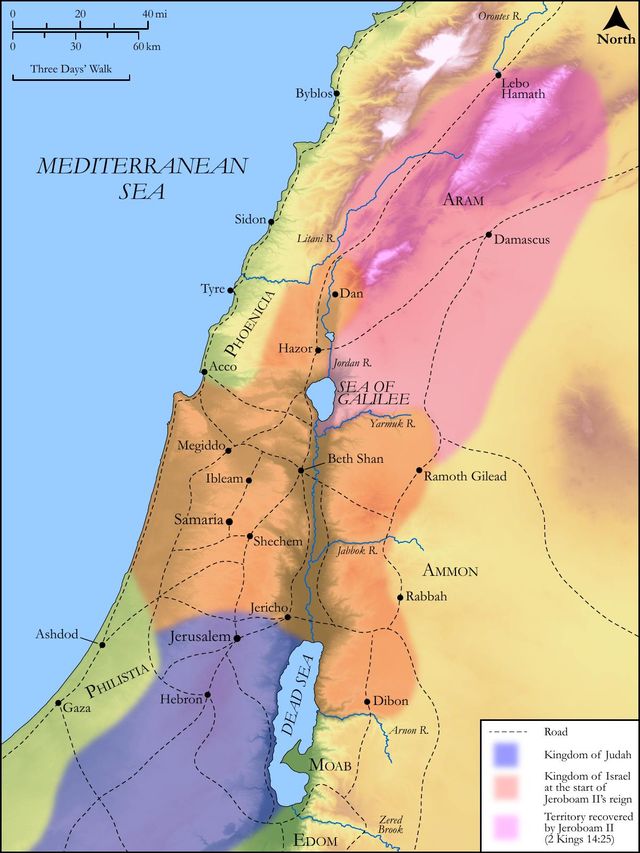
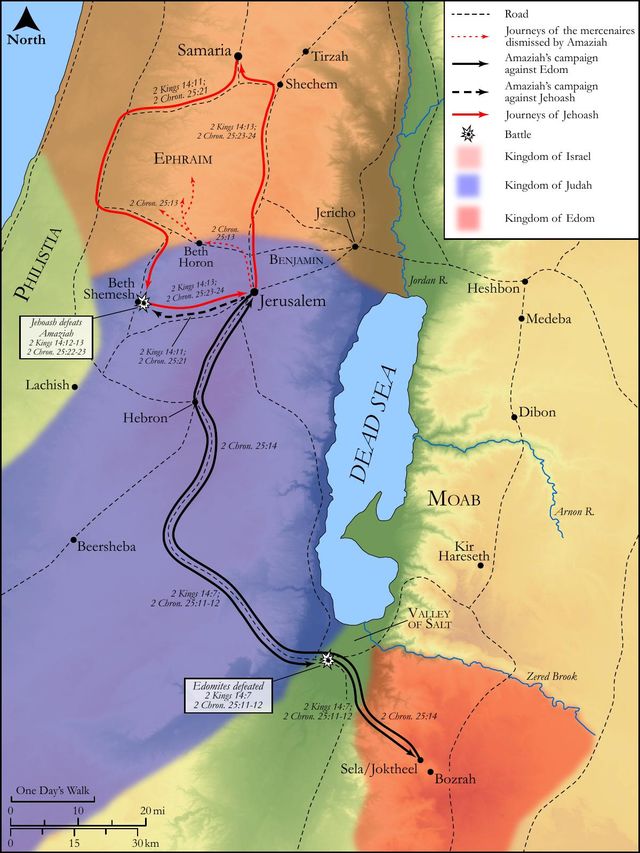
Study this verse
Public-domain commentary
Matthew Henry
From his Commentary on the Whole Bible. Henry comments on passages, not single verses — this entry covers 2 Kings 14:15–22.
Here are three kings brought to their graves in these few verses: - 1. Joash king of Israel, Kg2 14:15, Kg2 14:16. We attended his funeral once before, Kg2 13:12, Kg2 13:13. But, because the historian had occasion to give a further account of his life and actions, he again mentions his death and burial. 2. Amaziah king of Judah. Fifteen years he survived his conqueror the king of Israel, Kg2 14:17. A man may live a great while after he has been shamed, may be thoroughly mortified (as Amaziah no doubt was) and yet not dead. His acts are said to be found written in his annals (Kg2 14:18), but not his might; for his cruelty when he was a conqueror over the Edomites, and his insolence when he challenged the king of Israel, showed him void of true courage. He was slain by his own subjects, who hated him for his maladministration (Kg2 14:19) and made Jerusalem too hot for him, the ignominious breach made in their walls being occasioned by his folly and presumption. He fled to Lachish. How long he continued concealed or sheltered there we are not told, but, at last, he was there murdered, Kg2 14:19. No further did the rage of the rebels extend, for they brought him in a chariot to Jerusalem, and buried him there among his ancestors. 3. Azariah succeeded Amaziah, but not till twelve years after his father's death, for Amaziah died in the fifteenth year of Jeroboam (as appears by comparing Kg2 14:23 with Kg2 14:2), but Azariah did not begin his reign till the twenty-seventh of Jeroboam (ch. 15:1), for he was but four years old at the death of his father, so that, for twelve years, till he came to be sixteen, the government was in the hands of protectors. He reigned very long (ch. 15:2) and yet the account of his reign is here industriously huddled up, and broken off abruptly (v. 22): He built Elath (which had belonged to the Edomites, but, it is probable, was recovered by his father, v. 7), after that the king slept with his fathers, as if that had been all he did that was worth mentioning, or rather it is meant of king Amaziah: he built it soon after Amaziah died.
Continue studying 2 Kings 14:17 across the web’s major study libraries — every link below opens this exact verse, chapter, or book on the destination site.
Read & Compare
 BibleGatewayThis verse in more than 200 translations and 70 languages.
 Bible.comThe YouVersion reader — hundreds of translations, reading plans, and highlights.
 ESV.orgCrossway's official English Standard Version reader.
 NET BibleThe NET translation with 60,000+ translators' notes on every rendering decision.
 STEP BibleTyndale House's free study tool — original text, vocabulary, and scholarly resources.
 BibliaLogos Bible Software's free web reader.
 USCCBThe New American Bible (Revised Edition) with the U.S. bishops' study notes.
Commentaries
 BibleHub CommentariesDozens of classic commentaries on this verse, gathered on one page.
 StudyLightMore than 100 commentary sets — the largest collection on the web.
 BibleRefPlain-English commentary on what this verse means, verse by verse.
 Enduring WordDavid Guzik's free commentary on this chapter, widely used by Bible teachers.
 Bible Study ToolsVerse commentary alongside Greek and Hebrew study aids.
Original Language & Research
- BibleHub InterlinearThe verse word by word — original language, transliteration, and English.
- BibleHub LexiconEvery word's original-language definition and Strong's entry.
 Blue Letter BibleDeep-study tools — Strong's numbers, concordance, and word studies.
 SefariaThe Hebrew text with Rashi and centuries of Jewish commentary.
Sermons, Hymns & Audio


TrulyRandomVerse is not affiliated with these sites and doesn’t control their content. They’re linked because they’re genuinely useful.
Summary
Second Kings 14:17 serves as a precise chronological anchor within the tumultuous narrative of the divided monarchy, stating that Amaziah, king of Judah, outlived Jehoash, king of Israel, by a significant fifteen years. This seemingly straightforward historical detail profoundly underscores the ultimate sovereignty of God over the lifespans of kings and nations, reveals the enduring and often ironic consequences of human pride and folly, and illustrates the unfolding of divine purposes even amidst political upheaval, personal defeat, and the intricate tapestry of Israelite and Judahite history.
Context
ShowHideLiterary Context
This verse is strategically placed within the detailed account of Amaziah's reign as king of Judah, which is chronicled in 2 Kings 14:1-20. His rule commenced with a period of general adherence to the LORD, albeit imperfectly, as he notably failed to dismantle the high places (2 Kings 14:3-4). A significant military triumph over Edom in the Valley of Salt (2 Kings 14:7) unfortunately fueled his arrogance, leading him to issue a rash and ill-advised challenge to Jehoash, the king of Israel (2 Kings 14:8). This act of hubris culminated in a devastating defeat for Judah at Beth-shemesh, where Amaziah was captured, Jerusalem's defensive wall was breached, and the sacred temple and royal palace treasuries were plundered (2 Kings 14:11-14). Despite this profound humiliation and national catastrophe, 2 Kings 14:17 remarkably highlights that Amaziah continued to reign for a considerable period after his victorious adversary, Jehoash, had passed away, thereby setting the somber stage for his eventual assassination by conspiracy (2 Kings 14:19).
Historical & Cultural Context
The era of the divided monarchy was characterized by incessant geopolitical instability, marked by frequent military engagements, shifting alliances, and a fluctuating spiritual landscape among the kings of both the northern kingdom of Israel and the southern kingdom of Judah. Kingship among the nations round about was often perceived as a direct reflection of divine favor or judgment, and the longevity of a monarch's reign was commonly interpreted as a tangible sign of God's blessing, patience, or even impending judgment. Amaziah's audacious challenge to Jehoash was not uncommon among ancient monarchs, frequently stemming from a desire to assert dominance or retaliate for perceived slights. The subsequent plundering of Jerusalem and its temple by Jehoash was far more than a mere act of war; it was a profound act of humiliation, symbolically signifying a catastrophic loss of divine protection and a severe blow to national prestige. Amaziah's continued reign for fifteen years after such a crushing defeat, and after the death of his victor, suggests a complex internal political dynamic where, despite external humiliation, a degree of internal stability might have been maintained, even if his relationship with his own people was clearly strained, ultimately culminating in his violent demise.
Key Themes
ShowHideThis verse, though brief, powerfully contributes to several overarching themes pervasive throughout 2 Kings. Firstly, it profoundly underscores the sovereignty of God over life and death, unequivocally demonstrating that the duration of a king's reign is ultimately determined by divine decree, not by human military prowess, political maneuvering, or even personal failure. Amaziah's extended life, despite his profound military and personal humiliation, serves as a testament to God's mysterious and unsearchable timing. Secondly, it vividly illustrates the consequences of pride and disobedience. Amaziah's initial success was tragically followed by a catastrophic defeat directly attributable to his escalating arrogance, as meticulously detailed in 2 Kings 14:8-14. His prolonged reign after this defeat meant living with the enduring repercussions of his poor choices, which inexorably led to his violent end (2 Kings 14:19-20). Finally, the verse subtly highlights the cyclical nature of sin, divine judgment, and God's enduring patience within the unfolding narrative of the kings, where periods of relative peace or success are frequently succeeded by moral decline and subsequent divine discipline.
Exposition and Analysis
ShowHideKey Word Analysis
ShowHideMeaning "strength of Jah" or "Yahweh has strengthened." The name carries a profound irony when viewed against the backdrop of his reign. While his initial strength and victory over Edom were indeed attributed to Yahweh's empowerment, his subsequent pride led him to rely on his own perceived might rather than God's, culminating in a devastating defeat. His prolonged life, though sovereignly granted by God, became a stark testament to the perilous consequences of misplacing one's trust.
Meaning "Jehovah-fired." This name, shared by both the king of Judah (Amaziah's father) and the king of Israel mentioned here, intrinsically links to divine power or action. The fact that the "Jehovah-fired" Jehoash of Israel died fifteen years before the defeated Amaziah powerfully illustrates that human strength, military success, or even divine favor in battle do not dictate the ultimate timeline of life, which remains firmly within God's sovereign control.
This phrase combines H2421 (châyâh), meaning "to live, whether literally or figuratively; causatively, to revive," and H310 (ʼachar), meaning "properly, the hind part; generally used as an adverb or conjunction, after." The combination emphasizes the continuation of life beyond a significant event (the death of Jehoash). It is a simple, factual statement that, in this context, underscores Amaziah's endurance, survival, and the ongoing unfolding of his narrative, even one profoundly marked by significant setbacks, humiliation, and the lingering consequences of his choices.
Verse Breakdown
ShowHide"And Amaziah the son of Joash king of Judah"
This initial clause precisely identifies the subject of the verse, Amaziah, as the ninth king of the southern kingdom of Judah. It meticulously clarifies his lineage as the son of Joash, thereby distinguishing him from other historical figures bearing similar names and firmly grounding the statement within the established royal succession of Judah.
"lived after the death of Jehoash son of Jehoahaz king of Israel"
This constitutes the core chronological statement of the verse. It establishes a definitive temporal relationship between the two monarchs, noting that Amaziah's reign extended significantly beyond the lifespan of his northern counterpart, Jehoash (also identified as Joash in some contexts), who had previously inflicted a profound and humiliating defeat upon him. This specific detail is critically important for accurately synchronizing the intertwined reigns of the two separate kingdoms.
"fifteen years"
This concluding phrase precisely quantifies the duration of Amaziah's reign subsequent to Jehoash's death. It provides a concrete numerical detail, enhancing the historical precision and factual nature of the biblical record. The fact that Amaziah reigned for such a substantial period after his great defeat and the passing of his victorious adversary underscores both the enduring consequences of his actions and the divine prerogative over the length and trajectory of one's life.
Literary Devices
ShowHideThe primary literary device at play in 2 Kings 14:17 is its function as a Chronological Marker. Its fundamental purpose is to provide precise historical dating and to meticulously synchronize the reigns of the kings of Judah and Israel, thereby reinforcing the biblical narrative's meticulous attention to historical accuracy. Beyond this, there is a clear element of Juxtaposition or Contrast subtly at work. The verse implicitly contrasts the fate of the defeated Amaziah, who remarkably lives on, with that of the victorious Jehoash, who dies earlier. This highlights the profound truth that military triumph or earthly success does not inherently guarantee a longer life or ultimate victory in the eyes of God. Furthermore, a subtle Irony pervades the verse, particularly when considering Amaziah's name, which means "Strength of Yahweh." Despite his name, his strength failed him due to his pride and disobedience, yet he was granted a prolonged life by the very Yahweh whose strength he had neglected, living to endure the full, bitter consequences of his folly.
Theological and Thematic Connections
ShowHideThis verse, while appearing as a simple chronological notation, profoundly reinforces core theological truths about God's absolute sovereignty. It powerfully demonstrates that the length of a person's life, even that of a powerful king, is ultimately held in God's hands, not determined by military success, political acumen, or even personal failures. Amaziah's extended reign after his humiliating defeat and the death of his adversary speaks volumes about divine patience and the unfolding of God's purposes on His own inscrutable timeline, allowing for the full consequences of human actions to manifest. It serves as a potent reminder that God's ways transcend human understanding, and His meticulous control extends over every facet of history, including the precise lifespans of individuals and the destinies of nations.
Reflection and Application
ShowHideThe seemingly dry historical fact that Amaziah outlived Jehoash by fifteen years offers a profoundly poignant and enduring lesson for believers today. It serves as a powerful reminder that the timelines of our lives are ultimately orchestrated by God, not by our personal achievements, our perceived failures, or even the actions of our adversaries. Even after experiencing significant setbacks, profound humiliations, or the painful consequences of our own pride and poor choices, God may, in His sovereign wisdom, grant us continued time on earth. This extended period is not necessarily a guarantee of blessing or ease, but rather often an invaluable opportunity for deep reflection, genuine repentance, or simply living out the full, sometimes difficult, implications of our decisions. Amaziah's story, which culminates in his tragic assassination, stands as a solemn cautionary tale: a long life does not inherently equate to a blessed, peaceful, or spiritually fruitful one, particularly if it remains marked by unaddressed pride, unrepentant sin, and a persistent turning away from God. It underscores the vital importance of cultivating true humility, maintaining a posture of unwavering obedience to God, and striving diligently to "finish well" in our faith journey, regardless of external circumstances or past mistakes. Our ultimate focus should always be on faithfulness to God and His purposes, rather than on outliving our perceived rivals or attempting to escape the natural consequences of our actions.
Questions for Reflection
ShowHideFAQ
ShowHideWhy is this specific chronological detail included in the biblical narrative?
ShowHideThis specific chronological detail serves several crucial and interconnected purposes within the biblical narrative. Firstly, it provides essential historical precision, enabling the accurate synchronization of the reigns of the kings of Judah and Israel, which is vital for constructing a comprehensive understanding of the broader historical timeline of the divided monarchy. Secondly, it powerfully highlights God's absolute sovereignty over the lives and deaths of kings and, by extension, all humanity. Despite Amaziah's humiliating military defeat at the hands of Jehoash, God, in His divine prerogative, determined that Amaziah would outlive his victor by a significant period of fifteen years. This clearly demonstrates that human success or failure in battle, or any earthly endeavor, does not dictate the divine timeline for life and death. Finally, it subtly underscores the enduring consequences of Amaziah's pride and folly. He lived for fifteen more years after his crushing defeat, presumably having to contend with the lingering aftermath of his poor choices, which ultimately culminated in his assassination (2 Kings 14:19).
Christ-Centered Fulfillment
ShowHideWhile 2 Kings 14:17 is a historical note concerning a king's lifespan, it implicitly points to the profound and foundational truth of divine sovereignty over life and death—a truth ultimately and perfectly fulfilled in the person and work of Jesus Christ. Amaziah, despite his name meaning "Strength of Yahweh," tragically relied on his own pride and suffered a devastating defeat, yet he lived on by God's decree, enduring the bitter consequences of his folly. In stark and glorious contrast, Jesus, the true and eternal King, though truly the "Strength of God and the Wisdom of God" (1 Corinthians 1:24), did not succumb to pride. Instead, He embraced ultimate humility, willingly submitting Himself even to the point of death on a cross (Philippians 2:8). His "defeat" on the cross was, paradoxically, His greatest and most decisive victory, for through it He triumphantly conquered the power of sin and death itself (Hebrews 2:14-15). Unlike Amaziah, whose extended life after defeat was marked by continued spiritual decline and a violent end, Jesus, after His sacrificial death, truly "lived after" in glorious resurrection, not for fifteen years, but for all eternity, holding the keys of death and Hades (Revelation 1:18). His perfect life, atoning death, and triumphant resurrection powerfully demonstrate God's ultimate and unwavering control over all things, and His victory ensures that all who are united in Him will also share in an eternal life that transcends any earthly defeat, timeline, or the sting of death (John 10:28).