


2 Kings 14:1
Bible text: King James Version (1769 Blayney text) · Public domain
Bible text: Berean Standard Bible · Public domain
Bible text: American Standard Version (1901) · Public domain
Bible text: World English Bible, Messianic edition · Public domain
Bible text: Geneva Bible (1599) · Public domain
Bible text: Young's Literal Translation · Public domain
- בִּשְׁנַתbish·Natin yearH8141Prep-b ¦ N-fscNoun Singular Feminine Constructבִּinשְׁנַתyear
- שְׁתַּיִםshe·Ta·yimtwoH8147N-fdNoun Dual Feminine Absolute
- לְיוֹאָשׁle·yo·'Ashof JoashH3101Prep-l ¦ N-proper-mNoun Proper MasculineלְofיוֹאָשׁJoash
- בֶּןben[the] son ofH1121N-mscNoun Singular Masculine Construct
- יוֹאָחָזyo·'a·ChazJehoahazH3099N-proper-mNoun Proper Masculine
- מֶלֶךְMe·lekh[the] king ofH4428N-mscNoun Singular Masculine Construct
- יִשְׂרָאֵלYis·ra·'ElIsraelH3478N-properNoun Proper Location
- מָלַךְma·Lakhhe became kingH4427V-Qal-Perf-3msVerb Qal Perfect 3rd Singular Masculine
- אֲמַצְיָהוּ'a·matz·Ya·huAmaziahH558N-proper-mNoun Proper Masculine
- בֶןven[the] son ofH1121N-mscNoun Singular Masculine Construct
- יוֹאָשׁyo·'AshJoashH3101N-proper-mNoun Proper Masculine
- מֶלֶךְMe·lekh[the] king ofH4428N-mscNoun Singular Masculine Construct
- יְהוּדָהye·hu·DahJudahH3063N-properNoun Proper Location
English is a literal word-by-word gloss of the Hebrew, not the KJV's wording. Why?
This is the original text the KJV's translators worked from — each Hebrew word with its own literal English meaning in this verse, prepared by scholars at Tyndale House, Cambridge. The KJV translates whole sentences, not word by word, so its wording differs: one Hebrew word can become several English words, and the KJV may choose “the LORD” where the gloss reads “Yahweh”. Both are faithful — they answer different questions. For the KJV's own rendering, switch to the KJV text.
Details
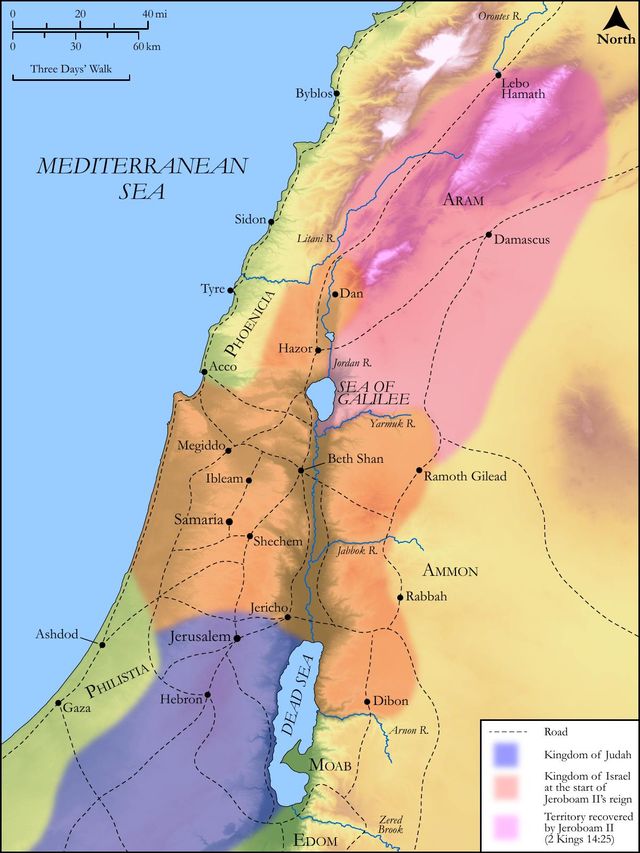
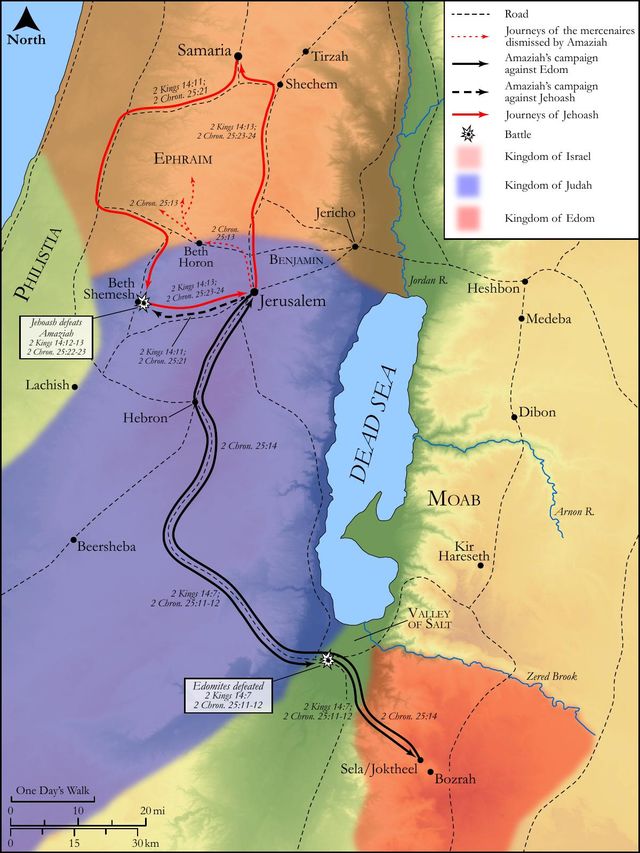
See on the biblical-era maps
Study this verse
Public-domain commentary
Matthew Henry
From his Commentary on the Whole Bible. Henry comments on passages, not single verses — this entry covers 2 Kings 14:1–7. His two-level outline is real structure in the source text, so it is rendered as structure.
Amaziah, the son and successor of Joash, is the king whom here we have an account of. Let us take a view of him,
I.In the temple; and there he acted, in some measure, well, like Joash, but not like David, Kg2 14:3.
He began well, but did not persevere: He did that which was right in the sight of the Lord, kept up his attendance on God's altars and his attention to God's word, yet not like David. It is not enough to do that which our pious predecessors did, merely to keep up the usage, but we must do it as they did it, from the same principle of faith and devotion and with the same sincerity and resolution. It is here taken notice of, as before, that the high places were not taken away, Kg2 14:4. It is hard to get clear of those corruptions which, by long usage, have gained both prescription and a favourable opinion.
II.On the bench; and there we have him doing justice on the traitors that murdered his father, not as soon as ever he came to the crown, lest it should occasion some disturbance, but he prudently deferred it till the kingdom was confirmed in his hand, Kg2 14:5. To weaken a factious party gradually, when it is not safe to provoke, often proves the way to ruin it effectually. Justice strikes surely by striking slowly, and is often executed most prudently when it is not executed presently. Wisdom here is profitable to direct. Amaziah did thus,
1.According to the rule of the law, that ancient rule, that he that sheds man's blood by man shall his blood be shed. Never let traitors or murderers expect to come to their graves like other men. Let them flee to the pit, and let no man stay them.
2.Under the limitation of the law: The children of the murderers he slew not, because the law of Moses had expressly provided that the children should not be put to death for the fathers, Kg2 14:6. It is probable that this is taken notice of because there were those about him that advised him to that rigour, both in revenge (because the crime was extraordinary - the murder of a king) and in policy, that the children might not plot against him, in revenge of their father's death. But against these insinuations he opposed the express law of God (Deu 24:16), which he was to judge by, and which he resolved to adhere to and trust God with the issue. God visits the iniquity of the fathers upon the children, because every man is guilty before him and owes him a death; so that, if he require the life for the father's sin, he does not wrong, the sinner having forfeited it already by his own. But he does not allow earthly princes to do thus: the children, before them, are innocent, and therefore must not suffer as guilty.
III.In the field; and there we find him triumphing over the Edomites, Kg2 14:7.
Edom had revolted from under the hand of Judah in Joram's time, Kg2 8:22. Now he makes war upon them to bring them back to their allegiance, kills 10,000 and takes the chief city of Arabia the stony (called Selah - a rock), and gave it a new name. We shall find a larger account of this expedition, Ch2 25:5, etc.
Historical interpretation
Historical reception
1 surviving comment on this verse from the historical church.
“In the second year of King Joash son of Ahaziah of Israel, King Amaziah son of Joash of Judah began to reign,” who avenged the death of his father, but with moderation, so that he spared the life of the relatives of the conspirators according to the prescriptions of the Law and was careful that the punishment might not be too excessive for the authors of the crime. Therefore Amaziah was pious, as long as he had before his eyes his father’s unhappy end, whose cause he could not ignore: offense against the true religion [of God]. However, when his reign began to be very prosperous, [Amaziah] rejected his fear of God which he had conceived after witnessing his father’s punishment, and embraced foreign cults. In the second book of the Annals, the Scripture relating his victory against the Edomites confirms that this was the reason of his apostasy: “But Amaziah took courage, and led out his people, and went to the Valley of Salt and smote ten thousand men of Seir. The men of Judah captured another ten thousand alive and took them to the top of a rock, and all were enchained.” And the text adds, “After Amaziah came from the slaughter of the Edomites, he brought the gods of the men of Seir, and set them up as his gods and worshiped them, making offerings to them.”
Continue studying 2 Kings 14:1 across the web’s major study libraries — every link below opens this exact verse, chapter, or book on the destination site.
Read & Compare
 BibleGatewayThis verse in more than 200 translations and 70 languages.
 Bible.comThe YouVersion reader — hundreds of translations, reading plans, and highlights.
 ESV.orgCrossway's official English Standard Version reader.
 NET BibleThe NET translation with 60,000+ translators' notes on every rendering decision.
 STEP BibleTyndale House's free study tool — original text, vocabulary, and scholarly resources.
 BibliaLogos Bible Software's free web reader.
 USCCBThe New American Bible (Revised Edition) with the U.S. bishops' study notes.
Commentaries
 BibleHub CommentariesDozens of classic commentaries on this verse, gathered on one page.
 StudyLightMore than 100 commentary sets — the largest collection on the web.
 BibleRefPlain-English commentary on what this verse means, verse by verse.
 Enduring WordDavid Guzik's free commentary on this chapter, widely used by Bible teachers.
 Bible Study ToolsVerse commentary alongside Greek and Hebrew study aids.
Original Language & Research
- BibleHub InterlinearThe verse word by word — original language, transliteration, and English.
- BibleHub LexiconEvery word's original-language definition and Strong's entry.
 Blue Letter BibleDeep-study tools — Strong's numbers, concordance, and word studies.
 SefariaThe Hebrew text with Rashi and centuries of Jewish commentary.
Sermons, Hymns & Audio


TrulyRandomVerse is not affiliated with these sites and doesn’t control their content. They’re linked because they’re genuinely useful.
Summary
This opening verse of 2 Kings 14 precisely chronicles the commencement of King Amaziah's reign over Judah, dating his ascension to the second regnal year of Joash, son of Jehoahaz, king of Israel. This meticulous chronological synchronism, a hallmark of the Deuteronomistic History, serves as a vital historical anchor, weaving together the parallel and often turbulent narratives of the divided Northern and Southern Kingdoms, thereby setting the stage for Amaziah's subsequent actions and the unfolding divine narrative of God's sovereign governance over human affairs.
Context
ShowHideLiterary Context
This verse serves as a crucial transitional marker, immediately following the conclusion of Joash (Jehoash) king of Israel's reign in 2 Kings 13. It also connects back to the reign of Amaziah's father, Joash (Jehoash) king of Judah, whose assassination is recounted at the close of 2 Kings 12. The book of 2 Kings, an integral part of the broader Deuteronomistic History (Joshua–Kings), consistently employs synchronistic dating to interweave the parallel narratives of the two kingdoms. This particular verse introduces a new monarch in Judah while simultaneously orienting his reign within the established timeline of his northern counterpart, a common literary device employed by the biblical author to maintain chronological coherence and highlight the interconnectedness of the fragmented monarchies. The detailed account of Amaziah's reign, encompassing his military campaigns, religious reforms, and eventual downfall, will occupy the remainder of 2 Kings 14.
Historical & Cultural Context
The period of the divided monarchy was characterized by profound political instability, pervasive spiritual apostasy, and intermittent conflicts, not only between Israel and Judah but also with surrounding nations. The presence of two kings named Joash (one in Israel, the other in Judah) reigning in close proximity or concurrently often presents a challenge for modern readers, yet the biblical text meticulously distinguishes them by their paternal lineage and kingdom affiliation. This verse places Amaziah's accession during a time when both kingdoms were navigating various internal and external pressures. Judah had just experienced the regicide of King Joash, indicative of significant internal strife within the royal court. Concurrently, Israel under Joash was contending with persistent Aramean incursions, as vividly recounted in 2 Kings 13:3-7. The precise dating reflects the administrative practices prevalent among the kingdoms of that day, where regnal years were meticulously recorded and often synchronized with those of neighboring states, thereby establishing a reliable historical record for both internal governance and diplomatic relations.
Key Themes
ShowHideThis verse subtly underscores several overarching themes that permeate the book of 2 Kings. Firstly, Chronological Precision is paramount, highlighting the biblical authors' unwavering commitment to historical accuracy and the grounding of profound theological truth in verifiable, real-world events. This meticulous record-keeping, often involving intricate synchronisms like the one found here, serves to validate the narrative's authenticity and demonstrate God's sovereign hand actively at work within history. Secondly, the verse reiterates the persistent reality of the Divided Monarchy, a direct consequence of the kingdom's schism following the reign of Solomon, as detailed in 1 Kings 12. Despite their political and spiritual separation, the destinies of Israel and Judah remain inextricably intertwined, with their kings' reigns frequently overlapping and influencing one another. Finally, the verse introduces the crucial theme of Royal Succession, specifically within the Davidic line in Judah. The continuity of the kingship from father to son, even in the wake of the regicide that prematurely ended Joash's reign, powerfully points to God's enduring covenant faithfulness to David, as solemnly promised in 2 Samuel 7:12-16, ensuring a perpetual dynasty through which the ultimate King, the Messiah, would eventually emerge.
Exposition and Analysis
ShowHideKey Word Analysis
ShowHideMeaning "strength of Jah" or "Yahweh is mighty." This name carries significant theological weight, implying divine strength or empowerment for the king. However, the subsequent narrative of Amaziah's reign will reveal an ironic contrast between the meaning of his name and his ultimate reliance on human strength, his pride, and his eventual spiritual failure, particularly his descent into idolatry as vividly detailed in 2 Chronicles 25:14-16.
Meaning "Yahweh has given" or "Yahweh has supported." This common name appears for both the king of Israel and the king of Judah in this period. The text's careful distinction between "Joash son of Jehoahaz king of Israel" and "Joash king of Judah" (Amaziah's father) underscores the critical importance of full identification in biblical genealogies and historical records to prevent confusion, especially given the prevalence of similar names in both royal lines during this turbulent era.
A primitive root meaning "to reign," or inceptively, "to ascend the throne." This verb signifies the formal commencement of a king's rule, emphasizing the transfer of authority and the beginning of a new administrative period. The use of this term marks the official start of Amaziah's 29-year tenure as monarch over Judah, a reign that would be characterized by both initial obedience and later apostasy.
Verse Breakdown
ShowHide"¶ In the second year of Joash son of Jehoahaz king of Israel"
This opening clause establishes the crucial synchronistic dating. It anchors Amaziah's accession to the reign of the contemporary king of the Northern Kingdom, Joash (also known as Jehoash), who was the son of Jehoahaz. This precise chronological marker is characteristic of the Deuteronomistic historian, allowing for the careful alignment and integration of events in both Israel and Judah, despite their political and spiritual separation. The paragraph marker (¶) is a KJV formatting convention, indicating a new textual division.
"reigned Amaziah the son of Joash king of Judah"
This second clause formally introduces the new king of the Southern Kingdom. Amaziah succeeds his father, Joash, who was tragically assassinated, as recorded in 2 Kings 12:20-21. The explicit identification "the son of Joash king of Judah" clearly distinguishes him from the Joash of Israel mentioned in the first clause, eliminating ambiguity and reinforcing the distinct royal lineages. This statement formally marks the beginning of Amaziah's 29-year reign over the kingdom of Judah.
Literary Devices
ShowHideThe primary literary device at play in 2 Kings 14:1 is Synchronism, a pervasive feature throughout the books of Kings. This involves meticulously dating the reign of a king in one kingdom by referencing the regnal year of a contemporary king in the other kingdom (e.g., "In the second year of Joash... reigned Amaziah"). This precise chronological alignment functions not merely as a historical device to provide a coherent timeline for the fragmented monarchies but also as a profound theological one, subtly affirming God's overarching control and intimate knowledge of all historical events, even amidst the complex and often chaotic human affairs of the divided kingdoms. Additionally, the verse employs Genealogy by explicitly naming the father of each king ("son of Jehoahaz," "son of Joash"), which is crucial for distinguishing individuals with common names and for establishing the legitimacy and unbroken lineage of the monarchs, particularly the enduring Davidic line in Judah. The concise and factual presentation also reflects a form of Historical Reportage, characteristic of the Deuteronomistic historian's style, which aims to present a reliable and authoritative account of Israel's past, grounded in verifiable details.
Theological and Thematic Connections
ShowHideThis seemingly simple chronological statement carries profound theological weight, underscoring God's meticulous involvement in the unfolding tapestry of human history. The precise dating and careful distinction between the two Joashes demonstrate that God's redemptive plan unfolds not in abstract theological concepts, but within the concrete, verifiable events of real people and nations. It highlights divine sovereignty over the rise and fall of kings, even amidst political assassinations, dynastic shifts, and the complexities of a divided kingdom. The continuity of the Davidic line, despite numerous challenges and the unfaithfulness of many rulers, powerfully speaks to God's unwavering covenant faithfulness to David. This historical grounding ensures that the spiritual lessons drawn from the narrative are rooted in tangible reality, affirming that God is indeed the Lord of history, orchestrating events to fulfill His eternal purposes, even through the actions of imperfect human rulers.
Reflection and Application
ShowHide2 Kings 14:1, while appearing as a mere historical record, invites us to consider the profound implications of God's sovereignty over time and human leadership. It reminds us that our lives, our nations, and our historical moments are not random occurrences but are held within the meticulous framework of God's providential plan. Just as God orchestrated the succession of kings in ancient Israel and Judah, meticulously recording their reigns and their interconnectedness, He remains actively involved in the affairs of the world today. This should inspire both humility and profound confidence: humility, recognizing that our plans and timelines are ultimately subordinate to His divine will; and confidence, knowing that a sovereign God is working all things together for His glory and the ultimate good of those who love Him. It encourages us to look beyond the superficiality of daily events, seeking to discern God's hand at work, trusting that even in seasons of political turmoil, societal upheaval, or personal transition, His eternal purposes will ultimately prevail. Our call, then, is to live faithfully within the specific time and context He has appointed for us, diligently contributing to His kingdom work with a deep awareness of His reigning presence.
Questions for Reflection
ShowHideFAQ
ShowHideWhy does the Bible meticulously synchronize the reigns of kings from Israel and Judah?
ShowHideThe meticulous synchronization, as vividly seen in 2 Kings 14:1, serves several crucial purposes within the biblical narrative. Historically, it provides an indispensable chronological framework for understanding the parallel and often intertwined narratives of the Northern Kingdom (Israel) and the Southern Kingdom (Judah) following the division of the monarchy. This allows the reader to accurately place events in both nations within a coherent and verifiable timeline. Theologically, it profoundly underscores the underlying unity of God's people, even in their politically divided state, and highlights God's overarching sovereignty. It demonstrates that God is actively involved in the history of both kingdoms, orchestrating events and raising up or bringing down rulers according to His divine plan, even when their human choices lead to chaos or conflict. This detailed record-keeping also lends significant credibility to the biblical narrative, grounding its profound spiritual truths in verifiable historical reality and demonstrating God's meticulous oversight of human history.
Christ-Centered Fulfillment
ShowHideWhile 2 Kings 14:1 appears as a simple historical marker, its profound significance for Christ-centered fulfillment lies in its contribution to the unbroken, divinely preserved chain of the Davidic dynasty. Amaziah, as "the son of Joash king of Judah," stands in the direct, promised lineage of King David, a lineage through which God solemnly covenanted an eternal kingdom and a perpetual throne (2 Samuel 7:12-16). This verse, therefore, is a subtle yet vital link in the extensive genealogical record that ultimately culminates in the person and work of Jesus Christ. Every successive king in Judah, despite their personal failings, periods of apostasy, or the political turmoil of their reigns, served as a divinely appointed placeholder in God's unfolding redemptive plan, meticulously preserving the royal line from which the Messiah would ultimately come. Jesus, the true Son of David (Matthew 1:1), is the ultimate and perfect fulfillment of this ancient promise, the King whose reign is truly eternal and whose kingdom will never end (Luke 1:32-33). Thus, this seemingly dry historical detail points powerfully to the unwavering faithfulness of God in preserving the lineage through which the Lamb of God, who takes away the sin of the world (John 1:29), would ultimately appear, establishing a kingdom far greater and more enduring than any earthly monarchy.