


2 Chronicles 25:1
- בֶּןbena son ofH1121N-mscNoun Singular Masculine Construct
- עֶשְׂרִים'es·RimtwentyH6242N-mpNoun Plural Masculine Absolute
- וְחָמֵשׁve·cha·Meshand fiveH2568Conj-w ¦ N-csNoun Singular common gender Absoluteוְandחָמֵשׁfive
- שָׁנָהsha·Nahyear[s]H8141N-fsNoun Singular Feminine Absolute
- מָלַךְma·Lakhhe became kingH4427V-Qal-Perf-3msVerb Qal Perfect 3rd Singular Masculine
- אֲמַצְיָהוּ'a·matz·Ya·huAmaziahH558N-proper-mNoun Proper Masculine
- וְעֶשְׂרִיםve·'es·Rimand twentyH6242Conj-w ¦ N-mpNoun Plural Masculine Absoluteוְandעֶשְׂרִיםtwenty
- וָתֵשַׁעva·Te·sha'and nineH8672Conj-w ¦ N-csNoun Singular common gender Absoluteוָandתֵשַׁעnine
- שָׁנָהsha·Nahyear[s]H8141N-fsNoun Singular Feminine Absolute
- מָלַךְma·Lakhhe reignedH4427V-Qal-Perf-3msVerb Qal Perfect 3rd Singular Masculine
- בִּירוּשָׁלִָםbi·ru·sha·Limin JerusalemH3389Prep-b ¦ N-properNoun Proper LocationבִּinירוּשָׁלִָםJerusalem
- וְשֵׁםve·Shemand [the] name ofH8034Conj-w ¦ N-mscNoun Singular Masculine Constructוְandשֵׁם[the] name of
- אִמּוֹ'i·Mohis motherH517N-fsc ¦ 3msNoun Singular Feminine Constructאִמּmotherוֹhis
- יְהוֹעַדָּןye·ho·'a·Dan[was] JehoaddanH3086N-proper-fNoun Proper Feminine
- מִירוּשָׁלָיִםmi·ru·sha·La·yimfrom JerusalemH3389Prep-m ¦ N-properNoun Proper LocationמִfromירוּשָׁלָיִםJerusalem
English is a literal word-by-word gloss of the Hebrew, not the KJV's wording. Why?
This is the original text the KJV's translators worked from — each Hebrew word with its own literal English meaning in this verse, prepared by scholars at Tyndale House, Cambridge. The KJV translates whole sentences, not word by word, so its wording differs: one Hebrew word can become several English words, and the KJV may choose “the LORD” where the gloss reads “Yahweh”. Both are faithful — they answer different questions. For the KJV's own rendering, switch to the KJV text.
Details
See on the biblical-era map
Study this verse
Public-domain commentary
Matthew Henry
From his Commentary on the Whole Bible. Henry comments on passages, not single verses — this entry covers 2 Chronicles 25:1–13. His three-level outline is real structure in the source text, so it is rendered as structure.
Here is, I. The general character of Amaziah: He did that which was right in the eyes of the Lord, worshipped the true God, kept the temple service a going, and countenanced religion in his kingdom; but he did not do it with a perfect heart (Ch2 25:2), that is, he was not a man of serious piety or devotion himself, nor had he any zeal for the exercises of religion. He was no enemy to it, but a cool and indifferent friend. Such is the character of too many in this Laodicean age: they do that which is good, but not with the heart, not with a perfect heart.
II.A necessary piece of justice which he did upon the traitors that murdered his father:
he put them to death, Ch2 25:3. Though we should suppose they intended to avenge on their king the death of the prophet (as was intimated, Ch2 24:25), yet this would by no means justify their wickedness; for they were not the avengers, but presumptuously took God's work out of his hands: and therefore Amaziah did what became him in calling them to an account for it, but forbade the putting of the children to death for the parents' sin, Ch2 25:4.
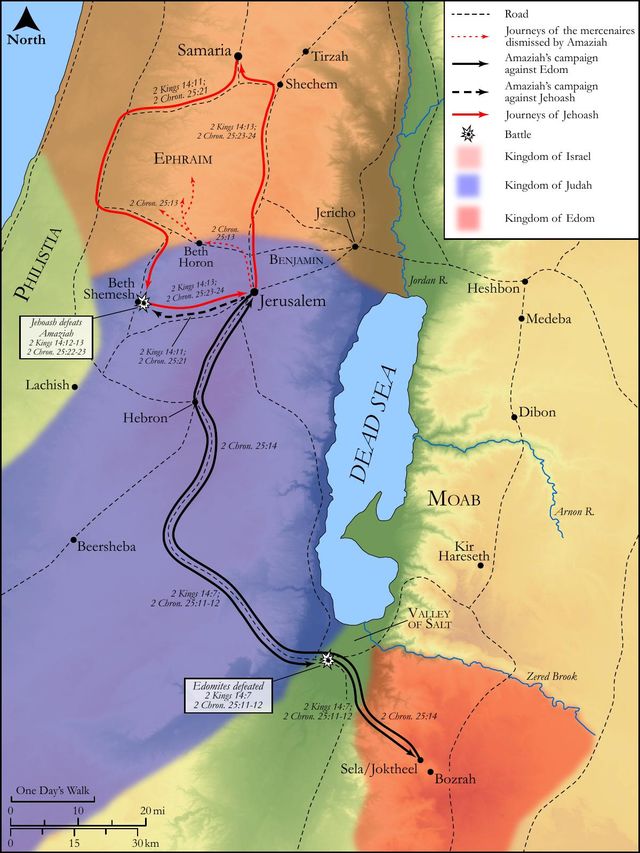
III.An expedition of his against the Edomites, who, some time ago, had revolted from under the dominion of Judah, to which he attempted to reduce them. Observe,
1.The great preparation he made for this expedition.
(1.)He mustered his own forces, and marshalled them (Ch2 25:5), and found Judah and Benjamin in all but 300,000 men that were fit for war, whereas, in Jehoshaphat's time, fifty or sixty years before, they were four times as many. Sin weakens a people, diminishes them, dispirits them, and lessens their number and figure.
(2.)He hired auxiliary troops out of the kingdom of Israel, Ch2 25:6. Finding his own kingdom defective in men, he thought to make up the deficiency with his money, and therefore took into his pay 100,000 Israelites. If he had advised with any of his prophets before he did this, or had but considered how little any of his ancestors got by their alliances with Israel, he would not have had this to undo again. But rashness makes work for repentance.
2.The command which God sent him by a prophet to dismiss out of his service the forces of Israel, Ch2 25:7, Ch2 25:8. He would not have him call in any assistance at all: it looked like distrust of God. If he made sure of God's presence, the army he had of his own was sufficient. But particularly he must not take in their assistance: For the Lord is not with the children of Ephraim, because they are not with him, but worship the calves. This was a good reason why he should not make use of them, because he could not depend upon them to do him any service. What good could be expected from those that had not God with them, nor his blessings upon their undertakings? It is comfortable to employ those who, we have reason to hope, have an interest in heaven, and dangerous to associate with those from whom the Lord has departed. The prophet assured him that if he persisted in his resolution to take these idolatrous apostate Israelites with him, in hopes thereby to make himself strong for the battle, it was at his peril; they would prove a dead weight to his army, would sink and betray it: "God shall make thee fall before the enemy, and these Israelites will be the ruin of thy cause; for God has power to help thee without them, and to cast thee down though thou hast them with thee."
3.The objection which Amaziah made against this command, and the satisfactory answer which the prophet gave to that objection, Ch2 25:9. The king had remitted 100 talents to the men of Israel for advance-money. "Now," says he, "if I send them back, I shall lose that: But what shall we do for the 100 talents?" This is an objection men often make against their duty: they are afraid of losing by it. "Regard not that," says the prophet: "The Lord is able to give thee much more than this; and, thou mayest depend upon it, he will not see thee lose by him. What are 100 talents between thee and him? He has ways enough to make up the loss to thee; it is below thee to speak of it." Note, A firm belief of God's all-sufficiency to bear us out in our duty, and to make up all the loss and damage we sustain in his service abundantly to our advantage, will make his yoke very easy and his burden very light. What is it to trust in God, but to be willing to venture the loss of any thing for him, in confidence of the goodness of the security he gives us that we shall not lose by him, but that whatever we part with for his sake shall be made up to us in kind or kindness. When we grudge to part with any thing for God and our religion, this should satisfy us, that God is able to give us much more than this. He is just, and he is good, and he is solvent. The king lost 100 talents by his obedience; and we find just that sum given to his grandson Jotham as a present (Ch2 27:5); then the principal was repaid, and, for interest, 10,000 measures of wheat and as many of barley.
4.His obedience to the command of God, which is upon record to his honour. He would rather lose his money, disoblige his allies, and dismiss a fourth part of his army just as they were going to take the field, than offend God: He separated the army of Ephraim, to go home again, Ch2 25:10. And they went home in great anger, taking it as a great affront thus to be made fools of, and to be cashiered as men not fit to be employed, and being perhaps disappointed of the advantages they promised themselves in spoil and plunder by joining with Judah against Edom. Men are apt to resent that which touches them in their profit or reputation, though it frees them from trouble.
5.His triumphs over the Edomites, Ch2 25:11, Ch2 25:12. He left dead upon the spot, in the field of battle, 10,000 men; 10,000 more he took prisoners, and barbarously killed them all by throwing them down some steep and craggy precipice. What provocation he had to exercise this cruelty towards them we are not told; but it was certainly very severe.
6.The mischief which the disbanded soldiers of Israel did to the cities of Judah, either in their return or soon after, Ch2 25:13. They were so enraged at being sent home that, if they might not go to share with Judah in the spoil of Edom, they would make a prey of Judah. Several cities that lay upon the borders they plundered, killing 3000 men that made resistance. But why should God suffer this to be done? Was it not in obedience to him that they were sent home, and yet shall the country thus suffer by it? Surely God's way is in the sea! Did not the prophet say that God was not with the children of Ephraim, and yet they are suffered to prevail against Judah? Doubtless God intended hereby to chastise those cities of Judah for their idolatries, which were found most in those parts that lay next to Israel. The men of Israel had corrupted them, and now they were made a plague to them. Satan both tempts and torments.
Continue studying 2 Chronicles 25:1 across the web’s major study libraries — every link below opens this exact verse, chapter, or book on the destination site.
Read & Compare
 BibleGatewayThis verse in more than 200 translations and 70 languages.
 Bible.comThe YouVersion reader — hundreds of translations, reading plans, and highlights.
 ESV.orgCrossway's official English Standard Version reader.
 NET BibleThe NET translation with 60,000+ translators' notes on every rendering decision.
 STEP BibleTyndale House's free study tool — original text, vocabulary, and scholarly resources.
 BibliaLogos Bible Software's free web reader.
 USCCBThe New American Bible (Revised Edition) with the U.S. bishops' study notes.
Commentaries
 BibleHub CommentariesDozens of classic commentaries on this verse, gathered on one page.
 StudyLightMore than 100 commentary sets — the largest collection on the web.
 BibleRefPlain-English commentary on what this verse means, verse by verse.
 Enduring WordDavid Guzik's free commentary on this chapter, widely used by Bible teachers.
 Bible Study ToolsVerse commentary alongside Greek and Hebrew study aids.
Original Language & Research
- BibleHub InterlinearThe verse word by word — original language, transliteration, and English.
- BibleHub LexiconEvery word's original-language definition and Strong's entry.
 Blue Letter BibleDeep-study tools — Strong's numbers, concordance, and word studies.
 SefariaThe Hebrew text with Rashi and centuries of Jewish commentary.
Sermons, Hymns & Audio


TrulyRandomVerse is not affiliated with these sites and doesn’t control their content. They’re linked because they’re genuinely useful.
Summary
2 Chronicles 25:1 serves as the formal introduction to King Amaziah's reign over Judah, providing the essential biographical and chronological details characteristic of the Chronicler's royal accession formula. This verse precisely records his age at the commencement of his rule, the total duration of his sovereignty in Jerusalem, and the name and origin of his mother, Jehoaddan. It acts as a foundational historical and genealogical marker, meticulously setting the stage for the subsequent narrative that will detail Amaziah's character, actions, and the ultimate trajectory and consequences of his kingship.
Context
ShowHideLiterary Context
This verse immediately follows the tumultuous and tragic conclusion of King Joash's reign in 2 Chronicles 24, which ended with his assassination by his own servants due to his apostasy and the murder of Zechariah, son of Jehoiada. Thus, 2 Chronicles 25:1 signals a new era for the Southern Kingdom of Judah, introducing the next king in the divinely preserved Davidic line. It functions as a standard, formulaic introduction employed consistently by the Chronicler for each new monarch, presenting crucial factual information before delving into the specifics of their rule, character, and the divine consequences of their actions. This consistent pattern throughout the books of Chronicles ensures a clear chronological and genealogical progression of Judah's kings, emphasizing continuity within the covenantal history. The details presented here find a direct parallel in the account found in 2 Kings 14:1-2, affirming the historical coherence across the biblical narratives.
Historical & Cultural Context
Amaziah's ascension to the throne occurred in a period marked by the recent regicide of his father, Joash, which underscored the instability and spiritual decline that could afflict the Davidic monarchy when kings deviated from God's commands. Assuming power at the age of twenty-five, Amaziah was considered mature enough to bear the full responsibilities of kingship in ancient Near Eastern societies, where early adulthood often signaled readiness for significant public roles. The inclusion of his mother, Jehoaddan of Jerusalem, is a standard feature in the Chronicler's royal introductions, reflecting the significant, albeit often unelaborated, influence the queen mother could wield within the royal court. Her Jerusalemite origin further grounds Amaziah's lineage firmly within the capital city and the heart of the kingdom, reinforcing his legitimate claim to the throne. The precise recording of age and length of reign was vital for maintaining accurate historical annals, establishing legitimacy, and providing a framework for the broader historical chronology of Judah.
Key Themes
ShowHideThough brief, this introductory verse contributes significantly to several overarching themes pervasive throughout the book of Chronicles. Firstly, it powerfully underscores the theme of Royal Succession and the unwavering continuity of the Davidic line. Despite the preceding apostasy and assassination, God's covenant faithfulness to David, promising an enduring dynasty, is visibly maintained through the installation of a new king. Secondly, the meticulous details of Amaziah's age at accession and the duration of his reign serve as crucial Chronological Markers, providing a precise historical anchor for understanding the flow of Judah's history and the unfolding of God's redemptive plan within time. Thirdly, this verse functions as a Foundational Introduction to a Reign, preparing the reader for the detailed account of Amaziah's character, actions, and the divine consequences of his choices. This sets the stage for the Chronicler's primary concern: to demonstrate how a king's faithfulness to God (or lack thereof) directly impacts the prosperity and stability of the kingdom, as will be immediately evident in 2 Chronicles 25:2.
Exposition and Analysis
ShowHideKey Word Analysis
ShowHideThis name means "Strength of Jah" or "Yahweh is strong." While the verse itself offers no explicit commentary on the name's significance, it provides a profound, and often ironic, theological backdrop to the king's subsequent actions. Amaziah's later reliance on foreign gods and armies, rather than the true strength of the Lord, stands in stark contrast to the very meaning of his name. This highlights a recurring motif in Chronicles: the king's faithfulness (or lack thereof) to God, often subtly foreshadowed or critiqued by the very names of the characters.
This name means "Jehovah-pleased" or "Yahweh is adorned." The inclusion of the queen mother's name was a standard practice in the royal annals of Judah, often indicating her status, lineage, and potential influence within the court. Like Amaziah's name, Jehoaddan's name carries theological weight, subtly connecting the royal lineage to divine favor. Her "Jerusalemite" origin (H3389) further roots the king directly within the capital and the heart of the kingdom, emphasizing his legitimate connection to the Davidic dynasty.
This primitive root signifies the formal act of becoming king, ascending the throne, and exercising royal authority. The Chronicler uses this term consistently to mark the legitimate commencement of a monarch's rule, emphasizing the transfer of power and the assumption of the weighty responsibilities associated with the throne. It denotes the beginning of a new chapter in the nation's history under a new leader, whose actions will subsequently be judged by divine standards.
Verse Breakdown
ShowHide"Amaziah [was] twenty and five years old [when] he began to reign"
This initial clause establishes the precise age at which Amaziah assumed the throne. This detail is more than mere biography; it provides a crucial chronological anchor for his reign within the broader sweep of Judah's history. At 25, he was considered mature and capable of leadership in the ancient world, yet also young enough to potentially have a long and impactful reign, the quality of which would be determined by his choices.
"and he reigned twenty and nine years in Jerusalem"
This part of the verse specifies the exact duration of Amaziah's rule and its geographical center. The 29-year reign provides another vital chronological marker, allowing historians and readers to precisely place his time as king within the larger biblical timeline. The phrase "in Jerusalem" emphasizes that he ruled from the established capital of the Southern Kingdom, reinforcing his legitimacy and the continuity of the Davidic dynasty in the city chosen by God.
"And his mother's name [was] Jehoaddan of Jerusalem"
This final clause identifies Amaziah's mother and her place of origin. The inclusion of the queen mother's name is a consistent feature in the Chronicler's royal introductions, indicating her significance within the royal family structure and her potential influence. Her origin "of Jerusalem" further connects the king directly to the city and highlights his immediate lineage within the royal house of Judah, underscoring his legitimate claim to the throne.
Literary Devices
ShowHideThe Chronicler employs several key literary devices in this introductory verse, which are characteristic of his historical and theological methodology. Primarily, the verse functions as a Formulaic Opening, a consistent pattern used to introduce each new king in the books of Chronicles. This formula typically includes the king's name, age at accession, length of reign, the capital city, and the mother's name. This consistent structure provides a sense of order, continuity, and historical reliability to the narrative, allowing the reader to quickly orient themselves to the new reign. Additionally, the specific numerical details of age and reign length serve as precise Chronological Markers, anchoring the historical account firmly in time and facilitating the correlation of events across the biblical record. While not explicitly stated, there is a subtle but potent element of Nominal Determinism or Ironic Foreshadowing in the name "Amaziah" ("Yahweh is strong"). This name, imbued with divine power, stands in poignant contrast to Amaziah's later failures to trust in God's strength, leading him to rely on foreign alliances and idols, ultimately resulting in his downfall and highlighting the Chronicler's theological agenda regarding faithfulness.
Theological and Thematic Connections
ShowHideThis seemingly straightforward historical record serves a profound theological purpose within the Chronicler's grand narrative. By meticulously detailing the succession of kings, even those who, like Amaziah, prove to be flawed and ultimately disobedient, the Chronicler continually underscores God's unwavering faithfulness to His covenant with David. The very fact that a new king ascends the throne, despite the apostasy and assassination that preceded him, testifies to the divine preservation of the Davidic line. This continuity is not merely historical but deeply theological, demonstrating God's sovereign hand guiding the affairs of nations and individuals, ensuring that His promises will ultimately be fulfilled. The Chronicler's focus is less on human merit and more on divine constancy, setting the stage for the unfolding drama of a king's choices and their consequences, always within the framework of God's overarching plan for His people and the world.
Reflection and Application
ShowHideThe introduction of Amaziah, with its precise details of age and reign, invites us to reflect deeply on the significance of beginnings and the profound weight of inherited contexts. Every leader, and indeed every individual, steps into a pre-existing reality shaped by the legacies of those who came before them. Amaziah inherited a kingdom marked by his father Joash's initial faithfulness but ultimate apostasy and violent end. This highlights the profound influence of legacy and the perennial challenge of charting one's own course, whether towards righteousness or deviation from God's path. For us, this means recognizing that our own lives, leadership roles, and personal journeys are significantly influenced by the spiritual, social, and historical landscapes we inherit. The verse also subtly reminds us of God's sovereign hand in history, meticulously overseeing the succession of leaders, even those who will later falter. This encourages us to approach new beginnings, whether personal, familial, or communal, with a humble awareness of our context, a commitment to righteous and God-honoring leadership, and a deep, abiding trust in God's overarching and perfect plan.
Questions for Reflection
ShowHideFAQ
ShowHideWhy does the Chronicler include the mother's name in the introduction of a king?
ShowHideThe inclusion of the queen mother's name (e.g., Jehoaddan of Jerusalem) is a standard and significant feature in the Chronicler's royal introductions, mirroring the practice found in the book of Kings. This practice serves several crucial purposes. Firstly, it provides a more complete biographical profile of the king, establishing his lineage and connecting him firmly to the royal family. Secondly, the queen mother often held a position of considerable influence and authority within the court, sometimes acting as a regent (especially if the king ascended at a young age) or a key advisor. Her identity could therefore shed light on potential influences on the king's character or policies, even if not explicitly detailed in every instance. Finally, when her origin is specified as "of Jerusalem," it reinforces the king's legitimate connection to the capital city, further cementing his place within the established Davidic dynasty. It is part of the Chronicler's meticulous record-keeping, emphasizing the historical and genealogical continuity of the kings of Judah.
What is the significance of the specific age and length of reign mentioned for Amaziah?
ShowHideThe precise details of "twenty and five years old [when] he began to reign" and "reigned twenty and nine years in Jerusalem" are crucial chronological markers within the Chronicler's historical framework. These specific numbers serve to anchor Amaziah's reign firmly within the timeline of the kings of Judah and the broader biblical history. The Chronicler, acting as both a meticulous historian and a discerning theologian, uses these numerical details to provide an accurate and verifiable record of the succession of kings. This precision allows for the correlation of events across different biblical books (such as 2 Kings 14), and helps readers understand the duration and context of each king's rule. Beyond mere historical record, this meticulousness reflects the Chronicler's profound conviction in God's sovereign ordering of history, where even the seemingly mundane details of human reigns are part of His unfolding redemptive plan.
Christ-Centered Fulfillment
ShowHideWhile 2 Chronicles 25:1 appears to be a simple historical record of a new king's accession, it contributes significantly to the grand, unfolding narrative that ultimately points to Christ. The meticulous recording of royal successions, even of flawed kings like Amaziah, underscores God's unwavering commitment to His covenant with David—a divine promise that a descendant of David would forever sit on the throne. Every new king, whether righteous or wicked, served as a temporary placeholder, maintaining the vital lineage that would eventually lead to the true and eternal King. This verse, therefore, is a subtle but vital thread in the rich tapestry of redemptive history, demonstrating the divine preservation of the royal line through which the Messiah would ultimately come. It foreshadows the ultimate King, Jesus Christ, who is indeed the "Son of David" (Matthew 1:1), the one whose kingdom will have no end and whose reign is perfect and eternal (Luke 1:32-33). Unlike Amaziah, whose reign was limited by time and human failing, Christ's reign is perfect, eternal, and truly embodies the "strength of Yahweh," bringing true delight and adornment to God's people (Isaiah 9:6-7). The stability of the Davidic throne, despite the instability and unfaithfulness of its human occupants, ultimately finds its perfect and everlasting fulfillment in the unshakable, eternal kingdom of our Lord and His Christ (Revelation 11:15).