


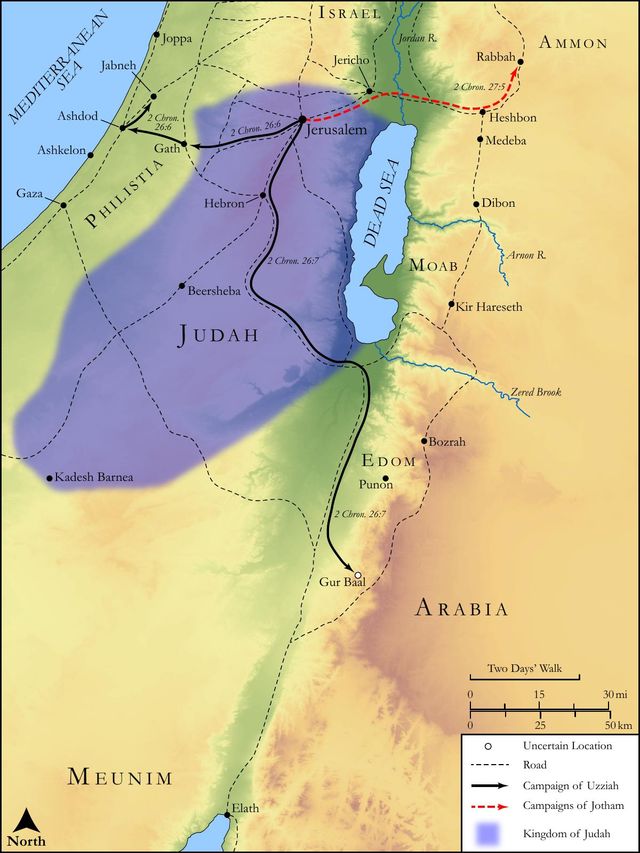
2 Chronicles 27:5
- וְהוּאVe·hu'and heH1931Conj-w ¦ Pro-3msPronoun Personal 3rd Singular Masculineוְandהוּאhe
- נִלְחַםnil·Chamhe waged warH3898V-Niphal-Perf-3msVerb Niphal Perfect 3rd Singular Masculine
- עִם'imwithH5973PrepPreposition
- מֶלֶךְMe·lekh[the] king ofH4428N-mscNoun Singular Masculine Construct
- בְּנֵיbe·nei[the] people ofH1121N-mpcNoun Plural Masculine Construct
- עַמּוֹן'a·mOnAmmonH5983N-proper-mNoun Proper Masculine
- וַיֶּחֱזַקvai·ye·che·Zakand he prevailedH2388Conj-w ¦ V-Qal-ConsecImperf-3msVerb Qal Consecutive Imperfect 3rd Singular Masculineוַandיֶּחֱזַקhe prevailed
- עֲלֵיהֶם'a·lei·Hemover themH5921Prep ¦ 3mpPrepositionעֲלֵיoverהֶםthem
- וַיִּתְּנוּvai·yi·te·nuand they gaveH5414Conj-w ¦ V-Qal-ConsecImperf-3mpVerb Qal Consecutive Imperfect 3rd Plural Masculineוַandיִּתְּנוּthey gave
- לוֹloto himPrep-l ¦ 3msSuffix Personal 3rd Singular Masculineלtoוֹhim
- בְנֵיve·nei[the] people ofH1121N-mpcNoun Plural Masculine Construct
- עַמּוֹןa·MonAmmonH5983N-proper-mNoun Proper Masculine
- בַּשָּׁנָהba·sha·Nahin the yearH8141Prep-b ¦ N-fsNoun Singular Feminine Absoluteבַּin theשָּׁנָהyear
- הַהִיאha·Hi'<the> thatH1931Art ¦ Pro-3fsPronoun Personal 3rd Singular Feminineהַ<the>הִיאthat
- מֵאָהme·'Ahone hundredH3967N-fsNoun Singular Feminine Absolute
- כִּכַּרki·kartalent[s] ofH3603N-fscNoun Singular Feminine Construct
- כֶּסֶףKe·sefsilverH3701N-msNoun Singular Masculine Absolute
- וַעֲשֶׂרֶתva·'a·Se·retand tenH6235Conj-w ¦ N-fscNoun Singular Feminine Constructוַandעֲשֶׂרֶתten
- אֲלָפִים'a·la·Fimthousand<s>H505N-cpNoun Plural common gender Absolute
- כֹּרִיםko·RimcorsH3734N-mpNoun Plural Masculine Absolute
- חִטִּיםchi·Timwheat<s>H2406N-mpNoun Plural Masculine Absolute
- וּשְׂעוֹרִיםu·se·'o·Rimand barley<s>H8184Conj-w ¦ N-mpNoun Plural Masculine Absoluteוּandשְׂעוֹרִיםbarley<s>
- עֲשֶׂרֶת'a·Se·rettenH6235N-fsNoun Singular Feminine Absolute
- אֲלָפִים'a·la·Fimthousand<s>H505N-cpNoun Plural common gender Absolute
- זֹאתZotthisH2063PrtParticle Demonstrative
- הֵשִׁיבוּhe·Shi·vuthey broughtH7725V-Hiphil-Perf-3cpVerb Hiphil Perfect 3rd Plural common gender
- לוֹloto himPrep-l ¦ 3msSuffix Personal 3rd Singular Masculineלtoוֹhim
- בְּנֵיbe·Nei[the] people ofH1121N-mpcNoun Plural Masculine Construct
- עַמּוֹןa·MonAmmonH5983N-proper-mNoun Proper Masculine
- וּבַשָּׁנָהu·va·sha·Nahand in the yearH8141Conj-w ¦ Prep-b ¦ N-fsNoun Singular Feminine Absoluteוּandבַin theשָּׁנָהyear
- הַשֵּׁנִיתha·she·Nit<the> secondH8145Art ¦ Adj-fscAdjective Numerical Position Singular Feminine Constructהַ<the>שֵּׁנִיתsecond
- וְהַשְּׁלִשִׁיתve·ha·she·li·Shitand <the> thirdH7992Conj-w ¦ Art ¦ Adj-fsAdjective Numerical Position Singular Feminine Absoluteוְandהַ<the>שְּׁלִשִׁיתthird
English is a literal word-by-word gloss of the Hebrew, not the KJV's wording. Why?
This is the original text the KJV's translators worked from — each Hebrew word with its own literal English meaning in this verse, prepared by scholars at Tyndale House, Cambridge. The KJV translates whole sentences, not word by word, so its wording differs: one Hebrew word can become several English words, and the KJV may choose “the LORD” where the gloss reads “Yahweh”. Both are faithful — they answer different questions. For the KJV's own rendering, switch to the KJV text.
Details
See on the biblical-era map
Study this verse
Public-domain commentary
Matthew Henry
From his Commentary on the Whole Bible. Henry comments on passages, not single verses — this entry covers 2 Chronicles 27:1–9. His two-level outline is real structure in the source text, so it is rendered as structure.
There is not much more related here concerning Jotham than we had before, Kg2 15:32, etc.
I.He reigned well.
He did that which was right in the sight of the Lord; the course of his reign was good, and pleasing to God, whose favour he made his end, and his word his rule, and (which shows that he acted from a good principle) he prepared his ways before the Lord his God (Ch2 27:6), that is, he walked circumspectly and with much caution, contrived how to shun that which was evil and compass that which was good. He looked before him, and cast his affairs into such a posture and method as made the regular management of them the more easy. Or he established or fixed his ways before the Lord, that is, he walked steadily and constantly in the way of his duty, was uniform and resolute in it: not like some of those that went before him, who, though they had some good in them, lost their credit by their inconstancy and inconsistency with themselves. They had run well, but something hindered them. It was not so with Jotham. Two things are observed here in his character: - 1. What was amiss in his father he amended in himself (Ch2 27:2): He did according to all that his father did well and wisely; howbeit he would not imitate him in which he did amiss; for he entered not into the temple of the Lord to burn incense as his father did, but took warning by his fate not to dare so presumptuous a thing. Note, We must not imitate the best men, and those we have the greatest veneration for, any further than they did well; but, on the contrary, their falls, and the injurious consequences of them, must be warnings to us to walk the more circumspectly, that we stumble not at the same stone that they stumbled at. 2. What was amiss in his people he could not prevail to amend: The people did yet corruptly. Perhaps it reflects some blame upon him, that he was wanting in his part towards the reformation of the land. Men may be very good themselves, and yet not have courage and zeal to do what they might do towards the reforming of others. however it certainly reflects a great deal of blame upon the people, that they did not do what they might have done to improve the advantages of so good a reign: they had good instructions given them and a good example set before them, but they would not be reformed; so that even in the reign of their good kings, as well as in that of the bad ones, they were treasuring up wrath against the day of wrath; for they still did corruptly, and the founder melted in vain.
II.He prospered, and became truly reputable.
1.He built. He began with the gate of the house of the Lord, which he repaired, beautified, and raised. He then fortified the wall of Ophel, and built cities in the mountains of Judah (Ch2 27:3, Ch2 27:4), took all possible care for the fortifying of his country and the replenishing of it.
2.He conquered. He prevailed against the Ammonites, who had invaded Judah in Jehoshaphat's time, Ch2 20:1. He triumphed over them, and exacted great contributions from them, Ch2 27:5. He became mighty (Ch2 27:6) in wealth and power, and influence upon the neighbouring nations, who courted his friendship and feared his displeasure; and this he got by preparing his ways before the Lord his God. The more stedfast we are in religion the more mighty we are both for the resistance of that which is evil and for the performance of that which is good.
III.He finished his course too soon, but finished it with honour.
He had the unhappiness to die in the midst of his days; but, to balance that, the happiness not to out-live his reputation, as the last three of his predecessors did. He died when he was but forty-one years of age (Ch2 27:8); but his wars and his ways, his wars abroad and his ways at home, were so glorious that they were recorded in the book of the kings of Israel, as well as of the kings of Judah, Ch2 27:7. The last words of the chapter are the most melancholy, as they inform us that Ahaz his son, whose character, in all respects, was the reverse of his, reigned in his stead. When the wealth and power with which wise men have done good devolve upon fools, that will do hurt with them, it is a lamentation, and shall be for a lamentation.
Continue studying 2 Chronicles 27:5 across the web’s major study libraries — every link below opens this exact verse, chapter, or book on the destination site.
Read & Compare
 BibleGatewayThis verse in more than 200 translations and 70 languages.
 Bible.comThe YouVersion reader — hundreds of translations, reading plans, and highlights.
 ESV.orgCrossway's official English Standard Version reader.
 NET BibleThe NET translation with 60,000+ translators' notes on every rendering decision.
 STEP BibleTyndale House's free study tool — original text, vocabulary, and scholarly resources.
 BibliaLogos Bible Software's free web reader.
 USCCBThe New American Bible (Revised Edition) with the U.S. bishops' study notes.
Commentaries
 BibleHub CommentariesDozens of classic commentaries on this verse, gathered on one page.
 StudyLightMore than 100 commentary sets — the largest collection on the web.
 BibleRefPlain-English commentary on what this verse means, verse by verse.
 Enduring WordDavid Guzik's free commentary on this chapter, widely used by Bible teachers.
 Bible Study ToolsVerse commentary alongside Greek and Hebrew study aids.
Original Language & Research
- BibleHub InterlinearThe verse word by word — original language, transliteration, and English.
- BibleHub LexiconEvery word's original-language definition and Strong's entry.
 Blue Letter BibleDeep-study tools — Strong's numbers, concordance, and word studies.
 SefariaThe Hebrew text with Rashi and centuries of Jewish commentary.
Sermons, Hymns & Audio


TrulyRandomVerse is not affiliated with these sites and doesn’t control their content. They’re linked because they’re genuinely useful.
Summary
2 Chronicles 27:5 vividly recounts King Jotham's decisive military victory over the Ammonites, leading to a substantial and sustained annual tribute of silver, wheat, and barley. This verse highlights a period of significant strength, prosperity, and regional dominance for the kingdom of Judah, directly attributing these successes to Jotham's righteous reign and God's sovereign favor.
Context
ShowHideLiterary Context
This verse is strategically placed within the Chronicler's account of King Jotham's reign, which commences in 2 Chronicles 27. It immediately follows a crucial commendation of Jotham's character: "he did that which was right in the sight of the Lord, according to all that his father Uzziah did: howbeit he entered not into the temple of the Lord" (2 Chronicles 27:2). This distinction is vital, as it contrasts Jotham's piety with his father Uzziah's later transgression of entering the temple to burn incense, which resulted in leprosy (see 2 Chronicles 26:16-21). The military victory and the subsequent tribute detailed in 2 Chronicles 27:5 are presented as direct, tangible evidence of God's blessing upon a king who walked in obedience and avoided his father's specific sin. The narrative culminates with Jotham growing "mighty, because he prepared his ways before the Lord his God" (2 Chronicles 27:6), firmly establishing the theological link between his faithful conduct and his flourishing kingdom.
Historical & Cultural Context
The Ammonites, a Semitic people descended from Lot (Genesis 19:38), were perennial adversaries of Israel and Judah, frequently engaging in conflicts throughout their history, as seen in accounts like Judges 3:12-30, 1 Samuel 11:1-11, and 2 Samuel 10:1-19. Jotham's decisive victory over them signifies Judah's formidable regional power and military prowess during his reign. The practice of exacting tribute from defeated nations was a standard and critical component of ancient Near Eastern geopolitics. Such payments served not only as a clear sign of submission and vassalage but also as a significant economic boost for the victorious kingdom. The specific quantities mentioned in the verse—100 talents of silver and 10,000 measures of wheat and barley—represent an enormous sum, underscoring the completeness of the Ammonites' subjugation and providing a substantial influx of wealth and resources that would have greatly enhanced Judah's economic stability and overall prosperity.
Key Themes
ShowHide2 Chronicles 27:5 powerfully illustrates several core themes central to the Chronicler's theological message. Foremost is the theme of divine blessing for righteousness. Jotham's military success and the resulting economic windfall are explicitly presented as direct consequences of his faithful walk with God, providing a stark contrast to the consequences of his father Uzziah's pride and disobedience. This reinforces the Deuteronomic principle that obedience to God leads to prosperity and victory, while disobedience invites judgment, a concept thoroughly explored in Deuteronomy 28. Another prominent theme is national strength and security. Jotham's ability to subdue a formidable and long-standing adversary like the Ammonites highlights Judah's robust military and political standing under a righteous king. Finally, the verse speaks to economic prosperity, demonstrating how God can provide abundant resources through various means when a nation or its leader aligns with His will. This echoes the widespread prosperity seen under other righteous kings, such as King Solomon.
Exposition and Analysis
ShowHideKey Word Analysis
ShowHideThis primitive root (H3898) means "to feed on" or "to consume," and by implication, "to battle" or "to make war." Its use here indicates Jotham's direct engagement in military conflict with the Ammonites. The verb implies a destructive and decisive confrontation, emphasizing that Jotham actively engaged and overcame his adversaries through warfare.
This verb (H2388) signifies to be strong, firm, or courageous, and specifically, to prevail or conquer. Its application to Jotham's action against the Ammonites emphasizes a decisive and complete subjugation, indicating not merely a battle won but a thorough overcoming of the enemy. It conveys that Jotham, by divine enablement, was made strong and effective in his military endeavors, leading to a conclusive triumph.
The Hebrew term (H3603) refers to a 'talent,' a large unit of weight, particularly for precious metals. While its primary meaning is 'circle' or 'round,' it came to denote a large, round coin or weight of silver or gold, typically around 75 pounds (approx. 34 kg). The mention of 'an hundred talents of silver' signifies an immense quantity of wealth, underscoring the severity of the Ammonites' subjugation and the substantial economic boon for Judah. This was a massive, not token, transfer of resources.
The term 'measures' (H3734) refers to a 'kor,' a substantial dry measure, equivalent to a homer, typically around 6 bushels or 220 liters. The tribute of 'ten thousand measures of wheat, and ten thousand of barley' indicates a colossal quantity of grain. This immense agricultural payment highlights the comprehensive nature of the Ammonites' subjugation and provided significant food security and economic stability for Judah.
Verse Breakdown
ShowHide"He fought also with the king of the Ammonites, and prevailed against them."
This opening clause establishes Jotham's active and successful military leadership. It highlights his direct engagement in warfare and the decisive outcome, indicating Judah's military superiority and divine favor under his command. The term "prevailed" signifies a complete and undeniable victory, marking the end of Ammonite resistance.
"And the children of Ammon gave him the same year an hundred talents of silver, and ten thousand measures of wheat, and ten thousand of barley."
This clause details the immediate and substantial economic consequences of Jotham's victory. The specific, large quantities of silver and grain underscore the magnitude of the tribute, reflecting the Ammonites' complete submission and Judah's significant material gain. This payment served as both a penalty and a symbol of their subjugation.
"So much did the children of Ammon pay unto him, both the second year, and the third."
This final clause emphasizes the sustained nature of the tribute. It was not a one-time payment but an annual obligation for at least three consecutive years. This demonstrates the long-term subjugation of the Ammonites and the enduring economic benefit and regional power enjoyed by Judah under Jotham's reign, solidifying his dominance.
Literary Devices
ShowHideThe Chronicler employs several literary devices in 2 Chronicles 27:5 to underscore Jotham's success and the divine favor bestowed upon him. The use of specific, large numbers (100 talents of silver, 10,000 measures of wheat, and 10,000 measures of barley) functions as a form of amplification, not necessarily to exaggerate literally, but to emphasize the immense scale of the tribute and thus the magnitude of Jotham's victory and Judah's subsequent prosperity. This precise quantification lends an air of historical veracity while simultaneously highlighting the divine blessing. The repetition of the phrase "So much did the children of Ammon pay unto him, both the second year, and the third" serves to highlight the sustained nature of the tribute, reinforcing the long-term impact of Jotham's decisive victory and Judah's continued dominance. Furthermore, the passage implicitly uses contrast by subtly setting Jotham's righteous and successful reign against the backdrop of his father Uzziah's later pride and subsequent affliction, thereby reinforcing the Chronicler's overarching theological theme of divine recompense for obedience and disobedience.
Theological and Thematic Connections
ShowHideThe account of Jotham's victory and the subsequent tribute in 2 Chronicles 27:5 serves as a powerful illustration of the Deuteronomic principle that obedience to God brings blessing and prosperity. Jotham's righteousness, explicitly stated earlier in the chapter, is directly linked to his military success and the economic boon for Judah. This demonstrates God's active involvement in the affairs of nations and His willingness to grant strength and provision to those who walk in His ways. It is a testament to the fact that true security and wealth ultimately come from divine favor, not merely human might or strategic brilliance. For the Chronicler, this narrative reinforces the idea that Israel's well-being is inextricably tied to its covenant faithfulness, showcasing God's faithfulness to His promises of blessing for obedience.
Reflection and Application
ShowHideWhile the immediate context of 2 Chronicles 27:5 is a historical account of military conquest and national tribute, its underlying principles offer profound spiritual lessons for believers today. Just as Jotham's righteousness led to tangible blessings for Judah, so too does faithfulness to God in our lives often yield spiritual and sometimes even tangible fruit. This verse encourages us to pursue integrity, obedience, and dependence on God in all our endeavors, whether facing personal challenges, professional obstacles, or spiritual battles. It reminds us that God is able to grant strength to "prevail" against adversaries and provide resources beyond our natural means. The sustained nature of the Ammonite tribute also speaks to the long-term benefits of consistent faithfulness; God's blessings often endure and compound over time, providing stability and security that extends beyond immediate circumstances. We are called to trust in God's sovereignty and provision, knowing that He can equip us for every good work and bring about His purposes in our lives and communities, demonstrating His power through our yieldedness.
Questions for Reflection
ShowHideFAQ
ShowHideWhy is Jotham's military success highlighted immediately after his righteousness?
ShowHideJotham's military success and the subsequent tribute are presented as a direct consequence and tangible evidence of his righteous reign. The Chronicler frequently links the prosperity and security of Judah's kings to their faithfulness to God, contrasting it with the misfortunes that befall disobedient rulers. This highlights the Deuteronomic principle that obedience to God brings blessing and victory, while disobedience brings judgment. The tribute from the Ammonites, a long-standing enemy, not only demonstrates Judah's strength but also God's favor upon a king who "did what was right in the eyes of the Lord" (2 Chronicles 27:2). This literary arrangement emphasizes the theological lesson that God honors those who honor Him, providing a clear cause-and-effect relationship for the Chronicler's audience.
Christ-Centered Fulfillment
ShowHideWhile Jotham's victory was a temporal triumph over an earthly foe, it serves as a historical foreshadowing of the ultimate and eternal victory achieved by Jesus Christ. Jotham "prevailed" against the Ammonites, securing a material tribute for his kingdom and establishing a period of peace and prosperity. Far greater, Christ, the true King of kings, "prevailed" over sin, death, and the spiritual powers of darkness through His sacrificial death and glorious resurrection. His triumph on the cross disarmed the spiritual rulers and authorities, making a public spectacle of them (Colossians 2:15). The "tribute" Christ receives is not silver or grain, but a redeemed humanity, purchased by His own blood from every tribe, tongue, people, and nation, who now willingly offer Him worship and service (Revelation 5:9-10). Just as Jotham's reign brought peace and prosperity to Judah, Christ's reign brings spiritual peace, reconciliation, and eternal life to all who believe in Him, offering a far greater "wealth" of grace, forgiveness, and an inheritance that is imperishable (Ephesians 1:7-8). His victory is not for a few years, but for all eternity, establishing a kingdom that will never end and conquering the one who holds the power of death (Hebrews 2:14-15).