


2 Chronicles 27:3
Bible text: King James Version (1769 Blayney text) · Public domain
Bible text: Berean Standard Bible · Public domain
Bible text: American Standard Version (1901) · Public domain
Bible text: World English Bible, Messianic edition · Public domain
Bible text: Geneva Bible (1599) · Public domain
Bible text: Young's Literal Translation · Public domain
- הוּאHu'heH1931Pro-3msPronoun Personal 3rd Singular Masculine
- בָּנָהba·Nahhe builtH1129V-Qal-Perf-3msVerb Qal Perfect 3rd Singular Masculine
- אֶת'et<obj.>H853DirObjMParticle Object Indicator
- שַׁעַרSha·'ar[the] gate ofH8179N-mscNoun Singular Masculine Construct
- בֵּיתbeit[the] house ofH1004N-mscNoun Singular Masculine Construct
- יְהוָהYah·wehYahwehH3068N-properNoun Proper Title
- הָעֶלְיוֹןha·'el·Yon<the> upperH5945Art ¦ Adj-msAdjective Singular Masculine Absoluteהָ<the>עֶלְיוֹןupper
- וּבְחוֹמַתu·ve·cho·Matand on [the] wall ofH2346Conj-w ¦ Prep-b ¦ N-fscNoun Singular Feminine Constructוּandבְonחוֹמַת[the] wall of
- הָעֹפֶלha·'O·fel<the> OphelH6077Art ¦ N-properNoun Proper Locationהָ<the>עֹפֶלOphel
- בָּנָהba·Nahhe builtH1129V-Qal-Perf-3msVerb Qal Perfect 3rd Singular Masculine
- לָרֹבla·Roto abundanceH7230Prep-l ¦ N-msNoun Singular Masculine Absoluteלָtoרֹבabundance
English is a literal word-by-word gloss of the Hebrew, not the KJV's wording. Why?
This is the original text the KJV's translators worked from — each Hebrew word with its own literal English meaning in this verse, prepared by scholars at Tyndale House, Cambridge. The KJV translates whole sentences, not word by word, so its wording differs: one Hebrew word can become several English words, and the KJV may choose “the LORD” where the gloss reads “Yahweh”. Both are faithful — they answer different questions. For the KJV's own rendering, switch to the KJV text.
Details
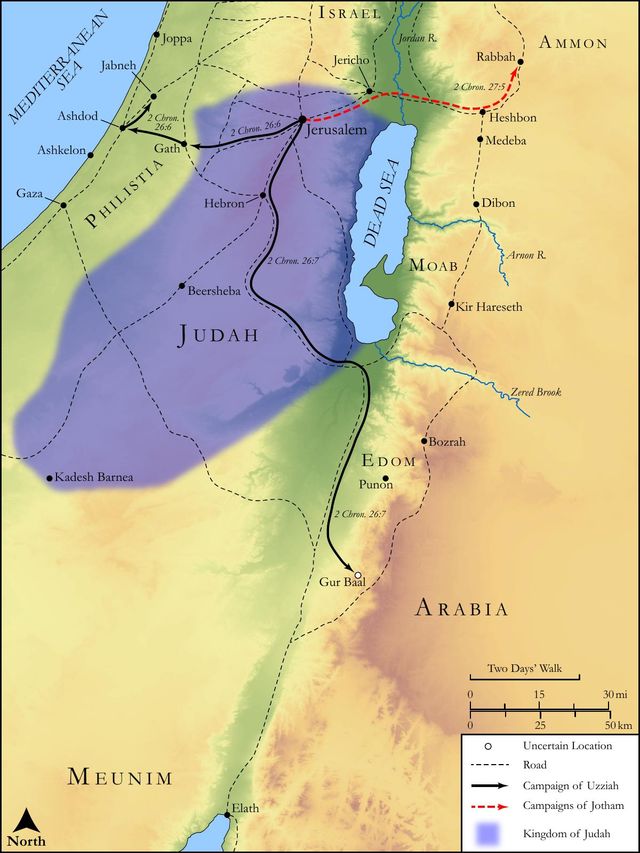
See on the biblical-era map
Study this verse
Public-domain commentary
Matthew Henry
From his Commentary on the Whole Bible. Henry comments on passages, not single verses — this entry covers 2 Chronicles 27:1–9. His two-level outline is real structure in the source text, so it is rendered as structure.
There is not much more related here concerning Jotham than we had before, Kg2 15:32, etc.
I.He reigned well.
He did that which was right in the sight of the Lord; the course of his reign was good, and pleasing to God, whose favour he made his end, and his word his rule, and (which shows that he acted from a good principle) he prepared his ways before the Lord his God (Ch2 27:6), that is, he walked circumspectly and with much caution, contrived how to shun that which was evil and compass that which was good. He looked before him, and cast his affairs into such a posture and method as made the regular management of them the more easy. Or he established or fixed his ways before the Lord, that is, he walked steadily and constantly in the way of his duty, was uniform and resolute in it: not like some of those that went before him, who, though they had some good in them, lost their credit by their inconstancy and inconsistency with themselves. They had run well, but something hindered them. It was not so with Jotham. Two things are observed here in his character: - 1. What was amiss in his father he amended in himself (Ch2 27:2): He did according to all that his father did well and wisely; howbeit he would not imitate him in which he did amiss; for he entered not into the temple of the Lord to burn incense as his father did, but took warning by his fate not to dare so presumptuous a thing. Note, We must not imitate the best men, and those we have the greatest veneration for, any further than they did well; but, on the contrary, their falls, and the injurious consequences of them, must be warnings to us to walk the more circumspectly, that we stumble not at the same stone that they stumbled at. 2. What was amiss in his people he could not prevail to amend: The people did yet corruptly. Perhaps it reflects some blame upon him, that he was wanting in his part towards the reformation of the land. Men may be very good themselves, and yet not have courage and zeal to do what they might do towards the reforming of others. however it certainly reflects a great deal of blame upon the people, that they did not do what they might have done to improve the advantages of so good a reign: they had good instructions given them and a good example set before them, but they would not be reformed; so that even in the reign of their good kings, as well as in that of the bad ones, they were treasuring up wrath against the day of wrath; for they still did corruptly, and the founder melted in vain.
II.He prospered, and became truly reputable.
1.He built. He began with the gate of the house of the Lord, which he repaired, beautified, and raised. He then fortified the wall of Ophel, and built cities in the mountains of Judah (Ch2 27:3, Ch2 27:4), took all possible care for the fortifying of his country and the replenishing of it.
2.He conquered. He prevailed against the Ammonites, who had invaded Judah in Jehoshaphat's time, Ch2 20:1. He triumphed over them, and exacted great contributions from them, Ch2 27:5. He became mighty (Ch2 27:6) in wealth and power, and influence upon the neighbouring nations, who courted his friendship and feared his displeasure; and this he got by preparing his ways before the Lord his God. The more stedfast we are in religion the more mighty we are both for the resistance of that which is evil and for the performance of that which is good.
III.He finished his course too soon, but finished it with honour.
He had the unhappiness to die in the midst of his days; but, to balance that, the happiness not to out-live his reputation, as the last three of his predecessors did. He died when he was but forty-one years of age (Ch2 27:8); but his wars and his ways, his wars abroad and his ways at home, were so glorious that they were recorded in the book of the kings of Israel, as well as of the kings of Judah, Ch2 27:7. The last words of the chapter are the most melancholy, as they inform us that Ahaz his son, whose character, in all respects, was the reverse of his, reigned in his stead. When the wealth and power with which wise men have done good devolve upon fools, that will do hurt with them, it is a lamentation, and shall be for a lamentation.
Continue studying 2 Chronicles 27:3 across the web’s major study libraries — every link below opens this exact verse, chapter, or book on the destination site.
Read & Compare
 BibleGatewayThis verse in more than 200 translations and 70 languages.
 Bible.comThe YouVersion reader — hundreds of translations, reading plans, and highlights.
 ESV.orgCrossway's official English Standard Version reader.
 NET BibleThe NET translation with 60,000+ translators' notes on every rendering decision.
 STEP BibleTyndale House's free study tool — original text, vocabulary, and scholarly resources.
 BibliaLogos Bible Software's free web reader.
 USCCBThe New American Bible (Revised Edition) with the U.S. bishops' study notes.
Commentaries
 BibleHub CommentariesDozens of classic commentaries on this verse, gathered on one page.
 StudyLightMore than 100 commentary sets — the largest collection on the web.
 BibleRefPlain-English commentary on what this verse means, verse by verse.
 Enduring WordDavid Guzik's free commentary on this chapter, widely used by Bible teachers.
 Bible Study ToolsVerse commentary alongside Greek and Hebrew study aids.
Original Language & Research
- BibleHub InterlinearThe verse word by word — original language, transliteration, and English.
- BibleHub LexiconEvery word's original-language definition and Strong's entry.
 Blue Letter BibleDeep-study tools — Strong's numbers, concordance, and word studies.
 SefariaThe Hebrew text with Rashi and centuries of Jewish commentary.
Sermons, Hymns & Audio


TrulyRandomVerse is not affiliated with these sites and doesn’t control their content. They’re linked because they’re genuinely useful.
Summary
King Jotham of Judah, a righteous and diligent monarch, demonstrated his commitment to both spiritual reverence and national security through significant architectural endeavors. This verse specifically highlights his construction of the "high gate of the house of the LORD," an act signifying his devotion to God and the enhancement of the nation's spiritual center, alongside his extensive fortifications "on the wall of Ophel," which strategically bolstered Jerusalem's defenses. These actions collectively underscore Jotham's balanced and effective leadership, prioritizing both sacred worship and practical governance for the holistic well-being of his kingdom.
Context
ShowHideLiterary Context
This verse is strategically placed within the Chronicler's concise yet impactful account of King Jotham's reign, immediately following an introduction that establishes his righteous character and his positive relationship with the Lord in 2 Chronicles 27:1-2. The narrative flow deliberately contrasts Jotham's actions with the significant transgression that marred his father Uzziah's later years—specifically Uzziah's unauthorized entry into the Temple to burn incense, detailed in 2 Chronicles 26:16-21. By highlighting Jotham's construction of a Temple gate, the Chronicler emphasizes Jotham's proper reverence for the sacred space and his adherence to divine protocol. The subsequent verses in 2 Chronicles 27 further elaborate on Jotham's military successes against the Ammonites and the prosperity he enjoyed, explicitly attributing it to his diligent walk before the Lord, as stated in 2 Chronicles 27:6.
Historical & Cultural Context
King Jotham ruled Judah from approximately 750-735 BCE, a period characterized by relative internal stability for Judah but increasingly overshadowed by the rising power and expansionist ambitions of the Assyrian Empire. In such an environment, robust defensive building projects were not merely symbolic but crucial for the physical security of Jerusalem, the capital city. The "house of the LORD" refers to the magnificent Temple in Jerusalem, which served as the spiritual, religious, and even national heart of the kingdom, having undergone various phases of construction and renovation since its original erection by Solomon. Kings in ancient Israel were often perceived as divinely appointed stewards of the Temple, with responsibility for its upkeep, enhancement, and the purity of worship conducted within it—a duty that profoundly signaled their piety and legitimate rule. The "Ophel" was a naturally fortified spur of land extending south from the Temple Mount, forming a vital strategic point for the defense of the city. Its fortification would have represented a substantial engineering undertaking, demonstrating a serious commitment to urban and national security.
Key Themes
ShowHideJotham's building activities, as detailed in 2 Chronicles 27:3, contribute significantly to several overarching themes prominent throughout the book of Chronicles. Firstly, the theme of righteous leadership and its resultant blessings is powerfully illustrated; Jotham's devotion to God, exemplified by his work on the Temple, directly leads to his strength and prosperity, a connection made explicit in 2 Chronicles 27:6. Secondly, the centrality of the Temple and the importance of proper worship is underscored. In stark contrast to his father Uzziah, who desecrated the Temple, Jotham enhances it, thereby demonstrating a profound and respectful reverence for God's dwelling place and the prescribed forms of worship. Thirdly, the theme of national security and responsible governance is clearly evident in his strategic fortification of Ophel, portraying a king who actively cares for the physical well-being and defense of his people. These interconnected themes collectively present Jotham as an exemplary king within the Chronicler's theological framework, one who masterfully balances spiritual devotion with practical, effective rule for the benefit of his entire kingdom.
Exposition and Analysis
ShowHideKey Word Analysis
ShowHideFrom a primitive root, this verb signifies "to build" in both literal and figurative senses. In this context, it denotes a substantial act of construction, implying not just minor repairs but significant architectural projects. Jotham's "building" indicates deliberate, purposeful action and investment in infrastructure, reflecting his active role as a responsible monarch.
This noun refers to an "opening, i.e., door or gate," often associated with city entrances or significant access points to buildings like the Temple. The "high gate" (combined with H5945, ʻelyôwn) suggests a prominent, elevated, or perhaps principal entrance. Its construction by Jotham underscores his focus on enhancing the accessibility and grandeur of the sacred space, contrasting with his father's improper entry.
Derived from a root meaning "to be great," this word signifies "abundance" in any respect. When applied to building, as here, it conveys the extensive, significant, or ample nature of the construction. This term emphasizes the substantial scale of Jotham's work on the Ophel wall, indicating considerable resources, labor, and strategic planning were dedicated to fortifying Jerusalem.
Verse Breakdown
ShowHide"He built the high gate of the house of the LORD"
This initial clause immediately establishes King Jotham's spiritual devotion and his role as a faithful steward of God's sanctuary. By constructing or significantly improving a prominent gate leading to the Temple, Jotham not only contributed to the physical enhancement of the sacred structure but also symbolically affirmed the paramount importance of proper access to and reverence for the divine presence. This act would have been perceived as a tangible expression of his piety and a commitment to facilitating appropriate worship within Judah.
"and on the wall of Ophel he built much"
This second clause reveals Jotham's practical wisdom and his unwavering dedication to the physical security of his kingdom. His extensive building efforts on the strategically vital Ophel wall demonstrate a proactive and comprehensive approach to national defense. This significant investment in defensive infrastructure would have substantially strengthened Jerusalem's fortifications, providing a greater sense of security for its inhabitants and showcasing Jotham's effective leadership in protecting his people and their capital from potential threats.
Literary Devices
ShowHideThe verse effectively employs Parallelism by juxtaposing two distinct yet complementary building projects: the spiritual enhancement of the Temple through the "high gate" and the practical fortification of Jerusalem through the "wall of Ophel." This structure underscores Jotham's balanced and holistic approach to leadership. Symbolism is also profoundly at play; the "high gate of the house of the LORD" symbolizes Jotham's deep reverence for God and his commitment to proper, accessible worship, while the "wall of Ophel" symbolizes his practical wisdom, foresight, and dedication to the physical protection and security of his people. The phrase "built much" functions as a form of Emphasis or Hyperbole, conveying the extensive and significant nature of his construction efforts, rather than merely minor repairs or additions, thereby highlighting the considerable scale of his achievements and commitment.
Theological and Thematic Connections
ShowHideKing Jotham's actions, as meticulously recorded in this verse, offer a powerful biblical paradigm for holistic leadership and faithful stewardship. His integrated approach—investing simultaneously in the spiritual infrastructure (the Temple) and the physical security (the city walls) of his nation—reflects a profound understanding that the true well-being and flourishing of a people are intrinsically dependent on both their relationship with God and their practical preparedness in the world. This seamless integration of spiritual devotion and practical governance is a recurring and vital theme throughout the Old Testament, where righteous kings are consistently depicted as those who diligently ensure both the purity and integrity of worship and the physical flourishing and defense of their kingdom. Jotham's reign, marked by such diligent and balanced leadership, served as a compelling testament to the blessings that accompany a king who "prepared his ways before the LORD his God" 2 Chronicles 27:6. His example continues to encourage believers today to consider how they, too, can cultivate both their spiritual lives and their practical responsibilities in a way that profoundly honors God and effectively serves their communities.
Reflection and Application
ShowHideJotham's reign, encapsulated in this pivotal verse, offers a compelling blueprint for how we, as individuals and communities, can live lives of profound purpose and unwavering integrity. His simultaneous focus on enhancing God's house and fortifying the city walls challenges us to critically examine our own priorities and investments. Are we diligently "building the high gate of the house of the LORD" in our lives—prioritizing our spiritual foundations, cultivating our relationship with God through prayer and His Word, and actively engaging in the life and mission of the church—with the same fervor and diligence Jotham showed for the Temple gate? Concurrently, are we wisely and proactively building up our "walls"—strengthening our character, developing our discernment, honing our practical skills, establishing healthy boundaries, and fostering emotional and mental resilience—to effectively withstand the inevitable challenges, temptations, and pressures of the world? True flourishing, much like the prosperity experienced by Jotham's Judah, emanates from a balanced and integrated commitment to both our inner spiritual lives and our outward practical responsibilities. It calls for a proactive approach that marries deep worship with practical wisdom, ensuring that our lives are built on an unshakeable foundation, both spiritually and practically.
Questions for Reflection
ShowHideFAQ
ShowHideWhat was the "high gate of the house of the LORD" and why was it significant?
ShowHideThe "high gate of the house of the LORD" (Hebrew: sha'ar ha'elyon) refers to a prominent or elevated entrance to the Temple in Jerusalem. While its precise location within the vast Temple complex remains a subject of scholarly debate, it was undoubtedly a significant access point, possibly leading to the inner court or a particularly revered section of the sanctuary. Its construction or substantial renovation by King Jotham was profoundly significant because it demonstrated his deep reverence for God and his unwavering commitment to the proper functioning, maintenance, and grandeur of the Temple, which served as the spiritual and national heart of Judah. This act stood in stark contrast to the later transgression of his father Uzziah, who presumptuously entered the Temple to burn incense, an act reserved for priests, as detailed in 2 Chronicles 26:16. Jotham's action highlighted his respect for divine boundaries and his dedication to enhancing the sacred space in a manner consistent with God's commands.
Why was building "on the wall of Ophel" so important for Judah?
ShowHideThe "Ophel" was a strategically vital and naturally fortified spur of land situated immediately south of the Temple Mount in Jerusalem. It formed a crucial and integral part of the city's overall defensive system, particularly protecting the vulnerable southern approach to both the Temple and the royal palace. In a historical period characterized by regional instability and the ever-present, rising threat of powerful empires like Assyria, strengthening Jerusalem's fortifications was of paramount importance for national security. Jotham's extensive building "on the wall of Ophel" (implied by the phrase "he built much") indicates a significant and substantial investment in military and urban infrastructure. This demonstrates his foresight and unwavering commitment to protecting his capital city and his people from external threats. This practical and wise leadership, alongside his spiritual devotion, contributed significantly to the stability and prosperity of his reign, as explicitly noted in 2 Chronicles 27:6.
Christ-Centered Fulfillment
ShowHideKing Jotham's commendable dual focus on building the Temple gate and fortifying the city walls, while exemplary in its time, ultimately serves as a shadow, pointing forward to the infinitely superior and eternal work of Jesus Christ. Jotham meticulously constructed a physical gate to a physical temple, but Jesus Himself declared, "I am the door; if anyone enters through Me, he will be saved" John 10:9. He is the ultimate "high gate" through whom humanity gains direct, unhindered access to the very presence of God, a spiritual access that immeasurably surpasses any earthly entrance. Furthermore, while Jotham diligently built stone walls for physical security, Jesus established a spiritual kingdom that "cannot be shaken" Hebrews 12:28, and He Himself stands as the ultimate fortress and impenetrable protector for His people. He is the one who boldly declared, "I will build My church, and the gates of Hades will not overpower it" Matthew 16:18, signifying a spiritual construction far more enduring and powerful than any earthly stone wall. His own resurrected body became the true Temple, the dwelling place of God among humanity John 2:19-21. Through His perfect sacrifice on the cross, He provides ultimate security, eternal peace, and an unassailable spiritual defense that no earthly enemy or spiritual adversary can ever breach. Thus, Jotham's good works, though significant, serve as a prophetic type, directing our gaze to the perfect, complete, and everlasting work of Christ, who builds an eternal spiritual house and provides everlasting security and salvation for all who trust in Him.