


2 Kings 15:32
Bible text: King James Version (1769 Blayney text) · Public domain
Bible text: Berean Standard Bible · Public domain
Bible text: American Standard Version (1901) · Public domain
Bible text: World English Bible, Messianic edition · Public domain
Bible text: Geneva Bible (1599) · Public domain
Bible text: Young's Literal Translation · Public domain
- בִּשְׁנַתbish·Natin yearH8141Prep-b ¦ N-fscNoun Singular Feminine Constructבִּinשְׁנַתyear
- שְׁתַּיִםshe·Ta·yimtwoH8147N-fdNoun Dual Feminine Absolute
- לְפֶקַחle·Fe·kachof PekahH6492Prep-l ¦ N-proper-mNoun Proper MasculineלְofפֶקַחPekah
- בֶּןben[the] son ofH1121N-mscNoun Singular Masculine Construct
- רְמַלְיָהוּre·mal·Ya·huRemaliahH7425N-proper-mNoun Proper Masculine
- מֶלֶךְMe·lekh[the] king ofH4428N-mscNoun Singular Masculine Construct
- יִשְׂרָאֵלYis·ra·'ElIsraelH3478N-properNoun Proper Location
- מָלַךְma·Lakhhe became kingH4427V-Qal-Perf-3msVerb Qal Perfect 3rd Singular Masculine
- יוֹתָםyo·TamJothamH3147N-proper-mNoun Proper Masculine
- בֶּןben[the] son ofH1121N-mscNoun Singular Masculine Construct
- עֻזִיָּהוּ'u·zi·Ya·huUzziahH5818N-proper-mNoun Proper Masculine
- מֶלֶךְMe·lekh[the] king ofH4428N-mscNoun Singular Masculine Construct
- יְהוּדָהye·hu·DahJudahH3063N-properNoun Proper Location
English is a literal word-by-word gloss of the Hebrew, not the KJV's wording. Why?
This is the original text the KJV's translators worked from — each Hebrew word with its own literal English meaning in this verse, prepared by scholars at Tyndale House, Cambridge. The KJV translates whole sentences, not word by word, so its wording differs: one Hebrew word can become several English words, and the KJV may choose “the LORD” where the gloss reads “Yahweh”. Both are faithful — they answer different questions. For the KJV's own rendering, switch to the KJV text.
Details
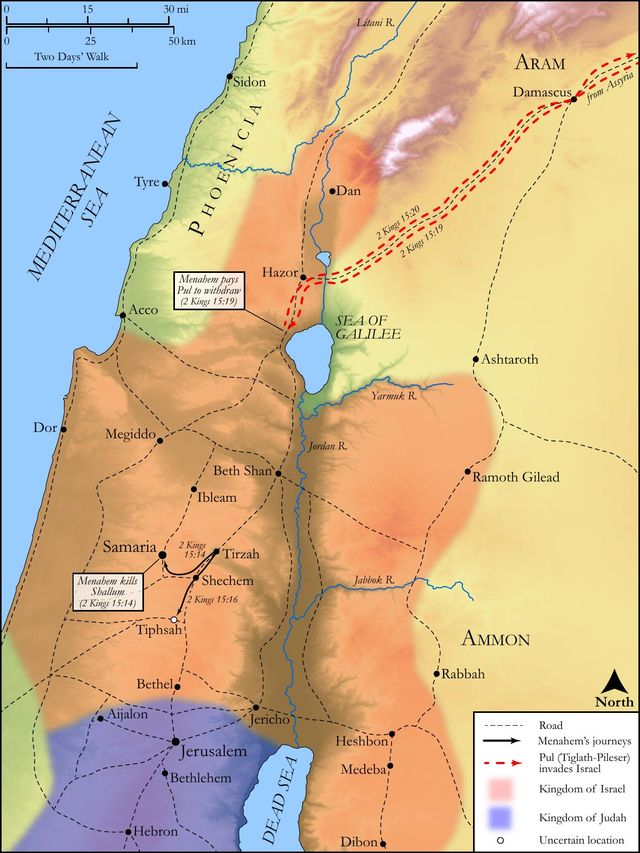
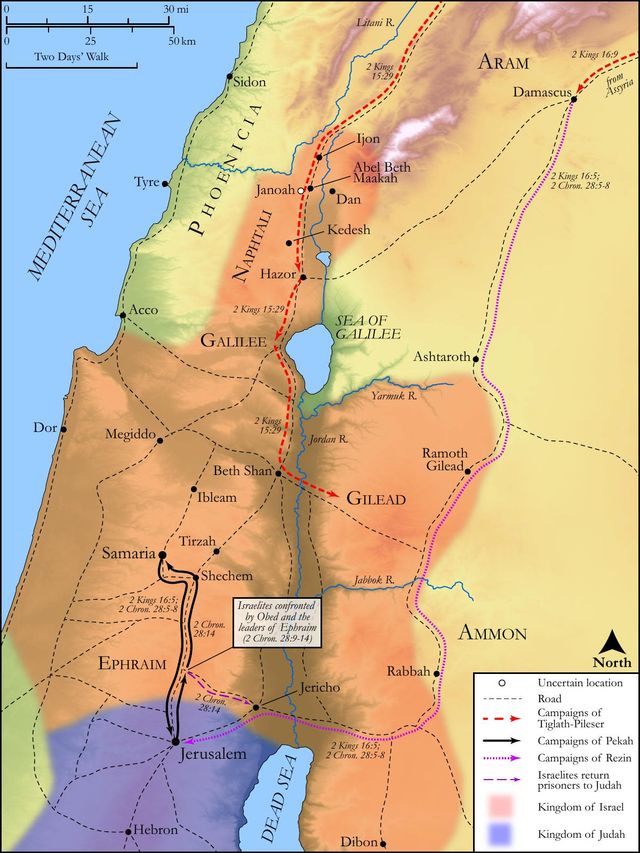
See on the biblical-era maps
Study this verse
Public-domain commentary
Matthew Henry
From his Commentary on the Whole Bible. Henry comments on passages, not single verses — this entry covers 2 Kings 15:32–38.
We have here a short account of the reign of Jotham king of Judah, of whom we are told, 1. That he reigned very well, did that which was right in the sight of the Lord, Kg2 15:34. Josephus gives him a very high character, stating that he was pious towards God, just towards men, and laid out himself for the public good, - that, whatever was amiss, he took care to have it rectified, - and, in short, wanted no virtue that became a good prince. Though the high places were not taken away, yet to draw people from them, and keep them close to God's holy place, he showed great respect to the temple, and built the higher gate which he went through to the temple. If magistrates cannot do all they would for the suppressing of vice and profaneness, let them do so much the more for the support and advancement of piety and virtue, and the bringing of them into reputation. If they cannot pull down the high places of sin, yet let them build and beautify the high gate of God's house. 2. That he died in the midst of his days, Kg2 15:33. Of most of the kings of Judah we are told how old they were when they began their reign, and by that may compute how old they were when they died; but no account is kept of the age of any of the kings of Israel that I remember, only of the years of their reigns. This honour God would put upon the kings of the house of David above those of other families. And by these accounts it appears that there was none of all the kings of Judah that reached David's age, seventy, the common age of man. Asa's age I do not find. Uzziah lived to be sixty-eight, Manasseh sixty-seven, and Jehoshaphat sixty; and these were the three oldest; many of those that were of note did not reach fifty. This Jotham died at forty-one. He was too great a blessing to be continued long to such an unworthy people. His death was a judgment, especially considering the character of his son and successor. 3. That in his days the confederacy was formed against Judah by Rezin and Remaliah's son, the king of Syria and the king of Israel, which appeared so very formidable in the beginning of the reign of Ahaz that, upon notice of it, the heart of that prince was moved and the heart of the people, as the trees of the wood are moved with the wind, Isa 7:2. The confederates were unjust in the attempt, yet it is here said (Kg2 15:37), The Lord began to send them against Judah, as he bade Shimei curse David, and took away from Job what the Sabeans robbed him of. Men are God's hand - the sword, the rod in his hand - which he makes use of as he pleases to serve his own righteous counsels, though men be unrighteous in their intentions. This storm gathered in the reign of pious Jotham, but he came to his grave in peace and it fell upon his degenerate son.
Historical interpretation
Historical reception
1 surviving comment on this verse from the historical church.
“In the second year of King Pekah son of Remaliah of Israel, King Jotham son of Uzziah of Judah began to reign.” After rising to power in that year, Jotham administered the government [of Judah] for sixteen years, earning great praise. While the second book of the Annals has shown all the feats illustriously accomplished by him, the Scripture never reproaches him in this passage for any error, except for his toleration of the high places, which was a fault common to all the most praised kings of Judah. In the first place, he strengthened Jerusalem with new fortifications and built towers and castles in desert places. He conquered the Ammonites, who were perpetual enemies of the Jews, and ordered them for the future to pay the kings of Judah an annual tribute.
Continue studying 2 Kings 15:32 across the web’s major study libraries — every link below opens this exact verse, chapter, or book on the destination site.
Read & Compare
 BibleGatewayThis verse in more than 200 translations and 70 languages.
 Bible.comThe YouVersion reader — hundreds of translations, reading plans, and highlights.
 ESV.orgCrossway's official English Standard Version reader.
 NET BibleThe NET translation with 60,000+ translators' notes on every rendering decision.
 STEP BibleTyndale House's free study tool — original text, vocabulary, and scholarly resources.
 BibliaLogos Bible Software's free web reader.
 USCCBThe New American Bible (Revised Edition) with the U.S. bishops' study notes.
Commentaries
 BibleHub CommentariesDozens of classic commentaries on this verse, gathered on one page.
 StudyLightMore than 100 commentary sets — the largest collection on the web.
 BibleRefPlain-English commentary on what this verse means, verse by verse.
 Enduring WordDavid Guzik's free commentary on this chapter, widely used by Bible teachers.
 Bible Study ToolsVerse commentary alongside Greek and Hebrew study aids.
Original Language & Research
- BibleHub InterlinearThe verse word by word — original language, transliteration, and English.
- BibleHub LexiconEvery word's original-language definition and Strong's entry.
 Blue Letter BibleDeep-study tools — Strong's numbers, concordance, and word studies.
 SefariaThe Hebrew text with Rashi and centuries of Jewish commentary.
Sermons, Hymns & Audio


TrulyRandomVerse is not affiliated with these sites and doesn’t control their content. They’re linked because they’re genuinely useful.
Summary
2 Kings 15:32 serves as a precise chronological anchor within the tumultuous era of the divided monarchy, specifically marking the commencement of Jotham's reign over the Southern Kingdom of Judah. This verse meticulously synchronizes Jotham's accession to the second year of Pekah's rule in the Northern Kingdom of Israel, thereby highlighting the ongoing political and historical interplay between the two separate entities and underscoring the biblical narrative's commitment to detailed historical record-keeping. It sets the stage for Jotham's righteous, yet relatively brief, independent reign, which followed his earlier regency during his father Uzziah's affliction.
Context
ShowHideLiterary Context
This verse is strategically placed within 2 Kings 15, a chapter characterized by a rapid succession of kings in both Israel and Judah. The narrative frequently alternates between the Northern and Southern Kingdoms, employing a consistent regnal formula that includes details like the king's age at accession, length of reign, mother's name, and a divine assessment of their rule. Verse 32 specifically transitions from the account of Pekahiah's assassination by Pekah (an event detailed in 2 Kings 15:25-26) and Pekah's subsequent twenty-year reign over Israel. By introducing Jotham's reign in Judah at this juncture, the author maintains a parallel chronological framework for both kingdoms, allowing readers to track their intertwined yet distinct histories. The verses immediately following 2 Kings 15:33-38 then elaborate on Jotham's character, actions, and the overall assessment of his rule.
Historical & Cultural Context
The period described in 2 Kings 15 falls within the latter half of the 8th century BCE, a time marked by profound political instability and the escalating threat of Assyrian expansion among the nations. The Northern Kingdom of Israel, having long departed from the Davidic covenant and the true worship of Yahweh, was plagued by frequent coups, assassinations, and short-lived reigns, as vividly exemplified by Pekah's violent ascent to power. In stark contrast, the Southern Kingdom of Judah, which maintained the Davidic lineage and the Jerusalem temple, generally experienced more stable and hereditary successions. Jotham's father, Uzziah, had enjoyed a long and prosperous reign, but was afflicted with leprosy for presuming to offer incense in the temple, a duty reserved for priests (2 Kings 15:5). This affliction led to Jotham serving as regent, managing the palace and judging the people, which provided him crucial experience for his eventual full kingship. The explicit mention of Pekah, king of Israel, underscores the enduring political and spiritual division that had separated the two kingdoms since the reign of Solomon (1 Kings 12).
Key Themes
ShowHideThough brief, this verse contributes significantly to several overarching themes present throughout 2 Kings and the broader historical books. It highlights the biblical narrative's commitment to chronological precision, meticulously dating events to demonstrate God's ordered unfolding of history and His sovereign control over time. It powerfully illustrates the theme of succession and continuity, particularly within the divinely ordained Davidic line in Judah, which stands in stark contrast to the volatile, often illegitimate, and violent changes of power in Israel. The simultaneous mention of kings from both nations reinforces the persistent reality of the divided monarchy and the distinct spiritual trajectories and consequences for Judah and Israel. Implicitly, it points to divine sovereignty, revealing God's ultimate control over the rise and fall of rulers, even amidst human rebellion and political machinations, ensuring the continuation of the promised lineage through which the Messiah would eventually come.
Exposition and Analysis
ShowHideKey Word Analysis
ShowHideTranslated as "began... to reign" (or "to reign" as the root), this primitive root signifies the formal act of assuming kingship or ascending the throne. It can also imply the induction into royalty or even the act of taking counsel. In the context of 2 Kings, its frequent use underscores the cyclical nature of kingship, the legitimacy (or lack thereof) of succession, and the divine appointment or permission behind each reign, even those marked by unrighteousness. Here, it marks the official commencement of Jotham's independent rule.
This noun, translated as "son," is fundamental for establishing lineage and legitimacy, particularly within the hereditary monarchy of Judah. Derived from a root meaning "to build," it conveys the idea of a son as a builder of the family name or line. Its consistent use in the regnal formulas emphasizes the patrilineal succession in Judah, a key component of the Davidic covenant, which stands in contrast to the frequent usurpations in Israel, thereby reinforcing the stability and divine promise associated with the house of David.
This proper noun, "Judah," identifies the Southern Kingdom over which Jotham reigns. Derived from a root meaning "to celebrate," Judah was the name of Jacob's fourth son, whose descendants formed the tribe from which the Davidic dynasty emerged. Its inclusion here is crucial for distinguishing Jotham's legitimate, covenantal rule from the non-Davidic and often illegitimate reigns of the Northern Kingdom of Israel. It highlights the enduring significance of the Davidic covenant and the unique spiritual heritage of Judah.
Verse Breakdown
ShowHide"In the second year of Pekah the son of Remaliah king of Israel"
This initial clause provides the precise chronological synchronism, dating Jotham's accession relative to Pekah's reign in the Northern Kingdom. By cross-referencing the two kingdoms, the biblical author establishes a parallel timeline, immediately placing Jotham's rule within a specific historical moment marked by the violent and unstable reign of Pekah, who had usurped the throne of Israel. This detail not only aids in historical reconstruction but also subtly highlights the contrasting natures of the two kingdoms' successions—one often characterized by chaos, the other by continuity.
"began Jotham the son of Uzziah king of Judah to reign."
This second clause introduces the new king of Judah. Jotham's lineage is explicitly stated, connecting him directly to his father, Uzziah (also known as Azariah), a king who had a long and generally righteous reign, despite his later affliction. The phrase "began... to reign" signifies the formal start of his independent rule, distinguishing it from his earlier regency during Uzziah's leprosy. This emphasis on legitimate, hereditary succession is a recurring theme for the kings of Judah, reinforcing the enduring nature of the Davidic covenant and God's faithfulness to His promises.
Literary Devices
ShowHideThe verse employs several literary devices, primarily serving historical and theological purposes. Chronological Precision is paramount, as the verse meticulously dates Jotham's reign by cross-referencing it with Pekah's reign in Israel. This precise dating is characteristic of the Deuteronomistic History, which seeks to provide a reliable and verifiable historical account of God's dealings with His people. The use of the Regnal Formula is evident, though condensed, as it introduces a new king with his lineage and the commencement of his reign, setting the stage for the fuller account to follow. Furthermore, the verse uses Juxtaposition by placing the king of Judah in direct chronological relation to the king of Israel. This subtle literary technique highlights the enduring reality of the divided monarchy and implicitly contrasts the relative stability of Judah's Davidic succession with the frequent, often violent, changes of power in Israel.
Theological and Thematic Connections
ShowHide2 Kings 15:32, though a simple historical notation, is profoundly theological in its implications. It underscores God's meticulous involvement in human history, demonstrating His sovereignty over the rise and fall of nations and their leaders. The precise dating and the emphasis on Jotham's legitimate succession within the Davidic line serve as a quiet but powerful testament to God's unwavering faithfulness to His covenant with David, ensuring that a descendant would always sit on the throne of Judah. This divine orchestration of history, even amidst the chaos and unfaithfulness of human rulers, points to a larger redemptive plan, assuring the continuity of the lineage through which the ultimate King, the Messiah, would one day come. The contrast between the stable succession in Judah and the volatile reigns in Israel implicitly teaches about the blessings of obedience and the consequences of abandoning God's covenant.
Reflection and Application
ShowHideThis seemingly mundane historical verse offers profound truths for contemporary believers. It reminds us that God is actively engaged in the unfolding of history, orchestrating events and overseeing the reigns of leaders, even those who do not acknowledge Him. Just as Jotham's reign began at a specific, divinely appointed time, so too are our lives and the broader sweep of human history governed by God's sovereign hand. This truth provides immense comfort and confidence, knowing that God's purposes will ultimately prevail, regardless of political instability, human machinations, or global crises. It encourages us to look beyond immediate circumstances and trust in God's overarching plan, recognizing that every detail, every succession, every historical moment, is part of His grand narrative of redemption. We are called to live faithfully within the times God has appointed for us, contributing to His kingdom with the same diligence Jotham exhibited in his generally righteous reign, understanding that our lives, too, fit into God's larger, eternal purposes.
Questions for Reflection
ShowHideFAQ
ShowHideWhy is the reign of Pekah, an Israelite king, mentioned when discussing Jotham, a king of Judah?
ShowHideThe mention of Pekah's reign serves a crucial chronological purpose, providing a synchronism between the Northern Kingdom of Israel and the Southern Kingdom of Judah. During the period of the divided monarchy, the biblical authors often used this cross-referencing method to establish a clear, parallel timeline for both kingdoms. Since the two kingdoms operated independently, often with different calendar systems or starting points for their reigns, linking them through contemporary rulers like Pekah and Jotham (as seen in 2 Kings 15:27) helps to integrate their separate histories into a unified narrative of God's dealings with His people. It also implicitly highlights the ongoing political reality of two distinct nations descended from a common ancestor, emphasizing the unique covenantal status of Judah.
Christ-Centered Fulfillment
ShowHideWhile 2 Kings 15:32 is a historical record of a human king's accession, it contributes to the larger biblical narrative that ultimately points to Christ. Jotham's reign, as part of the unbroken Davidic lineage in Judah, is a profound testament to God's unwavering faithfulness to His covenant with David, promising an eternal dynasty and a perpetual throne (2 Samuel 7:12-16). Every legitimate succession in Judah, including Jotham's, served as a temporary placeholder and a foreshadowing of the ultimate King who would sit on David's throne forever. Jesus Christ is the true and final fulfillment of this promise, the "Son of David" par excellence, whose genealogy explicitly traces back through this very line (Matthew 1:1 and Luke 3:23-38). Unlike earthly kings, whose reigns are finite and often flawed, Jesus' kingship is eternal, righteous, and perfect, establishing a spiritual kingdom that transcends human history and political boundaries (Revelation 11:15). Thus, this verse, in its quiet historical precision, subtly reinforces the divine plan for a lasting, righteous King from the line of Judah, ultimately fulfilled in the person and redemptive work of Jesus Christ, the King of kings and Lord of lords.