


2 Kings 15:34
Bible text: King James Version (1769 Blayney text) · Public domain
Bible text: Berean Standard Bible · Public domain
Bible text: American Standard Version (1901) · Public domain
Bible text: World English Bible, Messianic edition · Public domain
Bible text: Geneva Bible (1599) · Public domain
Bible text: Young's Literal Translation · Public domain
- וַיַּעַשׂvai·Ya·'asand he didH6213Conj-w ¦ V-Qal-ConsecImperf-3msVerb Qal Consecutive Imperfect 3rd Singular Masculineוַandיַּעַשׂhe did
- הַיָּשָׁרhai·ya·Sharthe rightH3477Art ¦ Adj-msAdjective Singular Masculine Absoluteהַtheיָּשָׁרright
- בְּעֵינֵיbe·'ei·Neiin [the] eyes ofH5869Prep-b ¦ N-fdcNoun Dual Feminine Constructבְּinעֵינֵי[the] eyes of
- יְהוָהYah·wehYahwehH3068N-properNoun Proper Title
- כְּכֹלke·Kholaccording to allH3605Prep-k ¦ N-msNoun Singular Masculine Absoluteכְּaccording toכֹלall
- אֲשֶׁר'a·SherthatH834RelParticle Relative
- עָשָׂה'a·Sahhe had doneH6213V-Qal-Perf-3msVerb Qal Perfect 3rd Singular Masculine
- עֻזִיָּהוּ'u·zi·Ya·huUzziahH5818N-proper-mNoun Proper Masculine
- אָבִיו'a·Vivhis fatherH1N-msc ¦ 3msNoun Singular Masculine Constructאָבִיfatherוhis
- עָשָׂה'a·Sahhe didH6213V-Qal-Perf-3msVerb Qal Perfect 3rd Singular Masculine
English is a literal word-by-word gloss of the Hebrew, not the KJV's wording. Why?
This is the original text the KJV's translators worked from — each Hebrew word with its own literal English meaning in this verse, prepared by scholars at Tyndale House, Cambridge. The KJV translates whole sentences, not word by word, so its wording differs: one Hebrew word can become several English words, and the KJV may choose “the LORD” where the gloss reads “Yahweh”. Both are faithful — they answer different questions. For the KJV's own rendering, switch to the KJV text.
Details
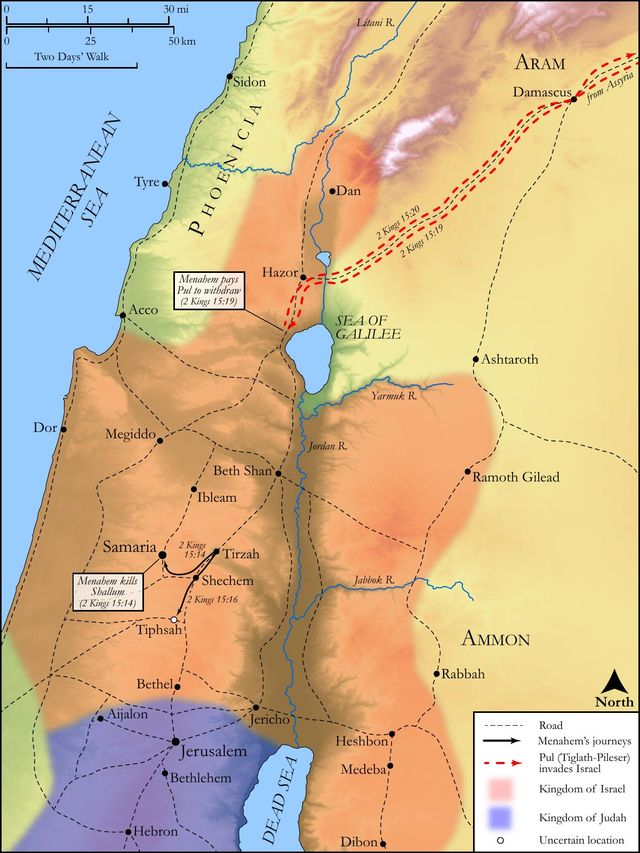
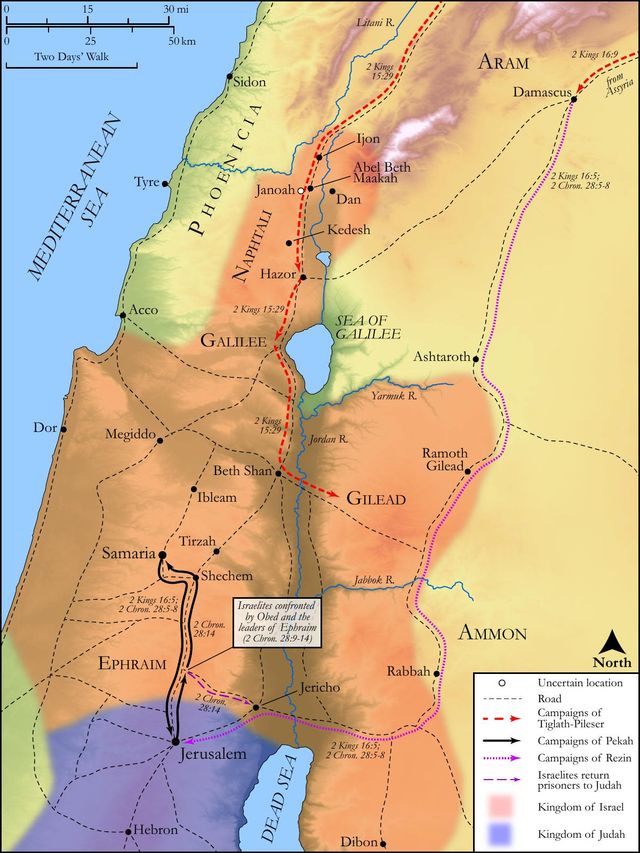
See on the biblical-era maps
Study this verse
Public-domain commentary
Matthew Henry
From his Commentary on the Whole Bible. Henry comments on passages, not single verses — this entry covers 2 Kings 15:32–38.
We have here a short account of the reign of Jotham king of Judah, of whom we are told, 1. That he reigned very well, did that which was right in the sight of the Lord, Kg2 15:34. Josephus gives him a very high character, stating that he was pious towards God, just towards men, and laid out himself for the public good, - that, whatever was amiss, he took care to have it rectified, - and, in short, wanted no virtue that became a good prince. Though the high places were not taken away, yet to draw people from them, and keep them close to God's holy place, he showed great respect to the temple, and built the higher gate which he went through to the temple. If magistrates cannot do all they would for the suppressing of vice and profaneness, let them do so much the more for the support and advancement of piety and virtue, and the bringing of them into reputation. If they cannot pull down the high places of sin, yet let them build and beautify the high gate of God's house. 2. That he died in the midst of his days, Kg2 15:33. Of most of the kings of Judah we are told how old they were when they began their reign, and by that may compute how old they were when they died; but no account is kept of the age of any of the kings of Israel that I remember, only of the years of their reigns. This honour God would put upon the kings of the house of David above those of other families. And by these accounts it appears that there was none of all the kings of Judah that reached David's age, seventy, the common age of man. Asa's age I do not find. Uzziah lived to be sixty-eight, Manasseh sixty-seven, and Jehoshaphat sixty; and these were the three oldest; many of those that were of note did not reach fifty. This Jotham died at forty-one. He was too great a blessing to be continued long to such an unworthy people. His death was a judgment, especially considering the character of his son and successor. 3. That in his days the confederacy was formed against Judah by Rezin and Remaliah's son, the king of Syria and the king of Israel, which appeared so very formidable in the beginning of the reign of Ahaz that, upon notice of it, the heart of that prince was moved and the heart of the people, as the trees of the wood are moved with the wind, Isa 7:2. The confederates were unjust in the attempt, yet it is here said (Kg2 15:37), The Lord began to send them against Judah, as he bade Shimei curse David, and took away from Job what the Sabeans robbed him of. Men are God's hand - the sword, the rod in his hand - which he makes use of as he pleases to serve his own righteous counsels, though men be unrighteous in their intentions. This storm gathered in the reign of pious Jotham, but he came to his grave in peace and it fell upon his degenerate son.
Historical interpretation
Historical reception
1 surviving comment on this verse from the historical church.
“In the second year of King Pekah son of Remaliah of Israel, King Jotham son of Uzziah of Judah began to reign.” After rising to power in that year, Jotham administered the government [of Judah] for sixteen years, earning great praise. While the second book of the Annals has shown all the feats illustriously accomplished by him, the Scripture never reproaches him in this passage for any error, except for his toleration of the high places, which was a fault common to all the most praised kings of Judah. In the first place, he strengthened Jerusalem with new fortifications and built towers and castles in desert places. He conquered the Ammonites, who were perpetual enemies of the Jews, and ordered them for the future to pay the kings of Judah an annual tribute.
Continue studying 2 Kings 15:34 across the web’s major study libraries — every link below opens this exact verse, chapter, or book on the destination site.
Read & Compare
 BibleGatewayThis verse in more than 200 translations and 70 languages.
 Bible.comThe YouVersion reader — hundreds of translations, reading plans, and highlights.
 ESV.orgCrossway's official English Standard Version reader.
 NET BibleThe NET translation with 60,000+ translators' notes on every rendering decision.
 STEP BibleTyndale House's free study tool — original text, vocabulary, and scholarly resources.
 BibliaLogos Bible Software's free web reader.
 USCCBThe New American Bible (Revised Edition) with the U.S. bishops' study notes.
Commentaries
 BibleHub CommentariesDozens of classic commentaries on this verse, gathered on one page.
 StudyLightMore than 100 commentary sets — the largest collection on the web.
 BibleRefPlain-English commentary on what this verse means, verse by verse.
 Enduring WordDavid Guzik's free commentary on this chapter, widely used by Bible teachers.
 Bible Study ToolsVerse commentary alongside Greek and Hebrew study aids.
Original Language & Research
- BibleHub InterlinearThe verse word by word — original language, transliteration, and English.
- BibleHub LexiconEvery word's original-language definition and Strong's entry.
 Blue Letter BibleDeep-study tools — Strong's numbers, concordance, and word studies.
 SefariaThe Hebrew text with Rashi and centuries of Jewish commentary.
Sermons, Hymns & Audio


TrulyRandomVerse is not affiliated with these sites and doesn’t control their content. They’re linked because they’re genuinely useful.
Summary
Second Kings 15:34 provides a concise yet profound divine assessment of King Jotham of Judah, declaring, "And he did [that which was] right in the sight of the LORD: he did according to all that his father Uzziah had done." This verse introduces Jotham's sixteen-year reign with a commendation of his moral and spiritual integrity, indicating his adherence to God's law and linking his righteous conduct to the generally commendable rule of his father, Uzziah.
Context
ShowHideLiterary Context
This verse functions as the standard introductory regnal formula for Jotham, immediately following the detailed account of his father Uzziah's extensive and largely successful reign, which concluded tragically with leprosy (2 Kings 15:5). The formulaic language, "he did that which was right in the sight of the LORD," is a recurring evaluative statement found throughout the books of Kings and Chronicles, serving to establish the spiritual trajectory and divine judgment for each monarch's rule. Jotham's brief introduction here is promptly followed by a crucial caveat regarding the persistent issue of the "high places" (2 Kings 15:35), and then details of his building projects and death (2 Kings 15:36-38). This placement situates Jotham's reign within the broader narrative of Judah's kings, a history frequently characterized by a complex interplay of faithfulness and spiritual compromise.
Historical & Cultural Context
Jotham ascended to the throne of Judah in the latter half of the 8th century BCE, a tumultuous period marked by the escalating dominance of the Assyrian Empire and its increasing pressure on the smaller nations of the Levant. He had already gained valuable experience as regent for his father, Uzziah, who had been afflicted with leprosy after presumptuously entering the Temple to burn incense (2 Chronicles 26:16-21). This regency likely provided him with significant preparation for the responsibilities of kingship. The phrase "according to all that his father Uzziah had done" refers to the overall character of Uzziah's reign, which was largely characterized by significant military strength, economic prosperity, and general faithfulness to Yahweh, particularly in its earlier stages (2 Kings 15:3; 2 Chronicles 26:1-15). The persistent issue of the "high places," mentioned in the subsequent verse (2 Kings 15:35), highlights a common cultural and religious syncretism where local altars, often dedicated to Yahweh but sometimes incorporating pagan elements, were used for worship outside the centralized Temple in Jerusalem, a practice consistently condemned by Deuteronomic law.
Key Themes
ShowHideThe verse contributes significantly to several overarching themes within the book of Kings. Firstly, it underscores the theme of Divine Assessment of Kingship, where the ultimate judgment of a ruler is not based on human popularity, political success, or military prowess, but rather on their obedience and faithfulness to the Lord. Secondly, it highlights the powerful theme of Filial Legacy and Influence, demonstrating how the example of a parent or predecessor can profoundly shape a leader's conduct, whether for good or ill. Jotham's positive emulation of Uzziah's general righteousness is a key aspect here. Thirdly, it subtly introduces the pervasive theme of Spiritual Compromise, as even "good" kings like Jotham and Uzziah often failed to fully eradicate the "high places," indicating a persistent challenge to pure Yahwistic worship throughout Judah's history. This challenge was later addressed more fully by reforming kings such as Hezekiah, who broke in pieces the bronze serpent and cut down the Asherah poles, and Josiah, who defiled the high places where the priests had burned incense.
Exposition and Analysis
ShowHideKey Word Analysis
ShowHideThis primitive root is broad in its meaning, encompassing actions such as to do, make, accomplish, perform, or execute. In this context, it refers to Jotham's active conduct and administration as king. The repetition of "did" in the verse emphasizes the consistent nature of his actions, both in their righteousness before God and in their alignment with his father's example.
This adjective denotes that which is straight, upright, just, or morally correct. When applied to a king's conduct "in the sight of the LORD," it signifies adherence to God's commandments, upholding justice, and maintaining proper worship of Yahweh, in stark contrast to the idolatry and wickedness characteristic of many kings in both Israel and Judah. It speaks to a life lived in accordance with divine standards.
This is the sacred, covenantal name of God, often translated as "Jehovah" or "the Lord." Its presence in the phrase "in the sight of the LORD" emphasizes that the ultimate arbiter of a king's conduct is God Himself, the self-existent and eternal One. This highlights that the evaluation of Jotham's reign is a divine, theological judgment, not merely a human or political assessment, underscoring God's sovereignty over human rule.
Verse Breakdown
ShowHide"And he did [that which was] right in the sight of the LORD"
This initial clause serves as the primary divine assessment of Jotham's reign, employing a standard formula used to commend kings who generally adhered to the Mosaic Law, promoted the exclusive worship of Yahweh, and did not lead the nation into idolatry or apostasy. This statement signifies a fundamental alignment with God's will and the covenant requirements for a king of Judah, indicating a reign marked by integrity and faithfulness, though not necessarily perfection.
"he did according to all that his father Uzziah had done"
This second clause specifies the nature and source of Jotham's righteousness by referencing his predecessor. It indicates that Jotham largely followed the pattern established by his father, Uzziah, whose long reign was characterized by strength, prosperity, and a general commitment to Yahweh, particularly in its earlier phases. This connection suggests a positive intergenerational spiritual legacy, where Jotham emulated the commendable aspects of Uzziah's rule, even though Uzziah's reign concluded with a serious personal transgression (presumptuous incense offering) and both kings failed to remove the "high places" (2 Kings 15:35).
Literary Devices
ShowHideThe verse prominently employs Formulaic Language, a hallmark of the Deuteronomistic history found in the books of Kings and Chronicles. Specifically, it utilizes the "regnal formula" that consistently introduces and evaluates each monarch, with the phrase "did that which was right in the sight of the LORD" serving as a recurring theological judgment, establishing a consistent divine standard for kingship. Furthermore, the verse uses Comparison by explicitly linking Jotham's actions to those of his father Uzziah. This comparison serves to commend Jotham by associating him with a generally successful and righteous reign. There is also a subtle Narrative Qualification or Subtle Irony at play; while Jotham is praised for following Uzziah, the subsequent verse (2 Kings 15:35) immediately notes Jotham's failure to remove the high places, a compromise also present during Uzziah's time, thus hinting that even "good" kings had their spiritual shortcomings and that the legacy was not entirely perfect.
Theological and Thematic Connections
ShowHideThis verse powerfully articulates the biblical emphasis on righteous leadership and the divine standard by which all human authority is ultimately judged. Jotham's commendation as one who "did right in the sight of the LORD" underscores that true success and legitimacy for a ruler, and indeed for any individual, are found not in human accolades or political expediency, but in obedience and faithfulness to God's revealed will. It highlights the profound importance of a spiritual legacy, where the actions and character of one generation can significantly influence the next. While Jotham commendably emulated his father's general righteousness, the broader narrative of Kings consistently reveals that even the best human efforts are often imperfect and incomplete, requiring ongoing spiritual vigilance and reform. The persistent issue of the high places, even under righteous kings, illustrates the human tendency towards compromise and the need for a deeper, more complete purification of worship and life.
Reflection and Application
ShowHideThe assessment of Jotham's reign in 2 Kings 15:34 offers profound insights for contemporary believers. It challenges us to critically examine whose "sight" truly matters in our daily lives and decisions. Are we primarily driven by human approval, societal norms, or the unwavering, unchanging standard of God's righteousness? Jotham's example reminds us that integrity and obedience to God are the foundational elements of a life well-lived, regardless of our specific roles, influence, or perceived success. Furthermore, the verse highlights the powerful impact of generational spiritual legacies. We are called to both learn from the positive examples of those who have gone before us and to critically assess areas where even the most commendable figures fell short. Like Jotham, we may inherit good practices and spiritual disciplines, but we must also be vigilant against inherited compromises or unaddressed spiritual issues, striving for a more complete and unreserved devotion to God in all areas of our lives. This requires constantly seeking to align our actions, worship, and priorities fully with His perfect will, moving beyond mere outward conformity to deep inward transformation.
Questions for Reflection
ShowHideFAQ
ShowHideWhat does "did that which was right in the sight of the LORD" truly mean for a king in the biblical narrative?
ShowHideThis phrase is a crucial theological verdict, meaning the king generally adhered to the Mosaic Law, promoted the worship of Yahweh as the one true God, and did not lead the people into idolatry or apostasy. It indicates a king who upheld the covenant and governed according to God's revealed will. However, it is vital to understand that this commendation does not imply perfection. As seen with Jotham, and indeed many other "good" kings, they often failed to remove the "high places" (2 Kings 15:35), which were local altars where people offered sacrifices, sometimes in a syncretistic manner, outside the centralized worship at the Temple in Jerusalem. Thus, while fundamentally righteous in their overall direction and commitment to Yahweh, these kings still had areas of spiritual compromise that prevented a full and pure worship.
How does Jotham's reign compare to his father Uzziah's, and what does this verse imply about their relationship?
ShowHideJotham's reign largely mirrored Uzziah's, which was one of the longest and most prosperous in Judah's history, marked by general righteousness, significant military success, and extensive building projects (2 Kings 15:3; 2 Chronicles 26:1-15). The verse implies a positive and influential relationship, with Jotham consciously emulating his father's overall commitment to Yahweh and his effective governance. This suggests a strong, positive intergenerational impact. However, Uzziah's reign ended tragically with him being struck with leprosy for presumptuously entering the Temple to burn incense (2 Chronicles 26:16-21). While Jotham continued the positive aspects of Uzziah's rule, he also continued the spiritual compromise of not removing the high places (2 Kings 15:35), suggesting that even a good legacy can carry unaddressed spiritual issues or incomplete reforms that subsequent generations must confront.
Christ-Centered Fulfillment
ShowHideThe assessment of Jotham as one who "did that which was right in the sight of the LORD" points ultimately to Jesus Christ, the only perfectly righteous King and the ultimate fulfillment of ideal kingship. While Jotham, like all human kings, had his limitations and failures—such as not removing the high places, as noted in 2 Kings 15:35—Jesus perfectly fulfilled all righteousness. He consistently did "that which was right in the sight of the LORD" because He Himself is God, living a life of absolute and unwavering obedience to the Father's will, even to the point of death on the cross (Philippians 2:8). Through His perfect life and atoning sacrifice, Christ not only provides the ultimate standard of righteousness but also graciously imputes His righteousness to all who believe in Him, making them righteous in God's sight (Romans 3:22). The lingering "high places" in Jotham's reign can be seen as a type of the persistent sin and spiritual compromise that plagues humanity; Christ, however, completely eradicates the power of sin through His decisive victory on the cross, enabling believers to walk in newness of life and truly do what is pleasing in God's sight by the transformative power of the Holy Spirit (Romans 6:4). He is the King who perfectly fulfills the divine standard, establishing a kingdom of righteousness that knows no compromise, blemish, or end (Hebrews 1:8-9).