


2 Chronicles 26:4
Bible text: King James Version (1769 Blayney text) · Public domain
Bible text: Berean Standard Bible · Public domain
Bible text: American Standard Version (1901) · Public domain
Bible text: World English Bible, Messianic edition · Public domain
Bible text: Geneva Bible (1599) · Public domain
Bible text: Young's Literal Translation · Public domain
- וַיַּעַשׂvai·Ya·'asand he didH6213Conj-w ¦ V-Qal-ConsecImperf-3msVerb Qal Consecutive Imperfect 3rd Singular Masculineוַandיַּעַשׂhe did
- הַיָּשָׁרhai·ya·Sharthe rightH3477Art ¦ Adj-msAdjective Singular Masculine Absoluteהַtheיָּשָׁרright
- בְּעֵינֵיbe·'ei·Neiin [the] eyes ofH5869Prep-b ¦ N-fdcNoun Dual Feminine Constructבְּinעֵינֵי[the] eyes of
- יְהוָהYah·wehYahwehH3068N-properNoun Proper Title
- כְּכֹלke·Kholaccording to allH3605Prep-k ¦ N-msNoun Singular Masculine Absoluteכְּaccording toכֹלall
- אֲשֶׁר'a·SherthatH834RelParticle Relative
- עָשָׂה'a·Sahhe had doneH6213V-Qal-Perf-3msVerb Qal Perfect 3rd Singular Masculine
- אֲמַצְיָהוּ'a·matz·Ya·huAmaziahH558N-proper-mNoun Proper Masculine
- אָבִיו'a·Vivhis fatherH1N-msc ¦ 3msNoun Singular Masculine Constructאָבִיfatherוhis
English is a literal word-by-word gloss of the Hebrew, not the KJV's wording. Why?
This is the original text the KJV's translators worked from — each Hebrew word with its own literal English meaning in this verse, prepared by scholars at Tyndale House, Cambridge. The KJV translates whole sentences, not word by word, so its wording differs: one Hebrew word can become several English words, and the KJV may choose “the LORD” where the gloss reads “Yahweh”. Both are faithful — they answer different questions. For the KJV's own rendering, switch to the KJV text.
Details
See on the biblical-era map
Study this verse
Public-domain commentary
Matthew Henry
From his Commentary on the Whole Bible. Henry comments on passages, not single verses — this entry covers 2 Chronicles 26:1–15. His three-level outline is real structure in the source text, so it is rendered as structure.
We have here an account of two things concerning Uzziah: -
I.His piety.
In this he was not very eminent or zealous; yet he did that which was right in the sight of the Lord. He kept up the pure worship of the true God as his father did, and was better than his father, inasmuch as we have no reason to think he ever worshipped idols as his father did, no, not in his latter days, when his heart was lifted up. It is said (Ch2 26:5), He sought God in the days of Zechariah, who, some think, was the son of the Zechariah whom his grandfather Joash slew. This Zechariah was one that had understanding in the visions of God, either the visions which he himself was favoured with or the visions of the preceding prophets. He was well versed in prophecy, and conversed much with the upper world, was an intelligent, devout, good man; and, it seems, had great influence with Uzziah. Happy are the great men who have such about them and are willing to be advised by them; but unhappy those who seek God only while they have such with them and have not a principle in themselves to bear them out to the end.
II.His prosperity.
1.In general, as long as he sought the Lord, and minded religion, God made him to prosper. Note,
(1.)Those only prosper whom God makes to prosper; for prosperity is his gift.
(2.)Religion and piety are very friendly to outward prosperity. Many have found and owned this, that as long as they sought the Lord and kept close to their duty they prospered; but since they forsook God every thing has gone cross.
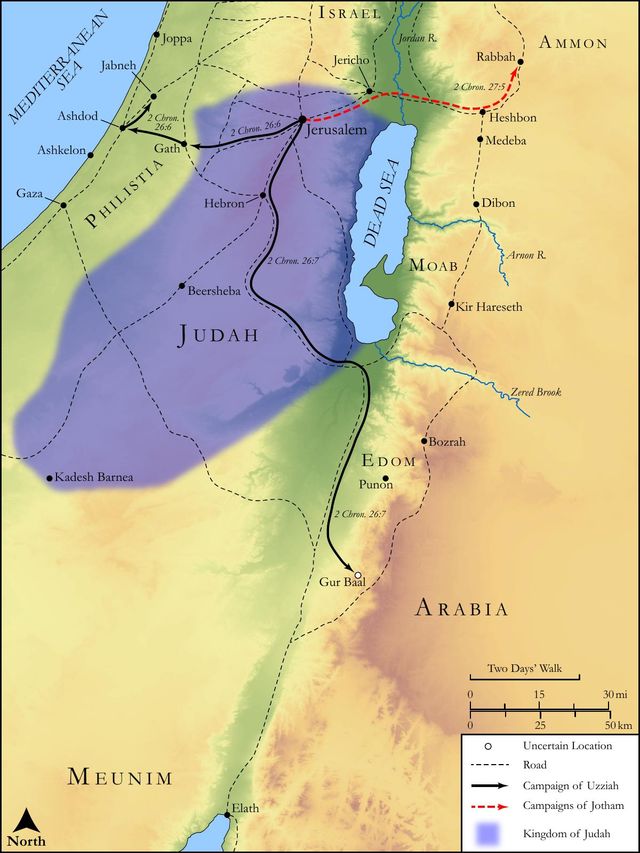
2.Here are several particular instances of his prosperity: - (1.) His success in his wars: God helped him (Ch2 26:7), and then he triumphed over the Philistines (those old enemies of God's people), demolished the fortifications of their cities, and put garrisons of his own among them, Ch2 26:6. He obliged the Ammonites to pay him tribute, Ch2 26:8. He made all quiet about him, and kept them in awe. (2.) The greatness of his fame and reputation. His name was celebrated throughout all the neighbouring countries (Ch2 26:8) and it was a good name, a name for good things with God and good people. This is true fame, and makes a man truly honourable. (3.) His buildings. While he acted offensively abroad, he did not neglect the defence of his kingdom at home, but built towers in Jerusalem and fortified them, Ch2 26:9. Much of the wall of Jerusalem was in his father's time broken down, particularly at the corner gate. But his best fortification of Jerusalem was his close adherence to the worship of God: if his father had not forsaken this the wall of Jerusalem would not have been broken down. While he fortified the city, he did not forget the country, but built towers in the desert too (Ch2 26:10), to protect the country people from the inroads of the plunderers, bands of whom sometimes alarmed them and plundered them, as Ch2 21:16. (4.) His husbandry. He dealt much in cattle and corn, employed many hands, and got much wealth by his dealing; for he took a pleasure in it: he loved husbandry (Ch2 21:10), and probably did himself inspect his affairs in the country, which was no disparagement to him, but an advantage, as it encouraged industry among his subjects. It is an honour to the husbandman's calling that one of the most illustrious princes of the house of David followed it and loved it. He was not one of those that delight in war, nor did he addict himself to sport and pleasure, but delighted in the innocent and quiet employments of the husbandman. (5.) His standing armies. He had, as it should seem, two military establishments. [1.] A host of fighting men that were to make excursions abroad. These went out to war by bands, Ch2 21:11. They fetched in spoil from the neighbouring countries by way of reprisal for the depredations they had so often made upon Judah, [2.] Another army for guards and garrisons, that were ready to defend the country in case it should be invaded, Ch2 21:12, Ch2 21:13. So great were their number and valour that they made war with mighty power; no enemy durst face them, or, at least, could stand before them. Men unarmed can do little in war. Uzziah therefore furnished himself with a great armoury, whence his soldiers were supplied with arms offensive and defensive (Ch2 21:14), spears, bows, and slings, shields, helmets, and habergeons: swords are not mentioned, because it is probable that every man had a sword of his own, which he wore constantly. Engines were invented, in his time, for annoying besiegers with darts and stones shot from the towers and bulwarks, Ch2 21:15. What a pity it is that the wars and fightings which come from men's lusts have made it necessary for cunning men to employ their skill in inventing instruments of death.
Continue studying 2 Chronicles 26:4 across the web’s major study libraries — every link below opens this exact verse, chapter, or book on the destination site.
Read & Compare
 BibleGatewayThis verse in more than 200 translations and 70 languages.
 Bible.comThe YouVersion reader — hundreds of translations, reading plans, and highlights.
 ESV.orgCrossway's official English Standard Version reader.
 NET BibleThe NET translation with 60,000+ translators' notes on every rendering decision.
 STEP BibleTyndale House's free study tool — original text, vocabulary, and scholarly resources.
 BibliaLogos Bible Software's free web reader.
 USCCBThe New American Bible (Revised Edition) with the U.S. bishops' study notes.
Commentaries
 BibleHub CommentariesDozens of classic commentaries on this verse, gathered on one page.
 StudyLightMore than 100 commentary sets — the largest collection on the web.
 BibleRefPlain-English commentary on what this verse means, verse by verse.
 Enduring WordDavid Guzik's free commentary on this chapter, widely used by Bible teachers.
 Bible Study ToolsVerse commentary alongside Greek and Hebrew study aids.
Original Language & Research
- BibleHub InterlinearThe verse word by word — original language, transliteration, and English.
- BibleHub LexiconEvery word's original-language definition and Strong's entry.
 Blue Letter BibleDeep-study tools — Strong's numbers, concordance, and word studies.
 SefariaThe Hebrew text with Rashi and centuries of Jewish commentary.
Sermons, Hymns & Audio


TrulyRandomVerse is not affiliated with these sites and doesn’t control their content. They’re linked because they’re genuinely useful.
Summary
2 Chronicles 26:4 introduces King Uzziah of Judah with an initial positive assessment of his reign, stating he "did [that which was] right in the sight of the LORD." This commendation, however, is immediately qualified by the phrase "according to all that his father Amaziah did," a subtle yet crucial nuance that foreshadows the complexities and eventual decline of Uzziah's own rule, mirroring the trajectory of his predecessor, despite a period of significant prosperity and strength for Judah.
Context
ShowHideLiterary Context
This verse serves as the customary introduction to a new king's reign in the Chronicler's history, providing an immediate spiritual evaluation. It follows the narrative of Uzziah's father, Amaziah, detailed in 2 Chronicles 25. Amaziah's reign began with a positive assessment of doing "right in the sight of the LORD," but was immediately qualified with "but not with a perfect heart" (2 Chronicles 25:2), and ultimately ended in idolatry and a tragic assassination. By comparing Uzziah to Amaziah, the Chronicler sets up a parallel narrative, hinting that Uzziah, despite his initial successes and long reign, would also eventually falter, specifically due to pride, as detailed later in 2 Chronicles 26:16. This initial evaluation is therefore not merely a statement of fact but a narrative device that prepares the reader for the full scope of Uzziah's complex reign.
Historical & Cultural Context
Uzziah, also known as Azariah (2 Kings 15:1-7), ascended the throne of Judah at the remarkably young age of 16, following the assassination of his father, King Amaziah. This period, the 8th century BC, was a time of relative stability and prosperity for Judah, largely due to Uzziah's military prowess, agricultural innovations, and fortified defenses, as elaborated in the subsequent verses of 2 Chronicles 26. The phrase "did right in the sight of the LORD" was a standard biblical formula used by the Chronicler and Deuteronomistic historian to evaluate a king's adherence to the Mosaic Law and covenant obligations. It signified a king's general faithfulness to God's commands, particularly regarding the worship of Yahweh alone and the suppression of idolatry. However, as seen with Amaziah and later with Uzziah, this initial positive assessment often came with caveats or was followed by a subsequent decline in faithfulness, highlighting the conditional nature of divine blessing and the constant need for vigilance against pride and apostasy.
Key Themes
ShowHideThis verse introduces several key themes that resonate throughout the book of Chronicles and beyond. The theme of Initial Righteousness is prominent, affirming Uzziah's early commitment to God's ways, which sets the stage for the significant prosperity and strength Judah experienced under his rule. However, the crucial qualification, "according to all that his father Amaziah did," introduces the theme of Parental Influence and Its Nuances. While Amaziah began well, he later turned away from the Lord, leading to his downfall. This comparison subtly foreshadows Uzziah's own eventual pride and unfaithfulness, demonstrating that following a parent's example is not always straightforward; one must discern both the good and the pitfalls. This also underscores the theme of Conditional Obedience and Blessing, where a king's righteousness and the nation's prosperity are contingent on their ongoing faithfulness to the Lord, rather than being an absolute or guaranteed state. The Chronicler consistently uses these evaluations to highlight the spiritual condition of the nation's leadership and its direct impact on the people.
Exposition and Analysis
ShowHideKey Word Analysis
ShowHideDerived from the root meaning "to be straight," this adjective (H3477) signifies moral rectitude, uprightness, and justice. In the context of a king's actions, it denotes adherence to divine standards and covenant obligations, indicating behavior that is pleasing to God. It implies integrity and alignment with God's revealed will, standing in stark contrast to actions done "right in his own eyes" (Judges 17:6), which often leads to chaos and ungodliness.
This noun (H5869), literally meaning "eye," is used here figuratively in the phrase "in the sight of the LORD" (Hebrew, b'einei Yahweh). It signifies the perspective or judgment of God. This emphasizes that Uzziah's actions were not merely evaluated by human standards or popular opinion, but by the omniscient and righteous gaze of the Almighty. It implies divine scrutiny and the ultimate accountability of human leadership to God's perfect standard.
This verb (H6213) is a fundamental and versatile root meaning "to do" or "to make" in the broadest sense. In this context, it refers to Uzziah's actions and conduct as king. The repetition of this verb, once for Uzziah and again for Amaziah ("according to all that his father Amaziah did"), subtly highlights the parallel nature of their reigns and actions, suggesting a shared trajectory of conduct and outcome.
Verse Breakdown
ShowHide"And he did [that which was] right"
This clause provides the initial, positive assessment of King Uzziah's reign. It indicates that his actions and policies were in general alignment with God's commands and the covenant stipulations for the kings of Judah. This implies a period of obedience, justice, and adherence to the worship of Yahweh, which would indeed characterize the early and middle parts of his long reign, leading to significant national prosperity and strength.
"in the sight of the LORD"
This specifies the ultimate arbiter of Uzziah's righteousness. It is not merely that his actions were good in the eyes of his people or politically expedient, but that they met with divine approval. This highlights the Chronicler's theological perspective, where the spiritual condition of the king directly impacts the nation's welfare, and God is the ultimate judge of all human conduct, especially that of leaders.
"according to all that his father Amaziah did"
This is the crucial qualifying phrase that adds depth and complexity to the initial positive assessment. It suggests a pattern of behavior and spiritual trajectory similar to Amaziah. While Amaziah began well, his heart was "not perfect" (2 Chronicles 25:2), and he eventually turned to idolatry and pride, leading to his demise. This comparison thus serves as a subtle warning or foreshadowing, indicating that Uzziah's initial righteousness might not endure perfectly, and that he too might succumb to the same spiritual pitfalls that afflicted his father, ultimately leading to his own tragic end due to pride.
Literary Devices
ShowHideThe Chronicler masterfully employs several literary devices in this concise verse. Most notably, there is a strong element of Foreshadowing. By comparing Uzziah's reign to that of his father Amaziah, whose story of initial righteousness followed by pride and apostasy is well-documented in the preceding chapter, the Chronicler subtly hints at Uzziah's own eventual downfall. This creates a sense of dramatic Irony, as an ostensibly positive opening statement carries a hidden, ominous warning. The use of Formulaic Language ("did right in the sight of the LORD") is characteristic of the Chronicler's evaluations of kings, providing a consistent framework for assessing their reigns. However, the immediate qualification regarding Amaziah transforms this formula from a simple statement of fact into a nuanced Parallelism, inviting the reader to draw connections between the father's and son's spiritual journeys and anticipate a similar trajectory of initial success followed by moral failure.
Theological and Thematic Connections
ShowHideThis verse, while brief, encapsulates profound theological truths about human leadership, the nature of righteousness, and the ever-present danger of pride. Uzziah's initial commendable actions, judged "right in the sight of the LORD," affirm the biblical principle that obedience to God's commands brings blessing and prosperity. However, the immediate qualification, linking his conduct to that of his father Amaziah, introduces a critical nuance: external conformity to God's law is insufficient without a "perfect heart" or wholehearted devotion. This highlights the human tendency towards spiritual compromise and the deceptive nature of outward success masking inward decay. The Chronicler consistently emphasizes that true righteousness is not merely about doing the right things, but about doing them with the right heart and sustained humility, a lesson tragically illustrated by both Amaziah and Uzziah, who, despite their initial good starts, ultimately succumbed to pride and unfaithfulness. Their stories serve as powerful reminders that even those who begin well can falter if vigilance and humility are not maintained.
Reflection and Application
ShowHideUzziah's story, introduced by this verse, offers a potent lesson for believers today: a good start is commendable, but endurance in faith and humility is paramount. We are called not just to "do right" initially, but to persevere in righteousness with a wholehearted devotion to the Lord throughout our lives. The subtle warning embedded in the comparison to Amaziah reminds us that even seemingly righteous examples from our past or present can have hidden flaws or cautionary tales. We must learn from both the successes and failures of those who came before us, discerning not just what they did, but why and with what heart. Uzziah's eventual fall, despite his initial obedience and great accomplishments, serves as a stark reminder of the insidious nature of pride. It can creep into the hearts of even the most blessed and successful, leading to spiritual trespass and downfall. Therefore, maintaining a posture of humility, constant dependence on God, and a vigilant self-examination of our motives are crucial for enduring spiritual integrity and a sustained walk with the Lord.
Questions for Reflection
ShowHideFAQ
ShowHideWho was Amaziah, and why is his example significant for understanding Uzziah?
ShowHideAmaziah was Uzziah's father and the preceding king of Judah, whose reign is detailed in 2 Chronicles 25. His example is profoundly significant because, like Uzziah, he began his reign by doing "right in the sight of the LORD" (2 Chronicles 25:2), but with the crucial caveat "but not with a perfect heart." Amaziah later turned to idolatry after a military victory, ignoring a prophet's warning, and ultimately suffered a humiliating defeat and assassination. By stating that Uzziah did "according to all that his father Amaziah did," the Chronicler subtly foreshadows that Uzziah's reign, despite its initial righteousness and great prosperity, would also eventually be marred by pride and unfaithfulness, leading to his own tragic end. Amaziah's story serves as a cautionary template for understanding Uzziah's trajectory.
What does "did right in the sight of the LORD" truly mean, and how can it be qualified?
ShowHideThe phrase "did right in the sight of the LORD" is a standard theological evaluation in the books of Kings and Chronicles, signifying that a king generally adhered to God's covenant laws, maintained the worship of Yahweh, and avoided idolatry. It points to actions that are morally and spiritually upright according to divine standards. However, as seen with kings like Amaziah and Uzziah, this positive evaluation can be qualified in several ways. It might mean that while their outward actions were commendable, their heart was "not perfect" or not fully devoted to God (2 Chronicles 25:2). It could also imply that their righteousness was not sustained throughout their entire reign, and they eventually succumbed to pride, apostasy, or other sins, as Uzziah did when he presumptuously entered the temple to burn incense (2 Chronicles 26:16-21). Thus, the Chronicler uses this phrase not as an absolute stamp of perfection, but as an initial assessment that often sets the stage for a more complex and nuanced spiritual narrative.
Christ-Centered Fulfillment
ShowHideThe narrative of King Uzziah, introduced by his initial "rightness" qualified by the example of his flawed father, powerfully highlights the inherent limitations and ultimate failures of human kingship and righteousness. While Uzziah began well and achieved great things, his story, like that of Amaziah and indeed all human kings, ultimately points to the desperate need for a perfect King. Uzziah's eventual fall due to pride, despite his initial obedience, underscores the biblical truth that "all have sinned and fall short of the glory of God" (Romans 3:23). Unlike Uzziah, whose "rightness" was conditional and ultimately compromised, Jesus Christ is the King whose righteousness is absolute, perfect, and eternal. He is the Son who perfectly fulfills the will of His Father, never deviating from God's commands and never succumbing to pride or self-exaltation. Where human kings like Uzziah sought glory for themselves, Christ "did not count equality with God a thing to be grasped, but emptied himself" (Philippians 2:6-7). He is the true Lamb of God, who offers a perfect sacrifice for sin (John 1:29), providing a righteousness not by human effort or a fleeting "good start," but by grace through faith in Him (Ephesians 2:8-9). Uzziah's story, therefore, is a poignant illustration of the need for the one King whose reign is truly "right in the sight of the LORD" in every respect, forever, and whose perfect obedience secures eternal blessings for all who trust in Him (Hebrews 7:26-28).